


Mount Le Conte is one of the crown jewels of Great Smoky Mountains National Park, and reaching its summit is a bucket-list hike for many travelers to Tennessee. With several trails leading to the top, two of the most compelling choices are Trillium Gap Trail and Rainbow Falls Trail. Both offer a strenuous, full-day adventure and access to LeConte Lodge, but the experience, scenery, and logistics differ in ways that matter once you lace up your boots. This guide compares the two routes in practical detail so you can decide which Mount Le Conte ascent fits you better.
Get the latest updates straight to your inbox!
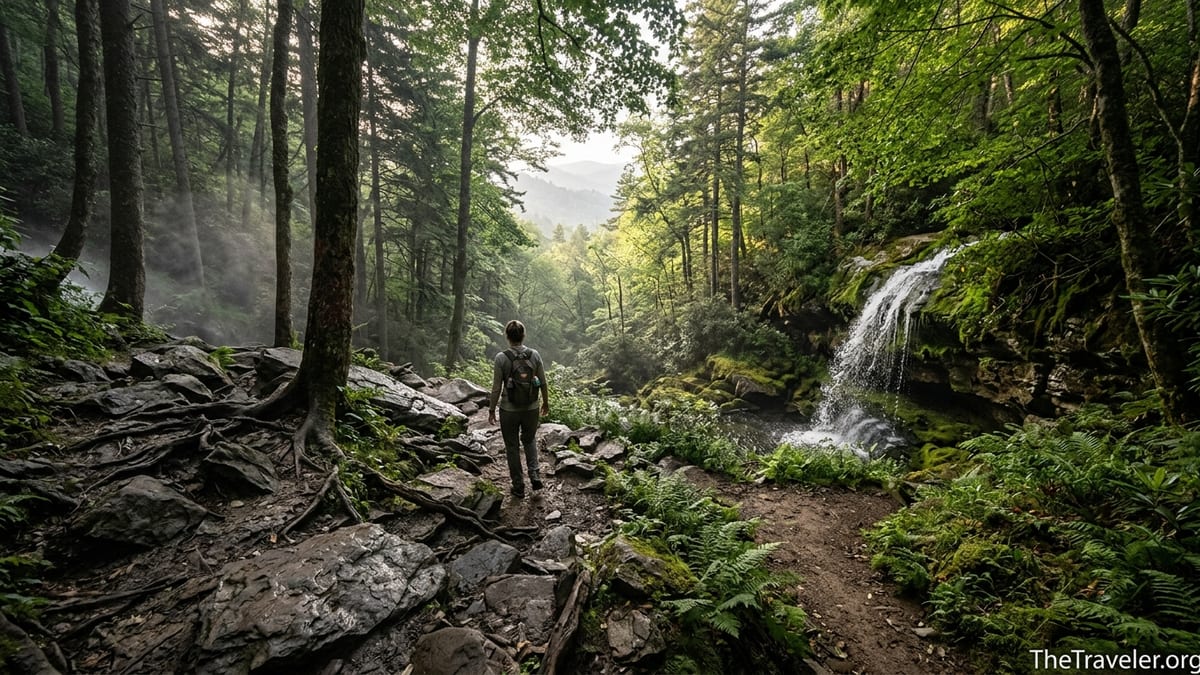
Mount Le Conte Basics You Need To Know First
Before you choose between Trillium Gap and Rainbow Falls, it helps to understand what you are committing to on Mount Le Conte itself. The mountain rises to 6,593 feet and is one of the most visited high peaks in the Appalachians. From the Gatlinburg side of Great Smoky Mountains National Park, you climb roughly 3,800 to 4,000 feet in a single day, which is significant elevation gain by any standard. For most hikers, that means a 9 to 12 hour outing including breaks, photos, and time wandering around the summit viewpoints such as Cliff Top and Myrtle Point.
There is no road to the top, only trails. The two routes in focus here both start from the Cherokee Orchard and Roaring Fork area above Gatlinburg and eventually connect to the summit area and LeConte Lodge. The lodge is the only formal lodging inside the park and must be reserved many months in advance, but day hikers can still enjoy the dining cabin area, the spring for water refills, and short spur paths to dramatic overlooks. If you are staying in Gatlinburg or Pigeon Forge, many travelers choose to start their hike after an early breakfast in town and finish in time for dinner back in the valley.
It is also important to factor in current park rules. Great Smoky Mountains National Park requires a paid parking tag if you will be parked longer than 15 minutes, and roadside parking near trailheads is not allowed. On busy days such as sunny Saturdays in October, both Rainbow Falls and Trillium Gap trailhead lots can fill up early, so many hikers aim to arrive by 7:00 a.m. or even earlier. This is especially relevant on peak foliage weekends, when traffic along Cherokee Orchard Road and Roaring Fork Motor Nature Trail can slow to a crawl by mid-morning.
Weather is another major consideration. Conditions at the summit of Mount Le Conte are often 10 to 20 degrees Fahrenheit cooler than in Gatlinburg, with frequent cloud, wind, and sudden showers. In summer, you might leave town in shorts and a T-shirt at 70 degrees and find yourself in dense fog and 50 degrees on the summit. In shoulder seasons, light snow and ice can linger on the upper sections of both trails. Regardless of the route you choose, bring extra layers, a rain shell, and at least 2 to 3 liters of water per person.
Trillium Gap Trail: What This Route Is Really Like
Trillium Gap Trail approaches Mount Le Conte from the Roaring Fork Motor Nature Trail and is best known for passing Grotto Falls, one of the few waterfalls in the park you can actually walk behind. The complete route from the Trillium Gap trailhead to the summit of Le Conte is roughly 6.7 miles one way, with about 3,300 feet of elevation gain, according to park and lodge materials. That makes it a challenging but steady climb rather than a brutally steep slog, which some hikers find more forgiving over a long day.
The first 1.3 miles to Grotto Falls are the most popular segment, and on summer afternoons this stretch often feels like a casual family hike. You will see children in sneakers, visitors in jeans stopping for photos behind the falls, and even people carrying small dogs. If you are doing the full ascent to Le Conte, it pays to start early to enjoy this section in the quiet morning light before the crowds arrive. Many hikers on a June or July weekday report reaching the falls before 8:00 a.m. and having them almost to themselves, with only the sound of Roaring Fork and birds in the hemlocks.
Beyond Grotto Falls, the character of Trillium Gap changes noticeably. The crowds thin out, the trail narrows, and you begin a long, sustained climb through mixed hardwood forest that gradually transitions to spruce and fir as you gain altitude. This is also the route that the llama train uses to supply LeConte Lodge, typically several days a week in the main season. Encountering the pack llamas is often a highlight for visitors. Hikers are asked to step to the downhill side of the trail and give the animals space as they pass. Seeing them file through the misty forest is a very particular Mount Le Conte experience that you will not get on Rainbow Falls.
As you approach Trillium Gap itself and then the upper reaches of the trail, views open intermittently, but the scenery is more about the quiet forest atmosphere than big panoramas. On a cloudy or drizzly day, this can feel wonderfully atmospheric rather than disappointing, with mossy logs, dripping ferns, and the muffled sound of your footsteps. Travelers who enjoy long, meditative climbs, who are excited to see Grotto Falls on the way up, and who value a slightly more gradual grade often gravitate toward Trillium Gap as their preferred Le Conte route.
Rainbow Falls Trail: Steep, Scenic, and Strenuous
Rainbow Falls Trail starts closer to central Gatlinburg, from the Cherokee Orchard area, and is named for the 80 foot waterfall located about 2.7 miles from the trailhead. When conditions are right on sunny days, mist from the falls can create a visible rainbow, which makes this an extremely popular day hike even for visitors who have no intention of going all the way to Mount Le Conte. If you continue past the falls, the trail eventually climbs roughly 6.5 to 6.7 miles to reach the summit area, with about 4,000 feet of total elevation gain, making it one of the steeper ways up the mountain.
The lower section of Rainbow Falls Trail follows LeConte Creek, crossing it on footbridges and passing large boulders and rhododendron thickets. This part of the hike feels rugged and rocky, and after heavy rain some sections can be muddy and slick. Regulars in the park often describe this as a trail where trekking poles pay off, especially on the descent. The approach to Rainbow Falls involves uneven stone steps and roots, and people in ordinary walking shoes often underestimate how tiring this can be after several hours.
Above Rainbow Falls, the crowds thin dramatically and the trail becomes more serious. You continue to climb on rocky tread and switchbacks, with occasional views back toward Gatlinburg through breaks in the trees. Many hikers report that the stretch between Rainbow Falls and the junction with the Bullhead Trail feels like the most demanding part of the whole route, with sustained, steep segments that can be punishing on a hot July afternoon. Even fit hikers who comfortably jog 5Ks at home sometimes find themselves taking short breathers at switchback corners here.
The reward is a strong sense of accomplishment and a classic Smokies experience. On clear days, the upper portions of Rainbow Falls Trail offer glimpses of surrounding ridges and, once you connect with the upper trails near Mount Le Conte, easy access to viewpoints like Cliff Top. Travelers who enjoy challenging themselves, who do not mind a steeper grade, and who want to include one of the park’s tallest waterfalls as a key milestone often choose Rainbow Falls as their primary Le Conte ascent route.
Difficulty, Fitness, and Who Each Trail Suits Best
Both Trillium Gap and Rainbow Falls are strenuous hikes by typical national park day hiking standards. For most visitors who are not regular mountain hikers, it is realistic to expect a full day of physical effort, with tired legs and sore knees at the end. That said, the style of difficulty is slightly different, which is why your personal fitness and preferences matter when choosing between them.
Trillium Gap, at about 6.7 miles one way and 3,300 feet of ascent, spreads its elevation gain over a bit more distance. Many hikers describe it as a steady grind rather than a series of steep walls. If you are comfortable with long walks but less excited about constant big steps, this may suit you better. For example, a traveler who regularly logs 8 to 10 miles on local greenway trails or rolling forest paths, but rarely encounters very steep grades, often finds Trillium more manageable. The ability to take a break at Grotto Falls and again at Trillium Gap itself also gives the day a natural rhythm.
Rainbow Falls, by contrast, tends to feel more intense because much of its roughly 4,000 feet of gain is packed into rocky, uneven segments. Visitors who run or hike hilly trails at home, who have strong knees and ankles, and who genuinely enjoy “earning it” on steep ascents often prefer this route. As one common real-world pattern, trail runners from cities like Asheville or Knoxville, who spend their weekends on local mountain singletrack, frequently gravitate to Rainbow Falls because it lets them push their conditioning and descend quickly afterward.
For families or mixed-ability groups, one practical approach is to make Rainbow Falls itself the turnaround point for those who are unsure, while the stronger members of the party continue to the summit and return via the same route. Another option is to have one or two people hike up via Rainbow Falls and down via Bullhead Trail when seasonal closures allow, although the park has been working on trail rehabilitation that sometimes limits this loop. In contrast, Trillium Gap is often chosen by groups where everyone plans to stay together the whole day, appreciating its slightly gentler sustained grade and the added novelty of the llama train.
If you have knee or ankle concerns, or if you know that steep rocky descents are tough on your joints, Trillium Gap is usually the safer choice. You will still need trekking poles and supportive footwear, but your joints are less likely to be hammered by long, uneven stone staircases. On the other hand, if you have time for only one day in the Smokies and want a dramatic, physically demanding route that includes a signature waterfall, Rainbow Falls may be exactly the memorable challenge you seek.
Scenery, Atmosphere, and Seasonal Considerations
In terms of scenery, both trails deliver a mix of forest, water features, and high-country atmosphere, but the flavor differs enough that many regular visitors have strong preferences. Trillium Gap is the more “enchanted forest” route, especially in spring and early summer. Wildflowers such as trillium, violets, and sometimes rhododendron line the trail, and the section near Grotto Falls feels lush and mossy. As you climb higher, the gradual transition into spruce-fir forest gives you that distinctly high-elevation Smokies feel, with cool air and the scent of evergreens. On misty days in May or June, the combination of fog drifting through the trees and the quiet clip-clop of the llamas can feel very atmospheric.
Rainbow Falls offers a more dramatic focal point in the waterfall itself. In late spring and early summer, when water levels are moderate to high, Rainbow Falls can be a roaring sheet of water plunging over a rock ledge into a boulder-filled basin. On sunny mid-morning hikes, visitors often stop for 20 to 30 minutes here, snacking on granola bars and taking photos as light catches the mist. Above the falls, the trail feels wilder and less manicured, with more exposed rock, occasional downed trees, and glimpses into steep ravines. On clear autumn days, you also get occasional views of colorful ridges and the Gatlinburg valley far below.
Season matters too. In March and April, snow and ice can linger on the upper portions of both routes, but Rainbow Falls is often icier near the waterfall basin and in shaded switchbacks above. Local outfitters in Gatlinburg sometimes rent microspikes for early-season hikers for exactly this reason. In July and August, heat and humidity at lower elevations can be intense. On Rainbow Falls, where some sections are quite exposed and rocky, you will feel that heat more acutely than on the shadier, more enclosed stretches of Trillium Gap.
Autumn foliage presents another trade-off. The forested slopes along Trillium Gap often glow with gold and orange in mid to late October, making the long approach a tunnel of color. Rainbow Falls offers more intermittent views outward toward brightly colored ridges. On peak foliage weekends, both trails are very popular, and parking becomes a defining issue. Travelers who prefer quieter experiences often shift to weekday hikes or shoulder weeks just before or after the peak.
Logistics: Trailheads, Parking, and Time Management
From a logistics standpoint, Trillium Gap and Rainbow Falls share the same general access area but differ in trailhead details. Rainbow Falls Trail begins near the end of Cherokee Orchard Road, a loop road that leaves Gatlinburg via Historic Nature Trail. The parking area is relatively large for the Smokies but still fills quickly on busy days. On a Saturday in June, it is common to see the main lot full by 8:30 a.m., with cars circling for a spot. Because Great Smoky Mountains National Park now requires a parking tag for stays longer than 15 minutes, many hikers purchase a day tag online in advance and print it at their lodging, then place it in their windshield on arrival.
Trillium Gap Trail historically shared trailhead access via the one-way Roaring Fork Motor Nature Trail, which branches off from Cherokee Orchard Road. During peak season, the park sometimes operates shuttle options or adjusts traffic management in the area, especially because the Grotto Falls segment attracts many non-hikers. In practice, this means that you should always check the latest park alerts before your trip and allow extra driving time to reach the trailhead. Travelers staying in downtown Gatlinburg hotels often budget about 25 to 35 minutes from pulling out of a parking garage to actually stepping onto the trail, factoring in slow driving and possible brief queues at the park entrance area.
Time management is crucial. For a round-trip hike to Mount Le Conte via either route, many visitors take between 8 and 11 hours, depending on fitness, group size, and how long they linger at Grotto Falls, Rainbow Falls, or the summit viewpoints. As a rough practical example, a moderately fit couple starting up Trillium Gap at 7:00 a.m., taking 20 minutes at Grotto Falls, and stopping periodically for photos may reach LeConte Lodge around noon or 1:00 p.m., then spend an hour exploring Cliff Top and Myrtle Point before beginning their descent and returning to the car by 5:30 or 6:00 p.m.
If you have a reservation at LeConte Lodge, your timing and gear decisions change. Overnight guests can spread the climb and descent over two days, which makes both Trillium Gap and Rainbow Falls routes feel more relaxed. For example, a family might hike up Rainbow Falls on day one, arriving mid-afternoon, enjoy dinner and sunrise from Cliff Top, and then hike down Trillium Gap the next day to experience Grotto Falls and a different kind of scenery. This kind of one-way route is only practical if you arrange a car shuttle between trailheads in advance or use two vehicles, a detail that many first-time visitors overlook.
Gear, Safety, and Real-World Tips for Each Route
Regardless of which trail you choose, basic mountain day hiking gear is essential. Sturdy hiking shoes or boots with good traction, a small daypack with 2 to 3 liters of water, energy snacks such as nuts and energy bars, and a lightweight rain jacket should be considered standard. Trekking poles are strongly recommended for both Trillium Gap and Rainbow Falls, especially for the descent, when tired legs meet steep, uneven steps. A simple first-aid kit, blister treatment, and a headlamp or flashlight are important insurance if your day runs longer than expected.
Specific to Trillium Gap, remember that the first 1.3 miles to Grotto Falls is shared with many casual visitors. Start early to avoid stop-and-go traffic on narrow sections where people are taking photos or letting kids splash in the creek. Because this route tends to feel cooler and more enclosed, bring an extra light layer even in summer. In wetter months, expect muddy patches and roots; waterproof or water-resistant footwear can make the day more comfortable. When you encounter the llama train, follow any instructions from the wrangler and step aside early, as the animals move at a steady, unhurried pace and cannot easily dodge clusters of hikers.
On Rainbow Falls, rock and root hazards are more pronounced, particularly in the approach to the falls and on the steeper sections above. After heavy rain, the rocks around the waterfall itself can be extremely slick, and every season search and rescue crews respond to injuries from people climbing beyond safe viewing areas. Stay on established paths and resist the temptation to scramble onto wet boulders directly beneath the falls. In summer, carry electrolytes or a sports drink to help manage sweating on the steep upper switchbacks. A practical trick many regulars use is to store a cold drink and a snack in a small cooler in the car, giving you something to look forward to at the end of the long descent.
In either case, keep wildlife etiquette in mind. Black bears are common in the Smokies, including along these trails. Most encounters are distant and uneventful, but you should store food securely in your pack, avoid feeding animals, and give bears space if you see them. Many hikers also carry a printed map or download an offline map of the park to their phone before leaving their hotel or cabin, since cell coverage on the mountain is intermittent at best. Local outdoor retailers in Gatlinburg sell waterproof trail maps covering Mount Le Conte and nearby peaks for a fairly modest price, which is a worthwhile small investment in safety.
Which Route Fits You Better in Practice?
When you put all of these factors together, the choice between Trillium Gap Trail and Rainbow Falls Trail comes down to your priorities, your fitness, and the type of experience you want to remember. If you picture a classic Smokies forest hike, complete with a walk-behind waterfall, the novelty of llamas carrying supplies to a rustic mountain lodge, and a long but relatively steady climb, Trillium Gap is probably your route. It is especially well suited to travelers who enjoy immersive forest scenery, who prefer a slightly more gradual grade, and who do not mind trading big waterfall drama for a more intimate, atmospheric feel.
If, on the other hand, you are excited by the idea of tackling one of the steeper approaches to Mount Le Conte, visiting one of the park’s tallest waterfalls on the way, and testing your legs and lungs on rocky, demanding terrain, Rainbow Falls is likely a better fit. It tends to appeal to hikers with some prior mountain experience or solid cardiovascular fitness, and to travelers who have only one big hiking day in their Smokies itinerary and want it to feel like a real accomplishment. The sense of satisfaction you get from reaching LeConte Lodge after a long climb up Rainbow Falls is hard to beat.
In real-world trip planning, many visitors choose based on group makeup. A multigenerational family with teenagers and grandparents might choose Trillium Gap so that anyone who is tired can turn around at Grotto Falls and still feel they participated in a classic Smokies hike. A pair of fit friends on a quick weekend escape from Nashville or Atlanta might opt for Rainbow Falls to squeeze a challenging high-country adventure into a tight schedule. Travelers staying multiple nights sometimes combine routes, hiking up one trail and down another to experience both, using two vehicles or a shuttle arrangement.
Whichever route you select, remember that success on Mount Le Conte has as much to do with planning, pacing, and respect for the mountain as it does with raw fitness. Start early, carry the right gear, build in generous time for breaks and weather surprises, and stay aware of your body’s signals. If you reach Rainbow Falls or Grotto Falls and decide that turning around is the right call that day, you will still have enjoyed one of the most iconic hikes in Great Smoky Mountains National Park. The summit will be there next time.
The Takeaway
Trillium Gap Trail and Rainbow Falls Trail both offer demanding, rewarding paths to the summit of Mount Le Conte, but they cater to slightly different hikers. Trillium Gap provides a steadier climb, lush forest scenery, and the charm of Grotto Falls and the llama train, making it ideal for those who value atmosphere and endurance over steep challenge. Rainbow Falls delivers a rugged, steeper ascent past one of the park’s signature waterfalls, appealing to visitors who want a physically intense, milestone-style hike.
In practice, your decision should reflect your fitness level, comfort with steep rocky terrain, interest in waterfalls versus quiet forest, and the needs of your group. Look honestly at your hiking experience, consider the season and weather, and do not underestimate the time and energy required for a 13 mile day with thousands of feet of climbing. With realistic expectations and thoughtful preparation, either trail can become the highlight of your Smokies trip, offering you not just a summit, but a full-day journey through some of the most beloved landscapes in the eastern United States.
FAQ
Q1. Which trail to Mount Le Conte is easier, Trillium Gap or Rainbow Falls?
Trillium Gap is generally considered slightly easier because it spreads the elevation gain over a bit more distance, while Rainbow Falls is steeper and rockier, especially above the waterfall.
Q2. How long does it take to hike to Mount Le Conte via Trillium Gap?
Most hikers take 4.5 to 6 hours to reach the summit via Trillium Gap and 3.5 to 5 hours to descend, depending on fitness, breaks, and weather.
Q3. How long does it take to hike to Mount Le Conte via Rainbow Falls?
Allow 4 to 6.5 hours to reach the summit via Rainbow Falls and 3.5 to 5 hours to come back down. Steep, rocky sections can slow your pace more than expected.
Q4. Can beginners hike either trail to Mount Le Conte?
Fit beginners who regularly walk or exercise can complete either route with good preparation, but both are strenuous. True first-time hikers are usually better off starting with the waterfalls only and saving the summit for a future trip.
Q5. Is it safe to hike Rainbow Falls or Trillium Gap in bad weather?
Heavy rain, thunderstorms, ice, or high winds can make both trails hazardous, especially near waterfalls and on rocky sections. In poor conditions, it is safer to postpone the hike or turn around early.
Q6. Do I need special permits to hike to Mount Le Conte?
You do not need a hiking permit for day trips, but you must purchase a parking tag if your vehicle will be parked more than 15 minutes. Overnight stays at LeConte Lodge require advance reservations.
Q7. Can I hike up one trail and down the other in a single day?
Yes, strong hikers sometimes go up Trillium Gap and down Rainbow Falls or vice versa, but this requires arranging transportation between trailheads and adds logistical complexity to an already long day.
Q8. Which trail is better for photography?
Rainbow Falls is better if you want a dramatic waterfall and occasional wide views, while Trillium Gap excels for intimate forest scenes, Grotto Falls, and moody high-elevation woods.
Q9. Are there restrooms or water sources along the trails?
There are typically restrooms at or near the trailheads, but not along the trails themselves. Water sources are limited and untreated, so most hikers bring their own and may refill or filter at the summit area.
Q10. When is the best time of year to hike either trail?
Late spring through early fall offers the most reliable conditions, with May and June popular for wildflowers and October for fall colors. Shoulder seasons can be beautiful but may bring snow or ice higher up.