


On paper, Trillium Gap Trail sounds almost friendly for a Mount LeConte route: a waterfall, shaded forest, a gradual grade compared with Alum Cave or Rainbow Falls. That reputation is exactly why so many hikers underestimate one particular section of this trail. They plan for a pretty walk to Grotto Falls or a long but moderate climb to LeConte Lodge and instead find themselves grinding through a far more punishing stretch than they expected.
Get the latest updates straight to your inbox!
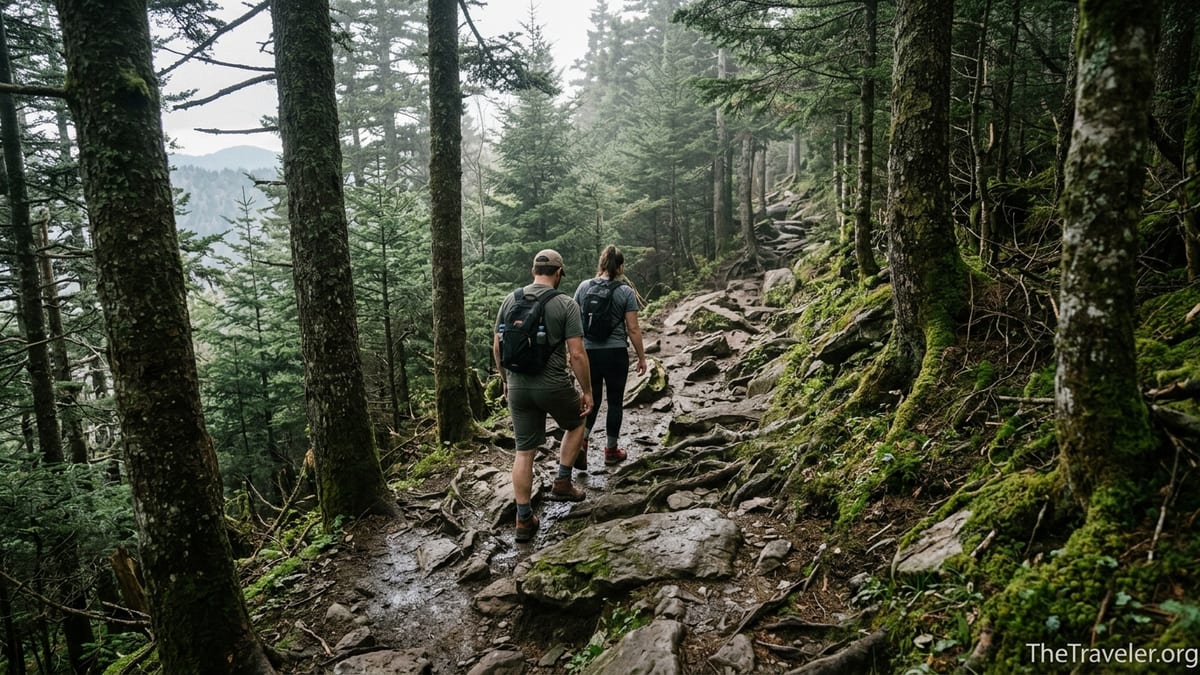
The “Easy” Reputation That Sets Hikers Up
Trillium Gap Trail starts from the Roaring Fork Motor Nature Trail near Gatlinburg and climbs about 3,200 vertical feet over roughly 6.5 miles to reach the LeConte Lodge area. The National Park Service describes the full 13 mile round trip as strenuous, but among Smokies regulars, Trillium Gap is often labeled the “gentle” way up LeConte compared with steep, rocky routes like Alum Cave or Rainbow Falls. That word gentle sticks in people’s minds when they are building their itineraries.
For casual visitors, the first 1.3 to 1.5 miles to Grotto Falls reinforce that impression. This lower segment gains only around 500 to 550 feet of elevation, and the path winds through cool hemlock forest with multiple small creek crossings. Families in sandals and flip flops often make it to the waterfall and back with little trouble, and online reviews tend to gush about how short and easy it is. It is easy to forget that this is just the warm up for a much longer mountain climb.
Because the early miles feel manageable, many hikers, especially those used to short Appalachian day hikes, assume the trail simply continues on in the same relaxed style all the way to Mount LeConte. They pack a single 16 ounce water bottle, toss a rain jacket in the car instead of their pack, and tell themselves they will have no problem doing “the waterfall trail” all the way to the top and back in a day.
The reality is that after Grotto Falls the character of Trillium Gap Trail changes dramatically. The grade increases, the tread becomes rockier and narrower, and the miles begin stacking up. The section between Trillium Gap and the upper junctions near LeConte Lodge in particular is where most people run headlong into the limits of their fitness, gear and daylight.
The Real Crux: Trillium Gap to LeConte Lodge
The section most hikers underestimate begins just past Trillium Gap itself, roughly three miles from the trailhead. Up to this point, you have walked behind Grotto Falls, traversed a rougher, rockier middle segment, and reached the open saddle beneath Brushy Mountain. Many hikers take the short spur to Brushy Mountain’s viewpoint and then turn around here, which is wise if time or energy is already fading.
From Trillium Gap up to the LeConte Lodge area is about three more miles, but those miles feel longer than the map suggests. The elevation gain is more concentrated, and the trail surface is a mix of embedded rocks, roots and short, eroded steeper pitches. After rain, these rocks turn slick, and in early spring or late fall, icy patches can linger in shaded spots even when Gatlinburg feels like spring down below.
On busy summer weekends, hikers often reach this upper section already tired from delays lower down. Parking along Roaring Fork can fill by mid morning, and many visitors end up walking extra distance along the one way road to reach the official trailhead. Add an hour of slow progress in the crowd around Grotto Falls, and you may already be two or more hours in before you even pass Trillium Gap. Yet many still push on, underestimating how long the final miles to the lodge will actually take.
Trip reports from experienced hikers frequently mention needing four to five hours to reach LeConte via Trillium Gap at a steady, realistic pace, not counting long photo stops. The final hour above Trillium Gap is where progress slows most. You are moving at higher elevation, the grade ramps up, and fatigue from the day settles in. It is common to see people stopping every few minutes to catch their breath, particularly in humid mid summer conditions.
Why This Segment Feels Harder Than The Numbers
On paper, about three miles and roughly 1,500 to 1,700 feet of remaining elevation gain from Trillium Gap to LeConte may not sound extreme, especially to hikers used to Western peaks. The problem is context. You reach this section already having climbed around 1,500 feet over several miles. Legs are pre fatigued, especially for hikers who rarely exceed five or six miles at home, and the long, continuous ascent offers very few truly flat recovery stretches.
The trail itself also contributes to the perceived difficulty. This upper stretch has multiple narrow sidehill sections with loose stone and rooty steps carved into the slope. On dry days, that means careful foot placement and slower progress. On wet days, it can mean slick mud between rocks and awkward, high steps that tax knees and hips. The llama trains that supply LeConte Lodge several days a week use this same path, and their hooves naturally dig ruts and loosen small rocks, adding to the unevenness.
Weather amplifies everything. Mount LeConte’s summit area sits above 6,500 feet, and temperatures can be noticeably cooler than in Gatlinburg. A hiker leaving town in shorts and a light T shirt on a warm June morning may find themselves on this upper section in chilly mist by afternoon, with sweat soaked clothing sucking away warmth each time they stop. In shoulder seasons, brief afternoon storms can leave the trail running with water, turning rocky steps into mini waterfalls.
The psychological factor might be the most underestimated of all. Once you have committed to climbing above Trillium Gap, turning around feels like giving up, especially if you have dreamed about reaching the lodge or the LeConte high points. Many hikers push on even as their pace crashes, telling themselves the lodge must be “just around the corner.” In reality, this section includes multiple false summits and forested bends where the payoff view never quite appears when you expect it.
How Misjudging This Stretch Plays Out In Real Life
Misunderstanding the Trillium Gap to LeConte section is more than a matter of sore legs. In peak season, rangers and volunteer search and rescue teams regularly assist hikers who underestimated time, daylight or their own conditioning on the upper mountain. Problems rarely start on the easy miles to Grotto Falls; they show up late in the day somewhere above Trillium Gap when the long descent still ahead finally dawns on people.
One common pattern is the “late lodge attempt.” A group sleeps in at a Gatlinburg hotel, grabs a leisurely breakfast on Parkway, then drives the Roaring Fork Motor Nature Trail. With traffic, picture stops and parking, they do not actually start hiking until late morning. They move slowly in the crowds to Grotto Falls, take extended photos behind the waterfall, and reach Trillium Gap in the early afternoon already more tired than expected. At that point, they decide to continue to the lodge anyway, banking on the idea that the trail is moderate. By the time they reach the LeConte area, the afternoon is slipping away, and the long return trip down the same trail can run into dusk or darkness.
Another pattern is the under equipped visitor. It is not unusual to see people above Trillium Gap with a single small bottle of water, no snacks and footwear more suited to city sidewalks. On uphill grades, dehydration and low blood sugar show up as dizziness, nausea and cramping. On a hot July or August afternoon, that can turn the last couple of miles to the lodge into a miserable slog, or force an unplanned turnaround that leaves hikers embarrassed and frustrated.
Even strong hikers can get caught out by weather shifts. Summer thunderstorms roll over the Smokies quickly. A sunny start at the trailhead does not guarantee sun above 5,000 feet in mid afternoon. On this upper section, where there are few broad viewpoints and much of the path stays in forest, hikers may not see dark clouds building until the first thunderclap. Getting caught in a downpour on steep, rocky sections makes both ascent and descent slower and more dangerous than anticipated.
All of these scenarios underline a single point: the stretch from Trillium Gap to LeConte Lodge is not a casual extension of the waterfall hike. It is a sustained mountain climb that demands real planning, gear and time management.
Planning Around The Crux: Time, Fitness, and Gear
If you treat the upper Trillium Gap section like a genuine backcountry objective rather than a scenic add on, it becomes far more enjoyable. The first adjustment is time. For most day hikers aiming for LeConte via Trillium Gap, starting at or shortly after sunrise is a realistic target, especially during the busy summer period when traffic and parking are at their worst. This early start buys cool temperatures for the lower climb and leaves a generous buffer of daylight for breaks and an unhurried descent.
In terms of fitness, a practical benchmark is whether you are comfortable with 10 to 12 miles and at least 2,500 to 3,000 feet of elevation gain on your home trails. If your typical outing is a three mile loop with a few rolling hills, you may want to spend a few months gradually increasing distance and vertical before attempting the full LeConte route. An excellent step up is hiking to Brushy Mountain via Trillium Gap and back, which gives you a full taste of the middle section without committing to the longest climb.
Gear does not need to be specialized, but it does need to be thoughtful. Sturdy, broken in hiking shoes or light boots with good traction will make a big difference on the rocky upper trail. Most hikers do well carrying at least two liters of water per person on warm days, plus electrolyte drink mix or salty snacks. A light insulating layer such as a fleece or synthetic puffy, paired with a compact rain shell, is a smart addition even in June or September. Simple trekking poles can save knees and improve balance on the uneven footing both up and down.
Route planning should factor in the park’s parking tag requirement and any road advisories along Cherokee Orchard Road and the Roaring Fork Motor Nature Trail. While Trillium Gap Trail itself has generally been open in recent seasons, other LeConte approaches like Bullhead have faced weekday closures for trail work, which can push more people onto Trillium Gap. Checking conditions the day before your hike can help you avoid surprises and choose the least congested option.
Reading The Trail As You Go: When To Turn Around
One of the most useful skills on Trillium Gap is knowing when to convert a LeConte attempt into a shorter, still rewarding day. The trail offers natural turnaround points: Grotto Falls at about 1.5 miles, Trillium Gap around three miles, and the Brushy Mountain spur a little beyond that. Each has its own payoff and gives you a clear sense of how your body and group are handling the climb.
If anyone in your party is breathing heavily and needing frequent stops well before Grotto Falls, it is wise to enjoy the waterfall and return rather than pushing into the rougher miles beyond. Between Grotto Falls and Trillium Gap, if the pace slows to the point where you are covering less than a mile an hour on steady uphill, it is a signal that reaching LeConte and coming back before dark may not be realistic that day, especially outside of mid summer’s long daylight.
At Trillium Gap, take a deliberate inventory: remaining daylight, energy levels, water and food, and weather trends. If clouds are building and temperatures are dropping, or if you are already more tired than expected, the safer and often more enjoyable choice is to turn around, or to hike the short spur to Brushy Mountain for a view and then descend. Too often, hikers treat LeConte as an all or nothing prize, when in reality the forest, the falls and the mid mountain views are valuable experiences on their own.
Making a conservative choice also protects the experience for others. Search and rescue operations tied to overdue hikers or minor injuries above Trillium Gap can stretch park resources, especially on weekends. Turning back when your margin grows thin is not failure; it is good mountain judgment and keeps you free to return another season better prepared.
The Takeaway
The Trillium Gap Trail has a split personality. The lower miles to Grotto Falls offer one of the most accessible and family friendly waterfall hikes in Great Smoky Mountains National Park. The upper miles, especially between Trillium Gap and the LeConte Lodge area, are a sustained, often grueling climb that many visitors underestimate. Confusing these two faces of the same trail leads to late finishes, exhausting slogs and, in some cases, avoidable emergencies.
If you approach that upper section with the respect you would give any serious mountain ascent, the rewards are substantial: deep, quiet forest, cool high elevation air and the satisfaction of reaching one of the Smokies’ most storied summits. Start early, carry more water and warm layers than you think you will need, and be honest about your pace as you climb. Understand that the crux is not the photogenic waterfall everyone talks about, but the long, rocky miles above Trillium Gap that only reveal their difficulty once you are in them.
For many hikers, the best first experience of Trillium Gap is to stop at Grotto Falls or Brushy Mountain and savor the day rather than pushing into the hardest terrain on a tight schedule. LeConte will still be there when you are ready for it. With realistic expectations and thoughtful preparation, you can turn the trail’s most underestimated section from an unwelcome surprise into a challenge you are fully prepared to meet.
FAQ
Q1. What is the total distance of Trillium Gap Trail to Mount LeConte?
The full out and back hike from the Trillium Gap trailhead to the LeConte Lodge area is roughly 13 miles, give or take a few tenths depending on side trips.
Q2. Which part of Trillium Gap Trail do most hikers underestimate?
Most hikers underestimate the upper section from Trillium Gap itself to the LeConte Lodge area, about three miles of sustained climbing on rougher, rockier trail.
Q3. How hard is the hike from Grotto Falls to Trillium Gap and beyond?
The stretch from Grotto Falls to Trillium Gap is steeper and rockier than the lower trail but still moderate for fit hikers; above Trillium Gap the difficulty ramps up noticeably.
Q4. How long does it usually take to reach LeConte via Trillium Gap?
Many average day hikers take around four to five hours to reach the LeConte area from the trailhead, not counting long breaks, and a similar time to descend.
Q5. Is the Trillium Gap route really easier than Alum Cave or Rainbow Falls?
Trillium Gap generally has a more gradual grade than Alum Cave or Rainbow Falls, but it is longer and still gains over 3,000 feet, so it is not an easy hike overall.
Q6. What gear is essential for the upper section of Trillium Gap Trail?
Sturdy hiking footwear, at least two liters of water per person, snacks, a light insulating layer, a rain shell and optionally trekking poles are strongly recommended.
Q7. When is the best time of day to start a LeConte hike on Trillium Gap?
Starting around sunrise or early in the morning is ideal to avoid crowds, heat and afternoon storms, and to leave plenty of daylight for the long descent.
Q8. Can beginners hike all the way to Mount LeConte on Trillium Gap?
Ambitious beginners in good cardio shape may manage it with preparation, but most will be better served stopping at Grotto Falls or Brushy Mountain on a first visit.
Q9. Are there reliable water sources on the upper part of the trail?
There are intermittent streams, but their flow can vary, so hikers should not rely on them and should carry the bulk of their drinking water from the trailhead.
Q10. What are good turnaround points if I decide not to go all the way?
Grotto Falls, Trillium Gap itself and the Brushy Mountain spur are all excellent turnaround spots that offer rewards without committing to the full upper climb.