


More news on this day
The U.S. Embassy in Paris has issued an urgent security alert for American citizens as nationwide protests and strikes intensify across France, disrupting transport networks, prompting localized curfews and raising fresh concerns for visitors in popular tourist areas.
Get the latest news straight to your inbox!
Security Alert Targets Nationwide Strike and Protest Wave
According to publicly available information from the U.S. Mission in France and recent travel industry coverage, the embassy’s latest alert, published on November 4 and amplified on November 5, focuses on a multi-sector national strike coinciding with ongoing protest activity. The alert notes that demonstrations have increasingly led to clashes with police, property damage and looting in some locations, particularly in major cities such as Paris, Lyon and Marseille.
The alert highlights November 5 as a key risk date, citing a coordinated strike by France’s major rail unions and participation by teachers, health care workers, government employees and other public-sector staff. Travelers are advised that disruption is not limited to scheduled protest routes and that gatherings can emerge quickly and move beyond traditional demonstration corridors.
While the overall U.S. Department of State advisory for France remains at Level 2, meaning travelers are urged to “exercise increased caution,” the Paris mission’s notice singles out the current protest wave as a distinct and evolving security concern. Publicly available summaries of the alert indicate that Americans are urged to avoid protest areas, prepare for transport shutdowns and maintain a low profile in affected neighborhoods.
The embassy alert follows several weeks of unrest linked to a combination of high school student mobilizations, union-led demonstrations over pay and public services, and broader anger over rising living costs. International reporting notes that protests which began in late September have at times turned violent, with thousands of arrests and hundreds of injuries among security personnel and demonstrators.
Transport Disruptions Hit Trains, Metro and Urban Networks
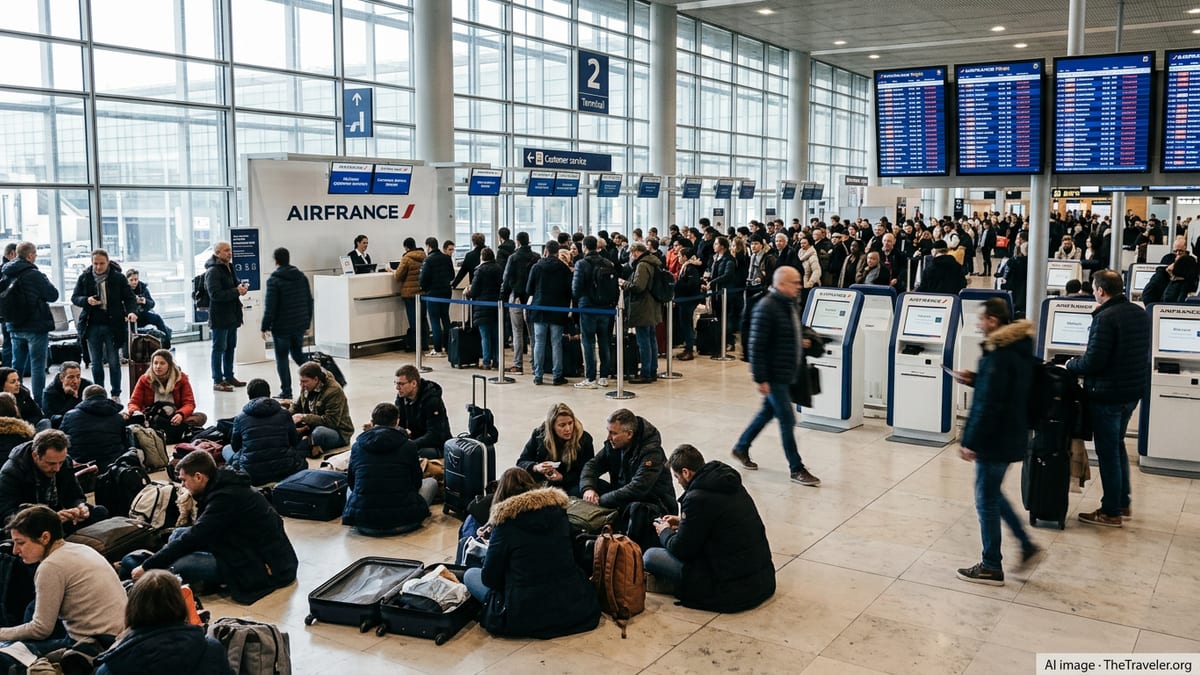
French and international travel advisories report that the November 5 strike is affecting both local and national rail services, including the Paris Metro and regional and long-distance lines. Travel industry bulletins indicate that all four of France’s main rail unions have backed the action, increasing the likelihood of reduced timetables, last-minute cancellations and significant crowding on any trains that do operate.
Intercity and high-speed services, including routes linking Paris with cities such as Lyon, Marseille and Bordeaux, are expected to face delays or cancellations, while commuter services around the capital may be especially affected during rush hours. Some regional buses and tram networks are also expected to run partial services or be suspended on key corridors where protests or police operations are underway.
Travel-focused reports emphasize that disruption can extend to major international gateways. Rail links from central Paris to Charles de Gaulle and Orly airports may operate on reduced schedules, and road access can be slowed by traffic diversions and security perimeters around demonstration routes. Travelers are being urged to allow extra time when traveling to or from airports and to confirm schedules directly with operators before departure.
In Paris itself, authorities have previously shut down selected Metro stations and rerouted buses along protest routes on major demonstration days. Although the exact pattern of closures can change at short notice, recent experience shows that stations around major gathering points such as Place de la République, Place de la Bastille and Place de la Nation are particularly vulnerable to interruptions.
Curfews, Crowd Control and Impact on Tourist Areas
Publicly available information from the U.S. government’s travel channels and European foreign ministries indicates that local authorities across France have the power to impose curfews and temporary restrictions on movement in response to unrest. Recent alerts note that curfews have been implemented in some urban districts, including parts of the Paris region, when demonstrations have escalated.
These measures can be introduced with limited advance notice and may affect access to prominent public squares, riverfronts and other gathering spots. Travelers may encounter security cordons, riot police deployments and traffic diversions around protest routes, particularly during late afternoon and evening marches.
Published coverage of the recent unrest notes that some cultural institutions have chosen to close temporarily or limit access on major protest days. Earlier in the autumn, high-profile sites such as the Louvre closed entrances after access routes were blocked by demonstrators, underlining the potential for disruption even when protests are not specifically targeting tourists.
For visitors staying in central districts, the most visible effects tend to be noise from marches, blocked streets, shuttered Metro entrances and a heavy police presence, rather than direct threats to personal safety. Travel advisories from several governments stress that protests and strikes are generally not directed at foreign visitors, but recommend avoiding large gatherings and keeping distance from confrontations between demonstrators and police.
Government Alert Levels and Wider Security Context
European government advisories on France point out that the country remains under the Vigipirate national security framework, which includes a three-tier alert system for responding to threats to public safety, including terrorism. Canada, the United Kingdom, Ireland and other countries currently advise their citizens that France has maintained a high vigilance posture since previous attacks and security incidents.
France’s existing security architecture means travelers may already be accustomed to bag checks at major museums, visible armed patrols near landmarks and controlled access at large events. The current protest wave adds an additional layer of disruption, combining civil unrest with an already elevated security environment.
International travel advisories describe the recent protests as more frequent and sometimes more confrontational than typical French demonstrations. Reports point to a combination of student-led actions, union mobilizations and other groups attempting to form a common front over economic grievances. On the most intense weekends, interior ministry figures cited in media coverage have reported several thousand arrests nationwide and significant numbers of injuries among police and gendarmes.
Despite these developments, foreign ministries have not raised France to the highest advisory categories reserved for widespread conflict or breakdown of public order. Instead, they are focusing on practical risk mitigation, emphasizing advance planning and situational awareness for tourists and business travelers.
Practical Guidance for Americans Traveling to France Now
Travel advisories compiled in recent days offer a broadly consistent set of recommendations for visitors who decide to proceed with trips to France while protests continue. First, travelers are encouraged to monitor local media, public transit apps and official city or transport operator feeds on the days leading up to and during major strike actions, since detailed disruption information is often released only shortly in advance.
Second, visitors are advised to build extra flexibility into plans, particularly if they have fixed-time commitments such as long-distance train departures or flights. Reserving earlier airport transfers, allowing generous margins for station changes and considering backup options such as licensed taxis can help reduce stress if core services are curtailed.
Third, travelers are urged to stay clear of demonstration routes and large gatherings, even if they appear peaceful. Published guidance from multiple governments stresses that peaceful marches can change rapidly if crowds and police units clash, and that bystanders risk exposure to tear gas, projectiles or pushing crowds. Avoiding well-known rally points on announced protest days is widely recommended.
Finally, the U.S. Embassy continues to encourage American citizens in France to enroll in the Smart Traveler Enrollment Program so they can receive timely security alerts by email or text. Publicly available material on the program explains that registration allows U.S. missions to disseminate location-specific updates in fast-moving situations such as transport strikes, curfews or significant protest escalations, providing an additional layer of situational awareness for travelers.