


More news on this day
As the United States prepares for the 250th anniversary of its independence in 2026, the nation’s first transcontinental railroad is reemerging as a powerful symbol of connection, mobility and national unity in a year of high profile rail themed celebrations.
Get the latest news straight to your inbox!
Historic Golden Spike Site Anchors a New Season of Commemoration
At Golden Spike National Historical Park in northern Utah, where the last spike was driven on May 10, 1869 to complete the first transcontinental railroad, preparations are shifting from the 150th anniversary marked in 2019 to a broader America 250 focus. National Park Service planning documents indicate that Golden Spike is highlighted among sites illustrating how transportation opened the continent and knit together distant regions into a single national market and polity.
Park materials recount how the original “Pacific Railroad,” later known as the Overland Route, created a continuous rail line of nearly 1,900 miles between the existing eastern network at Council Bluffs, Iowa, and the Pacific coast terminals around San Francisco Bay. The joining of Union Pacific and Central Pacific track at Promontory Summit cut cross country travel from months by wagon or ship to under a week by rail, reshaping migration, trade and communication.
As America 250 programming accelerates, Golden Spike’s living history steam operations, interpretive exhibits and anniversary events are being framed as part of a nationwide look at how infrastructure projects have reinforced national cohesion. Publicly available National Park Service summaries describe the transcontinental railroad as a turning point comparable in impact to the Declaration of Independence in redefining what the United States was and could become.
While final schedules for 2026 have not yet been released, planning documents and recent visitor outreach suggest expanded heritage demonstrations, education programs and partnerships with rail preservation groups, designed to draw both rail enthusiasts and families traveling for semiquincentennial themed trips.
America 250 Rail Branding Rolls Out on the National Network
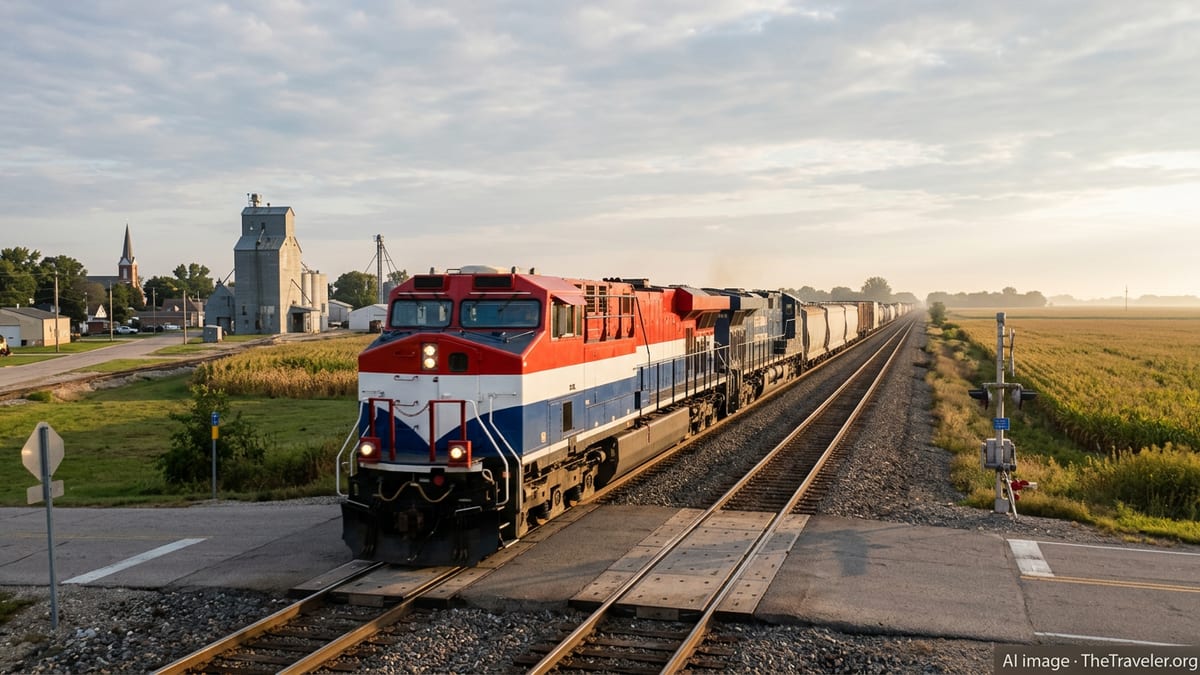
Passenger rail operators are adopting America 250 motifs to link modern travel with 19th century rail milestones. Amtrak has introduced a Freedom 250 themed Acela set and additional locomotives carrying America 250 graphics on corridors across the United States, according to company announcements and regional media coverage. The red, white and blue liveries position contemporary rail journeys as part of a long continuum of American mobility.
The design program is described in Amtrak materials as part of a broader partnership with the national semiquincentennial effort, aiming to encourage travelers to experience historic cities and landscapes by train. Wraps and decals reference 1776 and 250 years of independence while highlighting modern priorities such as sustainability and accessibility that distinguish today’s network from the steam era routes that followed the Golden Spike.
Enthusiast reports and social media images show America 250 themed locomotives appearing well beyond the Northeast Corridor, with long distance and state supported routes carrying the branding into small towns and regional hubs. For many smaller communities originally placed on the map by 19th century railroad construction, the new paint schemes serve as a rolling reminder of how railroads once defined local fortunes and still link them to the wider country.
Other railroads are participating with special heritage units and commemorative trains. Freight carrier announcements describe locomotives dedicated to the 250th anniversary as tributes to the role of rail in building the national economy, echoing the commercial aspirations that drove the original transcontinental line across the Rockies and the Great Basin.
New Federal Legislation Ties Rail Investment to the Semiquincentennial
On Capitol Hill, transportation policy is also invoking the legacy of the first transcontinental railroad. The Building Unrivaled Infrastructure and Long term Development for America’s 250th Act, known as the BUILD America 250 Act, advanced in the House Transportation and Infrastructure Committee in May 2026 with provisions for hundreds of billions of dollars in surface transportation spending and a substantial rail component.
Committee summaries and independent analyses state that the draft legislation would authorize tens of billions of dollars for Amtrak and competitive rail grant programs over five years. Observers note that the bill’s title explicitly references the 250th anniversary, framing modern rail investment as a successor to the 19th century federal support that helped launch the first transcontinental route through land grants and bonds.
Advocacy groups argue that linking the bill to America 250 underscores the idea that national anniversaries are not only about commemoration but also about renewing infrastructure. Commentaries comparing the two eras suggest that while the original Pacific Railroad was built by private companies backed by federal policy, today’s emphasis is on public safety standards, climate resilience and integrating passenger and freight services into a more balanced national transportation system.
In this reading, the Golden Spike becomes less a nostalgic relic and more a reference point for a new wave of long term projects that again seek to overcome distance, connect regions and redistribute opportunity across the continent.
Heritage Trains and Museums Use 2026 to Revisit Rail’s Unifying Role
Beyond the mainline network, heritage railroads and museums are positioning America 250 programming around the story of the transcontinental railroad and its legacy. Union Pacific has announced a coast to coast tour in 2026 with its restored Big Boy steam locomotive No. 4014, described by the railroad as a tribute to the role of railroads in building and unifying the country. The tour’s planned route is designed to visit multiple regions and major population centers, echoing in spirit the geographic reach of the original line.
Museums and preservation groups are also aligning exhibits with the anniversary. Information from the B&O Railroad Museum and other institutions indicates that restored locomotives associated with national celebratory trains are being used as focal points for discussions of how rail shaped American life, from military logistics and migration to the evolution of time zones and standardized commerce.
Some planned initiatives have been scaled back. The American Freedom Train Foundation, which had promoted a new nationwide steam powered tour for the semiquincentennial, announced in April that financial and logistical constraints forced cancellation of the project. The group has pledged instead to direct remaining resources to preservation and education efforts within the heritage rail sector.
Analysts of the rail preservation community note that, taken together, the Big Boy tour, museum programs and thematic excursions still represent one of the most visible national spotlights on rail history since the 1976 Bicentennial, when a previous American Freedom Train toured the country. For many organizers, 2026 is being treated as a once in a generation opportunity to connect younger audiences with stories that begin at the Golden Spike but extend into the present day.
Reexamining the Complex Legacy of the Transcontinental Railroad
As the transcontinental railroad returns to public attention during America 250, historians and cultural institutions are emphasizing that its legacy is as complicated as it is transformative. Scholarly work and public interpretation stress that the line’s construction depended heavily on immigrant labor, including thousands of Chinese workers, as well as Irish and other European migrants who faced dangerous conditions and discrimination.
National Park Service interpretation at Golden Spike and related exhibits around the country increasingly foreground these stories, presenting the completion of the railroad as a collective achievement shaped by diverse communities. Updated markers and programs also address the impact on Indigenous nations, whose lands were crossed, divided or opened to settlement by the arrival of the iron road.
Experts participating in semiquincentennial planning argue that viewing the first transcontinental railroad through this wider lens aligns with the broader goals of Freedom 250 initiatives, which seek to tell a more inclusive national story. By situating the Golden Spike alongside sites of the American Revolution, civil rights landmarks and industrial heritage corridors, planners aim to show how different eras of struggle, innovation and expansion intersect.
As anniversary trains roll and new laws are debated, the nation’s first coast to coast railroad is once again visible in public life, not only as a feat of engineering but as a reminder that the project of linking disparate places and people into a shared civic journey remains unfinished.