


More news on this day
Passengers on United Airlines Flight 946 from Washington Dulles to Amsterdam faced an unexpected ordeal overnight after the Boeing 767 made a mid-air U-turn and diverted to St. John’s, Canada, following reports of an in-flight emergency over the North Atlantic.
Get the latest news straight to your inbox!
Transatlantic Flight Diverts to St. John’s After Reported Engine Issue
Publicly available flight-tracking data shows that United Airlines Flight 946 departed Washington Dulles International Airport on the evening of Sunday, October 11, 2026, operating a scheduled overnight service to Amsterdam Schiphol. The aircraft, a Boeing 767-300ER, climbed out on a northeasterly route commonly used for transatlantic crossings.
Specialist aviation outlets report that partway across the Atlantic, the crew declared an emergency and began diverting toward Canada, citing a suspected engine-related problem. Data from multiple live-tracking platforms indicates that the twin-engine widebody altered course and descended toward Newfoundland, ultimately landing at St. John’s International Airport.
Initial reports describe the incident as an engine shutdown at cruise altitude, prompting the diversion in line with standard safety procedures for long-haul twin-engine aircraft operating over oceanic routes. While full technical details have not been published, the aircraft completed the diversion and came to a stop at St. John’s, where emergency services were positioned as a precaution.
Information from flight-history services lists the aircraft as one of the older Boeing 767s in United’s fleet, with the airframe in service for more than three decades. The type has long been a workhorse on the carrier’s Atlantic network, including the daily Washington to Amsterdam rotation.
Hours-Long Disruption Leaves Passengers Stranded Overnight
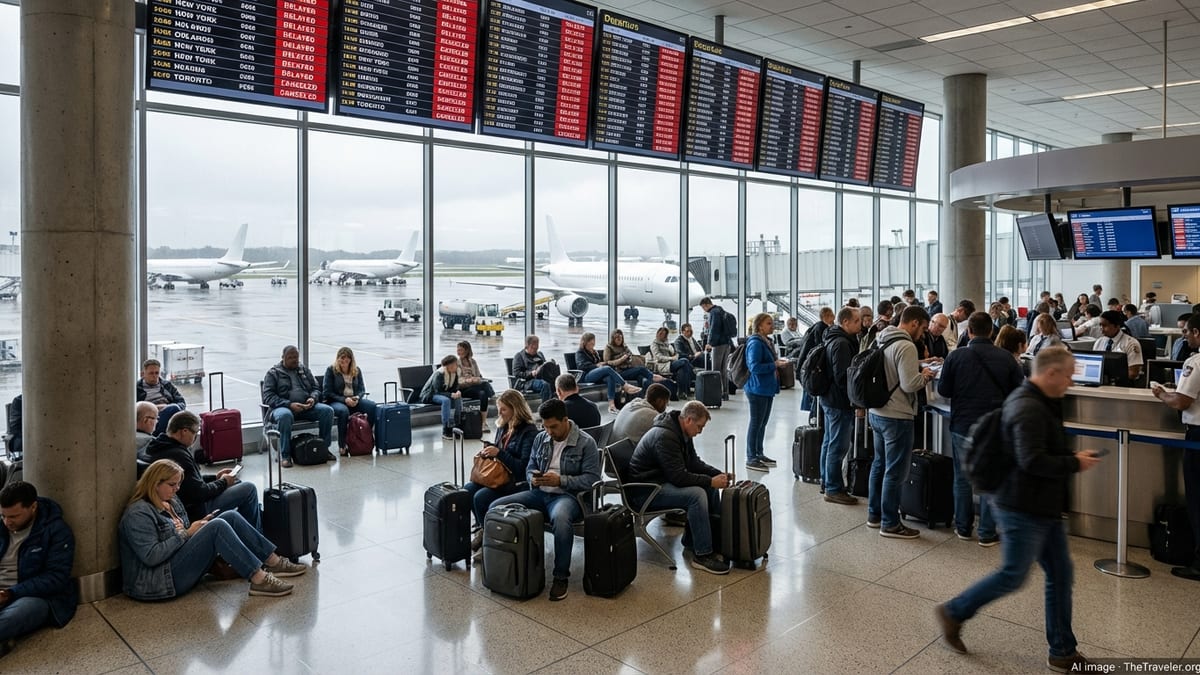
Once on the ground in St. John’s, travelers expecting to wake up in Amsterdam instead found themselves unexpectedly in Canada’s Atlantic provinces. Early accounts circulating on social media and aviation forums describe passengers remaining on board for a period while the aircraft was secured and inspected before disembarkation procedures began.
As of the morning of October 12, no clear onward flight plan had been published through public flight-information channels for the disrupted passengers. Available schedules do not show a same-aircraft continuation to Amsterdam, and there is no publicly listed rescue flight under the original UA946 number from St. John’s, indicating that re-accommodation may involve rebooking onto other services or an extended layover.
For many travelers, the timing of the diversion has likely meant missed connections at Amsterdam Schiphol, which functions as a major European transfer hub. Passengers booked onward to destinations across Europe, the Middle East, and Africa may now face complex rerouting once alternative options can be arranged.
Comments from affected travelers online suggest frustration with the uncertainty around hotel arrangements, meal vouchers, and rebooking timelines. However, the same accounts acknowledge that the diversion itself appears to have been precautionary and that the landing in St. John’s was uneventful from the passenger perspective.
What Rules Apply When Flights Divert or Terminate Early
The disruption raises familiar questions for international travelers about what airlines are required to provide after an emergency diversion. Under United States regulations, there is no federal rule that guarantees hotel rooms or set financial compensation purely for delays or diversions, even when they occur far from the intended destination.
Airlines operating from the European Union can fall under EU Regulation 261/2004 for flights departing an EU airport or arriving with an EU carrier. In this case, the flight originated in the United States and was operated by a U.S. carrier, which means the more robust EU compensation framework is less likely to apply to the Washington-to-Canada segment, even though the final destination was Amsterdam.
Internal policy documents and customer-commitment statements published by United outline that assistance such as hotel accommodation, meal vouchers, and rebooking is handled case by case. Typically, emergency diversions attributed to safety or technical issues are treated differently from controllable schedule disruptions like crew misallocation or minor mechanical delays.
Travelers on disrupted long-haul flights are generally rebooked on the next available services in the same cabin, space permitting. In high-demand transatlantic markets, however, economy cabins can be heavily booked days in advance, sometimes leading to extended waits or rerouting through alternate European hubs.
Impact on United’s Washington–Amsterdam Corridor
United’s Flight 946 is a long-established link between Washington Dulles and Amsterdam, serving both business travelers and leisure passengers heading for the Netherlands and beyond. According to current schedules, the service operates as a daily overnight departure, with partner-airline codeshares also sold under other European carriers’ flight numbers.
Operational data from recent days shows that the route has been running close to schedule despite seasonal weather and broader network disruption. The diverting of a widebody aircraft to St. John’s temporarily removes one long-haul frame from circulation on the Atlantic network, increasing pressure on an already tightly utilized fleet of Boeing 767s.
Travel-industry analysts note that the 767 family, while aging, continues to play a critical role for United on mid-density transatlantic routes where larger twin-aisle aircraft may not be commercially viable year-round. Events like an engine-related diversion highlight both the resilience built into long-haul operations and the operational challenges that arise when a single aircraft is unexpectedly taken out of service.
For Schiphol, one missed transatlantic arrival can disrupt not only point-to-point traffic but also connecting banks of passengers transferring onto partner airlines. Travel agents and corporate travel managers monitoring the situation are likely to adjust itineraries in the short term, shifting some bookings through other hubs until regular operations on the Washington–Amsterdam pairing are clearly restored.
What Travelers Can Do After an In-Flight Emergency Diversion
For passengers unexpectedly stranded after a diversion into an unplanned airport, immediate priorities usually include confirming rebooking options, clarifying entitlement to hotel and meal assistance, and updating any onward travel or accommodation reservations at the final destination. Publicly available guidance from consumer-advocacy groups encourages travelers to keep all receipts and records in case reimbursement or insurance claims are possible later.
Comprehensive travel insurance policies sometimes include coverage for additional hotel nights, meals, and ground transportation costs after major disruptions, particularly when the cause is a mechanical or technical failure outside the traveler’s control. However, coverage varies widely between policies, and travelers may need to document the diversion and delay using airline statements or flight-tracking records.
Consumer groups also recommend that passengers affected by serious disruptions maintain a record of communications, including screenshots of flight-status updates and any written notices offered at the airport. Such documentation can be useful if travelers later seek goodwill gestures such as frequent-flyer miles, travel credits, or partial refunds from the airline.
For those on board United Flight 946, the priority on the night of October 11 and morning of October 12 has been reaching a safe place to rest and securing a new path to Amsterdam or onward destinations. As more information emerges about how the airline rebooks and assists those affected, the incident is likely to fuel ongoing debates about passenger rights and the balance between operational safety decisions and customer protection in global air travel.