


More news on this day
United States carriers are weighing a new twist on post‑pandemic cabin design, exploring permanently blocked middle seats in some economy rows on long narrowbody flights as a way to trim flight attendant requirements while marketing a more spacious experience.
Get the latest news straight to your inbox!
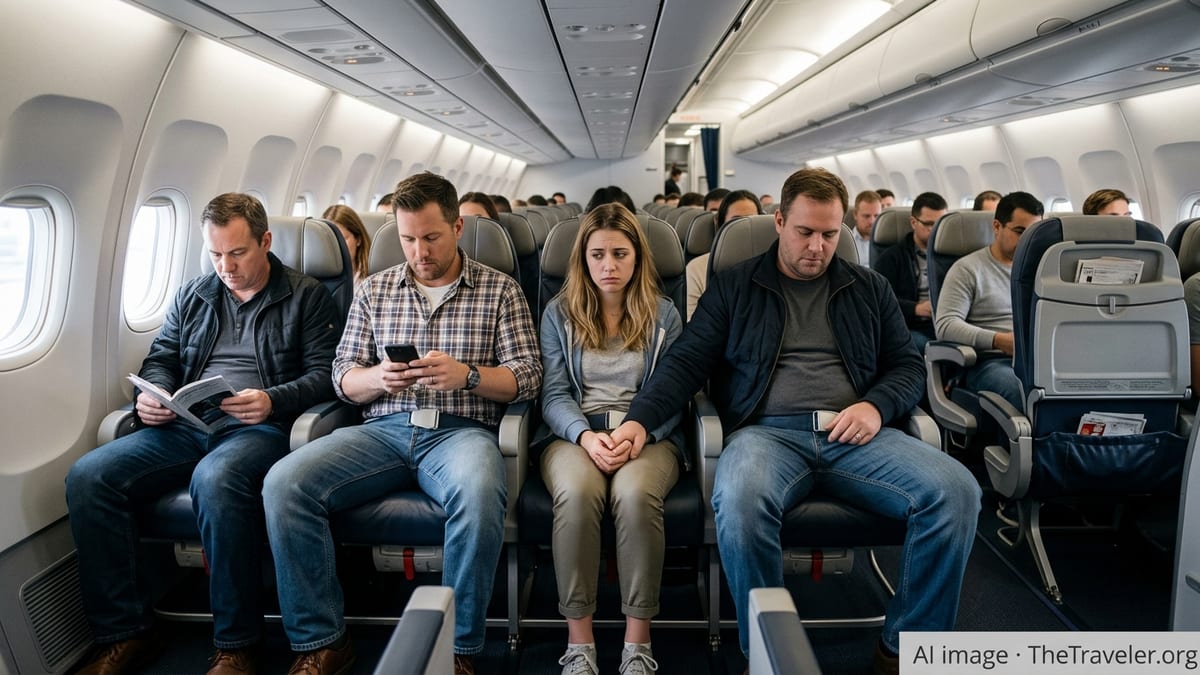
United’s A321XLR Plan Puts Focus on Cabin Configuration and Crew Rules
Industry reports indicate that United Airlines is preparing an unconventional economy layout for its incoming Airbus A321XLR fleet, with some middle seats physically disabled rather than simply left unsold. Coverage from aviation outlets describes a concept in which certain three‑abreast rows become two‑seat pairs, allowing the aircraft to be certified with fewer usable passenger seats than a typical domestic A321 configuration.
The proposed layout is being framed as a dual‑purpose strategy: reducing minimum flight attendant numbers while packaging the blocked middle seats as a comfort upgrade on long narrowbody flights, including premium transcontinental and select international routes. Publicly available information on the project suggests United is positioning the A321XLR as a premium‑leaning aircraft, trading some capacity for higher yields and lower staffing costs on sectors that can exceed seven hours.
Unlike temporary seat blocks used widely during the early stages of the pandemic, the seats in question would be structurally or mechanically restricted from passenger use. That distinction is significant from a regulatory standpoint because it determines how many flight attendants the Federal Aviation Administration counts as necessary under existing rules.
FAA Rules Tie Flight Attendants to Installed, Usable Seats
Under federal regulations for large air carriers, the minimum number of flight attendants is calculated based on the passenger seating configuration of the aircraft. The core rule requires one flight attendant for each block of up to 50 passenger seats, with staffing rising in steps as certified capacity increases. Industry reference materials summarizing these rules emphasize that the trigger is the number of approved passenger seats, not the number of travelers actually on board.
Historically, airlines have worked within that framework by adjusting total certified seat counts or by physically deactivating seats when seeking to operate with a lower minimum crew. Regulatory documents and past Federal Register notices describe how blocked or removed seats can, if properly documented and enforced, reduce the official passenger‑carrying capacity used in crew calculations.
In practice, this means that if a narrowbody such as an A321XLR is configured with a certified maximum just beneath the threshold for an additional flight attendant, the airline can staff one fewer crew member on that type. On long‑haul routes that require augmented pilot crews and involve complex scheduling, even a small reduction in cabin crew complements can deliver recurring cost savings.
Cost Pressures and the Search for “Premium Economy Lite”
The exploration of permanently blocked middle seats is emerging against a backdrop of higher labor costs, tight flight attendant availability, and strong demand for more spacious economy products. Transcontinental routes linking the East and West coasts, as well as thinner long‑haul markets suited to the A321XLR, are seen as prime candidates for hybrid offerings that sit between standard economy and full premium economy.
Analysts writing in aviation trade publications have noted that a blocked middle seat effectively turns a standard 3‑3 narrowbody layout into a 2‑2 product across selected rows. During the pandemic, several carriers briefly adopted similar seating patterns for distancing, but later abandoned them once load factors recovered because the revenue penalty outweighed the benefit when middle seats were simply left empty.
Permanently disabling the seat changes the equation. Because the seat no longer counts toward the certified maximum, the airline gains a structural reduction in minimum crew requirements that can partially offset lost ticket revenue. At the same time, those two‑across pairs can be sold at a premium above regular economy, creating what some commentators describe as a “premium economy lite” cabin section without the extensive reconfiguration associated with widebody premium cabins.
Safety, Evacuation Standards, and Political Scrutiny
The emerging trend is intersecting with a wider debate in Washington over crew levels and evacuation safety. In May, two U.S. senators urged the FAA to review how reduced minimum crew requirements on some large aircraft could affect emergency evacuations, citing recent incidents in which carriers struggled to clear cabins within the 90‑second benchmark.
The senators’ letter pointed to the long‑standing one‑per‑50‑seats standard and argued that reductions, even when compliant with regulation, might undermine the spirit of evacuation certification when cabins are densely packed. The correspondence specifically referenced approvals that allowed certain dual‑aisle jets to operate with fewer flight attendants than earlier staffing models envisioned, and called for additional research into how modern seat layouts, passenger behavior, and baggage habits affect real‑world evacuation times.
While the current discussion over blocked middle seats on transcontinental narrowbodies is focused on single‑aisle aircraft, the same underlying concern applies: whether fewer flight attendants spread over long cabins can manage crowd control and assist passengers quickly in an emergency. Cabin crew unions have repeatedly warned that any move to cut staffing, even if framed as a design‑driven efficiency, may leave fewer trained professionals available when seconds matter most.
What Travelers Could See on Future Transcontinental Flights
For passengers, the most visible change on aircraft adopting this model would be clusters of economy seats with an empty middle position that is not offered for sale. These pairs could be branded as a distinct sub‑cabin within main cabin or folded into existing extra‑legroom products, marketed with promises of greater personal space and a quieter environment on long sectors.
On busy transcontinental routes such as New York to Los Angeles or San Francisco, where demand for comfort is strong but widebody deployment is increasingly rare, airlines may see an opportunity to differentiate while keeping operating costs in check. A321XLRs and similar long‑range narrowbodies are already being positioned by manufacturers as tools to open thinner city pairs and to replace some twin‑aisle capacity with more fuel‑efficient single‑aisle operations.
However, this model will be closely watched by regulators, lawmakers, and passenger advocates. Any approval to certify cabins with permanently blocked seats that support lower minimum crew levels is likely to come with strict requirements on how those seats are disabled, monitored, and maintained over the life of the aircraft. As more details emerge from cabin certification programs and airline schedule filings, travelers will gain a clearer picture of how often these blocked‑middle layouts appear on U.S. transcontinental routes and how strongly they are tied to crew reductions versus passenger comfort positioning.