


More news on this day
The United States has reaffirmed a Level 3 “Reconsider Travel” advisory for Nigeria even as 11 other African nations move onto or remain on Washington’s highest Level 4 “Do Not Travel” list in 2026, underscoring sharply diverging risk assessments across the continent for U.S. travelers.
Get the latest news straight to your inbox!
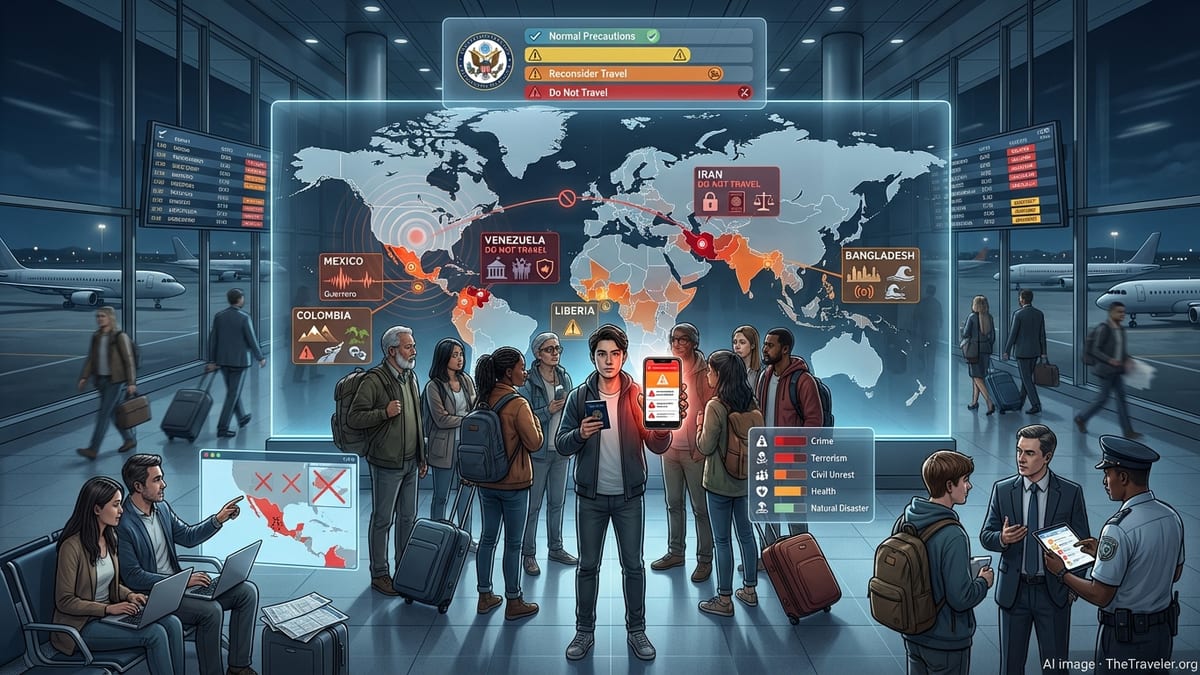
How the U.S. four-tier travel warning system works
The U.S. Department of State applies a four-level advisory system to every country, ranging from Level 1, where travelers are advised to exercise normal precautions, to Level 4, which urges citizens not to travel and to leave as soon as it is safe if already in-country. Public documents from the department explain that Level 4 advisories reflect a greater likelihood of life-threatening risks and limited ability to provide emergency assistance.
Level 2, “Exercise Increased Caution,” is typically associated with higher crime or sporadic unrest, while Level 3, “Reconsider Travel,” signals sustained security threats such as terrorism, kidnapping, or widespread violent crime. These levels can also be driven by major health risks, including disease outbreaks or the collapse of local medical infrastructure.
Advisories are not static. They are updated as conditions change, and in some cases, individual regions within a country are assigned stricter guidance than the national rating. Official risk maps and country pages show that some destinations with a Level 3 national advisory have specific provinces or states listed at an internal Level 4 due to conflict or insurgency.
For travelers, the advisory level can shape access to insurance, corporate approval processes and even academic or humanitarian travel policies. Some universities and multinational employers use Level 3 and Level 4 advisories as automatic triggers for additional reviews, mandatory security training or outright travel suspensions.
Nigeria remains at Level 3 amid persistent security concerns
As of October 2026, the State Department’s Nigeria advisory remains at Level 3, “Reconsider Travel,” reflecting a mix of crime, terrorism, kidnapping, and civil unrest. The current notice, updated in June 2026, highlights ongoing attacks by insurgent and extremist groups, banditry and communal violence that affect large parts of the country.
The advisory divides Nigeria into risk zones, with several northern and northwestern states flagged internally at “Do Not Travel” due to frequent armed attacks, roadside ambushes and kidnappings for ransom. Publicly available text on the advisory page points to the presence of groups such as Boko Haram and ISIS-West Africa and notes that security operations can occur with little warning.
Major cities such as Abuja, Lagos and Port Harcourt are not exempt from concern. The advisory references risks of crime, sporadic terrorist incidents and targeted kidnappings, while also drawing attention to curfews, checkpoints and other security measures that can disrupt movements. Travelers are urged to maintain low profiles, avoid large gatherings and keep flexible itineraries in case roads or airports are affected by unrest.
For would-be visitors, the Level 3 status does not constitute a legal ban on travel, but it signals that the U.S. government assesses a heightened risk profile compared with many other African business and leisure destinations. Risk management firms and institutional travel offices often respond by requiring detailed security plans or by restricting nonessential trips to Nigeria.
Eleven African countries now under Level 4 “Do Not Travel” warning
In contrast with Nigeria’s Level 3 rating, 11 African countries currently fall under the State Department’s strictest Level 4 “Do Not Travel” advisory in 2026, according to advisory listings and regional media reporting. Recent roundups by African and international outlets indicate that Burkina Faso, the Central African Republic, Chad, the Democratic Republic of the Congo, Libya, Mali, Niger, Somalia, South Sudan, Sudan and Uganda are all on the Level 4 list.
These destinations share a combination of severe risks, including active armed conflict, widespread terrorism, political instability, and pervasive kidnapping threats. Some also face major humanitarian crises, with mass displacement and heavily disrupted infrastructure making it difficult to guarantee basic services such as healthcare, electricity and secure transportation.
The State Department’s explanatory material for Level 4 notes that, in such environments, the capacity of U.S. consular staff to assist citizens may be sharply curtailed or entirely unavailable. Embassies may operate with limited personnel or could be temporarily closed, and evacuation options may be constrained by closed borders, airspace restrictions or active fighting around key airports.
Travel industry analysis shows that the cluster of Level 4 advisories has a direct impact on air connectivity, insurance and tour operations in parts of the Sahel, Central Africa and the Horn of Africa. Some major international insurers restrict coverage for trips to Level 4 countries or impose surcharges and special conditions. In practice, these restrictions can make fully independent tourism or nonessential corporate travel financially and logistically difficult.
Implications for U.S. travelers and travel planners
The divergence between Nigeria’s Level 3 status and the Level 4 designations elsewhere in Africa is reshaping how travel planners categorize the continent. Risk consultancies and corporate travel managers increasingly differentiate between countries where trips are still possible under strict controls and those where travel is paused altogether in response to the U.S. advisories.
Some universities and non-governmental organizations reference the federal travel advisory system directly in their internal policies, treating Level 4 destinations as off-limits for students and volunteers while subjecting Level 3 destinations, including Nigeria, to heightened review. This can involve mandatory security briefings, vetted local partners, and pre-approved ground transportation arrangements.
Published guidance from consular and security sources also emphasizes that conditions can vary dramatically within each country. In a single destination, a capital city with visible security presence and functioning hotels can coexist with outlying regions affected by insurgency or intercommunal violence. As a result, itineraries are increasingly tailored to specific corridors judged to be more stable, even when overall advisories remain severe.
Insurance and evacuation coverage are another key consideration. Some providers exclude claims arising from travel in Level 4 countries or require advance registration for travel in Level 3 destinations. Travelers planning trips that involve Nigeria or its high-risk neighbors are being urged, in publicly available advisories and industry commentary, to read policy language closely and confirm that medical evacuation, security extraction and trip interruption are explicitly included.
What to watch next in West and Central Africa
Analysts tracking State Department updates note that the list of Level 4 African countries has grown over recent years in step with coups, protracted insurgencies and prolonged political transitions in the Sahel and surrounding regions. Media coverage in 2026 points to continuing volatility in Burkina Faso, Mali, Niger and Sudan, where conflict dynamics and shifting alliances among armed groups may influence future advisory reviews.
For Nigeria, the focus is on whether security conditions allow any relaxation of the current Level 3 guidance or, conversely, whether further deterioration in certain states might prompt tighter language. The advisory history for the country shows periodic updates as new patterns of attacks, kidnappings or civil unrest emerge, and as authorities implement or lift restrictions on movement.
Regional air links, cross-border trade routes and humanitarian corridors also play into the travel risk picture. Disruptions in neighboring Level 4 countries can spill over into border regions of Nigeria and other Level 3 destinations, affecting road safety, refugee flows and the availability of secure logistics for aid groups and commercial operators.
Travelers, airlines and tour operators are therefore watching not just individual advisories, but the broader regional map of security alerts in West and Central Africa. With Nigeria holding at Level 3 and 11 African states under Level 4 “Do Not Travel” warnings, U.S. citizens considering travel to the region in late 2026 are being encouraged, through publicly accessible guidance, to monitor advisory updates closely and to build additional flexibility and contingency planning into any itinerary.