


More news on this day
The United States has updated its travel advisory for Venezuela, sharpening warnings about disaster risks and entrenched violent crime following powerful late June earthquakes and continuing instability across the South American nation.
Get the latest news straight to your inbox!
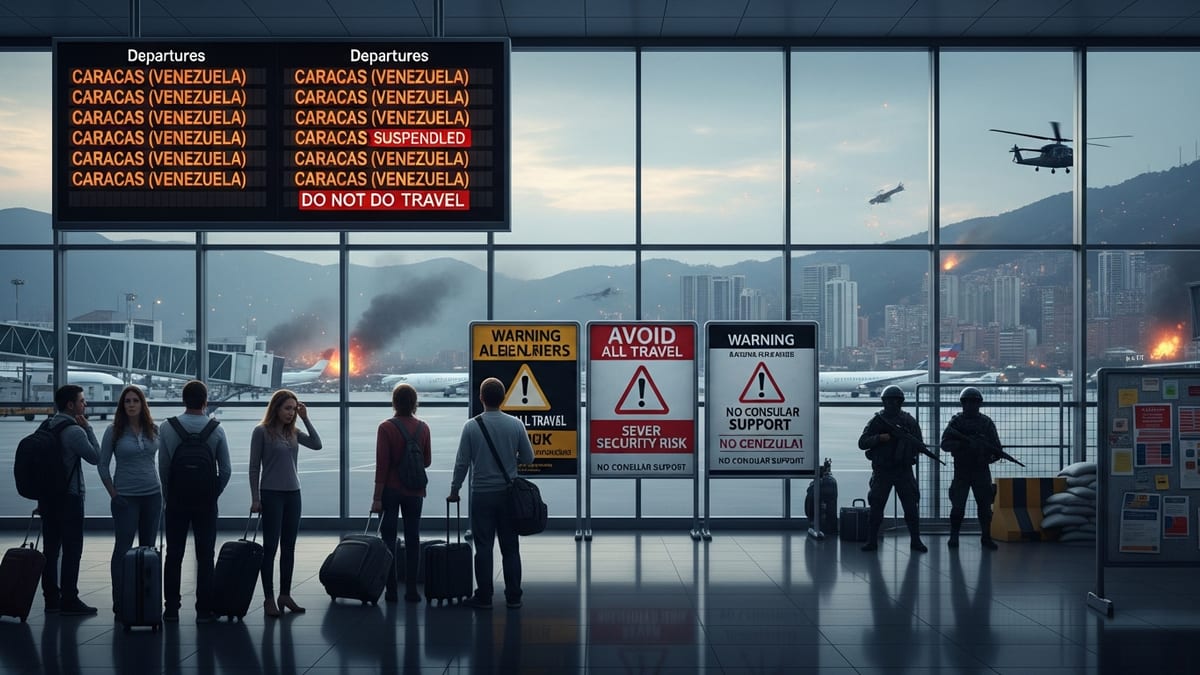
Advisory Raised as Natural Disaster Risks Mount
The latest update to the U.S. travel advisory for Venezuela highlights natural disaster concerns alongside longstanding security threats, pointing to a challenging environment for any nonessential travel. Publicly available information from the State Department shows that the advisory, refreshed at the end of June 2026, now flags natural disaster risk in addition to crime, kidnapping, terrorism and poor health infrastructure.
The move comes in the wake of strong earthquakes reported in late June that triggered states of emergency in multiple parts of the country, according to regional government travel notices. Those advisories describe significant damage in affected regions and warn that aftershocks, landslides and disrupted utilities remain possible in the weeks that follow.
Travel risk bulletins from several foreign ministries note that emergency services and basic infrastructure in Venezuela were already under strain before the quakes, and that the new damage has compounded existing challenges. Observers point out that fragile water, electricity and communications networks can take longer to restore in areas facing chronic shortages and economic pressures.
U.S. officials have for several years classified Venezuela as a high‑risk destination, but the prominent addition of the natural disaster risk label underscores concern that large‑scale emergencies could quickly overwhelm local capacity. Public guidance indicates that visitors could face difficulty accessing shelter, food and medical care in the aftermath of a major event.
Violent Crime and Kidnapping Remain Central Concerns
Alongside disaster risks, the updated advisory reiterates that violent crime is widespread across Venezuela. Official travel advisories describe incidents of homicide, armed robbery, carjacking and kidnapping, noting that both residents and foreigners can be targeted. Reports indicate that irregular armed groups and criminal organizations operate in several regions, particularly near border zones.
The U.S. warning continues to single out areas along the Venezuela–Colombia border as especially dangerous, citing a mix of organized crime, armed groups and limited state presence. Travelers are also cautioned that road crime, including robberies at informal checkpoints and after dark, remains a persistent threat on intercity highways.
Security assessments from other governments echo these themes, often urging their citizens to avoid all travel to Venezuela because of the combination of high crime levels, political volatility and weak institutions. Such assessments emphasize that violent robbery and express kidnapping can occur without much warning, sometimes involving heavily armed assailants.
For travelers, the implication is that even routine movements within major cities may carry elevated risk. Public security information stresses that visible signs of wealth, such as high‑end electronics or jewelry, can attract unwanted attention, and that reliable private transportation arrangements are safer than public options when movement is unavoidable.
Poor Health Infrastructure Complicates Emergency Response
The revised U.S. advisory again draws attention to Venezuela’s strained health system, noting that poor medical infrastructure can endanger travelers in everyday situations and during large‑scale emergencies. Public information cites shortages of medicines, equipment and trained staff in many facilities, as well as uneven availability of specialized care.
Health agencies and consular guidance for foreign nationals recommend that anyone considering travel to Venezuela secure comprehensive medical and evacuation insurance, and bring an ample supply of any prescription medication. Some advisories stress that routine treatments taken for granted elsewhere, such as advanced trauma care or complex surgery, may not be readily available in all parts of the country.
These concerns are magnified in the context of earthquakes, floods or other disasters, when hospitals can face sudden surges in demand. International risk summaries note that damaged roads, power cuts and disrupted communications can further slow the delivery of care, even for those able to reach a medical facility.
Given these constraints, travel risk analysts suggest that travelers undertake a careful personal risk assessment before entering the country, taking into account existing health conditions and the possibility of disrupted services. Many university and corporate travel programs continue to restrict or prohibit nonessential travel to Venezuela as a result.
Implications for Airlines, Tour Operators and Overland Travelers
The strengthened advisory has practical consequences not only for individual travelers but also for airlines, tour operators and overland transport providers that include Venezuela in their networks. Industry observers note that a higher‑profile U.S. warning can reduce demand from leisure travelers and may prompt companies to review route viability and insurance coverage.
Some carriers scaled back or suspended direct connections to Venezuela in recent years amid broader security and political concerns. Travel industry commentary suggests that the renewed focus on disaster and crime risks could slow any efforts to restore regular schedules, particularly for itineraries marketed to U.S. and Canadian customers.
For overland travelers in neighboring countries, the advisory serves as an additional signal that border crossings into Venezuela may carry heightened danger. Government travel pages in the region point to the risk of roadblocks, fuel shortages and sporadic violence, all of which complicate transnational bus and private vehicle journeys.
Travel planners recommend that anyone with existing bookings involving Venezuela monitor airline and tour operator updates closely. In some cases, travelers may be able to reroute through alternative hubs in the Caribbean or elsewhere in South America to avoid transiting Venezuelan territory.
What Prospective Visitors Should Consider Now
For U.S. travelers, the updated advisory reinforces a long‑standing message that trips to Venezuela require significant caution and contingency planning, if they proceed at all. Publicly available guidance urges potential visitors to reconsider nonessential travel and to stay alert to rapidly changing conditions on the ground.
Those who decide that travel is unavoidable are encouraged by various travel‑risk resources to prepare detailed emergency plans, including communication arrangements with family or employers, backup routes and reliable local contacts. Documentation such as proof of travel insurance, extra copies of identification and secure storage for valuables are also highlighted as basic precautions.
International travel analysts note that advisories are typically reviewed and adjusted as conditions evolve, meaning that risk levels may change again in response to developments in Venezuela’s security, political and humanitarian situation. For now, the combination of disaster exposure, violent crime and fragile infrastructure keeps the country among the most challenging destinations in the region for foreign travelers.
Prospective visitors are advised to consult official travel advice from their home governments shortly before departure and throughout any stay, and to factor the possibility of sudden disruption into their plans. For many, the latest U.S. warning will be a decisive signal to postpone leisure trips and explore alternative destinations until the outlook improves.