


For many dual citizens, the launch of ETIAS adds a layer of confusion to an already complex question: which passport should you use to travel to Europe, and what happens if you renew or switch passports between trips? Whether you hold both US and Canadian passports, or an EU passport plus a non-EU passport, understanding how ETIAS attaches to a specific travel document is essential to avoid problems at airline check in or at the border.
Get the latest updates straight to your inbox!
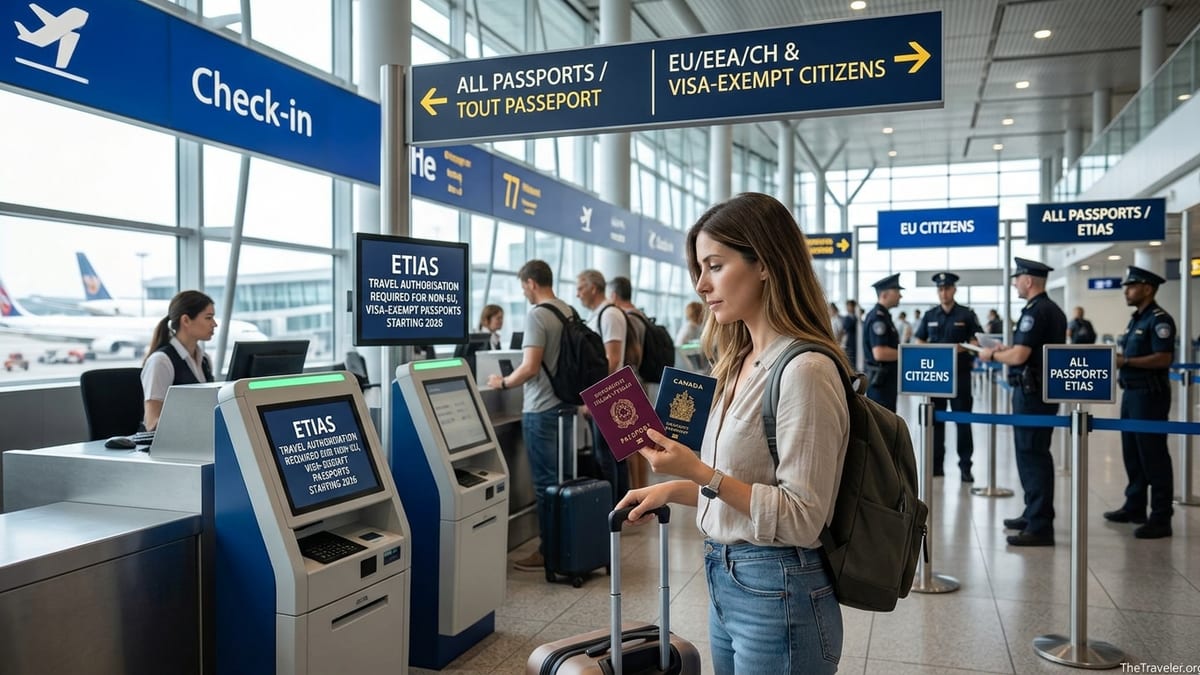
ETIAS, EU Citizens and Visa Exempt Travellers: The Core Distinction
ETIAS is an electronic travel authorisation for non-EU nationals from visa exempt countries who visit 30 European countries for short stays. It applies to travellers who currently enter without a visa and, starting in late 2026, will need to obtain an ETIAS approval before departure. According to the European Commission, the travel authorisation is always linked electronically to the passport used in the application and is not a visa or residence permit.
By contrast, nationals of EU and Schengen states, as well as Ireland, do not need ETIAS when they travel as citizens of those states. Official ETIAS guidance is explicit that if you are a national of any European country that requires ETIAS from visitors, or of Ireland, you are exempt from ETIAS regardless of any other nationality you hold. In that case your right of entry is based on citizenship, not on visitor status.
For dual citizens, the practical consequence is that you must choose which status you are using for a given trip. If you travel as a citizen of a European country, you should enter and exit with that country’s passport and you do not apply for ETIAS. If you instead choose to travel as a visitor on a non-EU, visa exempt passport, you will need an ETIAS linked to that specific travel document once the system is in operation.
Many dual nationals who live outside Europe find themselves caught in between. An EU passport might be expired or stuck in a lengthy renewal process. Official communication from EU agencies recognises this problem and advises that EU nationals are expected to travel on a valid EU or Schengen state passport where they have one. ETIAS does not override national nationality laws, so questions about your right of entry as a citizen are always governed by the laws of the state that issued your EU passport.
The Key Rule: One ETIAS, One Passport
The most important technical rule is simple. The ETIAS regulation and official FAQs state that you must present at the border the same travel document you used in your ETIAS application. Any change of travel document requires a new travel authorisation. In practice, this means that the passport number, issuing country and expiry date on your ETIAS record must match the passport you show to airline staff and border officers.
The ETIAS central system is designed so that each authorisation is tied to one passport. The European Commission’s description of ETIAS makes clear that the authorisation is valid for up to three years or until the passport used in the application expires, whichever comes first. If you obtain a new passport during that period, the Commission explains that you must apply for a new ETIAS using the new document because the existing authorisation cannot be transferred or updated.
There is currently no official process to simply edit or “move” an existing ETIAS to a renewed passport. Internal technical guidance used by the system’s operators lists substantial changes to passport details as a situation where the traveller must submit a new application rather than correcting the old one. This includes changes to passport number, name, nationality or other core data.
For dual and multiple citizens, the same rule applies even if your other passport carries the same nationality or offers the same visa exempt access. ETIAS cannot be shared across documents. If you apply using a US passport, that authorisation cannot be used with your Canadian passport on a later trip, and vice versa. Each passport you intend to use for ETIAS travel needs its own valid approval.
Scenario 1: Dual EU / Non-EU Citizens Switching From EU Passport to ETIAS
One common situation is a person who holds both an EU nationality and a non-EU, visa exempt nationality. For example, an Italian and Canadian dual citizen who lives in Toronto. As long as this traveller holds a valid Italian passport, EU rules say they are exempt from ETIAS and should enter Europe using the Italian document. In that case they are treated as an EU citizen and do not require a visitor authorisation.
Difficulties arise when the EU passport expires or cannot be used. Official ETIAS information aimed at dual nationals stresses that if you hold the nationality of a European ETIAS country or Ireland, you must travel with the passport issued by that state. If it has expired, you are expected to contact the consular authorities to obtain a new travel document. If you cannot renew in time, you may in practice consider travelling on your non-EU passport with ETIAS as a visa exempt visitor, but this choice does not change or remove your obligations as a citizen under the laws of your EU country.
If you do decide to travel as a visitor, you will apply for ETIAS using your non-EU passport. Once approved, you must present that same non-EU passport at airline check in and at Schengen border control for that particular trip. For short tourist or business stays that fall under ETIAS rules, you then use that non-EU document consistently for entry and exit, even though you also hold an EU nationality.
On a later trip, once your EU passport has been renewed, you can switch back to travelling as an EU citizen. In that case you simply present your EU passport and do not rely on ETIAS. The previous ETIAS authorisation on your non-EU passport does not limit your right to re-enter as a citizen whenever you wish, because citizenship rights sit above ETIAS in the legal hierarchy.
Scenario 2: Dual Non-EU Visa Exempt Citizens With Two Passports
Another typical case involves a traveller who has two non-EU passports from visa exempt countries. A dual US and Canadian national, for instance, will be eligible to apply for ETIAS with either passport once the system becomes mandatory. Official ETIAS articles on dual citizenship give this type of example and explain that such a traveller may choose which passport to use for their application.
The choice matters because the authorisation will only be valid with that one passport. If you apply using your US passport, you must travel with the US passport whenever you rely on that ETIAS for entry. If on a later trip you prefer to travel on the Canadian passport, perhaps because of different entry conditions in a third country, you will need a separate ETIAS linked to that Canadian document before approaching the Schengen border.
There is no mechanism to transfer an approval from one passport to another, even when both are from countries with the same ETIAS conditions. Airlines and carrier systems query ETIAS against the passport you enter at check in. Technical guidance to carriers notes that if a dual national from a visa exempt country presents a passport that does not show a valid ETIAS, the system will return a “no authorisation” response and boarding may be refused unless the traveller can demonstrate another basis for entry.
In practice, many dual non-EU citizens pick one passport as their “Europe passport” and consistently apply for and use ETIAS with that document. However, you are free to hold authorisations on both passports if you wish, as long as you respect the requirement to use the matching passport at the border for each trip.
Scenario 3: Renewing the Same Passport and Its Impact on ETIAS
Renewing a passport with the same nationality raises a slightly different issue. Suppose you are a US citizen who obtained ETIAS using a US passport that is valid for ten years. After five years, you renew and receive a new US passport with a different number. Even though your citizenship has not changed, ETIAS treats the new passport as a new travel document.
Official ETIAS information for travellers states that the authorisation is valid until the passport used in the application expires, and that if you get a new passport you need to obtain a new ETIAS. Internal guidance confirms that a change in passport number or document details is not a minor correction but a substantial change that triggers the need for a new application. There is, at present, no publicly described procedure to simply update an existing ETIAS record after a passport renewal.
In other words, the old authorisation stays attached to the old passport and cannot be used with the new one. If the old passport is still physically valid and you keep it, carriers and border officers may still accept it alongside the new passport during the overlap period. However, travellers are generally encouraged to keep their travel status simple and to obtain a fresh ETIAS on the new passport if they intend to use it for future trips.
As the implementation of ETIAS progresses, national authorities may publish more detailed practices on how they handle travellers carrying both an old passport with ETIAS and a new passport for identification. For now, the safest approach for short stays from late 2026 onward is to reapply whenever you receive a replacement passport, even with the same nationality.
Check In, Border Control and How To Present Multiple Passports
For dual citizens, the practical choreography at the airport can be as important as the legal rules. Airline check in systems are increasingly integrated with ETIAS and other border databases. When staff scan your passport, the system checks whether that document either belongs to an EU or Schengen citizen who is exempt, or holds a valid ETIAS if you are a visa exempt visitor.
Guidance provided to carriers explains that travellers who have a passport from a European state that participates in ETIAS or the Entry/Exit System should normally use that document. If a dual national presents a non-EU passport and the system returns no valid ETIAS, staff are expected to ask for additional documents that show either a right to enter as a citizen or another exemption. For example, a dual French and Canadian national might present their Canadian passport at check in but then be asked to show the French passport to prove EU citizenship.
At border control, Schengen officers will focus on the passport that forms the legal basis for your entry. If you choose to enter as a citizen, you present your EU or Schengen state passport. If you choose to enter as a visitor with ETIAS, you present the passport linked to your ETIAS authorisation. Officers may ask to see other passports you hold, but the decision and conditions of stay will be based on the document you use for admission.
As a rule of thumb, travellers using ETIAS should plan to show the same passport at every stage of the journey for that trip: when checking in, when boarding, at any intermediate checks and at final border control. Mixing documents at different points increases the risk of confusion and delays, especially once carrier systems are fully connected to ETIAS and the new Entry/Exit System.
Common Questions About Switching and Exiting With Different Passports
One of the most frequent questions from dual citizens is whether they can enter the Schengen area with one passport and leave with another. Legally, border authorities expect you to exit using the same status and, in practice, the same main passport with which you entered. This helps them verify that your stay respected the applicable rules, including ETIAS conditions or Schengen short stay limits.
In practice, some dual nationals do carry both passports and might present a different one when exiting, especially if they are connecting onward to a country that prefers a specific document. However, doing so can create discrepancies in automated records, particularly once the Entry/Exit System is fully operational and logs entry and exit for non-EU nationals based on the document scanned. For visitors using ETIAS, the safest approach is to present the same ETIAS-linked passport on both entry and exit.
Another concern is whether renewing an EU passport affects a past or current ETIAS held on a non-EU passport. The answer is no. ETIAS is a separate visitor authorisation attached to the non-EU passport that was used in the application. Renewing your EU passport may change how you choose to travel in the future, since you can again enter as a citizen, but it does not invalidate or alter an existing ETIAS on another passport.
Some travellers also ask if holding ETIAS on one passport obliges them to always use that passport to enter Europe. It does not. ETIAS is a permission you can use when you travel as a visitor with that specific passport. On a later trip, you might choose to enter as an EU citizen with your European passport instead, with no need to use or cancel the ETIAS. Each trip is a separate choice of which passport and status you use, subject to the underlying nationality and border laws of the countries involved.
How Nationality Laws Interact With ETIAS Rules
Throughout these scenarios, it is important to remember that ETIAS does not create or remove citizenship rights. It is a screening tool for visa exempt visitors. The underlying right of entry and stay as an EU or Schengen citizen is defined by each state’s nationality law and the Schengen Borders Code, not by ETIAS itself.
Official communications from the European Commission and EU agencies consistently state that dual nationals who hold an EU or Schengen state passport are expected to use that document when entering the area as citizens. ETIAS systems do not store data about EU nationals, and border officers cannot replace nationality-based rights with a visitor authorisation on another passport. If you have questions about your obligations as a citizen, such as whether you must enter or leave on your EU passport, you should consult the consulate or immigration authority of that specific country.
On the visitor side, ETIAS rules are harmonised at EU level. The core principles are uniform across the 30 participating countries: the authorisation is mandatory for eligible visa exempt travellers once it becomes operational, it is valid for multiple short stays within its validity period, and it is always linked to a single passport. You can apply from roughly 120 days before your intended departure and must receive approval before boarding a carrier bound for Europe.
Because implementation details continue to evolve, dual and multiple nationals should keep an eye on updates from the official ETIAS portal and from national immigration authorities in the countries they visit most often. These sources provide the most current information on how airlines and border officers will handle specific combinations of passports as the new systems roll out.
Planning Ahead: Practical Tips for Dual and Multiple Citizens
For anyone holding more than one passport, advance planning is the best way to avoid stress on the day of travel. Start by deciding, for each trip, whether you will enter as a citizen of a European or Schengen state or as a visitor from a visa exempt country. That decision determines whether you need ETIAS at all. If you are entering as a visitor, check that the passport you intend to use has sufficient validity and that any existing ETIAS linked to it will still be valid on the dates of your trip.
If you expect to renew a passport soon, consider the timing. Since ETIAS cannot be transferred, applying shortly before renewal may mean paying again for a new authorisation almost immediately. At the same time, do not cut things so close that you risk travelling without a valid passport or ETIAS. Official information notes that travellers can apply for a new authorisation from several months before their current one expires, which gives some flexibility to coordinate with passport renewals.
Finally, keep both passports accessible when you travel, even if you only show one at the external Schengen border. Airline staff, transit authorities or officers in third countries may ask to see the other document to verify your right to continue your journey. As long as you remember the central rule that ETIAS is attached to one specific passport and that you must present that passport at the European border, you can use your dual citizenship to your advantage while staying fully compliant with the new system.
ETIAS will change some of the mechanics of travel to Europe for visa exempt nationals, but it does not change who you are as a citizen. For dual and multiple nationals, the task is to match each trip with the right passport and status, apply for ETIAS where required, and carry the documents that support the choice you have made for that journey.