


Vancouver International Airport (YVR) is one of Canada’s most intuitive airports, but its domestic, international, and U.S. transborder areas can still feel confusing on a tight connection or late-night arrival. This guide walks you through the main terminal layout, levels, and walking routes so you can move confidently between check in, security, gates, baggage claim, and the Canada Line station.
Get the latest updates straight to your inbox!
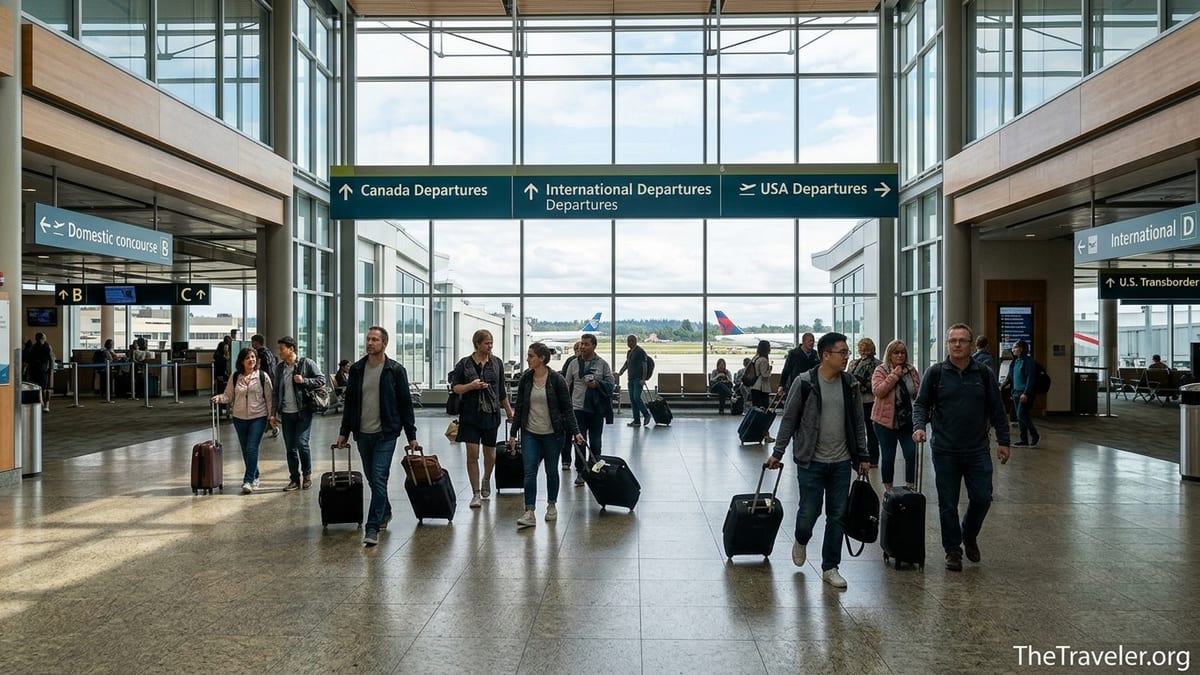
Understanding YVR’s Overall Layout
YVR’s main terminal is essentially one large building with three airside zones: Domestic (mostly B and C gates, with some domestic flights using D), International (primarily D gates), and U.S. transborder (E gates). You can think of it as a long spine with branches. Domestic is on one side, International is on the other, and the U.S. transborder pier extends off the International side. All three are physically connected, which is why many connections at YVR do not require a bus or shuttle between terminals.
At street level, you will see clearly signed entrances for Domestic and International. Both lead into the same overall structure and are linked by a central Link Building, which also houses the Canada Line station access and the Fairmont Vancouver Airport hotel. Many travelers only realize there is a single main terminal when they walk from the Domestic food court to the International side in a few minutes without ever going outdoors.
Most passengers will never see YVR’s smaller South Terminal, which handles regional and seaplane flights and sits a short shuttle ride away on Sea Island. For the purposes of this layout guide, focus on the main terminal, because that is where the majority of domestic, international, and U.S. flights arrive and depart, and where the Canada Line station is located.
The terminal is organized vertically as well as horizontally. Departures and check in are on upper levels, while Arrivals and baggage claim are on Level 2. The highest public level, Level 3, is where you will walk between Domestic and International areas and access security screening, most shops, and the pedestrian bridge to the Canada Line station.
Domestic Terminal: Check In, Security, and Gates B & C
The Domestic side of the main terminal serves flights within Canada. Major carriers here include Air Canada and WestJet, along with airlines such as Porter, Flair, Air Transat, and regional operators. If you are flying to cities like Toronto, Calgary, Edmonton, Victoria, Kelowna, or Whitehorse, you will almost always use the Domestic entrance and B or C gates, with occasional domestic departures using gates configured as part of the D pier.
Departing domestic passengers typically arrive at curbside on Level 3. From the drop off zone, automatic sliding doors lead directly into the check in halls, where airlines each occupy distinct rows of counters and self-service kiosks. Overhead digital signs tell you exactly which entrance to use for domestic flights with your airline, so a traveler flying Air Canada to Montreal will generally enter near the Air Canada check in zone, while someone flying WestJet to Winnipeg heads to the WestJet counters a short walk away.
After check in and baggage drop, you proceed to the Domestic security screening area, which is clearly marked with large signage toward the center of the Domestic hall. Wait times can vary, but mornings and late afternoons on weekdays are often the busiest. Once through security, you emerge airside into the Domestic concourses. B gates are generally to one side and serve many WestJet and other carriers, while C gates tend to be used heavily by Air Canada and some additional domestic and “swing” flights that might also use international-capable gates.
Within the Domestic concourse you will find amenities like the Air Canada Maple Leaf Lounge for eligible passengers near the C gates, multiple cafes, quick-service restaurants, and convenience shops. The Domestic pier is relatively linear, so walking from, say, B14 to C42 is mostly a straight, flat walk along well marked corridors with moving walkways in busier stretches. Allow around 10 to 15 minutes if you have a connection from a far B gate to a far C or D gate.
International Terminal: D Pier and Shared Domestic Use
The International side of YVR handles long haul flights to Europe, Asia, Mexico, the South Pacific, and other overseas destinations, as well as some domestic services that use the same modern D pier. Airlines here include Air Canada’s international operations along with carriers such as Cathay Pacific, Japan Airlines, Lufthansa, British Airways, Philippine Airlines, and a rotating group of seasonal operators. If your boarding pass shows a D gate for a non U.S. destination, you will depart from the International pier.
Check in for international flights also takes place on Level 3, but on the International side of the main terminal. Enter via the International doors and you will find another large hall of check in counters, often grouped by airline alliance or handling agent. For example, Air Canada’s international counters occupy a central zone, while carriers like Cathay Pacific or British Airways share space with other overseas airlines managed by the same ground handlers.
From check in, you follow overhead signs to International security screening. Once past security and outbound Canadian exit checks if applicable, you arrive into the expansive International departures hall. This area is known for its Pacific Northwest design touches, including Indigenous art installations and a central water feature and aquarium. D gates fan out from this hall in a pier layout, with larger wide-body gates farther along for aircraft like Boeing 777s and Airbus A350s.
Some domestic flights also depart from gates equipped for international use and may be labeled C or D depending on configuration. For instance, an Air Canada domestic flight to a busier Canadian city may leave from a gate that sometimes handles overseas arrivals. You will still follow your boarding pass and terminal screens, but walking routes remain connected, and moving between a domestic C gate and an international D gate is simply a matter of following signs along the pier.
U.S. Transborder Area: Preclearance and E Gates
The U.S. transborder zone at YVR is a dedicated area for flights to the United States, using the E gates. It operates with U.S. Customs and Border Protection preclearance, which means you complete U.S. immigration and customs formalities in Vancouver before boarding your flight. When you land in cities like Seattle, Los Angeles, San Francisco, Denver, Chicago, or New York, you arrive as if from a domestic U.S. flight and usually walk straight to baggage claim or your connection.
For departing U.S. flights, you check in either on the Domestic or International side depending on your airline, but then follow the clearly marked signs for “USA Departures” toward the transborder security and preclearance area. You first clear security screening, then proceed to U.S. immigration booths and kiosks. Processing times fluctuate, but mid morning and early afternoon can be particularly busy when multiple flights to major hubs leave within a short window, so many airlines recommend arriving at least three hours before departure.
Once past U.S. preclearance, you enter the E gate concourse. This area has its own selection of shops, bars, and grab and go food outlets, plus lounges such as the Air Canada Maple Leaf Lounge for transborder passengers. The layout is straightforward, with a central spine and gates branching off. Walking times between the first and last E gates are usually under 10 minutes, even at a relaxed pace.
Connecting from an international or domestic flight to a U.S. transborder flight usually requires you to leave one secure area and re enter through the transborder security and preclearance zone, unless you are on a specific through-checked in transit program arranged by your airline. For example, if you fly from Tokyo to Vancouver with a same day connection to Los Angeles on a single ticket with Air Canada, signs and staff will direct you to the correct corridor or in transit connection route after you clear Canadian entry formalities or designated transfer processing.
Arrivals Levels, Baggage Claim, and Meeting Points
All main terminal arrivals at YVR, whether domestic, international, or U.S. transborder, funnel down to Level 2, where baggage claim and public arrivals halls are located. Domestic arrivals emerge into their own baggage hall with several carousels dedicated to flights within Canada. International and U.S. arrivals follow separate corridors through border control, then reach baggage claim areas configured for their streams and finally exit into the International Arrivals public hall.
On the domestic side, arriving passengers step off the aircraft and follow overhead “Baggage Claim” and “Arrivals” signs down escalators or ramps to Level 2. You will pass a row of washrooms and often a small food or coffee outlet before the carousels. Overhead screens list flight numbers and carousel assignments. Recently updated baggage information displays also show estimated times until bags appear, which can help you decide whether to step away briefly to a washroom or stay close to the belt.
International arrivals typically route through Canada Border Services Agency processing before reaching baggage claim. You will scan your passport at a kiosk or present an arrival form, speak with a border services officer, and then proceed to your assigned carousel. After collecting your bags, you may need to pass your luggage through a final customs checkpoint or simply exit through the green channel, depending on declarations and current procedures. The public waiting area for international arrivals is just beyond the exit doors from customs, where family and friends often stand behind barriers watching sliding doors where passengers emerge.
If someone is meeting you, it is useful to specify whether you will come out at Domestic or International Arrivals, since they are in different ends of Level 2 but connected by an internal corridor. For example, a traveler arriving from Toronto will exit in the Domestic Arrivals hall near the domestic taxi and rideshare stands, while a traveler from London or a U.S. city will appear in the International Arrivals area closer to the hotel entrance and certain tour bus and cruise line desks. Both halls have seating, information desks, and access to elevators and escalators up to departure level and the Canada Line.
Canada Line Station and Ground Transport Connections
The Canada Line SkyTrain provides a direct rail link between YVR and downtown Vancouver as well as central Richmond. The YVR Airport station sits between the Domestic and International terminals, accessed from the Link Building on Level 3. When you exit security or baggage claim, follow signs for “Canada Line” or “Train to City” and you will be guided across enclosed walkways with clear views of the airfield.
From Domestic Departures, you typically walk toward the central area of Level 3, passing food options and shops until you see signage pointing to the escalators and elevators up to the Link Building. From the International side, you do the same in reverse, walking toward the middle of the terminal. The entire walk from a mid range gate area to the station entrance is usually between 5 and 10 minutes for most travelers, slightly longer if you are coming from the far end of a pier or pushing heavy luggage.
At the station concourse, ticket machines sell single use tickets and day passes, and fare gates control access to the platforms. Fares are set by TransLink and include an additional airport surcharge for some eastbound trips departing from Sea Island stations, which will appear automatically in the fare shown on the ticket machine. Trains typically run every 6 to 12 minutes during the day, and the ride to downtown Vancouver’s Waterfront Station takes around 25 minutes, which is often faster and more predictable than driving in traffic.
Other ground transport options are available from Level 2 outside the Arrivals halls. Dedicated taxi stands serve licensed cabs with posted approximate fixed rates to central areas, while rideshare services such as Uber and Lyft use designated pick up zones signposted near the terminal exits. Scheduled coach services, hotel shuttles, and cruise ship transfers also use marked bays. If you are connecting between the Canada Line and a hotel shuttle or tour bus, it is often easiest to meet at the International Arrivals curb, which is close to the Link Building elevators.
Walking Routes and Typical Connection Paths
Because YVR’s main terminal combines domestic, international, and U.S. transborder areas under one roof, many walking routes are straightforward and intuitive. The key is to follow the sector signs on overhead boards: “Canada,” “International,” and “USA Departures.” These color coded cues appear immediately after you clear security or enter from curbside, and they continue at each junction, so you rarely need to consult a paper map unless you prefer it.
For a simple domestic to domestic connection, such as flying from Victoria to Vancouver and then from Vancouver to Edmonton, you will usually remain entirely on the Domestic side. After disembarking your first flight, follow “Connections” or “Gates” signs rather than “Baggage Claim” if your bags are checked through and you already have boarding passes. You will re enter the departures concourse near other B or C gates and then walk to your onward gate. Walking time for this kind of connection is often under 15 minutes if your gates are in the same concourse.
Domestic to international connections, for example Vancouver to Toronto to London replaced with Vancouver to Calgary to London now connecting at YVR, typically involve a short intra terminal walk. You might arrive at a C gate and follow signs for “International Transfers” or simply proceed to the D pier. In some cases, you will pass through a dedicated corridor or checkpoint that separates domestic and international flows, especially if you are moving into a secure international area. Allow at least 60 to 90 minutes for these connections if you need to change sectors and potentially pass through additional screening.
International or domestic arrivals connecting onward to the U.S. transborder area will follow distinct “USA Connections” signage. Depending on your airline and ticket, you may clear Canadian entry formalities, collect your bag, and then proceed upstairs to check in and U.S. preclearance, or use an in transit route that keeps you within secure corridors before entering the U.S. zone. These walking routes can feel longer because they include time in processing queues, so building in at least 2 hours for an international to U.S. connection is prudent, especially during busy travel seasons.
The Takeaway
Vancouver International Airport’s integrated layout makes it easier than at many major hubs to move between domestic, international, and U.S. transborder flights, as long as you understand the basic structure of the terminal. Domestic operations center on B and C gates, international flights radiate from the D pier, and U.S. flights depart from their own E gate zone with preclearance. All three share a common building with departures on upper levels, arrivals and baggage on Level 2, and the Canada Line station linked through the central Link Building.
For most travelers, the crucial skills at YVR are reading the sector signs, allowing realistic time for border and security processes, and using the Canada Line for quick transfers to and from downtown Vancouver. Whether you are arriving from a short hop within British Columbia or a long haul from Asia or Europe, knowing where you will exit to baggage claim, which arrivals hall you will meet your ride in, and how to walk to your next sector can turn a potentially stressful connection into a smooth, predictable part of your journey.
FAQ
Q1. How long does it take to walk between the Domestic and International areas at YVR?
For most travelers, walking between the core Domestic and International departure halls on Level 3 takes around 5 to 10 minutes at a normal pace, using the central Link Building as the reference point.
Q2. If I land on a domestic flight and connect to an international flight, do I have to go through security again?
In many cases you remain within the secure area and follow “International Connections” signs, but some routings or operational changes can require an additional screening. Always follow the posted signs from your arrival gate and the instructions printed on your boarding pass.
Q3. Where is baggage claim located at Vancouver International Airport?
All baggage claim areas are on Level 2 of the main terminal. Domestic flights use the Domestic baggage hall, while international and U.S. arrivals follow border control procedures before reaching their own carousels and then exiting into the International Arrivals hall.
Q4. How do I get from YVR to downtown Vancouver on public transit?
Take the Canada Line SkyTrain from YVR Airport station, which is accessed from the Link Building between the Domestic and International terminals. Trains usually run every few minutes and reach downtown’s Waterfront Station in roughly 25 minutes.
Q5. Is the U.S. transborder area separate from the rest of the terminal?
Yes. The U.S. transborder E gates form a dedicated zone that you enter only after clearing security and U.S. Customs and Border Protection preclearance. Once you are in this area, you cannot return to the general departures zones without assistance from airport staff.
Q6. Where should drivers pick up arriving passengers at YVR?
Drivers can use the signed pick up lanes on Level 2 outside either Domestic or International Arrivals. It helps to agree in advance whether the passenger will exit from Domestic or International Arrivals so the driver can wait at the correct curb.
Q7. Can I walk between terminals without going outside?
Within the main terminal, Domestic, International, and U.S. transborder sectors are all connected indoors. You can walk between them on Level 3 or through secure corridors, depending on whether you are before or after security.
Q8. Do I always need to collect my luggage at YVR during a connection?
It depends on your routing and airline. On many purely domestic connections your bag is checked through automatically. On international or U.S. connections, you may be required to collect and recheck your luggage after customs. Check with your airline at check in.
Q9. How accessible is YVR for travelers with limited mobility?
The terminal has elevators, ramps, accessible washrooms, and clearly marked assistance points at curbside and within the building. Wheelchair assistance can be arranged through your airline in advance or through airport help phones near the entrances.
Q10. Is the South Terminal connected to the main YVR terminal by walkway?
No. The South Terminal, which handles many regional and seaplane flights, is separate from the main terminal and reached by a short shuttle or road transfer rather than an indoor walkway.