


Arriving at Venice Marco Polo Airport can feel magical and confusing at the same time. You step off the plane, smell the lagoon in the air and then face a maze of options: water bus, land bus, water taxi, land taxi, private transfer. This guide walks you through every realistic way to get from the airport to Venice in 2026, with approximate costs, journey times, luggage pros and cons, plus concrete examples to help you decide what works best for your itinerary and budget.
Get the latest updates straight to your inbox!
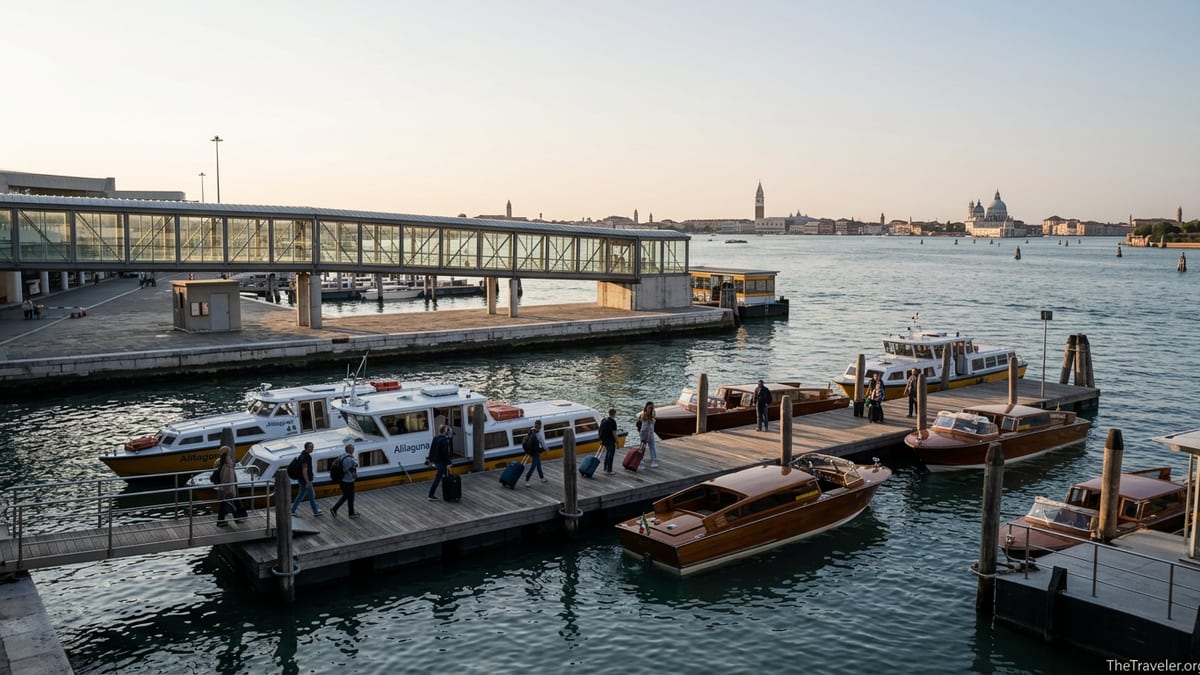
Understanding Your Route: Water vs Land
Venice Marco Polo Airport sits on the edge of the lagoon, about 13 kilometers from Venice’s car-free historic center. You have two fundamentally different ways to reach the city: across the water directly from the airport dock, or by road to Piazzale Roma, the final point cars and buses can reach. From there, you either walk or switch to a public vaporetto (water bus) or water taxi to continue along the canals.
Choosing between water and land usually comes down to three factors: where your hotel is, how much luggage you have, and your budget. A couple staying near San Marco with two carry-ons might happily spend a bit more for a scenic Alilaguna water bus ride straight to the basin in front of St Mark’s. A family of five staying in Cannaregio with several large suitcases may be better off taking an express bus to Piazzale Roma then a short vaporetto ride, which keeps costs under control and avoids lifting bags in and out of boats multiple times.
Travel time is not always as obvious as it looks. A water taxi from the airport dock to a canal-side hotel near Rialto can take about 25 to 30 minutes on the water, but you should add at least 10 to 15 minutes to walk from Arrivals to the docks, plus any waiting time for other groups to board if you are using a shared service. A direct ATVO or ACTV bus to Piazzale Roma typically takes about 20 to 25 minutes in normal traffic, but you must then transfer to a vaporetto and walk to your accommodation.
Because Venice’s transport network is fragmented between several companies, no single ticket covers everything from the airport directly to a random address. In practice, you will often use one provider for the airport segment (Alilaguna, ATVO, ACTV, taxi) and another for local movement inside Venice (ACTV vaporetti, walking or private water taxis). Keeping this in mind will help you compare realistic “door to door” experiences rather than only the advertised journey time.
Alilaguna Water Bus: Scenic Middle-Ground Option
Alilaguna is the main public water bus operator connecting Venice Marco Polo Airport with key stops around the lagoon. From the Arrivals hall, you follow signs to “Water Transport,” walk through a covered corridor and across a short outdoor section to the airport pier. Here, Alilaguna boats depart on several colored lines that typically include stops at Murano, Fondamente Nove, the Lido and central Venice areas like San Marco and Zattere, depending on the line and season.
As of mid 2026, a one-way adult ticket between Marco Polo and Venice on Alilaguna is typically in the mid-teens of euros, while returns are priced a little lower than two singles. Children under six usually travel free when accompanied by an adult, and luggage is included within defined limits for number and size of bags. The company regularly adjusts its fares, so expect something in the 15 to 18 euro range for a single trip, and treat any lower prices as a pleasant surprise rather than a guarantee.
Journey times depend heavily on the line and where you get off. A typical ride from the airport to San Marco on a stopping service can take 60 to 75 minutes, while routes terminating earlier, such as at Fondamente Nove or near the Arsenale, may be closer to 45 to 60 minutes. Boats can be busy in peak season, especially on weekends in May through September, when flights are full of cruise passengers and summer visitors. Seats are mostly on simple benches with limited external space, so expect a functional, not luxurious, experience.
For many visitors, Alilaguna hits a sweet spot between price and atmosphere. Imagine a solo traveler landing at 10:00 in the morning, staying at a hotel near San Zaccaria with only a cabin case and a backpack. Paying around 17 euros for a single Alilaguna ticket that drops them a three-minute walk from the hotel, with a lagoon cruise included, is often more appealing than 110 euros for a private water taxi or juggling buses and vaporetti. The main downsides are slower travel and less flexibility if your accommodation is far from an Alilaguna stop.
ACTV and ATVO Buses: The Fastest Budget Route
For travelers focused on simplicity and cost, the direct buses between Marco Polo Airport and Piazzale Roma are usually the best option. Two main operators run this route: ACTV, the local public transport company, and ATVO, a regional coach operator with an “Airlink” or “Express” service. Both depart from the bus stands just outside the terminal; the walk from Arrivals rarely takes more than five minutes.
Typical one-way adult tickets in mid 2026 are around 10 euros per person. ATVO runs express coaches that go non-stop from the airport to Piazzale Roma in about 20 to 25 minutes in normal conditions. ACTV services, such as Linea 5 “Aerobus” or other airport routes, may share that approximate journey time but can have more intermediate stops, especially during commuter periods. Both companies allow normal suitcases in the luggage hold or on board without extra fees, though extremely oversized items may be refused or charged.
The main trade-off with the buses is that they only take you as far as Piazzale Roma. From there, you must switch to a vaporetto or walk. For example, a couple staying in Dorsoduro near the Accademia bridge might ride an ATVO coach to Piazzale Roma, then take ACTV vaporetto line 1 down the Grand Canal to Accademia, before a five-minute walk to their guesthouse. Door-to-door, this might take about 45 to 60 minutes for around 20 euros per person, compared with roughly the same time and cost if they had taken Alilaguna to Zattere and walked from there.
Payment methods have become more convenient. ACTV buses now accept contactless bank cards with tap-in and tap-out validation, including a dedicated airport fare. ATVO still widely uses traditional paper tickets bought from machines, kiosks or the company desk inside the terminal, but some services also accept contactless on board. To avoid confusion in the arrivals crowd, many travelers buy their bus ticket immediately after baggage reclaim from clearly signed machines or desks, then walk straight out to the bus bays following the “Bus” signs.
Land Taxi and Private Car Transfers: Comfort to Piazzale Roma or Mestre
Land taxis at Marco Polo Airport operate from a dedicated rank just outside the arrivals area. They are run by a licensed cooperative, typically using standard four-door cars or larger vehicles for groups. In 2026, the fixed fare for a taxi from Marco Polo to Mestre is around the mid-30 euros mark, while a ride to Piazzale Roma in Venice usually falls in the 40 to 50 euro range depending on time of day, luggage and traffic. These figures can fluctuate slightly, but they give a realistic starting point.
For a group of four with two or three large suitcases, a land taxi can be cheaper and far more convenient than buying four separate bus tickets. Picture a family arriving with a toddler and grandparents: instead of lifting luggage into an express bus and then down again at Piazzale Roma, they might pay about 45 euros for a direct taxi that stops right by the square. From there, if their hotel is near the train station, they could walk across the Calatrava bridge in about ten minutes, pushing a stroller and rolling luggage.
Private car transfers booked in advance provide a similar experience with a named driver waiting in the arrivals hall, often holding a sign. Prices are usually slightly higher than picking up a regular taxi at the rank, but you gain predictability and language support. For example, a couple landing late at night might pay 60 to 70 euros for a pre-booked Mercedes minivan that takes them directly to Piazzale Roma, without queueing or navigating ticket machines after a long flight.
The main limitation of land taxis and private cars is that they cannot enter Venice beyond Piazzale Roma or the nearby Tronchetto parking island. If your hotel is deep inside the historic center and not close to a ferry stop, you will still need to transfer to a vaporetto or arrange a water taxi from Piazzale Roma. Travelers with mobility issues sometimes arrange a combined transfer: car to Piazzale Roma and pre-booked water taxi from the nearby canal to their hotel’s private jetty, if available.
Private Water Taxi: Fastest and Most Atmospheric Door-to-Door
Private water taxis are the most iconic way to arrive in Venice. Sleek wooden or fiberglass boats with enclosed cabins and open rear decks wait at the airport’s water taxi pier, next to the Alilaguna docks. From the arrivals hall, you follow the same “Water Transport” signs, walk the ten or so minutes to the pier, and confirm your booking at the appropriate desk or with the boat captain directly.
In 2026, a typical private water taxi from Marco Polo to a central Venice address costs somewhere around 110 to 150 euros for the boat, not per person, within standard daytime hours. Night trips and journeys to more remote locations can be more expensive. Most boats carry between six and ten passengers with luggage, though if you have multiple large suitcases or oversized items, the operator may require a larger or second boat at extra cost.
The major strengths of a private water taxi are speed and convenience. The actual ride to a hotel near Rialto or San Marco can be as short as 20 to 30 minutes, and if your hotel has its own jetty, you step off almost directly into the lobby. Real-world examples are common: a group of four friends sharing a 140-euro fare effectively pays 35 euros each for a private boat that drops them three steps from their guesthouse door, which compares favorably to four Alilaguna singles plus a walk with bags through busy alleys.
Shared water taxis, organized through some transfer platforms and agencies, offer lower per-person prices but can involve unpredictable waiting times while the operator groups passengers with similar arrival times and destinations. In practice, travelers sometimes report waiting 30 to 40 minutes at the pier before departure, which can cancel out the speed benefit. If you value certainty and are arriving late at night or in bad weather, paying for a dedicated private boat is usually the more reliable choice.
Private Transfers and Hotel-arranged Services
Many Venice hotels, especially four and five-star properties around San Marco, the Grand Canal and the Lido, offer to arrange private transfers from Marco Polo. These can combine a land limousine or van from the airport to Piazzale Roma or Tronchetto and a reserved water taxi from there to the hotel’s pier. Some premium hotels partner with specific operators so that a single booking covers both legs with coordinated timing.
Prices for hotel-arranged private transfers are often higher than organizing a car and water taxi separately, but you are paying for coordination and peace of mind. For instance, a couple staying at a luxury property near St Mark’s might pay 200 euros for a seamless transfer that starts with a driver meeting them at the arrivals gate, walking them to a waiting car, then escorting them to a private boat at Tronchetto, with luggage handled at every step. For honeymooners or travelers with mobility limitations, that kind of smooth experience can be worth the premium.
Mid-range and boutique hotels sometimes work with more budget-friendly partners, offering “shared luxury” arrangements. A typical scenario might involve a minivan shuttle from the airport to a central pick-up pier, where guests transfer to a shared but comfortable water taxi that stops at a handful of hotels in the same area. Per-person prices in such setups can sit between Alilaguna and a full private water taxi, with better luggage handling and less confusion than navigating everything alone.
When considering hotel-arranged transfers, ask for very clear written details: whether the price is per person or per boat, which pier they use, what happens if your flight is delayed, and whether surcharges apply for large luggage or night arrivals. This information helps you compare their offer with booking a standard private water taxi or relying on bus plus vaporetto combinations.
Comparing Options: Cost, Time and Luggage Scenarios
To choose the best option for your own trip, it helps to compare realistic door-to-door scenarios rather than individual segments. Consider a solo traveler with a backpack staying in Cannaregio near Fondamente Nove. Taking Alilaguna directly from the airport to Fondamente Nove for around 17 euros and then walking ten minutes to the guesthouse might take about an hour. The bus plus vaporetto alternative would involve a 10-euro bus to Piazzale Roma, a 9.50-euro vaporetto ticket along the canal and then a shorter walk, likely totaling similar time at slightly lower cost. The difference is whether you prefer a lake-like cruise or a more urban bus plus canal ride.
Now consider a family of four with two large suitcases and two cabin bags, staying near the train station at Santa Lucia. A land taxi from the airport to Piazzale Roma for about 45 euros, followed by a ten-minute walk over the bridge to the hotel, might be the simplest, most economical option. Taking ATVO or ACTV buses would cost around 40 euros in total for four adults, but require handling luggage on and off a crowded bus. A private water taxi directly to a canal door could easily exceed 120 euros, and would not save much time compared with taxi plus walk in this precise location.
For a couple celebrating an anniversary at a San Marco boutique hotel with a private jetty, a private water taxi often justifies its cost. They might pay 130 euros for a direct, 25-minute cruise across the lagoon, gliding under low bridges and docking almost inside the hotel. Bus plus vaporetto could cost them roughly 40 euros in total and take about an hour with two transfers. Alilaguna would sit somewhere in between on both time and price, but still require a walk of five to ten minutes along busy alleys, which might not have the same romance as stepping off the boat at the hotel’s own landing.
Luggage handling is a recurring theme. Alilaguna and public vaporetti are not designed for huge suitcases, and stairs at many piers can be slippery or narrow. Buses have luggage holds, but boarding and disembarking with bags in a crowd can be stressful. Private car and water taxi services generally involve more help from drivers and boatmen, which is worth considering if you are traveling with elderly relatives or small children, or if you have mobility issues yourself.
Practical Tips for Tickets, Night Arrivals and Accessibility
Ticket buying at Marco Polo is more straightforward if you know exactly which mode you are taking before you arrive. For buses, you can usually buy tickets from machines in the arrivals hall, at staffed counters or sometimes directly from the driver using cash or cards. For Alilaguna, tickets are available at the company desk in the arrivals area and again at the pier, as well as through official partner kiosks. Private taxis, both land and water, are normally paid directly to the driver or captain, increasingly by card as well as cash.
Late-night and very early-morning arrivals require special planning. Buses run well into the night but not always through to dawn, and Alilaguna services may stop by late evening depending on the line and season. If your flight lands around midnight and you expect to clear baggage after 00:30, it is essential to check in advance whether your chosen mode still operates at that hour. Many travelers landing after midnight choose a pre-booked private water taxi or a land taxi plus late vaporetto, accepting the higher cost in exchange for avoiding long waits or the risk of being stranded.
For travelers with reduced mobility, the bus plus vaporetto combination is often easier than pure water routes from the airport. The airport terminal and bus boarding area are equipped with ramps and elevators. Piazzale Roma and Santa Lucia station also have step-free routes to the vaporetto piers, though boats themselves still involve a step to board. Private water taxi companies can sometimes provide low-step boats or additional assistance if requested in advance. When booking, clearly explain any mobility aids you use and ask whether your chosen pier and hotel jetty are accessible.
A final practical point is Venice’s day-tripper entry fee on certain peak days between April and July 2026. This tourist access charge is collected by the municipality and is independent of transport tickets. Paying for Alilaguna or a bus does not exempt you from the city’s own fee if it applies to your date and circumstances. Check whether you need to register and pay the access contribution online before travel, especially if you are coming only for a day trip without overnight accommodation.
The Takeaway
There is no single “best” way to get from Venice Marco Polo Airport to Venice. Instead, there are several good choices, each tuned to different budgets, itineraries and expectations. Alilaguna offers a scenic, mid-priced cruise from the airport right into the lagoon heart of Venice, ideal for light packers whose hotels sit near one of its stops. ACTV and ATVO buses provide the fastest and cheapest route to Piazzale Roma, especially attractive for budget-conscious visitors and those staying near the train station or comfortable using vaporetti.
Land taxis and pre-arranged car transfers deliver flexibility and comfort up to the city gate, particularly good value for families or small groups with heavy luggage. Private water taxis remain the premium, cinematic arrival experience: the quickest true door-to-door option for canal-side hotels and an unforgettable way to see the city for the first time, at a price that makes the most sense when shared between several travelers.
Whichever option you choose, plan the route from the airport not just to Venice, but to your specific hotel door, including any final walking segment. Think in terms of total time, number of transfers, and how often you will need to lift your luggage. With that mindset, the choice between Alilaguna, buses, taxis and private transfers becomes much clearer, and your first hour in Venice turns into part of the adventure rather than an obstacle course.
FAQ
Q1. What is the cheapest way to get from Venice Marco Polo Airport to Venice?
The cheapest realistic options are the ACTV or ATVO buses to Piazzale Roma, which in 2026 typically cost around 10 euros per person one way, then either walking or using a standard vaporetto ticket to reach your final destination.
Q2. Is the Alilaguna water bus worth it compared to the bus plus vaporetto?
Alilaguna is usually worth it if your hotel is near one of its stops and you value a direct, scenic lagoon ride. It costs more than the bus alone and usually takes longer, but it can save a transfer at Piazzale Roma and offers a memorable arrival by water.
Q3. How much does a private water taxi cost from the airport into Venice?
In 2026, a standard private water taxi from Marco Polo Airport to a central Venice hotel often costs between about 110 and 150 euros per boat in daytime, with surcharges for night trips, remote locations or extra luggage.
Q4. Can I pay for buses and boats with a contactless bank card?
Yes, ACTV increasingly supports tap-in and tap-out with contactless bank cards on urban buses and vaporetti, including a specific airport fare, while ATVO and Alilaguna also accept cards at ticket offices and many on-board terminals, though carrying a backup payment method is still wise.
Q5. Which option is best if I have heavy or bulky luggage?
For heavy or bulky luggage, a land taxi or private car to Piazzale Roma is often easiest, sometimes combined with a private water taxi to your hotel jetty. Public buses and Alilaguna can handle normal suitcases, but boarding and disembarking with very large bags can be awkward in crowds.
Q6. What should I do if my flight arrives very late at night?
If you land close to or after midnight, check timetables carefully as some bus and Alilaguna services stop late evening. Many travelers in this situation pre-book a private water taxi or land taxi so they have guaranteed transport waiting, even if the flight is delayed.
Q7. Does any ticket include both the airport transfer and vaporetto rides in Venice?
A few combined products exist through Venice’s official tourist platforms that bundle an airport bus transfer with time-limited ACTV water bus access, but most regular tickets are separate. Always check the small print, as Alilaguna and ACTV are distinct operators with separate fare systems.
Q8. How long does it take to get from the airport to central Venice?
Expect roughly 20 to 25 minutes by express bus to Piazzale Roma plus any onward vaporetto or walking, around 45 to 75 minutes by Alilaguna depending on the line and stop, and about 25 to 30 minutes on a direct private water taxi from the airport pier to a central canal-side hotel.
Q9. Is it better to pre-book transfers or arrange everything on arrival?
Pre-booking is strongly recommended for private water taxis and car transfers, especially in high season or for late-night arrivals. For buses and Alilaguna, buying tickets on arrival is usually fine, though purchasing online in advance can save a few minutes and help you budget.
Q10. How do I choose between staying in Mestre and Venice itself for airport access?
Staying in Mestre makes airport transfers slightly cheaper and simpler by land taxi or bus, but you lose the experience of waking up inside the lagoon city. If budget allows, most short-term visitors prefer to stay in Venice itself and accept a slightly longer or more complex airport transfer for the unique atmosphere.