


Flying private in Europe is no longer reserved for heads of state and celebrities. Operators like GlobeAir have built their entire business around making short‑haul private jet travel more accessible, especially for time‑poor executives and affluent leisure travelers hopping between European cities. Still, chartering a jet remains a major purchase, and understanding what a GlobeAir flight really costs is essential before you start plugging routes into a booking form. This guide breaks down how GlobeAir prices its flights, what typical trips cost in the real world, and the tricks frequent travelers use to keep budgets under control.
Get the latest updates straight to your inbox!
Who GlobeAir Serves and Why Its Pricing Looks Different
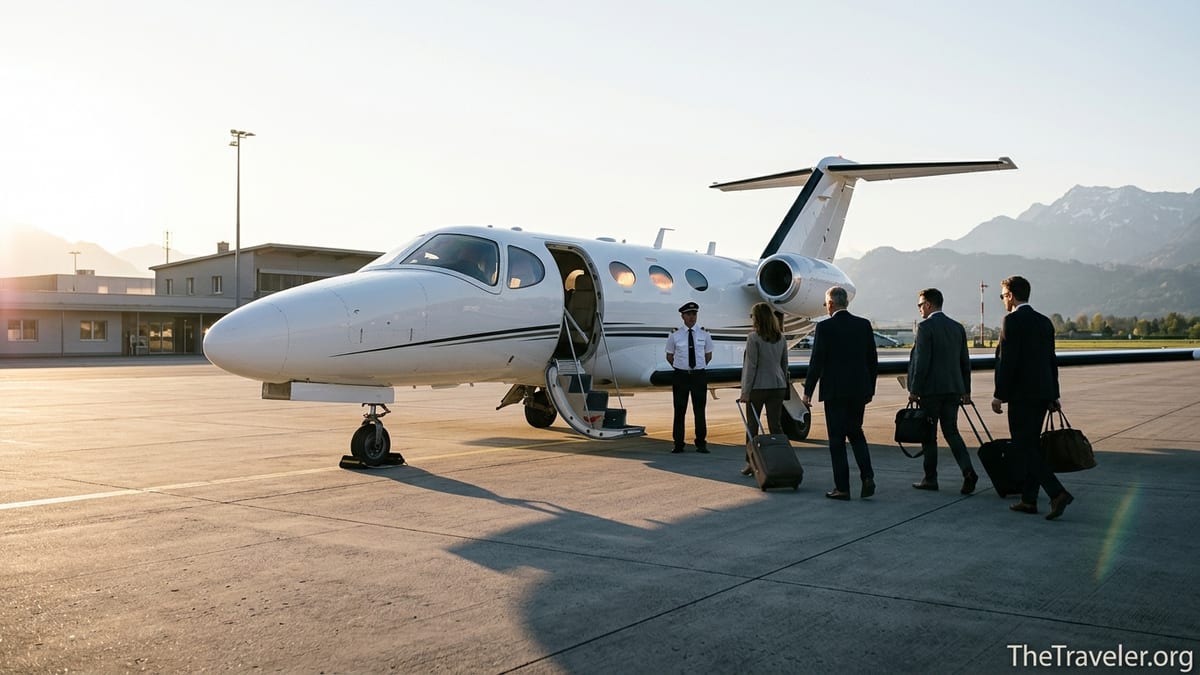
GlobeAir is a niche player with a very focused model. Based in Austria, it operates what is widely reported as the world’s largest fleet of Cessna Citation Mustang very light jets, seating up to four passengers plus two pilots. The company is designed around fast, point‑to‑point hops across Europe rather than long‑haul or ultra‑luxury cabin experiences. This specialization shapes how its pricing works in practice.
Because GlobeAir owns and operates a homogeneous fleet, it does not price like a broker that pulls in dozens of different aircraft types. Instead, it sells the efficiency of one aircraft class on a large scale. The Mustang is comparatively economical to operate, so GlobeAir can undercut the hourly rates of larger light jets with six or seven seats, particularly on routes under about two hours where speed and runway performance matter more than cabin size.
For travelers, the result is a pricing profile that often looks attractive for short business city pairs such as Zurich to Milan, Paris to Geneva or London to Amsterdam. On these runs, a Mustang is typically one of the lowest‑cost jet options that still offers a true private cabin and the ability to use smaller airports closer to city centers. GlobeAir builds its marketing around this “air taxi” idea, where you pay a premium compared with commercial business class, but often less than you would expect for what is still a fully private aircraft.
Importantly, GlobeAir focuses almost exclusively on Europe and nearby regions reachable within the Mustang’s range, so its pricing model is optimized for those distances. Travelers expecting long‑haul Gulfstream or Global Express type pricing will find a very different, more compact cost structure, though still firmly in the premium travel category.
How GlobeAir Builds a Fare: The Key Cost Components
When you receive a GlobeAir quote, the figure is not simply “distance times price per mile.” Behind the scenes it reflects a blend of fixed and variable costs, wrapped into one total charter price. Although GlobeAir does not publicly publish a universal per‑hour rate for all flights, industry data on Citation Mustang operations and comparable quotes suggest that the core flying cost typically sits in the range of several thousand euros per flight hour for the whole aircraft, not per passenger.
That base flying cost covers fuel, pilot salaries, maintenance reserves, insurance, and a margin for the operator. To this, GlobeAir’s algorithms add positioning time if the aircraft has to fly empty to collect you, airport and handling fees that vary sharply between airports, and sometimes overnight or de‑icing charges in winter. For example, departing from a major hub with high handling costs will push the total up compared with using a smaller secondary airport 40 minutes away.
The quote also reflects how efficiently the operator can use its fleet. GlobeAir’s homogeneous Mustang fleet lets it reposition aircraft strategically, which helps keep dead‑leg time down. If your requested route happens to line up with where a jet already needs to be, or with a popular corridor where they have fixed‑rate offers, you may see more favorable pricing than on a bespoke, one‑off routing to a remote airfield.
From the customer’s perspective, the important point is that GlobeAir sells flights as a fixed all‑in price for the aircraft, not as a menu of line items. You will see a total for the trip, sometimes broken down by outbound and return sectors. Dividing that number by the number of passengers and the flight time is a useful way to sense check whether you are getting fair value compared with other operators and with premium commercial tickets on the same route.
Real‑World Examples: What Typical GlobeAir Routes Cost
While prices vary with demand, dates, and airport choices, published examples and comparable Mustang charters give a realistic feel for what a GlobeAir itinerary might cost. A classic business route is London to Paris, which many European travelers fly commercially in business class. A light jet such as a Citation Mustang on this sector often prices in the low five‑figure euro range for a one‑way flight, once all airport fees and positioning are factored in. Travelers who have compared quotes from multiple operators report ranges roughly between about 11,000 and 17,000 euros for a short cross‑Channel flight on a four to six seat jet, depending on timing and availability.
Summer leisure routes can be more expensive, particularly to Mediterranean holiday hotspots with strong seasonal demand. GlobeAir itself showcases popular summer city pairings operated with the Mustang and partner aircraft, including trips from Paris or London to Palma de Mallorca. Published promotional tables indicate indicative prices deep into five figures on busier dates. On a peak August weekend, for instance, a one‑way private flight from London to Palma on a small jet may sit in the mid‑teens of thousands of euros, while Paris to Palma on a similar aircraft type often falls within a comparable band.
Shorter intra‑Alpine or regional hops highlight GlobeAir’s cost structure in a different way. Routes such as Zurich to Nice or Milan to Geneva can be under an hour of flight time on a Mustang, which keeps the pure flying cost down. However, once airport and handling fees are added, the total charter price still typically lands comfortably above 5,000 euros even on low‑season weekdays, with busier dates quickly climbing higher. The real economy emerges when three or four passengers share the aircraft. Split four ways, a 7,000 euro flight from Zurich to Nice becomes 1,750 euros per person, suddenly far closer to last‑minute flexible business class tickets on the same route.
It is also worth noting that GlobeAir sometimes offers attractive one‑way prices when a flight can be paired with an existing schedule or when the company is actively promoting a city pair. Travelers who are flexible on departure times and days can occasionally secure a Mustang for significantly less than a customized on‑demand itinerary, especially outside ultra‑peak holiday periods.
Empty Legs, Fixed Routes and Other Ways to Pay Less
One of the most powerful ways to reduce GlobeAir costs is to tap into empty legs. These are repositioning flights the company must operate with no passengers on board, for example to get an aircraft from Geneva back to its home base after dropping a client in Frankfurt. Rather than fly totally empty, operators often publish these sectors at sharply discounted rates, sometimes at a fraction of the usual charter price.
Independent charter platforms and forums occasionally show Citation Mustang empty legs across Europe for sums that can dip into the low thousands of euros for entire short sectors, far below the usual bespoke charter rate. While these specific flights are not always operated by GlobeAir, they illustrate the underlying economics. If you can align your travel with a GlobeAir empty leg, you may be able to book a four‑seat Mustang for a price closer to what two last‑minute business class tickets would cost on a commercial carrier.
GlobeAir also promotes certain fixed‑rate routes at times, particularly during the European summer. On selected city pairs between major capitals and Mediterranean resorts, indicative prices are published for the season. These offers tend to bundle in guaranteed availability at a pre‑agreed rate on specific dates or windows, which can be attractive for travelers who value predictability over squeezing out the last euro of savings through complex shopping.
The trade‑off is flexibility. Empty legs usually occur at less convenient times and may only be confirmed at fairly short notice, making them best suited to leisure travelers or ultra‑flexible business flyers. Fixed summer routes, by contrast, often need booking well in advance and can carry change fees if you need to alter dates. Understanding your tolerance for schedule rigidity helps determine whether these discounted or semi‑discounted options are truly good value for your circumstances.
Jet Cards and Prepaid Hours: Smoothing Out the Cost Curve
For frequent flyers, GlobeAir offers Jet Card and fractional style programs that repackage ad‑hoc charter costs into a bank of pre‑purchased hours. While the fine print evolves over time, the core idea remains consistent. You deposit a substantial sum that buys you a defined block of hours on the Mustang fleet, often with guaranteed availability within a certain notice period and fixed hourly rates across a designated service area.
These products do not necessarily deliver the lowest theoretical price on every single flight. Instead, they smooth out volatility. Rather than receiving one quote of 4,500 euros per hour in February and another at 6,000 euros per hour in August, you might pay a blended internal rate that averages somewhere in between for the duration of your Jet Card. For companies that need to budget travel costs on an annual basis, this predictability can be as valuable as shaving a few hundred euros off each mission.
In return for your upfront commitment, GlobeAir typically bundles in extras such as capped or waived repositioning fees within a defined core region, priority access during peak periods, and sometimes more favorable cancellation terms than ad‑hoc charter clients receive. These perks do have a cost baked into the program pricing, so they are usually only worthwhile if you fly often enough to use a meaningful portion of your hours each year.
For example, an executive team that regularly shuttles between Vienna, Munich, Zurich and Milan might find that a GlobeAir Jet Card turns what would have been 20 separate ad‑hoc bookings per year into a single predictable line item. On the other hand, a leisure traveler planning one special trip from London to Courchevel for a ski holiday will almost always be better served by a standard pay‑as‑you‑go charter or by hunting for an empty leg that fits their dates.
Comparing GlobeAir with Other Private Jet Options in Europe
To understand GlobeAir’s pricing, it helps to compare it to common alternatives. Traditional light jets such as the Citation CJ2 or Phenom 300 typically have higher hourly charter rates, reflecting larger cabins and longer range. On a one‑hour hop, you might see a Mustang priced several thousand euros lower than a larger light jet on the same route, especially once landing and handling fees for the heavier aircraft are factored in. For four passengers who are comfortable in a compact cabin, that difference can be decisive.
Against fractional ownership or full aircraft ownership, GlobeAir’s pay‑as‑you‑go Mustang model avoids capital tied up in an asset and long‑term commitments. While the pure hourly cost of flying your own aircraft can be lower if utilization is very high, you bear full responsibility for maintenance, crew, insurance and hangarage. By contrast, GlobeAir rolls these costs into each charter, so your only financial exposure is the trips you actually fly. For many companies and individuals whose flying is irregular or seasonal, the slightly higher apparent per‑hour price is worth the freedom from fixed overhead.
On the other side of the spectrum, first and business class fares on major European airlines remain cheaper on most city pairs when planned in advance. A round‑trip business class ticket from Paris to Rome booked a month ahead might cost a few hundred euros, compared with a private jet price in the five‑figure range for the whole aircraft. The equation shifts in GlobeAir’s favor when tickets are bought very late, when schedules are constrained, or when the ability to use small regional airports saves you full extra days of travel time.
Ultimately, GlobeAir’s sweet spot is the traveler who values time and convenience over cabin size, flies mostly within Europe, and can regularly fill three or four seats on a Mustang. For such clients, the per‑person cost of a GlobeAir charter can sit surprisingly close to last‑minute commercial business class, particularly on routes poorly served by direct airline flights.
The Takeaway
GlobeAir has carved out a distinct position in the European private aviation market by building an efficient air taxi operation around the Citation Mustang. Its pricing reflects that focus. Rather than offering a vast catalog of aircraft, it concentrates on delivering comparatively economical, short‑haul private jet flights for up to four passengers, with all‑in quotes that bundle flying time, fees and repositioning into a single figure.
In practical terms, travelers can expect typical one‑way flights between major European cities to land in the low to mid five‑figure euro range, once all factors are considered, with shorter regional hops sometimes coming in lower and peak‑season leisure runs trending higher. Empty legs, seasonal fixed‑route offers and Jet Card programs provide additional ways to manage or reduce costs, especially for those who can be flexible on timing or who fly repeatedly across the same corridors.
For occasional flyers, the key to making GlobeAir’s pricing work is to travel with a small group and to be realistic about where private aviation delivers genuine value. When a four‑seat Mustang saves a day of connecting flights, avoids overnight stays and lets a team visit multiple cities in one day, the effective cost per person can compare surprisingly well to a stack of flexible business class tickets, hotel rooms and lost working hours. Approached with clear expectations and an understanding of how prices are built, GlobeAir can be a powerful tool in the European traveler’s arsenal.
FAQ
Q1. How much does a typical GlobeAir flight within Europe cost?
A typical one‑way GlobeAir flight between major European cities usually falls somewhere in the low to mid five‑figure euro range for the whole aircraft, depending on distance, airports used, and how busy the date is.
Q2. Is the price on a GlobeAir quote per person or for the whole jet?
GlobeAir prices its flights per aircraft, not per seat. The quoted amount covers the entire Mustang for up to four passengers, so the per‑person cost drops as you fill the cabin.
Q3. Why are short flights on GlobeAir still so expensive compared with commercial tickets?
Even short sectors must cover fixed costs such as pilots, maintenance, insurance and airport fees. Once those are spread across a single small jet, the total remains far higher than a commercial business class ticket, though often lower per person than many expect when four travelers share the aircraft.
Q4. Can I see an hourly rate when booking with GlobeAir?
GlobeAir usually presents all‑in trip prices rather than a simple hourly rate. However, you can divide the quote by estimated flight time to get an implied hourly cost, which often lands in the several‑thousand‑euro range per hour for a Mustang.
Q5. Do empty legs with GlobeAir really offer big savings?
Empty legs can be dramatically cheaper than standard charters, sometimes costing only a fraction of a normal quote. The trade‑off is limited flexibility, because you must fit your plans to specific repositioning flights that may be confirmed only at short notice.
Q6. How do Jet Cards change the way I pay for GlobeAir flights?
With a Jet Card or prepaid hours program, you pay a large sum upfront in exchange for a bank of flight time at fixed internal rates and priority access. This can smooth out seasonal price swings and simplify budgeting for frequent flyers.
Q7. Are there extra fees on top of the initial GlobeAir quote?
GlobeAir’s quotes are generally designed to be inclusive of core costs, but extra charges may apply for last‑minute schedule changes, de‑icing in winter, or extended crew wait times if you significantly delay departure.
Q8. Is GlobeAir cheaper than owning my own light jet?
On a pure hourly basis, intense users of a personally owned aircraft can sometimes fly for less, but ownership carries substantial fixed costs and responsibilities. GlobeAir is usually more economical for travelers with irregular or moderate flying patterns.
Q9. How far can I fly with GlobeAir’s Citation Mustang fleet?
The Mustang is optimized for short to medium European hops. In practice, most GlobeAir missions are under two or three hours, linking cities such as Vienna, Zurich, Milan, Paris, London, Palma and similar destinations within that range.
Q10. When does choosing GlobeAir offer the best value for money?
GlobeAir delivers the strongest value when three or four passengers need fast, point‑to‑point travel between European cities, especially at short notice or on routes with poor commercial connections, and when saving time is more important than having a large cabin.