


Travelling between Vienna and Ljubljana in 2027 remains one of Central Europe’s most rewarding city-to-city journeys. Direct daytime EuroCity trains continue to link the Austrian and Slovenian capitals via Graz and Maribor, while frequent buses and various connecting rail options add flexibility for different budgets and schedules. This guide draws on the latest timetable and pricing information for the 2026–2027 timetable period to help you choose the best way to travel.
Get the latest updates straight to your inbox!
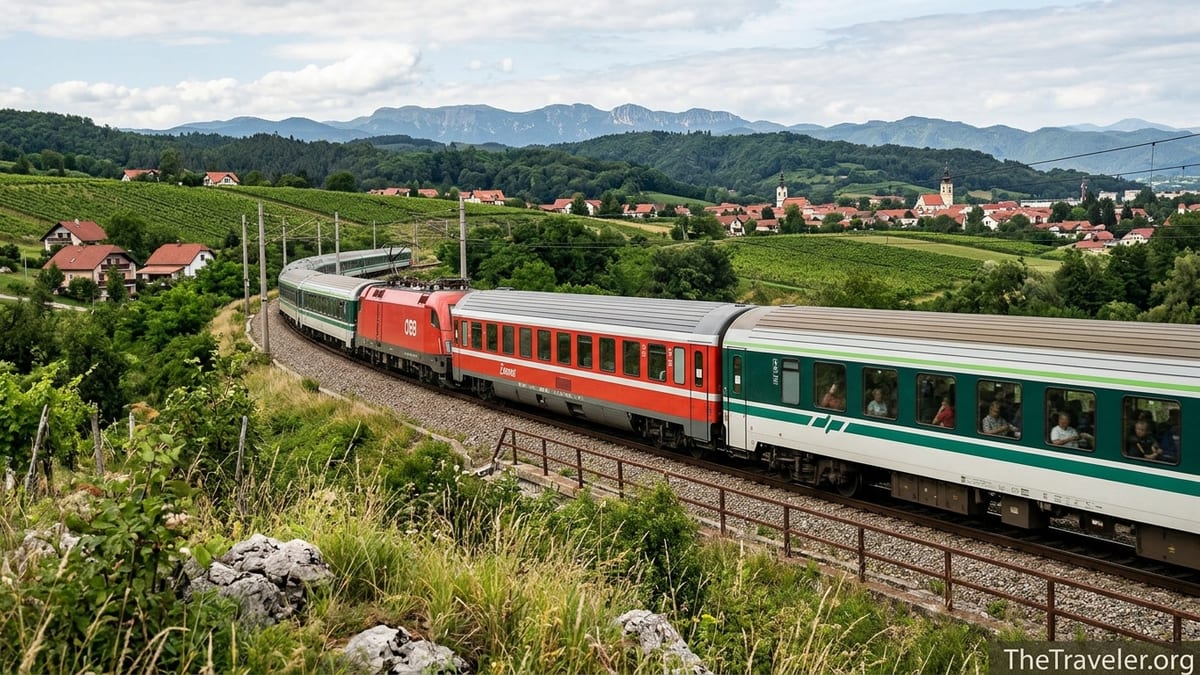
How the Vienna–Ljubljana route works in 2027
Direct trains between Vienna Hauptbahnhof and Ljubljana are not a future project; they already exist and are scheduled to continue in the 2027 timetable period. EuroCity services branded around the historic "Emona" route run via Graz and Maribor, forming the backbone of daytime rail travel between the two cities. These trains are jointly operated by ÖBB and Slovenian Railways and are shown in both operators’ timetable materials for 2026, which roll forward into the 2027 European timetable year beginning in mid December 2026.
The core pattern is a roughly six hour direct trip between Vienna Hauptbahnhof and Ljubljana main station. For example, Slovenian Railways’ current leaflet for the Ljubljana–Vienna route via Maribor lists EuroCity train Emona with a departure from Vienna around mid morning and arrival in Ljubljana early afternoon, with the reverse working in the morning from Ljubljana to Vienna. The same leaflet also shows connections using regional trains between Ljubljana and Graz that hook into EuroCity services at Graz for passengers who do not catch the direct train on a given day.
It is important to distinguish these genuine through EuroCity services from journeys that require one or more changes. The rail route itself always runs south from Vienna to Graz, then southeast to Maribor, Pragersko and Celje before turning southwest to Ljubljana. However, some timetables show separate trains along that chain rather than a single through EuroCity. In practice that means you may board a Railjet or EuroCity between Vienna and Graz or Maribor, then continue on a Slovenian Railways regional or intercity train for the rest of the route.
For 2027 travel planning, you should expect at least one or two direct EuroCity services each day in each direction, supplemented by multiple itineraries with changes at Graz, Maribor, Pragersko or Celje. Engineering work around Ljubljana station, expected to continue into early 2027, can temporarily alter stopping patterns and connection times, so it is wise to check specific dates shortly before travel.
Direct EuroCity vs connections via Graz, Maribor and other hubs
On paper, the most straightforward option is the direct EuroCity Vienna–Ljubljana train. It departs Vienna Hauptbahnhof from the main long-distance concourse, typically in the morning, and arrives at Ljubljana’s central station about six hours later. Typical intermediate stops include Wiener Neustadt, Bruck an der Mur or Leoben, Graz Hauptbahnhof, Spielfeld-Straß (the Austrian border station), Maribor, Celje and sometimes Zidani Most. This pattern gives useful access to southern Austrian and northern Slovenian cities while still offering a one-seat ride between the capitals.
Why then do you sometimes see longer or more complex journeys in booking systems? Part of the answer lies in how ÖBB and SŽ build their connections. Some departures from Vienna run as Railjet or other EuroCity services that terminate at Graz or Maribor, with a timed connection onto a regional or intercity train for Ljubljana. For example, an itinerary might show a Railjet from Vienna to Graz in about 2 hours 30 minutes using the modern southern route, then a cross-platform change to a Slovenian regional service that continues via Maribor and Celje to Ljubljana, bringing the total journey time closer to 6 hours 30 minutes or 7 hours.
Other options split the journey further. You may see a Vienna to Graz InterCity, then a Graz to Maribor regional train, then a separate Maribor to Ljubljana intercity or regional service. Each change adds at least 10 to 20 minutes of buffer time, and some of the Slovenian regional trains run at lower speeds on curving track, so overall times can extend toward seven or even eight hours. Construction around Ljubljana and periodic track works in Slovenia can lengthen these legs further, which is one reason why a simple theoretical map distance does not match the actual journey time.
From a traveller’s point of view, the direct EuroCity remains preferable whenever it fits your schedule. Boarding once in Vienna and staying in the same seat until Ljubljana removes the stress of short connections and platform changes with luggage. However, if the timing of the direct train does not work, a connection at Graz or Maribor is not difficult. Both stations are compact, well signed and have clear departure boards, and Graz Hauptbahnhof in particular has frequent local trams into the city for anyone choosing to break the trip overnight.
The Koralmbahn effect and the genuinely fastest route
One of the biggest structural changes for southern Austria in this decade is the opening of the Koralmbahn high speed line between Graz and Klagenfurt. Full passenger operations are scheduled from the December 2025 timetable change, with ÖBB materials highlighting a cut in journey times between Graz and Klagenfurt to around 45 minutes and a Vienna–Klagenfurt travel time of about 3 hours 10 minutes once the new route is in full use. This massively strengthens the Vienna–Graz–Klagenfurt–Villach axis for connections toward Italy and Carinthia.
For Vienna–Ljubljana specifically, however, the Koralmbahn is more of an indirect benefit than a game changer. The classic and still shortest rail route from Vienna to Ljubljana runs via Graz and Maribor, not via Klagenfurt and Villach. If you tried to build an itinerary that uses the Koralmbahn, you would likely travel Vienna to Graz and then to Klagenfurt on the high speed line, continue to Villach and finally cross the Karavanke tunnel to Jesenice and onward to Ljubljana. Timetable examples and commentary from rail specialists suggest that this path is longer in both distance and time compared with the direct chain via Maribor, even with the high speed section in Austria.
ÖBB’s 2027 timetable press material focuses the Koralmbahn improvements on within-Austria travel and does not promote this route as the fastest way to reach Ljubljana. Cross-border planners note that substantial sections in Slovenia, particularly between Jesenice and Ljubljana or between Maribor and Ljubljana, still have relatively low line speeds compared to the new Austrian high speed sections. In other words, Vienna–Graz is now faster and more reliable thanks to the modernized southern corridor, but once trains cross into Slovenia they run on existing infrastructure, so total Vienna–Ljubljana times remain around six hours for the faster direct trains.
For a practical 2027 trip from Vienna to Ljubljana, the fastest realistic rail journey on a typical weekday remains the direct EuroCity or a very simple connection via Graz or Maribor that totals about six hours. If you see much faster times in an online planner, treat them cautiously and verify the details on ÖBB’s and Slovenian Railways’ official booking tools by entering your exact travel date. Likewise, if a planner suggests a detour via Klagenfurt and Villach but with a similar arrival time, weigh it against the straightforward comfort of the classic route via Maribor.
Classes, reservations and onboard comfort on Vienna–Ljubljana trains
Direct EuroCity trains between Vienna and Ljubljana normally use conventional locomotive-hauled carriages rather than Railjet push–pull sets. These carriages provide both second class and first class seating, typically in a mix of open-saloon and six-seat compartments. In second class, you can expect standard 2+2 seating with adequate legroom and luggage racks above the seats, along with larger luggage areas near the doors. First class generally offers roomier 2+1 seating, quieter coaches and sometimes complementary newspapers or small extras, although exact amenities can vary between ÖBB and SŽ stock.
Seat reservations on these EuroCity services are recommended but usually not compulsory. If you purchase a Sparschiene advance ticket through ÖBB, the system may either include a seat reservation or offer it for a small additional fee, often just a few euros per person. On busy summer weekends and around public holidays, these trains can be popular with both international and local travellers, so a reservation is worth the small cost, especially if you are travelling as a couple or family and want to sit together between Vienna and Graz where demand is strongest.
Onboard catering usually consists of either a full restaurant or bistro car on the Austrian section and trolley service or a small buffet counter on some Slovenian segments. Recent examples on similar EuroCity routes in the region show main dishes and hot meals priced broadly in the 10 to 15 euro range, with coffee and soft drinks in the 3 to 4 euro range. When there is no full restaurant car, snack carts offer sandwiches, basic hot snacks and drinks at comparable prices. Bringing your own picnic from Vienna Hauptbahnhof or Ljubljana, where both stations have supermarkets and bakeries, remains a popular and budget friendly option.
Wi Fi availability is evolving. Many ÖBB long distance trains offer free onboard Wi Fi, especially on Railjet sets, and some of the carriages used on EuroCity services toward Slovenia have been refitted with wireless internet. However, coverage can be inconsistent after crossing the border, particularly on older Slovenian Railways stock, and signal strength may drop in tunnels and remote valleys. If a stable connection matters, download maps and entertainment before departure and treat onboard Wi Fi as a useful bonus rather than a guarantee.
Tickets, Sparschiene fares and real-world examples
For 2027 travel, ÖBB remains the most convenient booking channel for most international passengers starting or ending in Vienna. ÖBB’s Sparschiene advance purchase fares for Vienna–Ljubljana have in recent timetable periods often started around 29 to 35 euros in second class for a one-way trip when booked several weeks ahead. Example searches in late 2026 for winter and early spring 2027 departure dates show promotional Sparschiene prices from the low 30 euro range, rising to 40 or 50 euros on busy days or when limited quotas have sold out.
Standard flexible fares are considerably higher but give full refundability and flexibility on the chosen day. For Vienna–Ljubljana, realistic one-way standard fares in second class typically fall somewhere in the 60 to 90 euro range, depending on the date and whether the journey is priced as a straight cross-border through ticket or as a combination across the border section. These tickets often allow travel on any permitted train on the booked day, which is useful if you prefer not to commit to a specific departure.
Slovenian Railways also sells tickets and some advance purchase offers for travel originating in Slovenia. For a Ljubljana–Vienna journey, SŽ promotional fares observed in recent booking examples are broadly similar to ÖBB Sparschiene levels when converted at current exchange rates, with one-way second class offers starting in the approximate 30 to 35 euro bracket on less busy days. Refund conditions differ: Sparschiene tickets are usually nonrefundable and tied to the specific train, while standard fares from either operator tend to be refundable before departure, often with a modest service charge.
To make the costs concrete, consider a spring 2027 weekday example where a solo traveller books six weeks in advance. They might find a Sparschiene ticket for around 32 euros in second class on the morning direct EuroCity, plus 3 euros for a seat reservation. Closer to departure, with Sparschiene quotas sold out, the same person could face 75 euros for a flexible standard ticket. A couple booking together would simply double these figures, so 70 euros total for two Sparschiene tickets booked early versus perhaps 150 euros for two flexible tickets if purchased a few days before travel.
Comparing trains with Vienna–Ljubljana long-distance buses
FlixBus and at least one regional operator such as Nomago operate regular long-distance buses between Vienna and Ljubljana. Recent schedules for autumn 2026 show several daily departures, including early morning, daytime and late evening services. Typical journey times range from about 4 hours 30 minutes on the fastest direct buses to around 5 hours 30 minutes or slightly longer on services with intermediate stops. Departure points in Vienna include the Erdberg bus terminal and, on some runs, Vienna Hauptbahnhof bus stands. Most buses arrive at Ljubljana’s central bus station adjacent to the main railway station, with occasional services also stopping at the Dolgi Most park-and-ride on the western edge of the city.
Observed fares in late 2026 for travel into 2027 show promotional bus tickets between Vienna and Ljubljana from roughly 23 to 25 euros one way on FlixBus when booked online in advance, with more common prices in the 30 to 40 euro range depending on demand, departure time and how near to travel date you book. A check of bus comparison tools shortly before publication showed examples such as a 5 hour 15 minute FlixBus trip leaving Vienna Erdberg in the very early morning for about 30 euros and a 4 hour 30 minute Nomago service from Vienna central station to Ljubljana for the equivalent of roughly 40 to 45 US dollars.
Bus companies often include one large suitcase and one piece of hand luggage in the basic fare, but charge additional fees for extra or oversize items, sports equipment or bicycles. In contrast, standard rail tickets on this route do not usually limit you to a single checked bag; as long as you can carry your luggage yourself and store it in the racks, there is normally no extra fee. Coaches also face potential traffic delays, particularly near Vienna and around Ljubljana’s ring roads at peak hours or during holiday weekends. A journey scheduled for 4 hours 45 minutes on the timetable can creep over five hours in heavy traffic, narrowing or even erasing the time advantage over the direct train.
In terms of comfort, modern long-distance coaches provide reclining seats, air conditioning, USB sockets and often Wi Fi, but space to move around is limited and toilets are more basic than on a train. The train allows you to walk the length of the carriage, visit the bistro, change seats if space permits and generally stretch out more. For travellers sensitive to motion sickness, the smoother ride of the train may also be preferable to the winding highways in southern Austria and northern Slovenia.
Scenery, door-to-door logistics and a sample travel day
The rail route between Vienna and Ljubljana is varied and quietly attractive without being an uninterrupted panorama of high peaks. Leaving Vienna, the line runs through the flat or gently rolling landscapes of Lower Austria before climbing toward the foothills of the Alps on the approach to Styria. Between Bruck an der Mur or Leoben and Graz, the line crosses wooded valleys and rivers, with short tunnels and hillside views that give a pleasant sense of crossing into southern Austria.
South of Graz toward Spielfeld-Straß and Maribor, the scenery alternates between vineyard-covered slopes and agricultural plains. Crossing the border near the Mur River, the train enters northeastern Slovenia, where views open onto low hills and small towns. As you head toward Celje and Zidani Most, the line follows river valleys, at points running quite close to the water, and the final approach into Ljubljana passes suburban areas and light industry before the train pulls into the central station. It is a route with a strong sense of regional geography, but expect a mix of scenic stretches and more ordinary views rather than an all-day Alpine spectacle.
A realistic travel-day itinerary from central Vienna to Ljubljana’s Old Town might begin at 08:30 in the Innere Stadt. From there, you could take the U1 metro from Stephansplatz to Südtiroler Platz / Hauptbahnhof in about 5 to 7 minutes, leaving plenty of time to walk up into the main station concourse. If you aim for a mid morning direct EuroCity departure, arriving at Vienna Hauptbahnhof by 09:30 for a 10:00ish train gives a comfortable 30 minute buffer to buy snacks, find the correct platform and board without rushing.
After approximately six hours on the train, you would arrive at Ljubljana around mid afternoon. The main station sits just north of the Old Town; with average walking speeds and traffic lights, it is about a 10 to 15 minute walk along Slovenska cesta and Čopova ulica to Prešeren Square, even with a wheeled suitcase. If your accommodation is deeper in the Old Town or up towards the castle, you might add another 5 to 10 minutes of walking, or take one of the city buses that stop near the station, using a contactless card or local smartcard where available.
Building a sensible buffer into this itinerary matters most if you are connecting from a flight. If you land at Vienna International Airport and plan to take the train, allow at least 2 hours between scheduled landing and the EuroCity departure, which accounts for immigration, baggage reclaim, the 15 to 20 minute Railjet or S Bahn ride into Vienna Hauptbahnhof and a margin for minor delays. If that feels tight, consider staying overnight in Vienna or Graz and travelling to Ljubljana the following day.
Optional stopovers in Graz or Maribor
For travellers who prefer a slower pace, breaking the trip in Graz or Maribor turns the Vienna–Ljubljana route into a short rail journey with a mini city break in between. Graz Hauptbahnhof is only about 2 hours 30 minutes from Vienna on the upgraded southern route, making it a comfortable half-day hop. From the station, frequent trams and buses reach the historic centre in less than 15 minutes, and many hotels are within walking distance of the Hauptplatz and Schlossberg funicular.
You could, for example, depart Vienna around late morning, arrive in Graz early afternoon, drop your luggage at a hotel and spend the rest of the day exploring the Old Town, Kunsthaus and riverside cafes. The following morning, you would take a mid morning regional or EuroCity train to continue via Maribor and Celje to Ljubljana, arriving mid afternoon. This splits the long six hour ride into two segments of about 2 and 3.5 hours respectively.
Maribor offers another atmospheric stop, especially for wine enthusiasts. Travelling Vienna to Maribor by train via Graz takes roughly 3 hours 40 minutes on a good connection. The station lies about 10 to 15 minutes on foot from the Drava riverfront and Lent district, with numerous guesthouses and hotels nearby. Spending a night here allows for a relaxed evening and perhaps a visit to local wine bars before catching a late morning or early afternoon train for the remaining 2 to 2.5 hours to Ljubljana.
Financially, these stopovers do have implications. Most Sparschiene advance fares are priced for end to end trips and may not allow a 24 hour break en route, especially across a border. If you know you want to stop over, you may need to buy separate tickets for Vienna–Graz and Graz–Ljubljana or Vienna–Maribor and Maribor–Ljubljana. This can work out slightly more expensive than a single through Sparschiene, but still cheaper than last minute standard fares. Checking both combined and split-ticket options on ÖBB and SŽ websites for your specific dates is worthwhile.
Practicalities: documents, accessibility, bikes and families
Although Austria and Slovenia are both in the Schengen Area, you should still travel with valid government-issued photo identification. For most visitors this means a passport; for EU and some other European citizens, a national identity card may also be acceptable. Routine border passport checks on the train are rare but possible, especially in response to security alerts, and random ticket inspections may require you to show ID that matches the name on a personalised ticket.
Both ÖBB and Slovenian Railways offer assistance for wheelchair users and passengers with reduced mobility, but advance booking is important, particularly for cross-border services. On EuroCity trains, at least one carriage is usually equipped with a wheelchair space and an accessible toilet. Boarding may involve a staff-deployed ramp at Vienna Hauptbahnhof, Graz, Maribor or Ljubljana. Since construction work at Ljubljana station is expected to continue into early 2027, step-free routes and platform allocations may change, so contacting both ÖBB and SŽ assistance services several days in advance is strongly recommended.
Carriage of bicycles is possible on many but not all trains between Vienna and Ljubljana. Long-distance EuroCity services often require both a bicycle ticket and a reservation, with spaces limited to a small number per train. Regional connections between Maribor and Ljubljana or Graz and Maribor may have more flexible bike arrangements but can still require a supplement or limitation on the number of bikes. If cycling is central to your trip, choose departure times that explicitly show bicycle symbols in the timetable and organise reservations as soon as bookings open, usually a few months before travel.
For families, the Vienna–Ljubljana train is generally an easy option. ÖBB offers discounted or free travel for children under certain age thresholds when accompanied by an adult holding a valid ticket, and family cards or national discount schemes can further reduce costs for Austrian residents. In practice, a family of four booking Sparschiene tickets a few weeks ahead might pay somewhere in the range of 100 to 150 euros total in second class for a one-way trip, depending on children’s ages and specific promotions at the time. The availability of tables, compartments, toilets and the ability to move around the train usually makes the six hour journey more manageable for younger travellers than a tightly packed coach ride.
Choosing between direct train, connecting train and bus in 2027
Putting all of this together, the direct EuroCity train remains the most balanced option for most travellers between Vienna and Ljubljana in 2027. It offers a simple, one-seat ride from city centre to city centre in roughly six hours, avoids motorway traffic risk, and provides space to move, work, eat and enjoy the changing scenery through southern Austria and northern Slovenia. Booking a Sparschiene advance fare keeps the price competitive with or even below typical bus fares, especially once you include seat reservations and the generous, fee-free luggage allowances on the train.
Connecting train itineraries via Graz, Maribor, Pragersko or Celje are a strong second choice. They broaden the range of departure times, which is helpful if the direct train does not match your schedule, and they open up the possibility of overnight stopovers in attractive intermediate cities. The trade off is additional complexity and slightly longer journey times, sometimes stretching toward seven hours. For travellers who prioritise flexibility and are comfortable making one or two changes with luggage, these itineraries work well, and standard flexible tickets can provide extra peace of mind if your plans are not fixed.
Buses, finally, are best for those whose top priorities are the lowest possible price on a specific date or a late evening or very early morning departure that no train offers. On some days a promotional bus fare of around 25 euros will undercut even Sparschiene train tickets, and a scheduled bus time of 4 hours 30 minutes can be attractive, especially for travellers already staying near Vienna’s Erdberg terminal or Ljubljana’s bus station. Against that, you must weigh traffic uncertainty, more constrained space, possible luggage surcharges and less comfortable onboard facilities on a longer road journey.
Whichever option you choose, the key to a smooth Vienna–Ljubljana journey in 2027 is to use the official ÖBB and Slovenian Railways booking tools to check your exact travel date, pay attention to engineering works, and book well ahead for the best fares. With direct EuroCity trains firmly established, upgraded infrastructure in Austria and a good choice of buses, this cross-border journey is more accessible and flexible than ever for travellers exploring Central Europe.