


More news on this day
Vietnam’s aviation sector is entering 2026 with powerful momentum, as record passenger numbers, aggressive airport expansion and the imminent debut of Long Thanh International Airport position the country at the center of a new Southeast Asia travel boom.
Get the latest news straight to your inbox!
Passenger Growth Puts Vietnam Among Asia’s Hottest Aviation Markets
Recent traffic figures show how quickly Vietnam’s skies are filling. Airports across the country handled around 109 million passengers in 2024, according to publicly available data from the Airports Corporation of Vietnam, highlighting a rapid rebound in both domestic and international demand. Industry assessments from global airline bodies indicate that Vietnam has climbed into the top tier of Asia Pacific air passenger markets, rising from 11th place in 2014 to eighth by 2024.
The momentum continued through 2025 as tourism and business travel surged. Official tourism statistics show that Vietnam welcomed more than 21 million international visitors in 2025, exceeding its pre‑pandemic peak and ranking among the fastest‑growing destinations worldwide. Air travel remains the dominant gateway, with more than four out of five foreign visitors arriving by plane, reinforcing aviation’s central role in the country’s economic strategy.
These gains are underpinned by policy changes and shifting regional travel patterns. Vietnam has widened its e‑visa program, lengthened permitted stays for many nationalities and eased entry requirements for key markets across Asia and Europe. At the same time, pent‑up demand for leisure trips, combined with a growing middle class across Southeast Asia, has fed strong outbound and inbound flows through Vietnamese hubs.
Analysts note that while domestic traffic saw some normalization after the immediate post‑pandemic spike, steady international expansion and rising frequencies on regional routes are expected to keep overall growth elevated through the second half of the decade. This backdrop is sharpening focus on whether Vietnam’s infrastructure can keep pace.
Long Thanh International Airport Nears Opening as New Mega Hub
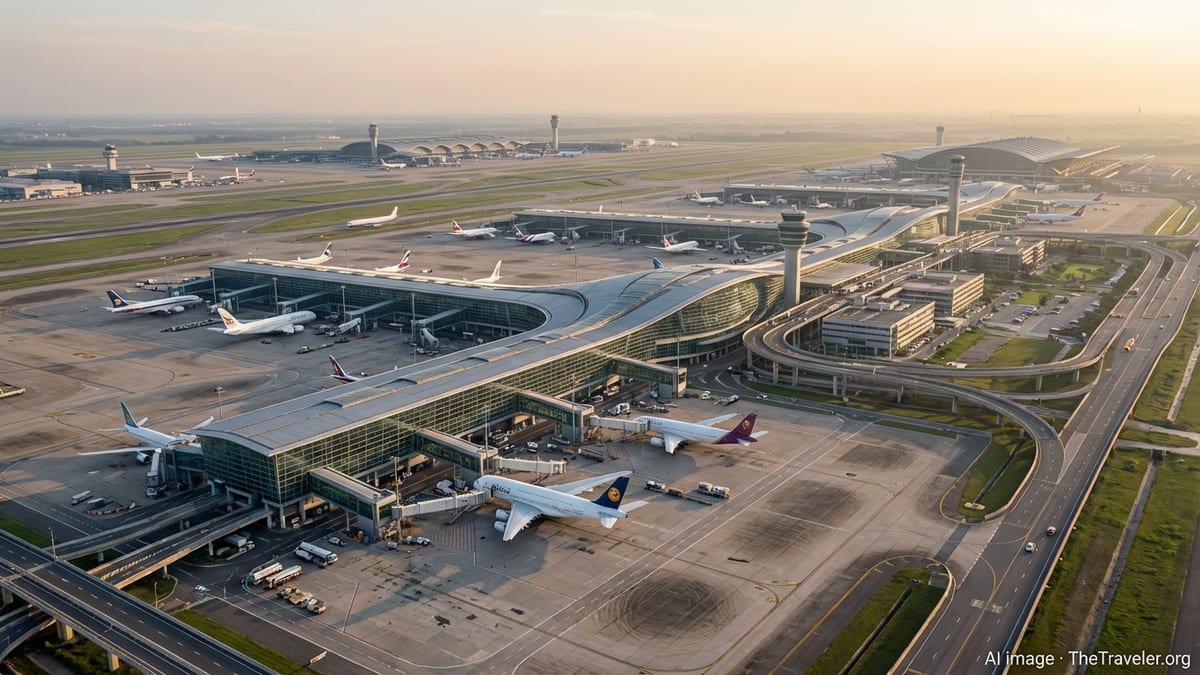
Long Thanh International Airport, taking shape about 40 kilometers east of Ho Chi Minh City, is emerging as the flagship response to Vietnam’s aviation bottlenecks. The first phase is designed for an initial capacity of around 25 million passengers per year, along with significant new cargo handling capability, and is one of the largest transport infrastructure projects in Southeast Asia.
Government statements and recent project updates indicate that key components of phase one are being accelerated, with many structures targeted for completion by mid‑2026 and commercial operations expected to start toward the end of 2026. The facility is intended to relieve chronic congestion at Tan Son Nhat International Airport, which has long operated near or above its designed capacity while handling most of southern Vietnam’s air traffic.
Long Thanh’s master plan foresees multiple construction phases that would eventually raise total capacity to 100 million passengers annually, placing the airport in the same league as major regional hubs. Plans also emphasize integrated road and rail links to Ho Chi Minh City, the industrial zones of Dong Nai and Binh Duong, and coastal tourism centers, signaling an ambition to create an interconnected logistics and travel ecosystem.
Sector reports circulated among investors highlight Long Thanh alongside projects such as the new Terminal 3 at Tan Son Nhat, expansions at Noi Bai in Hanoi and upgrades to a string of regional airports. Together, these schemes are expected to reshape Vietnam’s airport network and enable airlines to mount more long‑haul and high‑frequency regional services from 2026 onward.
Southeast Asia Travel Boom Reconfigures Regional Air Flows
Vietnam’s infrastructure push coincides with a broader Southeast Asia travel boom. Regional outlooks compiled by tourism organizations and ASEAN bodies suggest that international arrivals across the bloc are nearing or surpassing 2019 levels, supported by earlier reopening timelines, strong intraregional demand and the rise of short‑haul leisure travel.
Within this landscape, Vietnam stands out as a high‑growth market. Comparative data for 2024 and 2025 show Vietnam posting some of the fastest recovery and expansion rates in the region, outpacing several established competitors in percentage growth. Short‑haul markets in Southeast Asia, including Indonesia, the Philippines, Cambodia and Laos, have logged double‑digit increases in visitor flows to Vietnam, while Northeast Asian markets such as South Korea and China remain key volume drivers.
Industry analysts argue that Long Thanh’s scheduled entry into service in late 2026 could alter regional traffic patterns. The new airport is expected to support denser point‑to‑point links between Vietnam and secondary cities across ASEAN, while also enabling more efficient connections between Northeast Asia, South Asia and Australia via Vietnamese hubs. As capacity constraints ease, carriers are likely to experiment with new city pairs and schedules timed to capture connecting traffic.
This shift may intensify competition with traditional regional hubs, particularly in Singapore, Bangkok and Kuala Lumpur, which have long dominated transfer traffic. Vietnam’s value proposition centers on competitive costs, a growing domestic market, and proximity to manufacturing clusters, but success will depend on service quality, reliability and the ease of onward travel beyond major cities.
Airlines Race to Capture Capacity as New Hub Comes Into View
Vietnamese and foreign airlines are already positioning themselves for the Long Thanh era. Public filings and corporate reports show national carrier Vietnam Airlines pursuing a fleet renewal and network optimization strategy focused on medium and long‑haul growth, supported by partnerships with global airline alliances and code‑share agreements. Budget carriers, led by Vietjet and others, continue to expand aggressively on domestic and regional routes, targeting both price‑sensitive travelers and new first‑time flyers.
Low‑cost operators are particularly active in linking Vietnam with emerging tourism and labor corridors in Southeast Asia and South Asia, adding frequencies to destinations in Thailand, Malaysia, Indonesia and India. Published route announcements indicate that Vietnamese carriers are also probing opportunities in Australia and North Asia, where rising demand from both leisure and visiting‑friends‑and‑relatives segments is encouraging more nonstop and one‑stop options.
Foreign airlines, from full‑service network carriers to regional low‑cost brands, are increasing capacity into Hanoi, Ho Chi Minh City and Da Nang in anticipation of sustained demand. Some are evaluating how future operations at Long Thanh could complement existing services into Tan Son Nhat, potentially splitting traffic by market or cabin mix once the new airport opens.
Analysts caution that the rapid build‑up of capacity brings execution risks. Vietnam’s regulator has stepped up oversight of punctuality, safety and consumer protection, and airlines are under pressure to manage staffing, maintenance and ground services to avoid disruptions. How effectively the sector navigates these challenges during the transition to Long Thanh will influence traveler perceptions and repeat visitation.
Opportunities and Pressures for Vietnam’s Tourism and Economy
The aviation surge is closely intertwined with Vietnam’s economic and tourism ambitions. Tourism authorities report that travel and tourism already contribute a significant share of national GDP, with forecasts pointing to a rising contribution as international arrivals grow and visitor spending deepens beyond major gateways into secondary destinations.
Long Thanh is expected to strengthen Vietnam’s appeal as a meeting and events destination, a manufacturing and logistics hub, and a base for multi‑country Southeast Asia itineraries. Improved connectivity could push more visitors to combine Vietnam with neighboring Cambodia, Laos or Thailand, while also making it easier for business travelers to move between industrial zones, ports and urban centers in a single trip.
The boom also brings pressures. Popular hotspots from Da Nang and Hoi An to Phu Quoc and Nha Trang are grappling with infrastructure strain, environmental concerns and calls for more sustainable visitor management. Policymakers and local authorities face the task of aligning aviation‑led growth with investments in public transport, wastewater treatment, coastal protection and community‑based tourism initiatives.
As 2026 progresses, the pace of construction at Long Thanh and the rollout of new airline routes will be closely watched indicators of how far Vietnam can ride the current travel wave. If timelines hold and supporting infrastructure keeps up, the country’s aviation sector is poised to lift Vietnam into a more central role in Southeast Asia’s rapidly evolving travel map.