


On a clear spring afternoon in Helsinki, I stepped out of the metro at University of Helsinki station with no firm plan beyond walking. The city’s main sights were only a few blocks away, yet my route that day was not toward the market square or the ferry piers. Instead, I followed students up the escalator and into the streets that knit together the University of Helsinki’s city centre campus. Over the next few hours, in courtyards, libraries, tunnels and botanic gardens, the city rearranged itself into something softer and more human scaled: a version of Helsinki that lives between lectures, in the pages of library books and under the glass of tropical greenhouses.
Get the latest updates straight to your inbox!
A Campus Hidden in Plain Sight
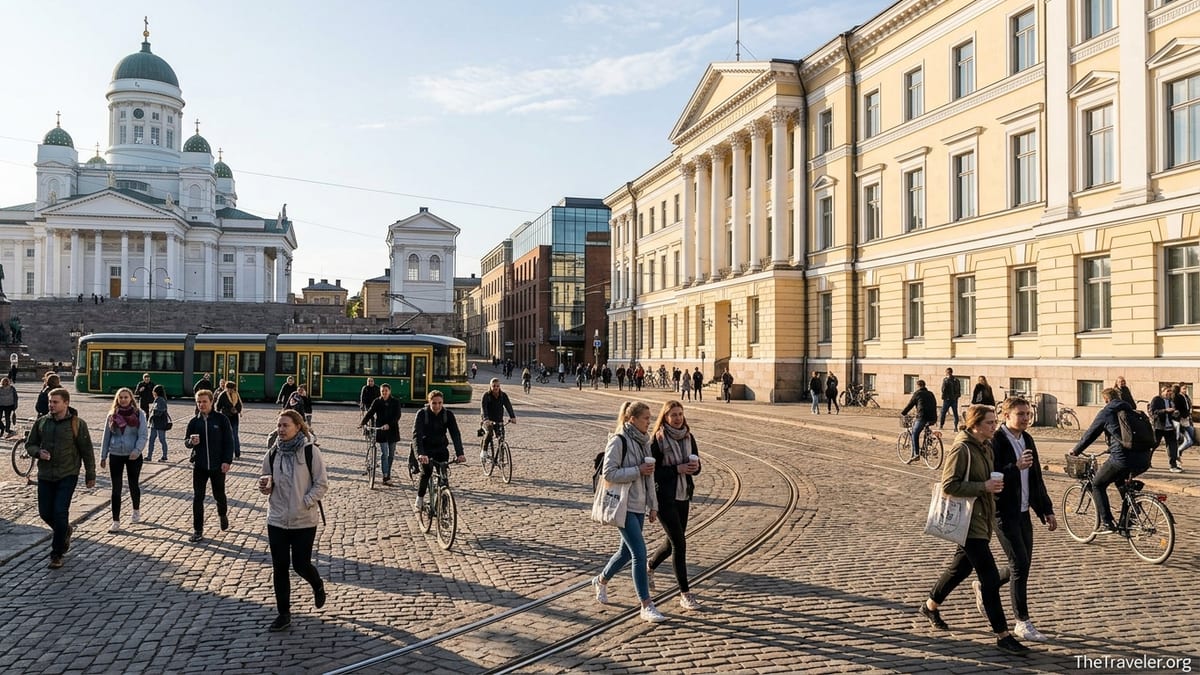
Most visitors to Helsinki pass within meters of the University of Helsinki without realizing it. The university’s main building and several key faculties line Senate Square and Unioninkatu, the same grand ensemble that frames Helsinki Cathedral and the Government Palace. From the steps of the cathedral, if you turn your back on the postcard view and look across the square, the stately neoclassical façade with tall windows and pale-yellow walls is not a museum or government office but the university’s historic main building. It has been here since the 19th century, quietly shaping the city’s intellectual life while tour groups circle the cathedral above.
Arriving from the metro, the university asserts itself more subtly. The station name, University of Helsinki, is your first clue. Students in wool coats and sneakers move with practiced purpose along Yliopistonkatu and Fabianinkatu, streets that are also home to shops, bakeries and offices. There are no gates or checkpoints. Instead, brass door plaques and small blue signs reveal that the buildings you are passing are lecture halls, language departments and research centers, interwoven with everyday city life. It feels less like entering a campus and more like discovering that the city itself has been studying all along.
To start my walk, I let the flow of students carry me toward Fabianinkatu 30. Here, a curving wall of glass and brick rises above the street: Kaisa House, the university’s main library. The building is only a short block from busy Aleksanterinkatu, one of Helsinki’s main shopping streets, yet its atmosphere is altogether different. The crowd outside is equal parts students, researchers and office workers slipping in for a quiet hour with a laptop.
What struck me first was how porous it all felt. There were no ticket desks or turnstiles, only a bank of self service machines and a calm lobby. Anyone can walk in, find a seat among the shelves and claim a piece of this academic city within the city. For a traveler used to campuses that feel closed or guarded, Helsinki’s openness is disarming in the best possible way.
Kaisa House: Helsinki’s Living Room of Ideas
Inside Kaisa House, the city drops to a whisper. The architecture pulls your gaze upward: an atrium carved with oval openings that stack floor upon floor, creating a vertical canyon of books and light. According to the university, this main library serves the city centre campus and offers a mix of quiet reading rooms, group work areas and open shelves spread across levels two to seven, plus additional facilities underground. The effect for a visitor is immediate. Even if you only mean to peek inside, it is hard not to linger.
I found a spot by a high window on the fifth floor. Below me, trams rolled along Kaisaniemenkatu and the green canopy of Kaisaniemi Park framed distant rooftops. Around me, students worked under small desk lamps, wires trailing to laptops, Finnish and Swedish notes scrawled across open notebooks. It felt less like a sterile library and more like a living room for the entire city, one where the unspoken rule is that everyone is welcome as long as they respect the quiet.
This is also one of the most practical places in central Helsinki to pause as a traveler. There is reliable Wi Fi, clean restrooms and, on the lower levels, a small café corner where you can buy coffee and a sweet bun for only a little more than you would pay in a standard chain café outside. While exact prices shift over time, a basic filtered coffee typically costs only a few euros, making it a budget friendly refuge in a city known for its high cost of living. On a cold or rainy day, you could easily spend an hour here warming up, charging your phone and planning the rest of your walk.
What surprised me most, though, was how normal my presence felt. Nobody looked twice at a stranger wandering among the stacks in English, pulling down a book about Finnish history, then another on Baltic sea birds. In Helsinki, the university library is not a closed academic tower. It is public infrastructure, as accessible as the tram system or the waterfront promenades.
From Senate Square to Secret Courtyards
Leaving Kaisa House, I traced a slow loop back toward Senate Square. The streets between the library and the cathedral are short and easy to navigate, yet they contain micro-worlds that reward unhurried exploration. On Unioninkatu, trams glide past the western edge of the square, their digital displays announcing routes that knit the city together. Line 2, for instance, runs along this street between the Senate Square area and the Market Square, placing the university squarely on one of the main tram corridors in the city centre.
At the corner, instead of rejoining the tour groups climbing the cathedral steps, I slipped into one of the university’s inner courtyards. Many of these are open during the day, their gates left ajar. Inside, the city noise softened. A few birch trees marked the seasons: bare branches in early spring, bright green leaves by May, yellow flutter in October. Bicycles leaned against walls of pale plaster and brick. A cluster of students in padded jackets spoke softly over takeaway coffee, the air filled with the overlapping sounds of Finnish, Swedish and English.
Places like the Topelia courtyard, mentioned in the university’s own material on campus biodiversity, show how the institution has threaded small pockets of green into its historic blocks. Instead of manicured lawns, you find low shrubs, moss covered corners and planting beds that seem to invite insects and birds as much as human visitors. For a traveler, these courtyards offer something rare in a capital city: genuinely quiet outdoor space only steps from major landmarks.
Cutting back toward Yliopistonkatu, I passed a university building that now hosts Science Corner, a hybrid of event space, café and exhibition hall. On some days, the ground floor hosts public talks on topics like climate change or artificial intelligence, delivered not for academic credit but for anyone curious enough to drop in. Even when nothing is scheduled, the café here functions as another informal salon of the city, a place where a tourist writing postcards might find themselves at the next table to a researcher working on Arctic sea ice.
Kaisaniemi Botanic Garden: Nature in the Middle of the City
From the university’s main buildings, it is only a ten minute walk to one of Helsinki’s most quietly remarkable places: Kaisaniemi Botanic Garden. Operated by the Finnish Museum of Natural History as part of the University of Helsinki, the garden has occupied this central site since the early 19th century. Today it covers several hectares of outdoor grounds and a cluster of glasshouses that together serve research, conservation and public enjoyment. According to official visitor information, the garden’s mission is to maintain scientific collections of living plants, many of them rare or endangered.
Reaching the garden from Senate Square or Kaisa House is part of the pleasure. The most direct route leads you along Kaisaniemenkatu and then into Kaisaniemi Park, where gravel paths and mature trees filter the traffic noise from nearby streets. Alternatively, you can cut through the new Kaisantunneli, a pedestrian and cycling tunnel opened in 2024 that links the eastern and western sides of the city centre beneath the railway tracks. This tunnel has quickly become one of the main east to west cycling routes in central Helsinki, but it is also a sheltered way for walkers to reach the park on a windy or rainy day.
Once inside the garden gates, the city feels far away. In summer, locals spread blankets on the lawns between flowerbeds and rock gardens, while children balance along low stone walls. Labels identify plants from different climate zones, and an outdoor map shows thematic sections ranging from boreal forest species to alpine flora. In colder months, the appeal shifts indoors. The glasshouses, divided into ten different rooms, hold everything from humid tropical palms to arid succulents. Entry tickets are reasonably priced by Nordic standards and often discounted for students and seniors, making this an affordable museum of living plants right in the centre.
What makes Kaisaniemi special in the context of a walk through the university is how clearly it reveals the institution’s dual identity. It is both a tranquil park for city residents and a working research facility where scientists study biodiversity and conservation. You may find a botanist photographing flowers for a study in one corner while, a few meters away, a couple on a city break takes a selfie under enormous leaves. The garden demonstrates, in a very literal way, how the university’s work grows into the fabric of Helsinki.
Student Cafés, Budget Lunches and Everyday Rituals
Walking any university district is also a walk through its eating habits, and central Helsinki is no exception. Around the city centre campus, especially along Yliopistonkatu, Fabianinkatu and nearby streets, you will find a mix of student cafeterias, independent cafés and more polished restaurants. For travelers on a budget, the student canteens are particularly interesting. Many are run by nationwide operators that provide subsidized lunches to students, but they also serve the general public at slightly higher prices that remain reasonable for central Helsinki.
Although exact pricing evolves, it is common to find a hot lunch buffet that includes salad, bread and a main dish in the range of roughly 10 to 13 euros for non students, while university students and some exchange students pay several euros less thanks to state support. Menus lean toward hearty, home style dishes: salmon soup with rye bread, vegetable casseroles, pasta bakes and simple grilled meats. For a visitor used to paying significantly more for a restaurant meal in the Nordic region, these cafeterias can feel like discovering a second, much more affordable Helsinki hiding behind student ID cards.
Between meals, the campus is dotted with small cafés that blend academic and urban life. Some, like the café inside Kaisa House or the Science Corner café, are effectively extensions of university buildings. Others are independent spots favored by students but open to everyone. In many of these places, it is entirely normal to see laptops on nearly every table outside the peak lunch hours. Reddit users discussing laptop friendly cafés in Helsinki frequently mention both the university libraries and certain city centre spots where lingering over coffee to work is part of the culture.
These micro rituals give the area its particular rhythm. Around 8:30 in the morning, there is a rush of takeaway coffees before the first lectures. Between 11 and 12, student restaurants fill quickly as people try to beat the lunch crowd from nearby offices. By late afternoon, the mood softens into something more languid. In one café just off the campus, I watched as a barista greeted regulars by name while pulling espresso shots, then slid over slices of berry cake to two tourists comparing tram maps. Everyone appeared to belong, even if they were just passing through.
Following the Tracks: Trams and Tunnels Around Campus
Part of what makes the University of Helsinki feel so integrated into the city is its easy connection to the public transport network. Trams form the backbone of central Helsinki’s movement, and several lines pass directly by or within a short walk of key university sites. Historical routes like tram 2 run along Unioninkatu between Senate Square and the Market Square, giving students and visitors a front row seat to some of the city’s most recognisable views as they commute. Elsewhere, lines thread along Kaisaniemenkatu and past the railway station, tying the campus to neighborhoods like Töölö and Pasila.
From a visitor’s perspective, the logistics are refreshingly simple. The University of Helsinki metro station sits directly beneath the city centre campus, with exits spilling out near Kaisa House, the main building and several faculty blocks. From the airport, a commuter train brings you to Helsinki Central Railway Station, from which it is a short, well signposted walk underground to the metro and then a one stop hop to the university station. Alternatively, you can stay on the surface and walk ten minutes through Kaisaniemi Park, using tram stops as landmarks along the way.
Recent infrastructure changes have tilted the city even more toward walking and cycling. The opening of Kaisantunneli in 2024, creating a protected east west corridor beneath the tracks between Kaisaniemi Park and the central districts, is part of a broader shift that also includes new tram lines such as the connection between Pasila and Kalasatama. While these projects might sound abstract, you feel them on the ground: there are simply more people on bikes and on foot, flowing past university buildings at all hours, blurring the line between campus and city.
For travelers who enjoy urban walking, the campus can serve as a natural starting point for longer rambles. From Kaisaniemi you can follow park paths north toward the Töölönlahti bay and its waterside promenade, or head east across the bridges to the more bohemian Kallio district, known for its cafés and small bars. A thread of tram tracks almost always runs within sight, a comforting navigational aid that means you are never more than a few minutes from a ride back to your hotel.
A Different Kind of Nightlife: From Lecture Halls to Kallio Bars
Helsinki’s city centre around the university does not erupt into wild nightlife each evening. Instead, it transitions gently from academic day to urban evening. Lecture halls empty, and some of the same students you saw hunched over laptops in Kaisa House reappear at small bars in nearby neighborhoods. For curious visitors, this opens the door to another side of the city that feels more local than the larger entertainment zones around Kamppi or the waterfront.
Just across the Pitkäsilta bridge from Kaisaniemi lies Kallio, a district often described by locals as bohemian or slightly rough around the edges in a good way. Recent conversations among Helsinki residents highlight a dense cluster of cafés and small restaurants here: places like Sävy and Päijänne for coffee and cake, or neighbourhood pizzerias, wine bars and Nepali dumpling spots around streets such as Fleminginkatu and Vaasankatu. While individual names rise and fall in popularity, the overall impression is consistent. This is where many students and young professionals go when they step away from the campus.
For a traveler who has spent the afternoon wandering the university courtyards and botanic garden, an evening stroll into Kallio can feel like changing scenes while staying within the same story. The same people who shared your tram carriage that morning now lean across candlelit tables or stand chatting in doorways. Prices here are not necessarily low by southern European standards, but compared with tourist bars around the harbour, you are more likely to find modestly priced draft beer, simple wines and casual food that caters mostly to locals.
Yet even as the atmosphere shifts, the university’s presence lingers. At one bar just off the main streets, I listened as a group discussed their thesis deadlines over pints, seamlessly blending Finnish and English. Another table debated municipal politics with the kind of detail you expect from people who spend their days in lecture halls facing Unioninkatu. In Helsinki, academic life does not end at the campus gates at sunset. It spills into nearby neighborhoods and, for the visitor willing to follow, offers a window into how young Helsinkians actually live.
The Takeaway
Walking through the University of Helsinki’s city centre campus reveals a version of the Finnish capital that many short term visitors never see. The big set pieces are there: Senate Square, the cathedral, trams clanging past historic façades. Yet beneath and between them, you encounter quieter stories. Libraries that double as public living rooms. Courtyards where birch trees and bicycles share space with hurried undergraduates. A botanic garden that serves both as a research facility and a downtown refuge.
For travelers, the practical advantages are obvious. This part of Helsinki is compact, well connected by metro and tram, and packed with resources that visitors can share: free entry to Kaisa House, relatively affordable canteen lunches, ample places to sit with a coffee and a map. But the intangible benefits might matter even more. Spending a day in and around the university allows you to feel, if only briefly, that you are part of the city’s everyday life rather than just a spectator on its edges.
The next time you emerge from the escalators at University of Helsinki station, resist the urge to hurry straight toward the harbour or shopping streets. Instead, follow the students for a while. Let their paths lead you through libraries and gardens, across tracks and into side streets where research institutes sit quietly above bakeries. You may find, as I did, that in walking the university you discover not just a campus but a second Helsinki, layered gently inside the first.
FAQ
Q1. Can non students visit the University of Helsinki’s main buildings and library?
Yes. Most central buildings, including Kaisa House, welcome public visitors during opening hours. You can enter, look around and use many reading areas without a university ID, as long as you respect the rules on quiet and food.
Q2. Is Kaisa House a good place for travelers to work remotely?
It can be. There is reliable Wi Fi, plenty of desks and a calm atmosphere. Keep in mind that it is primarily a study space, so phone calls should be taken in corridors and headphones are essential.
Q3. How do I get to the University of Helsinki campus from the airport?
Take the commuter train from the airport to Helsinki Central Railway Station. From there, either walk about ten minutes through Kaisaniemi Park or transfer to the metro for one stop to University of Helsinki station, which opens directly into the campus area.
Q4. Do I need a ticket to enter Kaisaniemi Botanic Garden?
The outdoor gardens are generally accessible via gates during opening hours, while the glasshouses require a paid ticket. Prices are modest by Nordic standards, with discounts for students and seniors, but you should check current details before visiting.
Q5. Are university student cafeterias open to the general public?
Yes. In most cases anyone can eat there, though students with valid ID pay a reduced subsidized price. Non students pay slightly more but still often less than at comparable central city restaurants.
Q6. Is the area around the University of Helsinki safe to walk at night?
Central Helsinki is generally considered safe, and the streets around the university are usually busy with students and commuters until late evening. As in any city, normal precautions apply, but many visitors feel comfortable walking here after dark.
Q7. Can I join events or lectures at the university as a visitor?
Yes, to a point. The university frequently hosts public lectures, exhibitions and open events, especially in venues like Science Corner. These are usually advertised on the university’s website and on notice boards around campus.
Q8. Is Kallio within walking distance of the university campus?
Yes. From the city centre campus or Kaisaniemi Park it is roughly a 15 to 20 minute walk across the Pitkäsilta bridge to Kallio. Alternatively, several tram lines connect the two areas in just a few stops.
Q9. Are there good photo spots on or near the campus?
Definitely. Popular spots include the view across Senate Square toward the cathedral with the university main building in the foreground, the interior atrium of Kaisa House and the glasshouses of Kaisaniemi Botanic Garden.
Q10. When is the best time of year to explore the University of Helsinki on foot?
Late spring and early autumn are ideal, when days are long and temperatures mild, and both students and outdoor spaces are at their liveliest. Winter walks can also be atmospheric, but you will spend more time indoors in libraries and cafés.