


Airline forums had warned me about security queues and tight connections in Europe, so when I booked an itinerary that routed me through Helsinki Airport, I braced for stress. Instead, I walked away wondering why more hubs are not run this way. From clear signage and compact design to quiet corners and easy transport into the city, the experience was noticeably smoother than I expected.
Get the latest updates straight to your inbox!
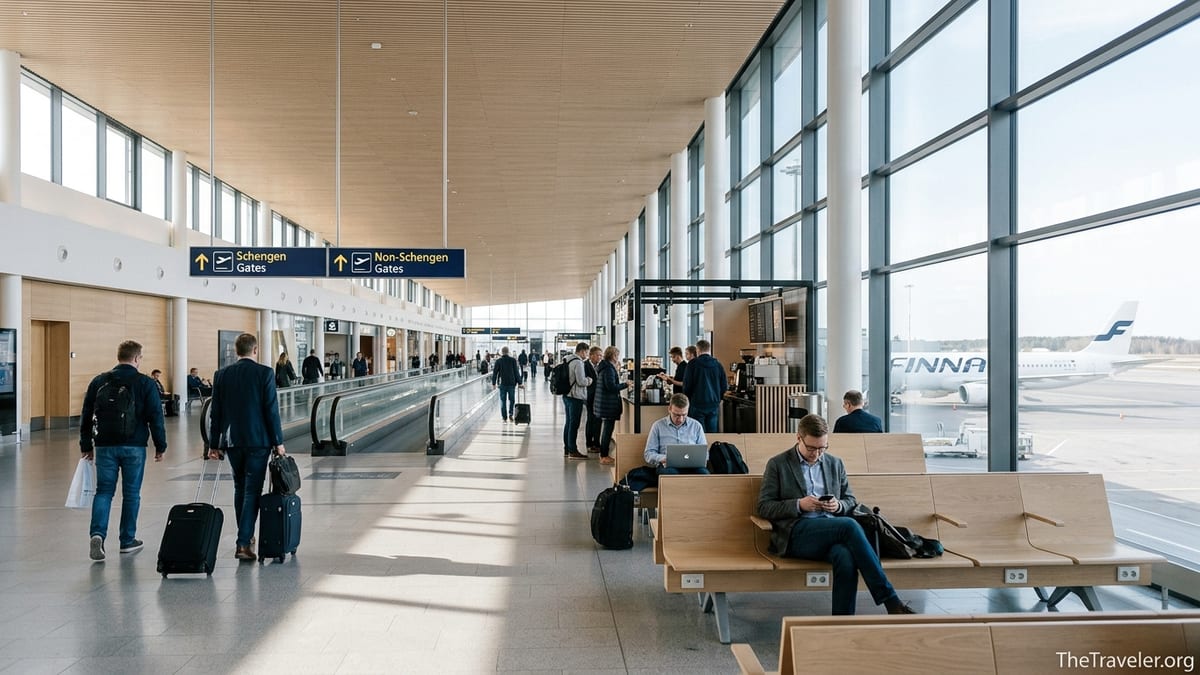
First Impressions: A Compact Hub That Actually Feels Intuitive
My first surprise came as soon as I stepped off the aircraft. Helsinki Airport operates as a single integrated terminal, with one main departures hall and two main gate areas: Schengen gates in the teens and twenties, and non-Schengen gates generally in the 30s to 50s. That sounds like standard hub jargon, but in practice it means this: you are almost never more than a 5–15 minute walk from your next gate, and you do not need to think about changing terminals or riding trains within the airport.
Wayfinding was refreshingly straightforward. Overhead signs consistently used the same colors and fonts, with “Transfer” arrows in green leading me along a central spine of moving walkways. The information screens were visible from long distances, so I did not need to crowd around a single monitor. Even as a first-time visitor, I could see at a glance that my non-Schengen connection would be at a gate in the 40s, beyond passport control but along the same main corridor.
Compared with sprawling hubs where you might ride buses or trains between terminals, Helsinki’s footprint felt human-scale. I did not once check a map app on my phone. Instead, I followed three things: the gate number, the color-coded signs, and the steady flow of transfer passengers. Within ten minutes of deplaning, I had passed a bank of restrooms, water fountains and a coffee bar, and was already approaching the border control point for my onward flight.
This compact design matters most when you are connecting on a tighter schedule. Finnair’s own guidance lists minimum connection times at around 35 minutes for domestic to domestic connections and around 40 to 75 minutes for international transfers, depending on whether you cross the Schengen border. That only works if walking distances are reasonable. In Helsinki, they are.
Security and Border Control: Efficient, But Plan Around the Busy Waves
Security and passport control are where many airports fall apart, especially in Europe’s busier hubs. I arrived into Helsinki in the late morning, one of the known peak periods when several banks of flights cluster around similar departure times. I expected long queues. Instead, I found a well-organized security area with several separate lanes and clear staff direction at the entrance.
Queue times obviously fluctuate, but on my transit morning I was through security in about 12 minutes. Staff were brisk but polite, and the layout helped: automated trays appeared from beneath the belt, instructions were shown on overhead screens in several languages, and there was space to repack your belongings after the scanners without feeling pushed along by the next wave of passengers.
Border control for non-Schengen departures was similarly streamlined. There were dedicated lines for EU/EEA passports and for other nationalities, with electronic gates handling a good portion of the traffic. Even with several long-haul departures to Asia and North America on the boards, the line moved steadily and I was stamped out in under 10 minutes.
That said, local travelers will tell you that Helsinki Airport, like any hub, has crunch times. Security can back up in the very early morning bank, around mid-morning and again mid-afternoon when holiday and business waves overlap. If you are on a self-constructed itinerary with separate tickets, or you tend to move slowly, building in extra time still makes sense. The airport’s efficiency works best when you pair it with realistic expectations.
Transferring Flights: A Realistic Test of the “Smooth Hub” Reputation
Helsinki has built much of its modern reputation on being a smart transfer point between Europe and Asia, as well as a practical gateway to Lapland. On my trip, I connected from a Schengen flight arriving from Central Europe to a non-Schengen long-haul departure. It is a classic stress test in any airport: you need to walk in the right direction, clear border control, and make it to a distant pier within your layover window.
In practice, the process felt almost linear. After leaving my inbound gate in the low 20s, I followed the overhead “Transfer” signs, which quickly gave me two clear options: “To Schengen” and “To non-Schengen.” There was no temptation to accidentally exit to the landside arrivals hall, something that still trips up travelers in some other European hubs. The non-Schengen route funneled me directly toward passport control, then onto a wide corridor leading to gates in the 40s and 50s.
The walk itself took barely ten minutes at a normal pace, helped by long moving walkways and uncluttered corridors. I stopped briefly at a water fountain and a restroom and still reached my next gate with enough time to browse duty-free. For context, some frequent flyers consider a 50-minute connection in Helsinki from Schengen to non-Schengen perfectly workable if the inbound flight is on time and the tickets are on a single itinerary, so that the airline will protect your connection if things go wrong.
The contrast with larger, more fragmented hubs was striking. I have had similar Schengen to non-Schengen transfers in other European airports where I felt like a contestant in an obstacle-course show: shuttle buses, new security checkpoints, meandering walks through shopping areas. In Helsinki, I simply walked in a straight, well-signposted line and let the design do the work.
Lounges, Workspaces and Places to Catch Your Breath
What you do in your layover after you clear formalities can shape your overall impression of an airport. In Helsinki, I found a surprisingly rich mix of quiet corners, work-friendly tables and paid lounges for a hub of its size. The airport has several lounges spread across both Schengen and non-Schengen areas, including airline-branded spaces and pay-in lounges that any passenger can access for a fee.
Near the Schengen gates, there are lounges used by Finnair and independent operators. These typically offer the essentials frequent travelers look for: Wi-Fi, hot and cold buffet food, drinks, and a much calmer atmosphere than the main terminal. In the non-Schengen area close to gate 40, a pay-in lounge operated by a global lounge company offers similar comforts along with showers, a staffed bar, family areas and dedicated workstations.
If you do not have lounge access, the terminal still caters fairly well to people who need to work or rest. I noticed high tables with power outlets close to the main windows, ideal for opening a laptop while you watch aircraft move across the apron. There were also softer seating clusters tucked away from the main foot traffic, where it felt acceptable to doze for half an hour between flights without being constantly bumped by rolling suitcases.
For longer layovers or overnight waits, Helsinki even offers sleeping pods in the departures hall. Located close to the main lounge area, these enclosed capsules can be rented by the hour and booked in advance. For travelers arriving on a late flight from Asia with a very early connection to northern Finland, the ability to lie completely flat in a private pod can be worth the extra cost, especially in winter when overnight trips into the city may not appeal.
Food, Design and the Subtle Comfort of “Very Finnish” Efficiency
Airports increasingly sell themselves as food destinations, but Helsinki’s dining scene felt more curated than chaotic. Instead of endless fast-food clones, I encountered a mix of Nordic-inspired cafes, casual sit-down restaurants and international options clustered in logical spots along the main concourse. In the non-Schengen pier, I ate a quick salmon soup with rye bread from a counter-service spot that managed to feel both local and practical.
Prices were in line with what you would expect in Finland, which is to say not cheap but not wildly out of step with other Nordic airports. A simple coffee might run you the equivalent of a few euros, with a sit-down meal costing more. If you are watching your budget, the airport allows you to bring in your own dry snacks and refill bottles at water fountains, which are clearly marked on maps and signage.
What stood out most, however, was the overall mood. The terminal design leans heavily into natural light, pale woods and open views, creating a calmer atmosphere than you find in many high-traffic hubs. Floor-to-ceiling windows along the piers flood the seating areas with daylight, even in winter, while the noise level remained surprisingly low despite full flights boarding around me.
This understated comfort feels very Finnish. There are no aggressive announcements blaring every minute, no constant pressure to shop, and very little visual clutter competing for your attention. Instead, the airport seems to trust that clear information, reliable services and a bit of quiet go a long way in making the travel day bearable.
Getting Into Helsinki: Trains, Buses and Easy Day Trips
On my outbound trip I stayed airside, but on the way back I had a longer layover and decided to head into Helsinki for a few hours. Here again, the process was more straightforward than I had anticipated. The train station is located directly beneath the terminal, connected by escalators and elevators from the arrivals level. Within a short walk of customs, I was standing on a clean, well-lit platform, buying a regional ticket from a machine that accepted cards.
Commuter trains run frequently along the ring rail line between the airport and Helsinki Central Station, with typical journey times of around half an hour. Tickets for this regional zone cost only a handful of euros, making the train not just the fastest but also one of the better-value options. Trains usually run from early morning until late night, and daytime frequencies are high enough that you rarely need to consult a timetable in detail.
Several bus routes also serve the airport, connecting it with different neighborhoods in the metropolitan area. For travelers heading directly to hotels near the central station or major conference venues, the train is usually the default choice. If your accommodation is in a suburb not directly served by the rail line, local buses provide a fairly seamless onward connection, and day tickets sold by the regional transport authority can cover multiple modes in one pass.
The practical takeaway is that Helsinki Airport makes it easy to turn a longer layover into a brief city visit. With a four or five hour gap between flights, you can clear passport control, ride into town, stroll the harbor and grab a coffee around the market square, then return with time to spare. The integrated terminal and reliable transport options lower the risk and stress that usually come with leaving the airport mid-journey.
The Takeaway
By the time I boarded my final flight out of Finland, the feeling I carried was one of measured appreciation. Helsinki Airport is not perfect, and it can still experience queues at peak times, especially at security and border control. Food and drink prices reflect Nordic cost levels, and spontaneous lounge access or sleeping pods are extras you will need to budget for rather than complimentary perks.
Yet in a continent full of complicated hub airports, Helsinki stands out for being compact, logical and quietly efficient. Clear signage, reasonable walking distances and a single integrated terminal take much of the stress out of tight connections. The mix of lounges, quiet seating areas and work-friendly spaces means you can shape your layover to match your needs, whether that is sleep, productivity or a simple moment of calm with a view of the runway.
For travelers planning itineraries between North America, Europe and Asia, or those heading north to Finnish Lapland, routing through Helsinki can be more than just a practical choice on a flight search screen. It can be the difference between a frantic sprint and a smooth, almost relaxing pause in your travel day. My own expectations had been modest. The reality was smoother, calmer and more thoughtfully designed than I had any right to hope.
FAQ
Q1. Is Helsinki Airport easy to navigate for first-time visitors?
Yes. The airport uses a single integrated terminal with clear, color-coded signage and a central corridor, so following gate numbers and “Transfer” signs is usually enough.
Q2. How much connection time should I allow when transiting Helsinki?
Airlines publish minimum connection times of roughly 35 to 75 minutes depending on the route, but many travelers prefer at least an hour for Schengen-only transfers and longer when crossing the Schengen border.
Q3. Are security and passport control at Helsinki Airport usually crowded?
They can be busy during early morning, mid-morning and mid-afternoon peaks, but outside those waves many passengers report moving through in 10 to 20 minutes.
Q4. Can I sleep at Helsinki Airport during a long layover?
Yes. There are enclosed sleeping pods available for rent in the departures area, and some quieter seating zones where travelers rest between flights.
Q5. What lounge options are available at Helsinki Airport?
The airport offers several lounges in both Schengen and non-Schengen areas, including airline-operated spaces and pay-in lounges with food, drinks, Wi-Fi and showers.
Q6. Is it worth leaving the airport to visit Helsinki on a layover?
If you have at least four to five hours between flights, taking the train into the city for a short walk and meal can be very manageable and adds variety to your journey.
Q7. How do I get from Helsinki Airport to the city center?
A frequent commuter train runs between the airport and Helsinki Central Station in about half an hour, and local buses connect the airport with various districts.
Q8. Are there good food options inside Helsinki Airport?
Yes. You will find a mix of Nordic-style cafes, international chains and casual restaurants, with plenty of quick options near the main gates.
Q9. Is Wi-Fi free at Helsinki Airport?
Yes. The airport provides free Wi-Fi throughout the terminal, and lounges offer additional workspaces and power outlets for heavier laptop use.
Q10. How does Helsinki Airport compare with larger European hubs?
Helsinki feels smaller, quieter and more straightforward than many major hubs, with shorter walking distances and less internal transport, which can make connections feel smoother.