


Western Sydney International (WSI) has finally opened to passengers, giving Sydney a long-awaited second major airport. For visitors and locals planning trips from late 2026 onward, the obvious question is no longer just which airline to choose, but which Sydney airport makes more sense: the brand-new Western Sydney International at Badgerys Creek or the long-established Sydney Kingsford Smith Airport (SYD) at Mascot. The answer depends heavily on where you are staying, which airline you fly, and how comfortable you are trading convenience to the CBD for cheaper fares or easier access to Western Sydney.
Get the latest updates straight to your inbox!
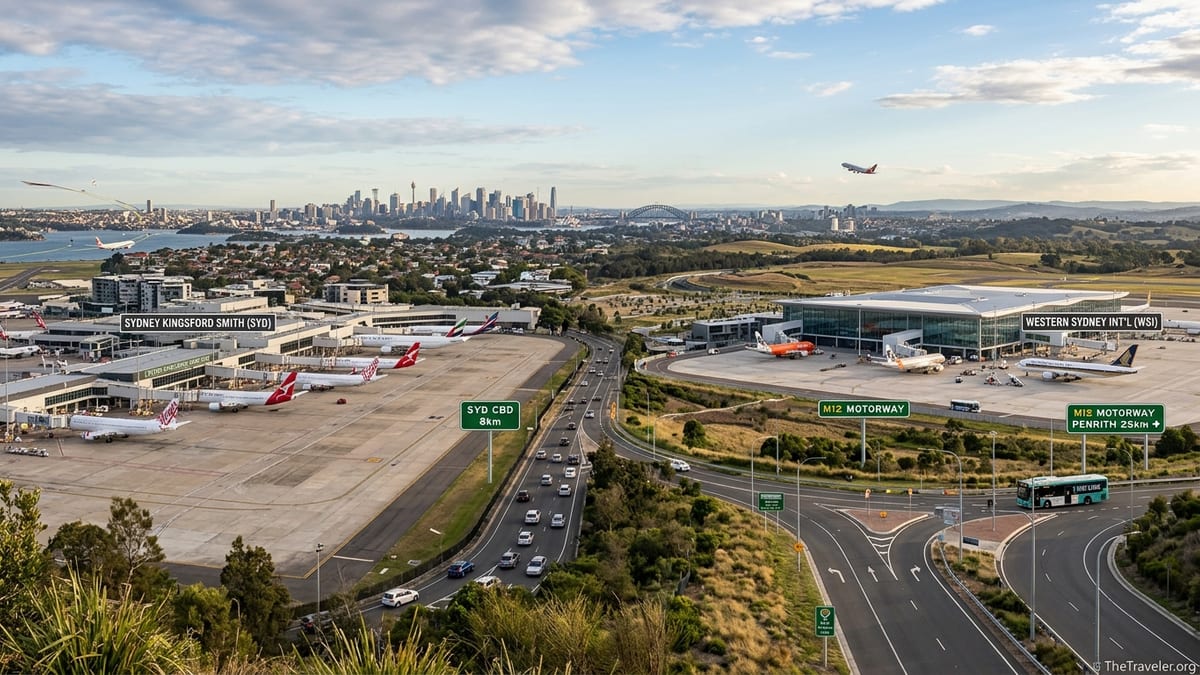
Key facts: Two very different Sydney gateways
Western Sydney International (Nancy-Bird Walton) Airport, IATA code WSI, began passenger operations on 25 October 2026 after cargo flights started in July. It sits about 44 km west of Sydney’s traditional central business district, in the Badgerys Creek and Luddenham area. The airport has been built as a long-term growth hub for Western Sydney, with a single modern terminal handling both domestic and international flights during its first phase.
Sydney Kingsford Smith Airport, IATA code SYD, remains Sydney’s main gateway and one of Australia’s busiest airports. Located in Mascot, roughly 8 km south of the CBD, it has three passenger terminals: T1 for international flights and T2/T3 for domestic services. SYD is hemmed in by suburbs and subject to a strict night curfew, but it still offers by far the widest range of airlines, destinations, and connections.
For at least the rest of the 2020s, WSI will complement rather than replace Sydney Airport. Many airlines will continue to use SYD exclusively, while a smaller group focus on serving Western Sydney from WSI. This creates a split market similar to what travelers see in cities like London or Tokyo, where different airports suit different types of trips and travelers.
Because the two airports are on opposite sides of the metropolis, choosing the wrong one can easily add an hour or more to your ground travel time. Before you book, it is worth checking not just the air fare but also the likely cost and duration of getting from each airport to your actual destination in Sydney.
Operating hours, curfews and noise rules
One of the biggest structural differences between WSI and SYD is operating hours. Sydney Airport at Mascot is constrained by the long-standing Sydney Airport Curfew Act, which generally prohibits regular scheduled take-offs and landings between 11 pm and 6 am. Airlines squeeze late-night departures and early-morning arrivals around those limits, but overnight flights are tightly controlled and slots are scarce.
Western Sydney International has been designed from the outset as a 24-hour operation. Freight flights already make use of night-time movements, and from November 2026 the new airport is intended to be Sydney’s primary base for overnight freight operations. Passenger airlines can schedule late-night and very early morning services that are simply not possible at curfew-limited Mascot.
For travelers, this has two key implications. First, if you need a very late departure from Sydney back to destinations like the Gold Coast, Melbourne or Singapore, WSI is more likely to offer it in the coming years. Second, at SYD you should expect the familiar peak-hour waves of arrivals and departures squeezed into daytime hours, whereas WSI has more flexibility to spread operations across the full 24 hours as new services ramp up.
On the ground, the noise footprint is also very different. SYD’s runways are surrounded by dense inner suburbs, where aircraft noise has been a live issue for decades. WSI sits in a less built-up part of Western Sydney that has been planned as an “aerotropolis” district. For most visitors, this is mainly a planning point: if you stay in the inner city or Eastern Suburbs, you are under the Sydney Airport flight paths; if you base yourself around Penrith, Liverpool or Campbelltown, you are much closer to WSI’s operations.
Airlines, destinations and connections
In late 2026, Sydney Airport still offers a far broader mix of airlines and routes than Western Sydney International. SYD handles the full range of full-service and low-cost Australian carriers, plus almost all of the major international brands from North America, Europe, Asia and the Middle East. If you want a non-stop flight from Sydney to Los Angeles, London, Tokyo, Dubai, Doha, Hong Kong or Bangkok, you will be using SYD for the foreseeable future.
WSI is opening with a smaller but growing roster of airlines. Jetstar operates early domestic services to destinations such as the Gold Coast, Melbourne and Brisbane, aimed squarely at Western Sydney residents who previously had to cross the city to reach Mascot. On the international side, Air New Zealand has launched flights between WSI and Auckland, and Singapore Airlines begins daily services to Singapore from late November 2026. Government and airport documents also refer to Chinese carriers and other Asia-Pacific airlines as likely future additions, but at the time of writing only a limited number of international routes are confirmed.
This difference in scale matters if you rely on onward connections. A traveler from New York, for example, will almost certainly arrive at SYD, then transfer domestically from there. Similarly, someone connecting from a European carrier via Singapore or Doha will usually land at Mascot unless their chosen airline specifically offers a WSI service. By contrast, a Western Sydney family flying directly to the Gold Coast for a school holiday might deliberately seek out a Jetstar flight from WSI to avoid crossing the city.
It is worth looking beyond published timetables and thinking about resilience. SYD’s dense network means that if one flight is cancelled, there are often alternative departures later in the day or nearby dates. At a new, smaller airport like WSI, one daily service per route is common in the early years. If that flight is disrupted, rebooking options can be more limited, which is something to factor in for time-critical trips such as cruises or important events.
Terminals, design and passenger experience
Sydney Airport’s three terminals reflect decades of incremental expansion rather than a single master design. International Terminal 1 has been progressively refurbished, but some passengers still find it crowded at peak times, and walking distances can be long. The domestic terminals T2 and T3 cater to different airlines and are not physically connected airside, which means you often have to exit and re-clear security when transferring between certain domestic carriers.
Western Sydney International has the advantage of being purpose-built in one go. Its initial terminal is designed to handle both domestic and international flights within the same overall complex. Early visitors in October 2026 have noted the sense of space, natural light and contemporary finishes that you would expect from a brand-new facility. Wayfinding and security layouts benefit from the latest thinking, and the retail and dining mix is still evolving as more tenants open.
For now, the flipside of WSI’s newness is that some services are still bedding in. You may find fewer lounge options than at SYD, fewer specialty shops, and a smaller choice of cafes or restaurants, especially late at night or very early in the morning. At Sydney Airport, on the other hand, years of commercial development mean you can expect multiple airline and independent lounges, a wide range of dining from fast-food chains to sit-down restaurants, and better-developed duty-free offerings.
From a purely comfort-focused point of view, frequent flyers who value premium lounges, spa facilities or very specific brands will probably prefer SYD in the short term. Leisure travelers out of Western Sydney who care more about avoiding a long cross-city slog may find WSI’s fresh, uncluttered terminal more appealing, even if the retail mix is still relatively modest.
Getting into central Sydney and Western Sydney
Transport links are where the two airports diverge most sharply. Sydney Airport at Mascot is tightly integrated into the city’s existing public transport network. The Airport Link train on the T8 line connects both the domestic and international terminals to Central Station in roughly 13 to 20 minutes, with trains running frequently throughout the day. As of mid-2026, a single adult trip between the airport and city stations typically costs a little over 20 Australian dollars once you include the station access fee that is charged in addition to the normal train fare.
Buses and road options at SYD are also well established. The 420 and 350 bus routes connect the airport with suburbs such as Burwood, Bondi Junction and the inner south for a standard Opal fare of just a few dollars. Taxis and rideshare services line up outside each terminal; a government-trialled flat taxi fare applies for direct trips from Sydney Airport to the CBD, and rideshare prices between the airport and central Sydney usually fall in the 40 to 70 Australian dollar range depending on traffic and time of day.
Western Sydney International is opening ahead of its long-term rail link. Until the Sydney Metro – Western Sydney Airport line is completed later this decade, the main public transport connection is WSI Link, a fare-free bus service between the airport and St Marys Station on the existing rail network. According to Transport for NSW, this bus began running from 25 October 2026, is designed to be frequent, and allows passengers to transfer at St Marys to suburban trains towards central hubs like Parramatta and the CBD. Door-to-door, a journey from WSI to Central Station is likely to take close to 90 minutes using the bus-plus-train combination.
By road, WSI is connected primarily via the new M12 motorway and upgraded arterial roads. Driving from the airport to central Sydney without heavy traffic can take around an hour, while trips to Western Sydney centres such as Penrith, Liverpool or Campbelltown can be substantially shorter. Early ride-hail estimates from Central Station to the new airport have hovered around 140 to 150 Australian dollars for a standard rideshare, reflecting both the distance and limited competition while volumes are still low.
Hotel locations and where it makes sense to stay
Hotel development patterns around the two airports also follow their different histories. Sydney Airport’s Mascot precinct already functions as a mature airport hotel zone. Within a few minutes’ shuttle or even walking distance of the domestic terminals, you will find familiar international brands ranging from budget to full-service, including properties geared to overnight layovers and early-morning departures. Many cruise passengers arriving at SYD opt to stay in the CBD instead, since central hotels offer easy access to Circular Quay and the Overseas Passenger Terminal while still being one quick train ride from the airport.
Western Sydney International sits within a rapidly developing “aerotropolis” region that is still taking shape. Planning documents and promotional material highlight upcoming business parks, logistics hubs and hotel projects, but in October 2026 the immediate airport hotel inventory remains limited compared with Mascot. Travelers using WSI for very early or late flights are more likely to base themselves in established Western Sydney centres such as Penrith, Parramatta, Liverpool or Campbelltown, then connect by car or public transport to the airport.
For visitors whose primary goal is sightseeing in central Sydney, staying in the CBD or nearby neighbourhoods like Surry Hills, Darling Harbour or The Rocks continues to make sense if they are flying into SYD. From these areas, access to the Opera House, Harbour Bridge, museums and ferries is straightforward, and the airport train or a taxi ride to Mascot is quick. Choosing accommodation near Parramatta or Penrith becomes more attractive if your flights use WSI and if you plan to focus on Western Sydney attractions, visiting the Blue Mountains, or attending events in venues such as Sydney Olympic Park.
In the coming years, travelers can expect more internationally branded hotels to open around the new airport and its associated business districts. Until then, the main consideration is whether your itinerary is city-centric, in which case SYD plus a CBD hotel is usually best, or west-focused, in which case pairing WSI with a base in Western Sydney can significantly cut your ground travel time.
Costs on the ground: real-world examples
When comparing WSI with SYD, it helps to think beyond the airfare and consider what you will realistically spend getting to and from the airport. At Sydney Airport, the most common public transport choice is the Airport Link train. A typical adult Opal fare from the domestic or international airport station to Central in mid-2026, including the station access fee, sits just above 20 Australian dollars. If you are travelling off-peak and carrying light luggage, some budget-conscious locals avoid the station access fee by taking a regular train to Wolli Creek or Mascot and then walking or catching a short bus ride to the terminals, but this is not ideal for first-time visitors or those with heavy bags.
A taxi under the CBD flat-fare scheme generally costs a little more than the train for solo travelers but can be competitive for two or three people, especially late at night when train frequencies drop. Rideshare prices vary, but it is common for a standard rideshare from SYD to a central city hotel to sit in the 40 to 70 Australian dollar range. Splitting that between two or three passengers can bring the per-person cost close to, or below, the train.
From WSI, early reports suggest that the fare-free WSI Link bus to St Marys can significantly reduce costs for patient travelers. A visitor landing on a Jetstar flight from the Gold Coast could take the free bus, tap on to a suburban train at St Marys for a normal Opal fare towards Parramatta or the CBD, and reach Parramatta for only a handful of dollars on the rail leg. The trade-off is time: that journey might take well over an hour to central Sydney, even before any transfer to a hotel.
On the other hand, a family of four from Penrith flying to Auckland on Air New Zealand might find WSI dramatically cheaper on the ground. A 30-minute drive or rideshare to WSI via the M4 and M12 could cost far less and take less time than driving or taking public transport to Mascot. In these cases, even a slightly higher air fare from WSI could still make sense once you add in fuel, tolls, parking or rideshare costs to and from the airport.
Which airport suits which itinerary?
For most short-term visitors to Sydney whose trips centre on the CBD, harbour and Eastern Suburbs, Sydney Airport at Mascot remains the most logical and convenient choice. Its combination of short travel time to central hotels, well-established train and bus links, dense taxi and rideshare availability, and huge range of onward flights is hard to beat. If you are flying long-haul from North America or Europe, or connecting to a cruise departing from Circular Quay or White Bay, you will almost certainly find yourself using SYD and should lean into its strengths.
Western Sydney International comes into its own for a different set of travellers. Residents of Western Sydney who live around Penrith, Liverpool, Campbelltown or the broader Nepean region may find that flying from WSI shaves hours off their overall journey by cutting out the cross-city trek to Mascot. So too might domestic leisure travellers heading for the Gold Coast, Brisbane or Melbourne on airlines that have chosen to focus their Western Sydney operations there, particularly if they value easy parking or late-night departures not available from SYD.
Internationally, WSI makes the most sense for travellers whose origin or destination is Western Sydney and whose airline offers a direct route there, such as the Singapore Airlines and Air New Zealand services. A Western Sydney-based business traveller heading to Singapore, for example, may happily trade SYD’s larger lounge for the convenience of driving 30 minutes to WSI and boarding a non-stop flight from a smaller, less congested airport.
There are also edge cases. A budget traveller who finds a significantly cheaper Jetstar fare to the Gold Coast from WSI but plans to spend their entire holiday in central Sydney may still be better off flying into SYD when total costs are added up. By the time you pay for a long rideshare or spend nearly two hours on public transport each way between WSI and the CBD, any saving on the ticket might disappear. Conversely, a traveler whose trip combines city sightseeing with hiking in the Blue Mountains and visiting family in Western Sydney might find a WSI arrival, a few nights in Parramatta or Penrith, and then a regional train into the city a very efficient pattern.
Looking ahead: how the picture may evolve
Both airports are in transition. Sydney Airport continues to invest in terminal upgrades, better security screening lanes, and improved ground transport management to handle surging passenger numbers without adding runways or operating hours. The curfew and surrounding urban density mean SYD’s focus will likely remain on optimizing existing capacity and serving a high volume of full-service international and domestic traffic.
Western Sydney International, by contrast, is in its infancy. The initial passenger schedule is intentionally modest, the free WSI Link bus bridges the current rail gap, and much of the surrounding aerotropolis precinct remains under development. As the Sydney Metro Western Sydney Airport line opens later this decade, the airport will gain its own dedicated rail link, cutting journey times and making WSI more competitive for CBD-bound travellers. Each new airline and route announcement will further expand the catchment of people for whom WSI is a viable first choice.
In the medium term, Sydney is likely to resemble multi-airport cities such as London or Tokyo, where locals learn to match trips to the airport that best fits their home location, budget and destination. Visitors will gradually see more itinerary options that offer one airport on arrival and the other on departure. For now, though, the simplest way to decide is to ask where you plan to spend most of your time on the ground and which airlines already serve the new airport.
Whichever airport you choose, it pays to check not only flight schedules and prices but also current ground transport options and hotel availability, as these are changing rapidly around Western Sydney International’s opening. With a little planning, travelers can use the two-airport system to their advantage, picking the gateway that best fits their own version of Sydney, whether that means rooftop bars in the CBD or weekend footy in Penrith.