


Western and eastern Sicily offer such different experiences that most first-time visitors will enjoy their trip more if they choose one side of the island and explore it in depth. Western Sicily revolves around Palermo’s layered history, Arab-Norman architecture and street food, with side trips to Trapani, the Egadi Islands and hilltop Erice. Eastern Sicily feels like another island entirely, focused on Mount Etna’s volcanic landscapes, Greek and Roman sites, elegant Taormina and easy access to lava fields, craters and gorges. This guide compares both coasts in practical detail so you can decide where to base yourselves for three to seven days without spending your holiday in the car.
Get the latest updates straight to your inbox!
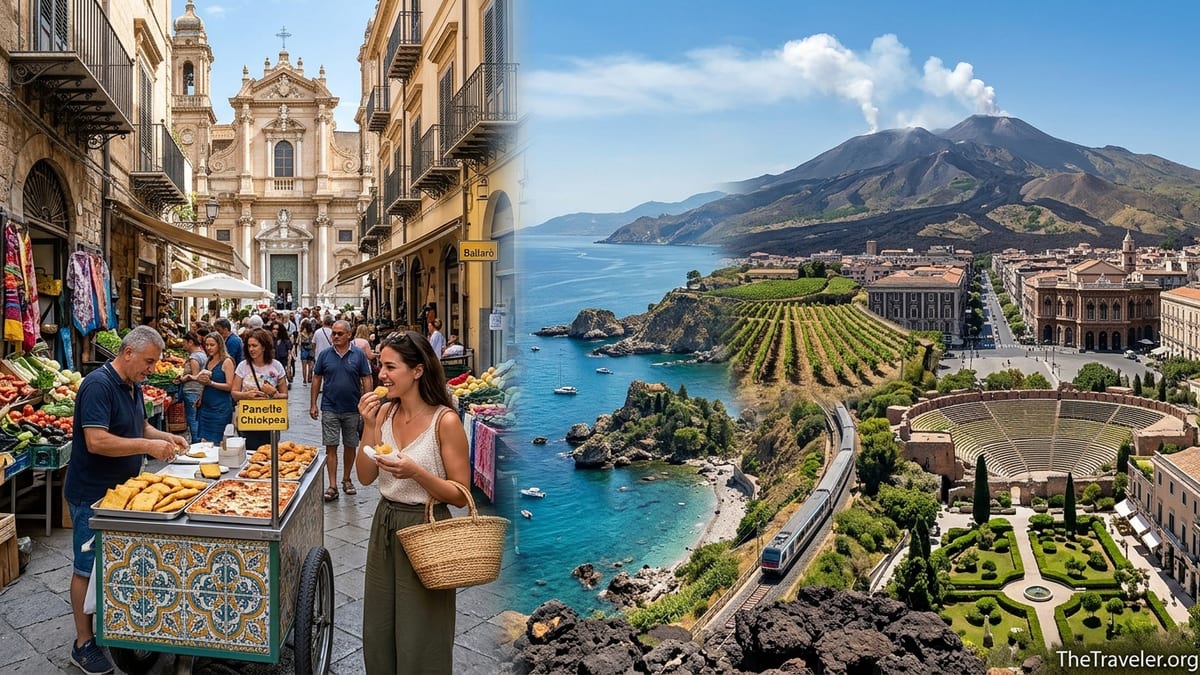
Overall feel: two very different Sicilies
Western Sicily, with Palermo and Trapani as main hubs, is dense, noisy and historical. Palermo’s centre is a tangle of Baroque churches, Arab-Norman palaces and neighbourhood markets such as Ballarò and Vucciria, where panelle chickpea fritters and sfincione pizza trays are sold from street carts. Within an hour or two you can move from Moorish-influenced lanes to the medieval town of Erice or the white coves of the Zingaro coastline. The west feels less polished, more lived-in and often better value once you step away from the most famous beaches.
Eastern Sicily around Catania, Taormina and Mount Etna has a very different energy. Catania is a black-lava city at the foot of an active volcano, with a theatrical main square, wide boulevards and nightlife that runs late even outside summer. Taormina sits high on a terrace above the sea with manicured gardens, luxury boutiques and one of Italy’s most photogenic Greek theatres. Here the landscape dominates the experience: smoking craters on Etna, the Alcantara Gorge carved through basalt walls, and rocky coves around Isola Bella and Giardini Naxos.
For first-time visitors choosing between them, the trade-off is between the slightly rougher, street-life intensity and island-hopping of the west, and the more resort-focused, volcanic and classical-ruin experience of the east. Both work for three days without a car; both reward longer stays if you are willing to drive or base yourself in two locations.
Getting there and around: airports, trains and buses
Most international visitors land either in Palermo in the west or in Catania in the east. Palermo’s Punta Raisi airport has frequent flights from major European hubs and is connected to the city by both train and shuttle bus. The Trinacria Express and the faster Genio Express link the airport with Palermo Centrale station in roughly 35 to 60 minutes, with a one-way ticket around 6.50 euros in late 2026. A dedicated airport bus operated by a private company costs about 6 euros one way and runs roughly every 30 minutes from early morning until late evening, stopping near key central hotels.
Trapani’s Birgi airport is smaller but still offers direct low-cost flights from some Italian and European cities. It is connected to Trapani by regional AST buses and seasonal shuttles running to both the port and the city’s bus terminal. Published 2026 timetables show frequent daily buses between the airport and Trapani town, coordinated with peak arrival times in summer. This makes Trapani a workable base without a car if you plan mainly boat trips to the Egadi Islands and short local excursions.
On the eastern side, Catania Fontanarossa is Sicily’s busiest airport, with dense connections to mainland Italy and Europe. The AMTS Alibus shuttle links the terminal and Catania Centrale station for 4 euros per person; the ticket is valid for 90 minutes on city buses and the service typically runs every 20 to 30 minutes from around 4.40 in the morning to after midnight. Recent municipal rules have introduced a flat taxi fare of about 27 euros between the airport and central Catania zones until at least the end of 2026, useful if you arrive late with luggage.
For longer movements, Sicily’s main rail line runs down the east coast, making Catania, Taormina-Giardini station and Syracuse straightforward to reach by train. On the west, trains connect Palermo with Cefalù and Trapani, but many routes are slow and infrequent. Between Palermo and Catania there are direct trains, yet the journey often takes around three hours. Buses generally fill in the gaps, especially to San Vito Lo Capo, Scopello, Segesta, Noto and inland archaeological sites. Public transport is practical for city-to-city travel and for popular beaches, but it is less convenient for remote coves, scattered temples and sunset viewpoints. Renting a car remains the easiest way to link multiple small towns in a short stay, particularly in western Sicily.
Beaches: sand versus coves on both coasts
Beach expectations are one of the biggest differences between western and eastern Sicily. In the west, the postcard beach is San Vito Lo Capo: a long white arc of sand under limestone cliffs, developed with lidos renting two sunbeds and an umbrella from roughly 25 to 35 euros per day in peak August, plus free public sections. South of it, the Zingaro Nature Reserve and the coves near Scopello offer clear turquoise water and rock or pebble beaches framed by cliffs. Access usually involves short hikes and modest entrance fees at the reserve gates, and in high summer the car parks near the trailheads can fill by mid-morning.
Closer to Palermo, Mondello is the city’s own beach suburb, with a wide sandy bay and Belle Epoque villas. Here, private lidos rent out sunbeds starting around 20 euros per pair in high season, and the free public strip is often crowded by locals. A little further along the coast, Cefalù offers a mix: a sandy crescent right under the old town and more rugged stretches beyond the centre. All of these western beaches are reachable without a car by seasonal buses from Palermo or Trapani, but services can be crowded in July and August and schedules thin out noticeably in late September and early October.
Eastern Sicily’s flagship beach near Taormina is not long sand but the pebble coves around Isola Bella and Mazzarò. The scenery is dramatic, with steep slopes and a tiny island linked to the shore, but you will mostly be on pebbles or concrete platforms. Lido packages near Taormina often cost from 30 euros upwards for two beds and an umbrella at the height of summer. Just south in Giardini Naxos you find a mix of coarser sand and pebbles, a more low-key resort atmosphere and slightly lower prices. Farther down the coast, the area between Syracuse and Noto, including beaches like Fontane Bianche and the Vendicari reserve, offers more of the soft golden sand that many visitors picture when they think of Sicily.
For visitors who prioritise long sandy beaches within an hour or so of a major city, western Sicily is more reliable. Eastern Sicily delivers spectacular seascapes but often on pebbly or rocky shores, unless you are prepared to travel south by car or bus toward the Syracuse coastline or inland river gorges for freshwater swimming.
Day trips and excursions: islands versus volcano
Western Sicily’s classic day trips from Palermo or Trapani focus on islands, hill towns and ancient temples. From Trapani port, frequent hydrofoils and ferries reach Favignana and Levanzo in under an hour. Typical return fares for foot passengers to Favignana in summer range from roughly 25 to 35 euros per person depending on operator and timetable, and bike or scooter rental on arrival is widely available. Once there, you can cycle between cove-like beaches such as Cala Rossa and Cala Azzurra, many with flat rock shelves and clear water ideal for snorkelling.
Also within easy reach from Trapani is the medieval town of Erice, accessible by cable car when winds permit or by the panoramic road. The cable car ticket is usually priced well under 15 euros return, while parking a rental car in Erice’s public lots costs only a few euros per hour. South of Trapani, the salt pans of Marsala and Paceco provide a very different landscape, with shallow basins, windmills and sunset colours. From Palermo, popular day trips include the Doric temple and amphitheatre at Segesta and the well-preserved Greek city of Selinunte, which usually require either a rental car or full-day coach excursion.
Eastern Sicily’s headline excursion is Mount Etna itself. Many visitors base in Catania or Taormina and either join a guided tour or drive to Rifugio Sapienza at around 1,900 metres. As of late 2026, the official cable car on the southern side charges about 54 euros return for adults to 2,500 metres. Packages that combine cable car, 4x4 buses and a short guided crater walk to roughly 2,750 to 2,900 metres generally cost between 78 and a little over 80 euros per person, paid partly in cash on site. Independent hiking options also exist, but summit access above about 2,900 metres is often restricted and subject to changing volcanic conditions.
Besides Etna, the east offers the theatre and medieval lanes of Taormina, the baroque cities of Syracuse and Noto, and the Alcantara Gorge, where paid park areas provide stairways and equipment rental to explore chilly, fast-flowing water between tall basalt walls. Many day tours combine Etna with a winery stop in the lava foothills, typically adding 30 to 60 euros per person to the price of a group excursion with tastings and light lunch. Compared with western Sicily’s ferries and hilltowns, the east is more about vertical landscapes and classical ruins than boat hopping.
History, food, prices and atmosphere
Historically, Palermo showcases Sicily’s mix of Norman, Arab and Baroque influences more obviously than Catania. The Palatine Chapel’s mosaics, the cathedral with its royal tombs and the tight Kalsa district all feel distinctly layered. Trapani and nearby Marsala recall the era of salt pans, tuna fisheries and fortified wines. In the east, Syracuse and Taormina focus more on Greek and Roman heritage: the Neapolis archaeological park in Syracuse contains a Greek theatre still used for performances, a Roman amphitheatre and the famous “Ear of Dionysius” cave, while Taormina’s hillside theatre frames Mt Etna in the background.
Food reinforces the contrast. Around Palermo and Trapani, street food dominates: arancine filled with ragu or butter, spleen sandwiches, chickpea fritters and panelle tucked into bread, inexpensive sfinci doughnuts dusted with sugar. Fish couscous in Trapani, often served in clay pots with rich broth, reflects North African roots. In the east, menus feature pasta alla Norma with tomatoes, fried aubergine and ricotta salata, as well as dishes showcasing pistachios from Bronte and wines from Etna’s lava terraces. Both sides share Sicilian staples such as cannoli and granite, yet flavours and presentation differ enough to feel like two related cuisines.
In cost terms, Palermo and Catania are generally the most affordable big bases, with midrange double hotel rooms outside peak August often available between roughly 80 and 140 euros per night, plus municipal tourist taxes of a few euros per person per night. Trapani is similar or slightly cheaper than Palermo; Taormina is the clear outlier: even in shoulder season, many central hotels and guesthouses quote well over 180 euros per night for a standard double, and in high summer three-star rooms can exceed 250 euros before breakfast and taxes. Restaurant prices follow the same pattern, with sit-down seafood dinners in Taormina’s core streets commonly reaching 40 to 50 euros per person with wine, compared with 25 to 35 euros in Palermo or Catania for comparable quality.
Atmosphere also varies. Palermo’s historic centre is busy, occasionally chaotic, and still has a significant local population alongside tourists. Catania combines a working port, university life and nightlife that continues late around piazzas and side streets. Trapani feels more small-town and maritime, especially near the port, while Taormina leans sharply toward polished tourism, with cruise excursions, destination weddings and designer boutiques concentrated in a compact pedestrian core. For some travellers that glamour is a highlight; for others it makes the experience feel less authentically Sicilian.
Sample itineraries: 3 and 7 days on each coast
For a three-day western Sicily trip without a car, a realistic plan is to base in Palermo. On day one, explore the historic centre on foot, visiting the cathedral, Palatine Chapel and Ballarò market, and spend evening hours sampling street food near Piazza Pretoria. Day two, take a morning train to Cefalù for beach time and old-town wandering before returning in the evening. Day three, join a coach or organised excursion to Monreale’s mosaic-covered cathedral and possibly on to Segesta if time allows. With a rental car, you could instead divide your base: one night in Palermo, two in Trapani, with a day trip to the salt pans or Erice.
For a full week in western Sicily with moderate driving, a strong route is three nights in Palermo and four in Trapani. From Palermo, fit in Mondello beach, Monreale and an optional day to Cefalù. Transfer to Trapani by train or bus, then spend one day on Favignana, one exploring Erice and the salt pans, and one on a longer excursion to Segesta or Selinunte using a car or organised tour. This pattern keeps individual drives mostly under two hours and avoids daily packing and unpacking.
On the eastern side, a three-day itinerary without a car works well with a base in Catania. Dedicate day one to the city’s baroque centre, fish market and evening aperitivo scene. On day two, take a guided Etna excursion that includes transport, which typically runs from morning to late afternoon and costs from around 55 euros per person for low-altitude hikes to 80 euros or more for higher cable car and 4x4 combinations, plus any winery supplement. On day three, ride the train or Interbus coach to Taormina for the day, using the cable car or local shuttle to reach Isola Bella for a swim.
For seven days in the east with limited driving, consider basing three nights in Catania, two in Taormina or Giardini Naxos and two in Syracuse. From Catania, schedule your Etna tour early in the stay to allow for possible weather disruptions, then day-trip to Taormina or the coast. Move to Taormina or nearby Giardini Naxos for balcony views and a slower resort pace, then continue by train or bus to Syracuse for archaeology, the island of Ortigia and, if time allows, a half-day to Fontane Bianche or the baroque town of Noto. If you prefer fewer hotel changes, you can base the full week in Catania and rely on organised day trips to Etna, Taormina and Syracuse, accepting some longer bus days.
Costs, cars, parking and practical budgets
Accommodation and transport choices make a significant difference to overall budget. For a couple staying two nights in Palermo or Catania and using only public transport, a realistic low-to-midrange budget in 2026 might include around 200 to 260 euros for a central hotel (100 to 130 euros per night), 25 to 35 euros per day for food if you mix street food with one sit-down meal, plus roughly 10 to 20 euros each for airport transfers and local buses or trams. Adding entrances to major monuments and one modestly priced guided city tour could bring the total for two nights to around 450 to 550 euros for two people.
With a rental car in the same cities, daily costs shift. Compact cars often start around 30 to 45 euros per day in low season, rising in summer, and many central hotels in Palermo, Catania and especially Taormina charge 15 to 30 euros per day for parking, whether on-site or at nearby garages. Municipal tourist taxes, usually collected per person per night, add another 2 to 4 euros each depending on category and municipality. A two-night stay with a car can therefore easily reach 550 to 650 euros once fuel, ZTL restrictions and parking are factored in, particularly if you choose a garage to avoid fines.
For a seven-night stay, numbers multiply. A couple relying on trains, intercity buses and two organised day tours on either coast might expect to spend roughly 900 to 1,400 euros on accommodation, depending on whether they include nights in Taormina or stick to Palermo, Trapani, Catania and Syracuse. Food for a week, even allowing for several seafood dinners and café breakfasts, may run from about 350 to 600 euros for two. Add 150 to 300 euros for public transport, airport transfers and museum entries, plus 200 to 350 euros for two midrange group excursions such as Etna and an islands or baroque city tour, and a one-week budget often settles somewhere in the 1,800 to 2,500 euro range for a couple.
Travellers who rent a car for most of a week in order to explore smaller towns and remote beaches generally add 300 to 500 euros in car hire, 80 to 150 euros in fuel and 80 to 200 euros in parking and tolls. On the flip side, they can reduce spending on guided tours if they prefer to visit sites independently. In both east and west, staying slightly outside the most expensive cores, such as choosing Giardini Naxos over central Taormina or a Trapani old-town guesthouse over a boutique hotel facing Favignana’s harbour, keeps budgets more manageable.
Climate, crowding and accessibility
Sicilian summers have grown hotter and drier, with daytime highs in July and August often reaching above 35 degrees Celsius in both Palermo and Catania. The heat is particularly noticeable in inland archaeological sites with little shade, such as Segesta, Selinunte or the Greek theatre and stone quarries in Syracuse. Beach access can also be affected as parking lots at San Vito Lo Capo, Scopello and Taormina’s coastal areas fill early, leading some municipalities to limit car entry or increase shuttle services during peak weeks around mid-August.
Mount Etna complicates planning further. Conditions near the summit can be 10 to 15 degrees cooler than the coast even on hot days, and sudden weather changes or eruptive phases can restrict access. In early 2026, for example, increased activity led authorities to limit guide routes at certain altitudes for safety, reminding visitors that advance bookings may still be altered near the date. When booking a high-altitude Etna excursion from either Catania or Taormina, it is wise to schedule early in your stay, carry warm layers and budget enough for rescheduling or choosing a lower-altitude alternative if upper paths close.
In terms of accessibility, Palermo’s old town and Catania’s centre both feature uneven paving, traffic and occasional narrow sidewalks, which can challenge travellers with mobility issues. Taormina’s Corso Umberto is largely flat, but many hotels involve stairs, and reaching Isola Bella requires steep paths or cable-car use. On the west, beach towns such as San Vito Lo Capo and Mondello offer flatter promenades and more step-free beach access but can be extremely crowded in high season. Shoulder months such as late May, June, late September and early October usually balance milder temperatures, open seasonal services and manageable visitor numbers on both coasts.
Who should choose which coast, and when to combine both
Western Sicily suits travellers who prioritise history, street life and value. Beach lovers who want long sandy stretches within reach of a major city will appreciate Mondello, Cefalù and San Vito Lo Capo, while food-focused visitors can spend days grazing Palermo’s markets and trying Trapani couscous, Marsala wines and rustic trattorie. The west works especially well for families and couples who like boat trips to islands, easy hilltop towns like Erice, and a slightly slower, more lived-in feel, especially outside August.
Eastern Sicily is ideal for those drawn to dramatic landscapes and classical ruins. Hikers and curious first-time visitors who want to stand on the flanks of an active volcano will find Etna tours, lava fields and the Alcantara Gorge compelling. Culture lovers can pair these with performances in Syracuse’s Greek theatre or sunsets from Taormina’s terraces. The east tends to suit travellers willing to pay a premium for views and atmosphere in Taormina, or those happy to base in Catania or Syracuse and make focused day trips.
For many first-time visitors with only a week, combining both coasts is possible but works best if you are comfortable with at least one three- to four-hour transfer and limit your bases to two or three. A practical combined plan might be three nights in Palermo and four in Catania, using the direct bus or train between them and skipping intermediate stops. However, this inevitably means sampling rather than deeply exploring each side. If your time is short and your interests clearly align with one coast, concentrating your week in either the Palermo–Trapani area or the Catania–Taormina–Etna–Syracuse corridor generally leads to a more relaxed and immersive trip.
Ultimately, the choice comes down to whether your Sicilian imagination runs more to markets, islands and Arab-Norman palaces, or to smoking craters, Greek theatres and clifftop resorts. With a clear sense of your priorities and the practical differences in transport, costs and landscapes outlined above, both western and eastern Sicily can deliver a first visit that feels rich without feeling rushed.