


The Absheron Peninsula, fanning out into the Caspian Sea east of Baku, is where Azerbaijan’s nickname the Land of Fire comes to life. Within an hour or two of the capital you can stand before a Zoroastrian fire temple, watch a hillside burn with natural gas flames, bump along dusty tracks to bubbling mud volcanoes and finish the day with Caspian winds in a stark coastal national park. With a bit of planning, you can link Absheron’s main sights into a logical loop that feels like a journey through both geology and history rather than a rushed box-ticking tour.
Get the latest updates straight to your inbox!
Why Absheron Belongs on Your Baku Itinerary
The Absheron Peninsula is essentially Baku’s backyard, a tongue of semi-desert land jutting into the Caspian Sea that concentrates many of Azerbaijan’s signature landscapes in a compact area. Within roughly 30 to 70 kilometers of downtown you can access sites like the Ateshgah Fire Temple at Surakhany, the burning hillside of Yanardag near Mammadli village, clusters of mud volcanoes around the Mud Volcanoes State Nature Reserve and the coastal habitats of Absheron National Park. That density makes Absheron one of the easiest full-day excursions from the capital without needing domestic flights or overnight stays.
What distinguishes Absheron is not just convenience but contrast. In a single day you can move from medieval fortress towers in villages such as Mardakan or Nardaran to extremely modern oil infrastructure along the coast, then on to wild-feeling steppe where gazelles and migratory birds still roam. Several of these sites, like Gobustan’s mud volcano fields and Yanardag’s eternal flames, are directly tied to the same underground gas and oil deposits that shaped Azerbaijan’s economy and culture.
Visitor numbers to the region have been rising in recent years as national parks and reserves receive more promotion and basic visitor facilities. Absheron National Park, established south of Baku, has been among the country’s most visited protected areas, while Gobustan’s rock art and mud volcano landscapes, often combined with Absheron’s fire sites on day trips, are now staples of regional itineraries. That popularity means you will find plenty of tour options and shared transport possibilities, alongside the freedom to self-drive if you prefer to explore at your own pace.
For most travelers, the challenge is not whether to go but how to organize the route so that it feels coherent. Thoughtful sequencing of stops and realistic travel times can mean the difference between a day spent mostly on the road and one that flows smoothly from one geological and cultural highlight to the next.
Choosing the Right Route: Classic Loop vs Focused Fire Circuit
The most efficient way to experience the Absheron Peninsula in a single day is to travel as a loop rather than shuttling back and forth from Baku between individual sights. A classic loop starts from central Baku in the morning, heads southwest towards Gobustan’s rock art and mud volcanoes, then arcs back across the peninsula to the Ateshgah Fire Temple in Surakhany and finishes at Yanardag before returning to the city in the evening. Many organized day tours follow a version of this pattern because it minimizes repeated driving and hits the highest-profile attractions in roughly 10 to 11 hours including stops.
If you want a shorter outing, consider a focused fire circuit that skips Gobustan and the more distant mud volcano sites. In that case you can leave Baku mid-morning, visit medieval village fortifications in Ramana or Mardakan, continue to the Ateshgah Fire Temple for early afternoon, then reach Yanardag for late-afternoon or sunset flames before returning to the city. This itinerary works well if you have limited time, are traveling with children or prefer not to spend long stretches in the car but still want to experience Absheron’s fire-related heritage.
Self-drivers should tailor their route to daylight hours and their comfort with local traffic. Roads to Surakhany and Yanardag are paved and straightforward, though traffic in and out of Baku can be heavy at commuting times. Tracks to mud volcano fields are rougher and often require a high-clearance vehicle, which is why many independent travelers drive a normal rental car only as far as Gobustan’s visitor area, then hire a local Lada driver on the spot to tackle the last few kilometers. A coastal diversion to Absheron National Park fits best on a second day or as an alternative to Gobustan if you prefer wildlife viewing and quiet beaches instead of rock art.
When estimating time, assume that each major site will take at least one hour on the ground, more if you like to linger or photograph. One common pitfall is underestimating the impact of lunch and coffee breaks, fuel stops and basic tasks like buying tickets, which can easily add two or more hours across the day. Building a modest buffer into your route plan will let you enjoy the landscapes without constantly watching the clock.
Morning: From Baku to Gobustan’s Rock Art and Mud Volcanoes
Most full-day circuits begin with an early departure from Baku around 8 or 9 a.m., taking the main highway southwest along the Caspian shoreline. Within an hour you reach the Gobustan area, where the landscape begins to change to low, eroded hills and rock outcrops. The UNESCO-listed Gobustan Rock Art Cultural Landscape sits just beyond the modern town, with a small visitor center and museum leading to walking paths among boulders carved with petroglyphs of hunters, animals and ancient boats. Plan at least 60 to 90 minutes for the museum and the easiest walking loop if you want time for photos and interpretation.
From Gobustan’s rock art zone, many travelers arrange a side trip to nearby mud volcano fields. Azerbaijan hosts hundreds of mud volcanoes, and the ones frequently visited on day trips form a grey, lunar-like field of conical mounds that occasionally gurgle cold mud. The access track is unpaved and often rutted, which is why tour operators typically switch guests into sturdy Soviet-era Lada vehicles for the last section. Visitors commonly report paying a modest fee per person or per car for this transfer and the site’s admission, usually equivalent to the cost of a casual meal in central Baku, making it a relatively accessible experience.
Conditions at the mud volcanoes are basic, with little shade or facilities beyond perhaps a small kiosk or informal vendor. Good footwear that you do not mind getting dirty is essential, and many travelers bring a change of socks if they plan to get close to the bubbling pools. On windy days the area feels very exposed, so a hat, sunglasses and a light scarf or buff can make time among the mounds more comfortable.
If you prefer to avoid rough tracks but still want to see examples of mud volcanoes, some itineraries include a visit to the newer Mud Volcanoes Tourism Complex associated with Gobustan, which offers a more structured environment, paved paths and designated viewpoints. It does not completely replace the feeling of standing in an open field of natural cones but is a practical compromise for visitors with mobility issues or limited time.
Midday: Crossing the Peninsula to the Ateshgah Fire Temple
By late morning or midday most routes leave the Gobustan area and cross back eastward towards the inner part of the Absheron Peninsula. The drive to Surakhany, home of the Ateshgah Fire Temple, typically takes around 60 to 90 minutes depending on traffic and any brief roadside stops. En route you may pass industrial zones and oil fields, a reminder that the same gas seeps that once fed open flames for worshippers now underpin modern extraction and refining. For many travelers, witnessing nodding pumpjacks against the horizon adds context to the Land of Fire narrative.
The Ateshgah complex itself is a walled, pentagonal courtyard with a central fire altar, surrounded by small chambers that once housed pilgrims and monks. Inscriptions link the site to a mix of Zoroastrian and later Hindu and Sikh visitors, though the exact history is complex and open to interpretation. The natural gas that originally fueled the temple’s flames no longer burns in its original form, but carefully managed gas lines now keep a symbolic fire alive for visitors to see. Expect to pay a modest entrance fee in local currency at a ticket office outside the main gate.
Inside, the complex is compact enough to explore in an hour yet detailed enough to reward a slower look. Small museum-style displays explain trade routes that once linked Absheron to the Indian subcontinent, and wall plaques in English and Azerbaijani describe rituals performed here. Photographers find plenty of angles, from the geometry of stone arches to close-ups of script carved into the walls. Midday light can be harsh, so if you are particularly keen on photography, consider timing your visit for earlier or later in the day when shadows add depth to the stonework.
Facilities around Ateshgah are relatively developed compared with other stops on the route. You will usually find restrooms near the entrance and several simple cafes or teahouses on surrounding streets serving dishes such as kebabs, plov and salads. This makes Surakhany a convenient place to pause for lunch, especially if you have been exploring Gobustan on foot earlier in the morning. Budget for a meal that is slightly lower in price than equivalent dishes in central Baku, reflecting the location outside the main tourist zones.
Afternoon and Sunset: Experiencing Yanardag’s Eternal Flames
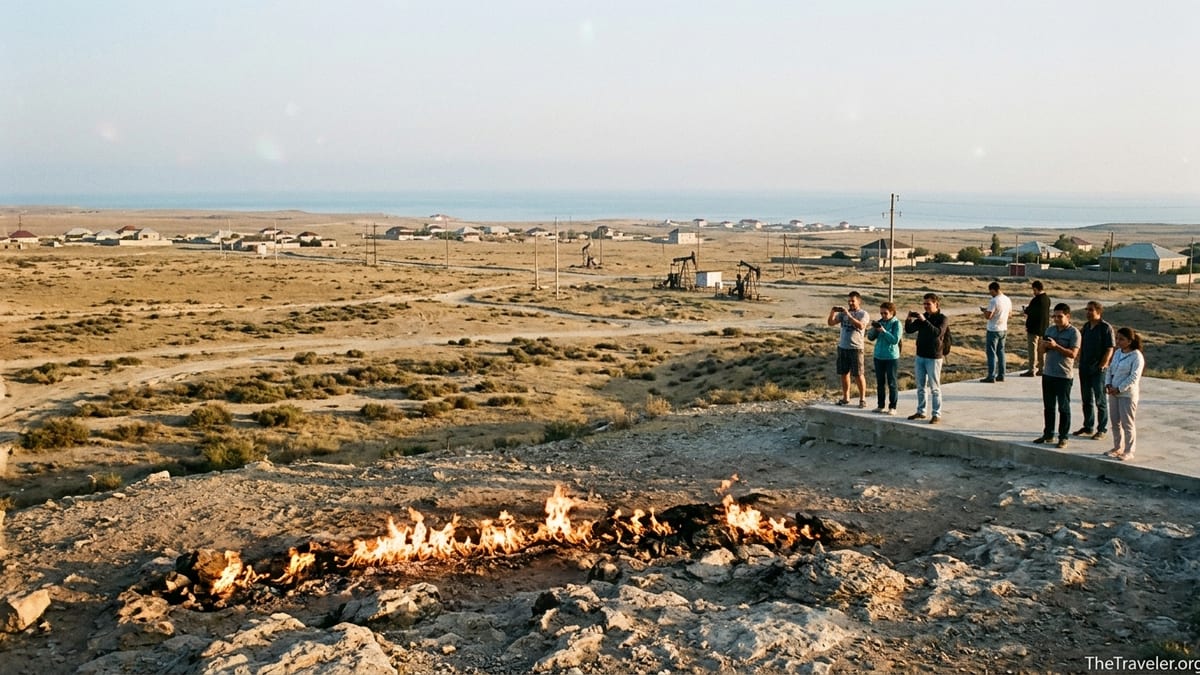
From Ateshgah, the route to Yanardag typically takes 30 to 40 minutes, skirting residential neighborhoods and low hills before rising gently towards the burning slope. Yanardag is not a towering mountain but rather a modest hillside where a line of natural gas vents feeds a continuous curtain of flame along an exposed rock face. The area around it has been formalized as a state reserve with ticketed entry, a visitor center and viewing terraces where you can safely observe the fire.
Many travelers time their arrival at Yanardag for late afternoon or early evening, when the contrast between the flames and a darkening sky becomes more dramatic. In strong daylight the fire is still visible but less photogenic, whereas at dusk the orange tongues of flame stand out sharply against the rock. Even in summer, a breeze can carry the heat sideways, so you may feel both wind-chilled and warmed on your face depending on where you stand along the viewing area.
The facility includes interpretive exhibits that explain the geology of natural gas seeps and recount local legends about shepherds and travelers who once used such flames for warmth and cooking. Benches and low walls provide places to sit and contemplate the scene, and a small café or stall often serves tea and snacks. Visitors commonly spend 45 to 60 minutes here, longer if waiting for the light to change or if the site is less crowded and quiet.
One practical tip is to bring an extra layer even in warmer months. The Absheron Peninsula is known for its winds, and exposed locations like Yanardag can feel notably cooler than sheltered streets in Baku. In shoulder seasons such as April, May, September and October, a lightweight jacket will make waiting for sunset more comfortable, especially if you have already spent most of the day outdoors.
Adding Absheron National Park and Castle Villages
Travelers with an extra day or those who prefer to build a more nature-focused route can add Absheron National Park to their itinerary. Located at the southern tip of the peninsula, roughly 30 kilometers from Baku, the park protects semi-arid landscapes and coastal habitats with dunes, steppe vegetation and access to the Caspian shoreline. Wildlife densities are not high and sightings are never guaranteed, but the area provides potential views of gazelles, foxes and a range of birdlife, especially during migration periods. The park’s small size makes it feasible for a half-day trip with simple walking and photo stops.
Reaching Absheron National Park is easiest with a private car or organized tour, as public transport connections are limited and the final approaches can be confusing for first-time visitors. Once inside, facilities are basic, typically limited to marked tracks, occasional ranger posts and perhaps a few simple shelters. Bring your own water, snacks and sun protection; the environment is open and shade is scarce. Many visitors arrive in the morning to enjoy softer light over the dunes and to avoid the peak afternoon heat in summer.
If you are more interested in historical architecture than open landscapes, consider weaving castle villages into your Absheron route. Settlements such as Mardakan, Nardaran, Ramana and Gala preserve stone fortifications and watchtowers that once guarded trade routes and coastal approaches. These towers, often dating from the medieval period, can be visited relatively quickly, with some allowing entry to climb interior staircases for views over the low-rise surroundings. Including one or two such stops on the way to or from Ateshgah adds variety without requiring major detours.
One possible structure for a second Absheron day would be a morning in Absheron National Park, followed by lunch in a village near the northern shoreline, then an afternoon exploring two or three castle settlements and finishing in the open-air museum area at Gala, which showcases vernacular architecture and traditional rural life. This slower circuit contrasts nicely with the geology-heavy fire route and offers a more intimate look at everyday life on the peninsula beyond Baku’s urban core.
Transport, Tours and Practical Logistics
There are three main ways to travel around the Absheron Peninsula: joining an organized tour from Baku, hiring a private driver or guide for the day, or combining public transport with taxis and walking. Organized day tours are widely advertised through hotels and guesthouses in Baku and typically include transport, guiding and entry to multiple sites like Gobustan, the mud volcanoes, Ateshgah and Yanardag in one package. Prices fluctuate with season and inclusions, but many travelers report paying an amount roughly equivalent to a mid-range dinner for two in Baku for a full-day group excursion.
Hiring a private driver or guide gives you more flexibility over timing and stops. This is particularly useful if you want to linger in places that interest you most, such as spending extra time photographing petroglyphs or walking in Absheron National Park. Drivers can be arranged through hotels, local travel agencies or ride-hailing services in Baku, with daily rates varying according to vehicle type and language skills. Splitting the cost between three or four travelers often makes this option comparable in price to joining a group tour while preserving a more personal experience.
Public transport is technically possible but best suited to confident, patient travelers or those focusing on a single site rather than a full loop. For example, city buses or minibuses can take you from Baku towards Surakhany for Ateshgah, from where you would still need a short taxi ride to the entrance. Reaching Yanardag from the city requires a combination of bus routes or a metro-plus-taxi combination. This approach can reduce costs, but it adds complexity and travel time, and schedules may shift without formal announcement.
Whichever transport method you choose, a few shared practicalities apply. Carry small denominations of Azerbaijani manat for entry fees, local snacks and short taxi rides, as card acceptance can be unreliable outside central Baku. Bring a fully charged phone with an offline map of the region in case network coverage dips, particularly near coastal or industrial zones. Comfortable, closed footwear and layered clothing are important, as surfaces can be dusty, rocky or muddy and temperatures vary significantly between shaded museums and windswept ridge tops.
Seasonal Considerations and Safety on the Peninsula
The Absheron Peninsula can be visited year-round, but conditions differ markedly with the seasons and will shape your experience. Summer months from June to August tend to be hot and dry, with strong sun and frequent winds; plan for early starts, midday shade and ample water, especially at exposed sites like the mud volcanoes and Yanardag. Spring and autumn offer more moderate temperatures and are widely regarded as the most comfortable months for full-day excursions, though you may still encounter brisk winds and occasional rain squalls.
Winter brings milder temperatures than inland regions but can feel harsh due to damp, penetrating winds from the Caspian. Sites remain open, but you will want a warm jacket, hat and gloves for standing still at viewpoints. On wet days, unpaved tracks to mud volcano fields can become slippery and at times impassable for regular vehicles, prompting some operators to adjust itineraries to focus on more accessible attractions like museums and the fire temple instead.
In terms of safety, the main risks on an Absheron route are environmental rather than criminal. Uneven rock surfaces at Gobustan, loose gravel around mud volcanoes and low walls near viewpoints warrant careful footing, especially if you are distracted by photography. At Yanardag, respect safety barriers and maintain a sensible distance from the flames, which can flare or shift slightly with the wind. Heat exhaustion and dehydration are easily preventable with water, sun protection and regular breaks in shade where available.
As always when traveling in semi-remote environments, inform someone at your accommodation about your planned route if you are self-driving and expect to return late, and carry a small kit with basic supplies such as plasters, pain relievers and tissues. If you are traveling with children, it is wise to agree in advance on clear ground rules about not running near cliff edges or approaching mud pools and open fires too closely.
The Takeaway
Experiencing the Absheron Peninsula is less about ticking off disconnected sights and more about understanding how they relate to each other and to Azerbaijan’s broader story. Linking Gobustan’s rock art, the surreal fields of mud volcanoes, the Ateshgah Fire Temple and Yanardag’s burning hillside into a thoughtful loop lets you trace a line from ancient belief systems through natural geology to modern energy production. Each stop adds a chapter, and together they create a day that feels both educational and viscerally memorable.
Building the right route for your interests and time frame is the key decision. Travelers drawn to dramatic landscapes and geology may prioritize Gobustan and the mud volcano fields, while those with an eye for architecture and cultural history might lean more heavily on castle villages, the fire temple and the open-air heritage museum at Gala. Nature enthusiasts can expand the trip into two days by adding Absheron National Park and quiet stretches of Caspian coastline for birdwatching and simple walks.
Whichever combination you choose, thoughtful timing, realistic expectations about driving and entry logistics, and a bit of flexibility for weather will go a long way. Plan around the light for your most photographic stops, carry cash and layers for the peninsula’s changeable winds and be willing to linger when a place resonates with you instead of racing on to the next marker on the map.
With that mindset, the Absheron Peninsula becomes more than a convenient day trip from Baku. It turns into a compact, powerful introduction to the natural forces and human stories that have shaped Azerbaijan, offering a blend of fire, stone, sea and sky that is hard to find anywhere else in such an accessible circuit.
FAQ
Q1. Can I visit Absheron’s main sights in one day from Baku?
Yes, most travelers comfortably visit Gobustan rock art, a mud volcano field, the Ateshgah Fire Temple and Yanardag on a long but manageable full-day loop from Baku.
Q2. Is it better to take a tour or travel independently on the Absheron Peninsula?
Organized tours simplify logistics and usually include transport to rough tracks near mud volcanoes, while independent travel offers more flexibility but requires more planning and navigation.
Q3. How much walking is involved at sites like Gobustan and Yanardag?
Gobustan involves short but sometimes uneven walks among rocks and petroglyphs, while Yanardag requires only a brief stroll from the entrance to the viewing terraces, making it accessible for most visitors.
Q4. Are the mud volcanoes safe to visit?
Yes, when you stay on firm ground and follow local guidance. The mud is generally cool rather than hot, but edges can be slippery, so good footwear and sensible distances are important.
Q5. Which season is best for an Absheron Peninsula trip?
Spring and autumn offer the most comfortable temperatures and light, while summer can be very hot and windy and winter tends to be chilly and damp, especially in exposed locations.
Q6. Can I reach Ateshgah and Yanardag using public transport?
It is possible to combine city buses or metro with short taxi rides to reach both sites, but routes can be slow and confusing, so many visitors prefer tours or private drivers for efficiency.
Q7. Do I need special clothing or gear for the trip?
Closed-toe shoes with good grip, layered clothing to handle sun and wind, a hat, sunglasses and sunscreen are usually sufficient; in winter add a warm jacket and gloves.
Q8. Are there food and restroom facilities along the route?
Yes, you will find basic facilities at major sites such as Gobustan’s visitor center, Ateshgah and Yanardag, along with simple cafes or teahouses in nearby villages and towns.
Q9. Is Absheron National Park worth adding if I only have one day?
It can be, if you are particularly interested in quiet coastal landscapes and wildlife, but most first-time visitors prioritize Gobustan, the fire temple and Yanardag when time is tight.
Q10. Can children enjoy an Absheron Peninsula day trip?
Many families report that children enjoy the spectacle of mud volcanoes and flames at Yanardag, but adults should supervise closely around uneven ground, open fires and roadside stops.