


Few cities offer day trips as dramatically different as those from Baku. Within an hour’s drive you can be tracing 10,000-year-old rock art in a lunar desert, or standing beside temples and burning hillsides that gave Azerbaijan its nickname, the Land of Fire. For most visitors with limited time, the real dilemma is simple: if you can only pick one day trip, should it be the Absheron Peninsula or Gobustan National Park?
Get the latest updates straight to your inbox!
Two Very Different Faces of Azerbaijan
On a map, Absheron and Gobustan sit practically next to each other, both fanning out from Baku along the Caspian shore. In reality, they deliver very different moods. The Absheron Peninsula is all about fire, faith and living culture: the Ateshgah Fire Temple, the eternal flames of Yanar Dag, fortified towers in sleepy villages and an increasingly urbanized landscape radiating from Baku. Gobustan, around 60 kilometers southwest of the capital, trades bustle for emptiness. Here the highlights are prehistoric: more than 6,000 petroglyphs carved into dark rock, wind-scoured plateaus and fields of bubbling mud volcanoes.
Travel logistics are similar. Both areas are achievable in a long half-day or relaxed full-day trip from central Baku, typically between 6 and 9 hours door to door. Many local operators now combine Gobustan in the morning with Absheron in the afternoon, reflecting how easily they can be chained together by car. Yet doing both in one push can feel rushed, especially in peak summer heat. To understand which single destination will leave a bigger impression on you, it helps to look at them through a few key lenses: history, landscape, comfort, cost and the kind of stories you want to bring home.
Think of Absheron as the better choice if you are intrigued by living religious traditions, industrial-era oil history and easy, mostly paved sightseeing. Gobustan is the stronger candidate if you are drawn to human prehistory, wild geology and more elemental landscapes where you feel the wind and dust as much as you see the views.
What You Actually See on an Absheron Peninsula Day Trip
A typical Absheron Peninsula tour focuses on four main stops: the Ateshgah Fire Temple near the village of Surakhani, the burning hillside of Yanar Dag, the open-air Qala (Gala) State Historical and Ethnographic Reserve, and one of the medieval coastal towers such as Mardakan. Some operators compress this into 5 to 6 hours; others stretch it into a full day with longer museum visits and a lunch stop in a village restaurant.
Ateshgah is usually the emotional centrepiece. Located about 30 kilometers from downtown Baku, this roughly pentagonal stone complex was a pilgrimage site for centuries, revered by Zoroastrians and later Hindu and Sikh merchants who came through the Caucasus. Inside the inner courtyard, a stone altar houses a gas-fueled flame that symbolically recalls the natural fires that once burned here. Signage and small exhibits explain how caravans used the complex, and many visitors spend about an hour wandering through the monks’ cells and rooftop viewpoints before continuing on.
From there, most tours swing north to Yanar Dag, a hillside where natural gas seeps keep a horizontal band of flame burning continuously along an exposed rock face. The flames themselves are modest in height, but the strangeness of a fire that burns day and night in the open air is what stays with people. Recent investment has added a visitor center, stepped viewing terraces and pathways. Travelers typically budget 30 to 45 minutes here, more if they linger over tea at the on-site cafe while watching the flames in different light.
Qala village, often visited either before Ateshgah or on the way back to Baku, adds a different texture. Its open-air museum pieces together rural Azerbaijani life across several centuries, with reconstructed stone houses, bread ovens and defensive structures. Combined with a stop at one of Absheron’s towers in Mardakan, where you can climb narrow stairs to parapets overlooking gardens and the sea, the peninsula tour becomes a compact survey of everyday life, religious change and early oil wealth in the region.
What You Actually See on a Gobustan Day Trip
Gobustan National Park, more accurately the Gobustan State Historical and Cultural Reserve, lies roughly an hour’s drive southwest of Baku. The heart of the visit is the UNESCO-listed rock art cultural landscape, spread across a series of limestone outcrops such as Boyukdash. A sleek, modern visitor center, opened in the past decade, orients travelers with interactive exhibits, scale models and short films that set the scene before anyone steps out into the wind.
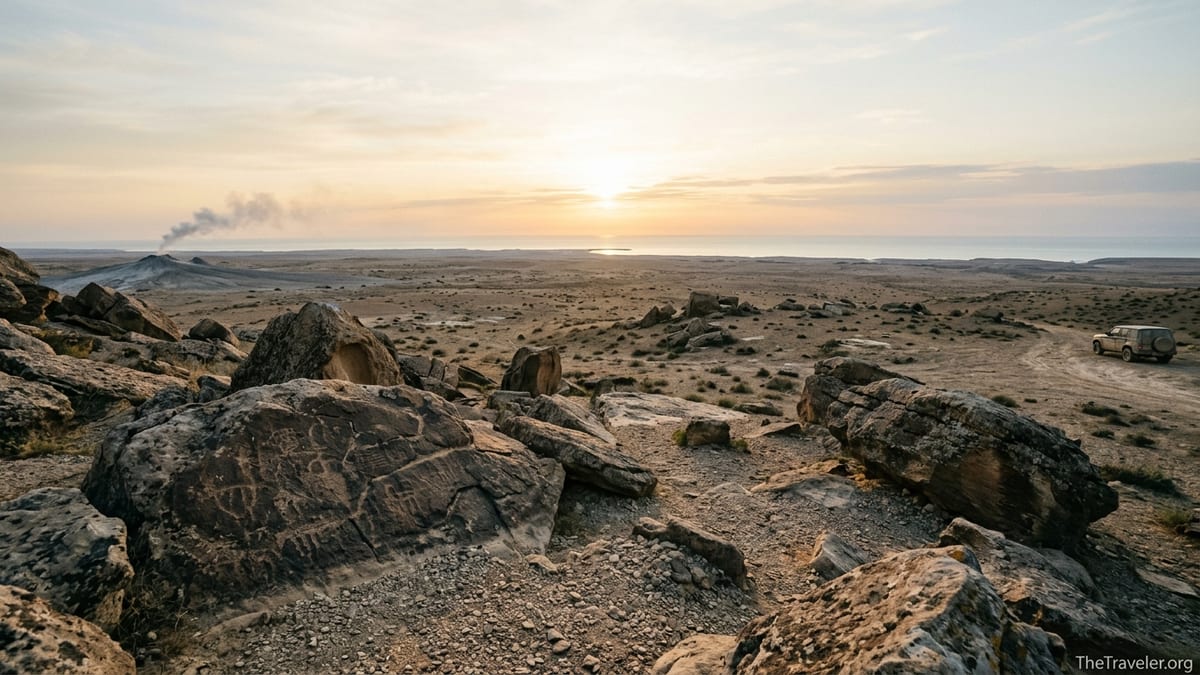
Outside, a signposted trail leads across the slopes, where dark boulders are etched with thousands of images: long-horned ibex, hunting scenes, boats that resemble reed vessels, even dancers in lines that some compare to early ritual scenes. Archaeologists date many of these petroglyphs to between the Upper Paleolithic and the Middle Ages, giving Gobustan a span of human presence difficult to grasp in a single visit. Walking the loop usually takes 45 to 90 minutes, depending on how often you stop to photograph and how hot it is.
What differentiates Gobustan from other archaeological sites is how strongly the landscape asserts itself. Beyond the carvings, you look out on semi-desert scrub, the gray-blue Caspian in the distance and isolated cliffs smudged with shadow. Even in high season, the trails can feel quiet once groups spread out along the rocks. Many visitors remember not just a particular carving but the sound of the wind, the smell of sun-warmed dust and the sense of standing in an outdoor gallery that has been in use for tens of millennia.
Most Gobustan tours today add a second, very different highlight: the nearby mud volcanoes. Reached by a rough, often rutted track that usually requires a high-clearance vehicle arranged via a guide or local driver, these low earthen cones belch cold gray mud and gas bubbles. Visitors wander between dozens of small craters, watching mud burp, crack and sometimes spatter. It is messy, surreal and surprisingly quiet, with views back toward the Caspian. This combination of rock art and mud volcanoes turns a Gobustan trip into a day anchored equally in deep time and active geology.
Travel Time, Comfort and Practicalities
From a logistics point of view, Absheron is slightly easier and more comfortable. Roads to Ateshgah, Yanar Dag and Qala are paved, and much of the driving feels like an extension of metropolitan Baku, with suburbs, roadside cafes and fuel stations. Travelers who prefer not to spend time on bumpy tracks or in remote landscapes often appreciate that Absheron sightseeing is gentler on both nerves and wardrobe. Comfortable walking shoes are still advisable, but you are rarely more than a few steps from a paved path or cafe.
Gobustan demands a bit more resilience, especially if you include the mud volcanoes. The main road from Baku to the Gobustan reserve is good, and the visitor center and rock art paths are well maintained. However, the detour to the volcano fields typically involves 15 to 25 minutes each way along unpaved, dusty or muddy tracks. Many travelers book tours precisely so they do not need to worry about finding an appropriate vehicle or negotiating directions with local drivers near the reserve entrance.
Weather matters more in Gobustan too. In July and August, the exposed rock faces and dirt paths can feel brutally hot in the middle of the day, which is why a lot of tours now leave Baku around 9:00 in the morning to reach the rock art while temperatures are still manageable, or in cooler months tilt the timing later. Absheron sites are exposed as well, but more frequent shade, indoor exhibits and shorter outdoor stretches make the heat somewhat easier to tolerate.
In terms of accessibility, Absheron again has the edge. Those with limited mobility will find the flat courtyards of Ateshgah and the structured viewing terraces at Yanar Dag more manageable than the uneven, often sloping rock paths through Gobustan’s petroglyph fields. While the Gobustan museum itself is modern and accessible, getting close to many of the carvings involves steps and rocky ground.
Costs, Tours and Independent Travel
Prices in Azerbaijan fluctuate with fuel costs and seasonal demand, but as of recent seasons most small-group day tours from Baku to either Absheron or Gobustan fall into a similar ballpark. Travelers commonly see advertised rates in the range of 40 to 80 US dollars per person for a shared tour that includes transportation and guiding but not always entrance fees or lunch. Private tours, especially those combining Gobustan and Absheron in one long day, typically start higher and rise with group size and vehicle quality.
Entrance fees themselves are modest by international standards. Access to Gobustan’s visitor center and rock art zone is usually priced in the low single digits in US dollar equivalent per adult, with similar or slightly higher fees for major Absheron sites like Ateshgah and Yanar Dag. Some tickets include small on-site museums, while others charge a bit extra for audio guides or special exhibits. Many tour descriptions clearly note whether these fees are included; if they are not, travelers should budget a small amount of local currency for each stop, plus optional spending on tea, snacks and souvenirs.
Independent travel is feasible for both destinations, particularly for travelers comfortable using Baku’s ride-hailing apps or arranging taxis for the day. The challenge is coordinating multiple stops without overpaying, especially on Absheron where Ateshgah, Yanar Dag and Qala form a loose triangle rather than lying on a single road. For Gobustan, do-it-yourself visitors often take a bus or taxi to the reserve and then negotiate a short off-road trip to the mud volcanoes with drivers waiting near the park, but this requires time and some negotiation in Russian or Azerbaijani.
For most first-time visitors to Azerbaijan, booking at least a small-group tour proves the easiest way to maximize time. Not only does it simplify logistics, it also adds context; a knowledgeable local guide can connect the dots between prehistoric carvings and current village life, or between fire temples and modern oil production, in a way that signage alone rarely accomplishes.
Which Destination Feels More Impressive in Person?
Impressions are subjective, but patterns do emerge in how travelers describe these two day trips after the fact. Many come away from Absheron impressed by the idea of the Land of Fire rather than any single architectural detail. They remember the optical oddity of Yanar Dag’s hillside flames at dusk, the way the fire temple’s courtyard frames the sky, or a conversation over tea with a local guide about how natural gas shaped modern Azerbaijan. The day feels varied and relaxed, combining scenery, history and human stories without ever venturing too far from the city.
Gobustan, by contrast, tends to leave a more visceral mark. Visitors talk about pressing their fingers near carvings that have watched over the same valley for thousands of years, or about the uncanny quiet of mud volcanoes burbling in a silvery landscape. The scale is not monumental in the way of a giant cathedral or canyon, yet the weight of time and the rawness of the terrain make the experience feel powerful. Even travelers who usually prefer cities and museums often single out Gobustan as the most memorable day of their Azerbaijan stay.
If you are fascinated by human origins, archaeology or geology, Gobustan almost automatically wins. The combination of UNESCO-listed rock art, modern interpretation at the visitor center and the sensory novelty of cold mud volcanoes is extremely hard to match in the region. Travelers who collect World Heritage Sites or love photographing stark, minimal landscapes generally rate Gobustan as their top day trip from Baku.
On the other hand, if your interest leans toward architecture, religion and the way ancient beliefs echo in modern life, Absheron can resonate more deeply. Standing in Ateshgah’s courtyard while a guide explains how merchants from India once prayed here, then later watching gas-fed flames dance on Yanar Dag, ties together centuries of spiritual practice with the concrete realities of pipelines, refineries and Baku’s current skyline.
How to Decide Based on Your Travel Style
The choice between Absheron and Gobustan becomes clearer when you factor in your broader itinerary and personal comfort zones. Visitors with just two or three days in Baku who want a single, unforgettable snapshot of Azerbaijan’s landscapes and deep past will usually get the bigger emotional impact from Gobustan, provided they are comfortable with some sun, wind and rough ground. It is the place that most feels “only in Azerbaijan”: a fusion of ancient art gallery and active mud pits that you are unlikely to confuse with anywhere else.
Those traveling with younger children, older relatives or anyone who prefers shorter walks on stable surfaces might lean toward Absheron. The day breaks up into compact segments, with more chances to sit, find shade and access restrooms and cafes. The stories at each stop are easier to grasp quickly: a fire temple here, a burning hillside there, a castle tower to climb and a village museum full of reconstructed houses. The learning curve is gentler, which can make the day feel less demanding after a late arrival or heavy business schedule in Baku.
Weather and seasonality can tilt the decision too. In the hottest months, early or late trips to Gobustan are wonderful, but midday visits can be punishing without hats, sunscreen and plenty of water. In cooler seasons, the same open landscapes feel fresh and invigorating, whereas a windy winter’s day on Absheron’s exposed hillsides can be chilly. Checking the forecast for Baku and surrounding areas the night before and dressing in layers goes a long way for either excursion.
Finally, consider photography. Absheron offers striking shots of flames against stone temples, fortifications and village streets, but it also includes more built infrastructure and modern development. Gobustan’s images are cleaner and more stark: close-ups of carvings catching low sun, silhouettes of visitors on ridges, tiny human figures walking between mud volcano cones. Photographers who love texture, negative space and geological forms often find Gobustan particularly rewarding.
The Takeaway
If you only have time or budget for one major day trip from Baku, Gobustan generally leaves the deeper, more lasting impression for most travelers. The combination of world-class rock art, a thoughtfully designed museum and otherworldly mud volcano fields delivers a sense of stepping outside ordinary time. Even a short visit can reframe how you think about human history in the Caucasus and the restless geology under your feet.
Absheron, however, excels as a bridge between that deep past and the Azerbaijan of today. Its fire temple, burning hillside and coastal fortifications are vivid, photogenic and logistically easier for those who want a lower-effort outing. Travelers with additional days in the capital often end up doing both, pairing Gobustan one day with Absheron the next, and many tour operators now package them together for a long, intensive circuit. If you can stretch to two excursions, that is the ideal way to experience the full spectrum from prehistoric carvings to living fire worship traditions.
For visitors making a single choice, a simple rule of thumb helps. Choose Gobustan if you crave wild landscapes, human prehistory and unusual natural phenomena. Choose Absheron if you prefer structured sites, religious history and an easier day out that still anchors you firmly in the Land of Fire. Either way, you return to Baku not just with photos, but with a sharper sense of how this corner of the Caspian has shaped, and been shaped by, people and flames for thousands of years.
FAQ
Q1. Can I visit both Gobustan and Absheron in one day?
Yes, many local operators offer full-day tours that include Gobustan in the morning and key Absheron sites like Ateshgah and Yanar Dag in the afternoon, but expect a long, fairly full schedule.
Q2. Which day trip is better if I only have time for one?
If you prioritize unique landscapes and deep history, Gobustan usually feels more powerful. If you want easier logistics and a mix of religious and cultural sites, Absheron may suit you better.
Q3. Do I need a tour guide, or can I visit independently?
You can reach both areas independently by taxi or a combination of public transport and hired cars, but a guided tour simplifies logistics and adds valuable context, especially at Gobustan.
Q4. Is Gobustan suitable for children and older travelers?
Yes, but the outdoor trails are uneven and exposed to sun and wind. Families and older travelers comfortable with short walks on rocky paths usually enjoy it, while those with mobility issues may prefer Absheron.
Q5. What should I wear and bring for each trip?
For both, wear sturdy shoes, a hat and layered clothing, and bring water and sunscreen. For Gobustan and the mud volcanoes, expect dust and possible mud splashes, so avoid delicate footwear.
Q6. Are mud volcano visits included in all Gobustan tours?
No, some tours focus only on the rock art and museum. If seeing the mud volcanoes is a priority, check the itinerary carefully or confirm with the operator before booking.
Q7. How long do I need at Ateshgah and Yanar Dag?
Most visitors spend around an hour at Ateshgah exploring the complex and 30 to 45 minutes at Yanar Dag, longer if they stay for tea or to see the flames at different times of day.
Q8. Is one destination better in winter than the other?
Both are visitable year-round. In winter, Gobustan can feel raw but atmospheric, while Absheron’s shorter outdoor walks and indoor exhibits make it slightly more comfortable on cold or windy days.
Q9. Can I combine a half-day city tour of Baku with one of these trips?
Yes, some operators offer compact itineraries that pair a Baku city highlight tour with either Gobustan or Absheron, though this can feel tight and leaves less time at each site.
Q10. Do I need to book in advance or can I arrange a trip after arriving in Baku?
Outside the busiest periods you can often book a tour with just a day or two’s notice, but in peak seasons or for private trips and specific languages, advance booking is strongly recommended.