


Florence is not a quiet city. The historic center hums with tour groups, clattering suitcases, street music, and the constant shuffle of people angling for a better view of the Duomo. So when I climbed the hill to San Miniato al Monte, just beyond the ever-busy Piazzale Michelangelo, I expected more of the same: camera clicks, chatter, perhaps a busker or two. What surprised me most was the opposite. At the top of the final staircase, Florence’s noise simply fell away, replaced by something almost shocking in a major tourist city: peaceful, resonant silence.
Get the latest updates straight to your inbox!
From Crowded Piazzale Michelangelo to an Unexpected Hush
The contrast begins long before you step inside the basilica itself. Most visitors aiming for a classic Florence panorama stop at Piazzale Michelangelo, a broad terrace lined with souvenir stalls, food trucks, and smartphone-wielding crowds. Here the view is spectacular but the atmosphere is anything but serene. Music booms from portable speakers at sunset, vendors call out in several languages, and buses idle nearby as groups pose in front of the bronze replica of Michelangelo’s David.
From that piazzale, San Miniato al Monte is visible just a little higher up the hill, but psychologically it feels worlds away. The climb takes about ten additional minutes on foot, following stone steps and a quiet lane such as Via delle Porte Sante. The higher you go, the more the city’s soundtrack fades. Motor scooters become a distant buzz, conversation turns to a murmur, and then falls silent almost of its own accord as you approach the wide staircase leading to the basilica’s striped marble facade.
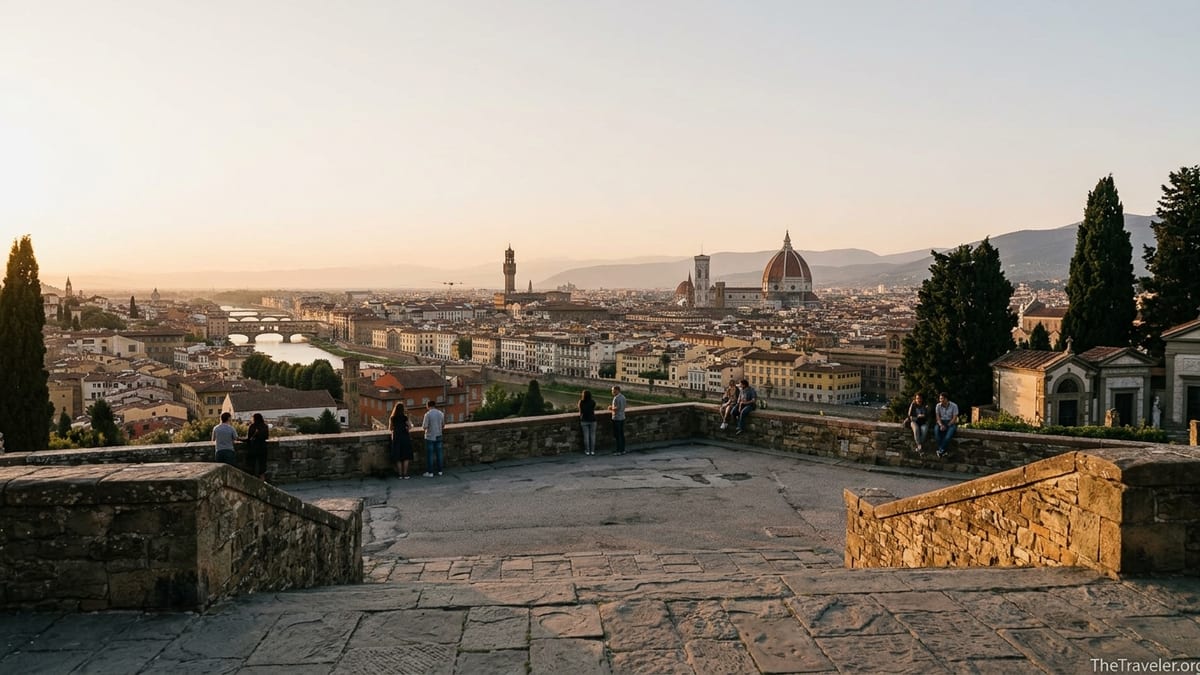
Reaching the terrace in front of San Miniato, the first sensation is space. Unlike the packed railings of Piazzale Michelangelo, there is room to stand alone, lean on the low stone wall, and actually listen. The bells of Florence carry faintly up the hill, and so does the wind as it brushes through the surrounding cypress and umbrella pines. It is not absolute silence, of course, but it is the sort of natural, unforced quiet that feels increasingly rare in European city centers.
On a recent late afternoon visit in early summer, I counted fewer than thirty people scattered across the terrace, most speaking in whispers or simply standing still, watching the Arno trace a silvery line through the rooftops below. No street musicians, no amplified sound, no tour guides with microphones. Just Florence, softened by distance, and a hilltop church that seems to demand a lower voice from everyone who comes near it.
A Living Monastery, Not Just Another Monument
Many visitors arrive at San Miniato expecting a museum-like church, a static monument to tick off between the Uffizi and the Accademia. Instead they discover a living Olivetan Benedictine monastery, with white-robed monks quietly coming and going between the basilica, cloister, and their quarters to the right of the main facade. This sense of ongoing religious life shapes the entire atmosphere and explains, in part, the hush that so surprised me.
The basilica dates to the 11th century and is considered one of the finest examples of Romanesque architecture in Tuscany. Its geometric green and white marble facade shimmers in the afternoon light, but step through the heavy wooden doors and your eyes adjust to a dim, cool interior structured around columns recycled from ancient Roman buildings. Visitors often instinctively slow their pace here. The floor is a patchwork of inlaid marble symbols, the ceiling a painted wooden truss, and the air carries a faint trace of incense.
Because the monks still use the space for daily prayer, there are no audio guides blaring and no large tour groups lingering at the front with laser pointers. Instead you see individual travelers or couples moving quietly from the nave to the crypt and up to the raised choir. Even during busy months like May or September, the basilica rarely feels crowded in the way Santa Croce or Santa Maria Novella can at peak hours. Notices at the entrance gently remind visitors to dress respectfully and keep voices low, and most people seem to comply willingly, drawn into the overall sense of calm.
There is even a small monastic shop, often accessed through the cloister, where the monks sell honey, herbal liqueurs, and simple devotional items produced by monastic communities across Italy. Transactions here are unhurried. Prices for items like a small jar of honey or a bottle of digestive liqueur are typically in the range you might expect at a modest specialty shop in Florence, but what lingers is less the purchase than the manner: soft voices, no pressure, and a shared desire not to disturb the quiet of the cloister outside.
Gregorian Chant: Silence That Turns Into Sound
The most remarkable transformation of silence at San Miniato happens in the late afternoon, when the monks gather for vespers accompanied by Gregorian chant. While schedules can vary slightly by season or liturgical calendar, visitors commonly plan to arrive in time for the early evening service, often around 5:30 or 6:30 p.m., confirming the precise time locally that day. It is wise to enter the church ten or fifteen minutes early, choose a seat in one of the wooden pews, and settle into the existing hush as scattered visitors find their places.
As the service begins, the quiet that first greeted you on the terrace deepens, then slowly fills with unaccompanied choral voices rising from the choir stalls. There are no microphones, no instruments, and no performance as such; the chant is simply the monks at prayer, following a centuries-old Benedictine rhythm. Yet for many travelers, this is one of the most moving experiences in Florence, precisely because of how unexpected it feels after a day spent in dense museum crowds and busy streets.
During one vespers I attended, a dozen or so visitors remained throughout the service, scattered among the locals. Most guidebooks mention that Gregorian chant is offered here, but comparatively few tourists actually make the climb at the right time, which means the basilica never feels like a concert hall. Sitting in the gathering dusk, with candles flickering at the side chapels and the chant reverberating under the wooden roof, you become acutely aware of the silence between the notes: the pauses, the collective in-breath, the momentary stillness when the last phrase fades.
For travelers used to Florence as a place of visual masterpieces, this is a different kind of art. The experience costs nothing beyond the effort to walk uphill or take a city bus, and there is no obligation to stay for the entire liturgy, though leaving discreetly at a natural break is courteous. Yet the memory of that measured chant inside a near-dark Romanesque basilica, high above the city’s traffic, can stay with you long after you have returned to the bright shop windows and restaurant terraces below.
Views and a Cemetery Suspended Above the City
One of San Miniato’s best-kept secrets is that its panoramic terrace is actually quieter than the more famous viewpoint just below it. From the broad landing at the top of the staircase, you see Florence’s essential landmarks aligned in a postcard-perfect composition: Brunelleschi’s great dome, Giotto’s campanile, the Palazzo Vecchio’s tower, and the river Arno threading between ocher rooftops. But here there is space to claim a short stretch of wall, to sit with a takeaway espresso from the small kiosk near Piazzale Michelangelo or a bottle of water bought for a couple of euros at a nearby tabacchi, and simply watch the light change.
Walk just a few steps to the side of the basilica and you encounter another facet of this suspended world: the Cimitero delle Porte Sante, or Sacred Doors Cemetery, a monumental hillside burial ground laid out within the defensive walls around San Miniato. The entrance is marked by stone portals, and inside, narrow pathways wind between ornate 19th and 20th century tombs. Local and national figures are buried here, from Carlo Collodi, author of Pinocchio, to prominent Florentine families whose surnames you may recognize from street names or shop signs in the city below.
What surprises many visitors is how peaceful the cemetery feels compared with the crowded churches where some of Florence’s famous citizens also rest. Here, marble angels lean over ivy-covered graves, family chapels display Art Nouveau ironwork, and the city spreads out in the background like a painted backdrop. On a weekday afternoon, you may encounter only a handful of other wanderers, some reading inscriptions, others simply admiring the sculptural details under the open sky.
The cemetery paths double as viewing platforms. At certain bends, especially along the terrace facing the historic center, you can pause on a low step or bench and look out between cypress trunks toward the Duomo. It is another kind of silence: not the liturgical quiet of the basilica, but a reflective hush shaped by time, memory, and the soft scrape of your own footsteps on stone.
Getting There: The Small Effort That Filters Out the Noise
Part of what protects San Miniato’s tranquil character is the modest effort required to reach it. Unlike the Duomo or Piazza della Signoria, which open almost directly off the main pedestrian drag, San Miniato requires either a climb or a bus ride and a short walk, and that small hurdle naturally filters out some of the most hurried tourism.
From the historic center near the Ponte Vecchio, many travelers simply walk. The route typically takes around 25 to 35 minutes, depending on pace, crossing the river and then ascending via the tree-lined ramps toward Piazzale Michelangelo. There are public fountains along the way where you can refill a reusable bottle, which is useful in the summer when temperatures in Florence can climb well above 30 degrees Celsius. After pausing at the piazzale, you continue up the final set of stairs or follow a quieter road around the back, eventually arriving at the church terrace.
For those who prefer not to climb, local buses numbered 12 and 13, among others, run from central Florence neighborhoods toward the area near Piazzale Michelangelo. A single urban ticket usually costs only a few euros and can be purchased at newsstands, tobacco shops, or via local transit apps before boarding. From the bus stop, you still have a short uphill walk, but the steepest sections are avoided. Taxis can also be used, especially in hot weather or for travelers with limited mobility, and the fare from central Florence is often in the range of a typical short city ride.
However you arrive, it is wise to check current opening hours of the church and cemetery once in Florence, as times can shift slightly with the season or on religious holidays. Even outside formal visiting hours, the exterior terrace remains accessible much of the day and into the evening, allowing visitors to enjoy the view and the relative quiet long after the major museums have closed.
Learning How to “Listen” to a Place
San Miniato al Monte is beautiful in obvious ways: its patterned facade glowing at sunset, its interior mosaics of Christ and the symbols of the evangelists, its view across one of Europe’s great Renaissance cities. But the aspect that lingers most after a visit is something less tangible: a heightened awareness of sound and its absence, of how a place can invite you to listen rather than simply look.
On my first visit, I realized how much of the day I had spent multi-tasking my attention, checking the time, comparing gelato flavors, photographing facades, following museum routes. At San Miniato, those habits fell away. Standing on the terrace, I found myself identifying layers of sound: a single motorbike on the viale below, a far-off siren, the rustle of leaves along the cemetery wall. Inside the basilica, even the soft creak of a pew or the click of a camera shutter seemed amplified by the surrounding stillness.
This quiet encourages slower, more respectful exploration of Florence overall. After leaving San Miniato, I noticed how quickly noise levels rose again as I descended toward the river, but I also felt more able to carve out small pockets of calm elsewhere: stepping into lesser-known churches like Ognissanti during the midday lull, pausing in cloistered courtyards, or even seeking out a quiet table in a backstreet cafe in the Oltrarno where locals linger over a simple espresso or a glass of house wine.
Other visitors have similar reactions. It is common to overhear someone on the terrace say that San Miniato feels like “a different Florence,” or that it is the first time all day they have truly relaxed. For travelers attempting to balance a packed itinerary with some measure of genuine rest, the basilica and its hilltop surroundings offer a blueprint for a quieter, more reflective way of moving through a famously busy city.
The Takeaway
What surprised me most about San Miniato al Monte was not its architecture, its history, or even its astonishing view, though all of these would be reason enough to visit. It was the silence: the way a city of more than 300,000 people could suddenly feel distant, softened, almost weightless from a vantage point just a short climb above its streets. In that space, the sounds that remain gain new meaning, whether they are the unaccompanied voices of monks at vespers or the rustle of cypress branches along the cemetery path.
For travelers heading to Florence, weaving San Miniato into your plans requires only a small logistic adjustment: an extra bus ride, a thirty-minute walk, or a detour before or after the golden-hour crowds at Piazzale Michelangelo. In return, you gain not only a remarkable view and a beautifully preserved Romanesque basilica, but also a rare opportunity to experience the city in a different register, one measured in quiet moments rather than in queues and ticket times.
In an age when so much travel is documented through constant photography and social media updates, San Miniato gently suggests another way: to put the phone away for a while, sit on the low wall, listen to the faint humming city below, and let the peaceful silence at the top of Florence’s hill work on you. Many visitors leave saying it was among the most memorable parts of their trip. After experiencing that quiet for myself, I understand why.
FAQ
Q1. How do I get to San Miniato al Monte from central Florence?
From the historic center you can walk in about 25 to 35 minutes by crossing the river and following the ramps to Piazzale Michelangelo, then continuing up the final staircase to the basilica. Alternatively, local buses such as lines 12 or 13 run toward the hill above the Oltrarno, from which it is a short uphill walk to San Miniato, or you can take a taxi for a relatively quick ride.
Q2. Is there an entry fee to visit San Miniato al Monte?
The basilica itself is generally free to enter, making it an excellent option for travelers looking for meaningful experiences that do not add to ticket costs. There may be small suggested donations for candles or specific chapels, and any purchases in the monastic shop, such as honey or liqueurs, are paid separately but optional.
Q3. When is the best time of day to experience the peaceful atmosphere?
Late afternoon and early evening are particularly special, especially if you plan your visit to coincide with vespers and Gregorian chant. Arriving an hour before sunset allows time to explore the church and cemetery in soft light, then to sit on the terrace as the city below transitions from day to night. Early morning can also be very quiet, with far fewer visitors than at midday.
Q4. Are visitors allowed to attend the monks’ Gregorian chant services?
Yes, visitors are welcome to attend vespers, which are often accompanied by Gregorian chant in the early evening. It is important to arrive a few minutes early, dress modestly, and remain silent or speak only in whispers. Photography and recording during the service are generally discouraged out of respect for the monks and local worshippers.
Q5. Is San Miniato al Monte suitable for travelers with limited mobility?
The hillside location and many steps can pose challenges for travelers with limited mobility. Taking a bus or taxi to the area near Piazzale Michelangelo reduces the steepest part of the climb, but there are still some inclines and uneven surfaces. Once at the terrace, however, the main viewpoint is relatively level, and it is possible to enjoy much of the panorama without exploring every staircase or cemetery path.
Q6. Can I visit the Cimitero delle Porte Sante next to the basilica?
Yes, the Cimitero delle Porte Sante is adjacent to San Miniato and is open to visitors during posted hours. It is a peaceful place to wander among historic graves and family chapels while enjoying additional views over Florence. As in any cemetery, maintaining a quiet, respectful demeanor and avoiding intrusive photography of mourners is essential.
Q7. How does the view from San Miniato compare with Piazzale Michelangelo?
Both viewpoints offer outstanding panoramas, but the atmosphere is very different. Piazzale Michelangelo is lower, busier, and more commercial, with food trucks, buskers, and crowds at sunset. San Miniato sits slightly higher and has a more intimate terrace, where the view is just as striking but the mood is noticeably calmer, making it easier to linger in relative silence.
Q8. Do I need to book a tour to visit San Miniato al Monte?
No, a tour is not necessary to enjoy San Miniato. Most visitors explore independently, taking time to appreciate the architecture, mosaics, and views at their own pace. That said, some guided walks of Florence’s hills and cemeteries do include the basilica and the Cimitero delle Porte Sante, which can add historical context if you prefer structured commentary.
Q9. What should I wear when visiting the basilica and attending services?
As San Miniato is an active place of worship, modest dress is expected. Shoulders should be covered, shorts and skirts should fall to at least mid-thigh, and hats should be removed inside. A light scarf or shawl is useful in warmer months for covering bare shoulders when you step into churches throughout Florence, including this one.
Q10. Is it safe to visit San Miniato al Monte in the evening?
In general, visiting around sunset and into the early evening is popular and feels safe, as there are usually other visitors present on the terrace and along the main routes to and from Piazzale Michelangelo. Standard city precautions apply: stick to well-lit paths, avoid walking alone very late at night, and keep an eye on your belongings as you would anywhere in Florence.