


From Piazzale Michelangelo, San Miniato al Monte looks like the perfect postcard backdrop: a striped marble church crowning Florence’s southern hills. Many visitors climb a little higher, admire the panorama, step briefly inside and then hurry back down toward the Arno. Yet this 11th century basilica is one of Florence’s most intricate storytelling machines, packed with quiet symbols, forgotten frescoes and astronomical surprises that most people never notice. Slow down inside San Miniato, and an entirely different city reveals itself under your feet, above your head and in the shadows of the crypt.
Get the latest updates straight to your inbox!
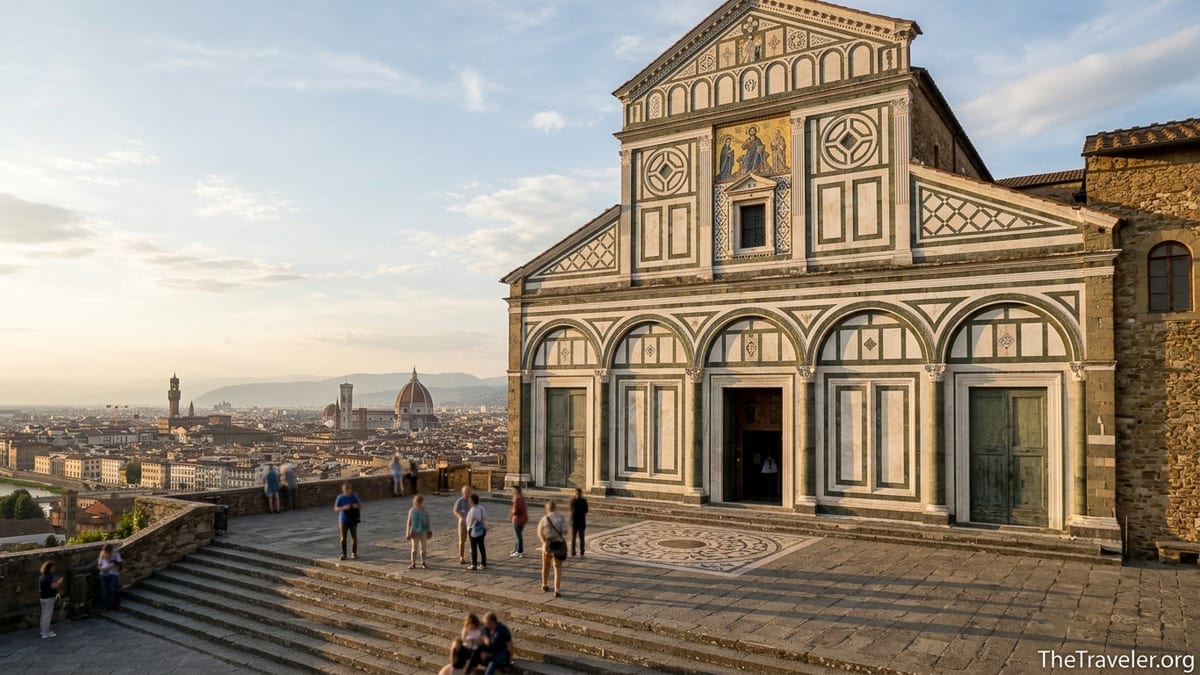
The Facade: Messages Hidden in Green and White Marble
Most visitors photograph San Miniato’s façade and move on, but the green and white marble pattern is more than decoration. The lower band, with its five rounded arches, hints at an ancient Roman triumphal front, announcing that you are entering a space where heaven and earth meet. The stone itself is part of the message: white marble from the Apuan Alps paired with deep green serpentine from Prato, a color code that repeats across medieval Florence and quietly marks this as a carefully curated public statement of power and faith.
Above the arches, the upper façade breaks into a more abstract language of geometry. Squares, circles and crosses interlock in a design that art historians link to ideas of cosmic order circulating in 11th and 12th century Tuscany. Even if you never read a line of Latin, these shapes told medieval worshippers that God’s universe was rational and harmonious. When you stand on the terrace today, framed by tour groups and Instagram poses, you are still looking at a stone diagram of the cosmos, set in place nearly a thousand years ago.
At the very top, most telephoto lenses zoom in on the gold mosaic panel without really reading it. The composition shows Christ enthroned between the Virgin Mary and Saint Minias, the Armenian martyr whose relics lie in the crypt. The gleaming tesserae catch the late afternoon light, but there is also a subtle hierarchy at work: Christ larger and frontal, the flanking figures slightly turned, like attendants in an imperial court. To a medieval Florentine this was a reminder that the city’s safety depended not just on civic government in Palazzo Vecchio, but on the intercession of its heavenly patrons watching from this hillside shrine.
Concrete tip: Bring a small pair of travel binoculars or use the zoom on your phone from the terrace steps. Spend two or three minutes tracing how the different geometric panels align around the mosaic. You will start to see the façade not as a flat postcard backdrop but as a carefully layered diagram of theology, politics and local identity.
The Marble Floor and Its Zodiac: A Hidden Astronomical Instrument
Once your eyes adjust to the dim interior, they naturally go to the glittering apse mosaic and the hanging crucifix. Yet some of San Miniato’s most surprising stories lie under your feet. The central nave floor is paved with marble intarsia, including a circular band of zodiac signs and geometric motifs that many visitors walk across without a second glance. These inlays are not simply ornamental; scholars have linked them to a broader tradition in Florence of embedding cosmic diagrams into church pavements, similar to the famous floor of the Baptistery across the river.
Look carefully near the middle of the nave and you will notice a round marble disk pierced by a small opening in the ceiling above. Around the summer solstice, a beam of sunlight enters through a high window and falls precisely onto this disk, crossing the zodiac ring across the year. In practical terms this functioned as a kind of monumental calendar and solar clock, helping monks and clergy refine the date of Easter and other feasts. In symbolic terms it turned the church into a stone observatory where heavenly motions played across the floor during liturgy.
Travelers rarely notice this device because there are no signs explaining it, and guided groups often focus instead on the more famous chapels. If you visit in late June, around midday, pause in the central aisle and look down for a bright oval of light on the marble. Even when the sunbeam is not visible, you can still trace the ring of zodiac signs carved and inlaid in pale and dark stone, each tiny figure a reminder that medieval Florence saw no contradiction between precise astronomy and intense Christian piety.
To appreciate the floor, it helps to change your perspective. Instead of hurrying straight to the apse, stand near the entrance and slowly walk up the central axis, looking down. You will notice a gradual shift from simple geometric patterns toward more intricate symbols, almost like moving deeper into a coded manuscript. This is intentional design: a pilgrimage of understanding staged in stone, where every step leads you closer to the altar and, in medieval thought, closer to the order behind the stars.
The Choir Screen and Pulpit: A Lost Medieval Soundstage
About halfway up the nave rises a marble choir screen with an attached pulpit, often mistaken for a mere decorative barrier. Many casual visitors stop here for a quick photo and then slip around it without realizing that they are walking through what used to be one of the most theatrical spaces in medieval Florence. Built in the early 13th century, this structure once divided the monastic choir from the lay faithful, shaping how sound, sight and ceremony functioned inside the basilica.
In an age before microphones, the elevated pulpit allowed readings and sermons to be projected down the nave. Frescoed saints and carved symbols would have framed the preacher, turning even a routine homily into something closer to a staged performance. Today the decoration is worn, but if you stand at the base of the pulpit and look up, you can still see the soft curve of the marble sounding board and worn steps bearing the imprint of generations of monks.
Most modern visitors are not allowed to climb the pulpit, but you can stand just below and imagine a crowded feast day in the 1200s: incense smoke hanging under the timber roof, candlelight glinting on the choir screen, the Latin chant echoing from the raised monks’ stalls behind you. The screen’s carved patterns are not random. They mimic the geometric order of the façade and floor, a visual echo that links the pilgrim’s journey from the terrace all the way to the altar.
On a practical level, the screen subtly manages visitor flow even today. Group tours tend to cluster in front of it, which means that if you slip to the side aisles you can often have quieter, more contemplative views of the apse and nave. Spend one or two minutes simply listening from different spots near the screen. You will notice how footsteps, whispered conversations and even the rustle of guidebooks change in volume, a small acoustic reminder that this was once a purpose-built soundstage for sacred drama.
The Crypt: Traces of Frescoes and the City’s First Martyr
Down a short stairway beneath the raised choir lies San Miniato’s crypt, the oldest part of the complex and one of the most atmospheric spaces in Florence. Many visitors take a quick lap around the central altar and then retreat, but this dim, low-vaulted hall preserves traces of stories that once defined the city’s spiritual geography. According to tradition, this is where the relics of Saint Minias, an Armenian prince beheaded in the 3rd century, were enshrined after being rediscovered in the early Middle Ages.
Look closely at the columns and arches and you will see alternations of marble and plain terracotta capitals, a modest but deliberate rhythm that contrasts with the more polished upper church. On the walls, dim patches of color mark the remains of medieval frescoes, their figures now barely legible. These ghostly images once formed a continuous painted skin, surrounding the tomb with scenes of saints, prophets and heavenly cityscapes. Standing here, you are effectively in a half-erased illustrated manuscript, with only fragments of pigment and line surviving to hint at the original narrative.
Another easily missed detail is the way the crypt’s layout mirrors and inverts the world above. The central aisle aligns with the main nave, the altar sits directly under the high altar, and the columns create a forest of stone beneath the forest of painted beams upstairs. For medieval visitors, processing down into the crypt was both a physical and symbolic descent, a journey into the roots of Florence’s faith and history. Modern travelers often duck in for a moment of cool air on a hot August afternoon without realizing they are standing in what was once the city’s spiritual anchor.
If you time your visit to coincide with Vespers, usually sung by the Olivetan Benedictine monks in the late afternoon, pause on the last step before entering fully. From this threshold you can hear the chant drifting down from the choir above while you stand among the columns of the crypt, caught between two soundscapes and two time periods. It is one of the most quietly powerful experiences you can have in Florence, and it costs nothing more than a bit of patience and attention.
The Sacristy Frescoes: Spinello Aretino’s Overlooked Storyboard
Along the left side of the church a plain wooden door leads to the sacristy, which many visitors assume is off-limits or uninteresting. When it is open to the public, step inside and you enter a small chamber wrapped in one of the most extensive late 14th century fresco cycles in Florence. Painted around 1387 to 1388 by Spinello Aretino, these scenes from the life of Saint Benedict once served as a kind of visual handbook for the monks, illustrating monastic virtues and temptations.
Because the sacristy is often quiet, you can stand almost alone before walls that compress an entire narrative world into a few square meters. Look for the panel where Benedict repairs a broken sieve for a peasant woman, or the dramatic episode of the devil shattering a bell. The figures are energetic, the colors surprisingly bright in places, and the architectural backdrops include miniature cities and cloisters that echo the very space you are standing in. Yet guidebooks frequently give this room only a passing mention, and many organized tours skip it entirely.
A telling detail here is how Spinello arranges his sequences in bands around the room, encouraging a circular reading. If you start near the door and follow the panels clockwise, you trace Benedict’s journey from young hermit to respected abbot. The narrative loops you back to the entrance, echoing the monastic rhythm of daily life: leave, return, repeat. It is an early example of immersive storytelling in architecture, and one that modern travelers can still read without speaking Italian.
From a practical standpoint, the sacristy is also one of the best places in San Miniato to appreciate fresco technique up close. Small areas of loss reveal the reddish preparatory drawing beneath the paint, and you can see where Spinello’s assistants joined sections of plaster along barely visible seams. If you are interested in medieval art, plan at least ten extra minutes here and bring a modest pair of reading glasses or a small flashlight (if allowed) to study the details without using flash photography.
The Chapel of the Cardinal of Portugal: A Renaissance Jewel Box
Back in the main church, most eyes gravitate toward the glittering apse mosaic, but one of San Miniato’s most refined spaces hides in the left aisle: the Chapel of the Cardinal of Portugal. Many visitors glance at its railing, assume it is closed, and walk past without really understanding what they are seeing. Built in the mid 15th century to house the tomb of the young Portuguese cardinal James of Lusitania, this chapel preserves an unusually complete ensemble of Renaissance architecture, sculpture and painting conceived as a single work of art.
Step closer and you will notice how the polychrome marble floor, coffered ceiling and painted walls all speak the same visual language. Marble pilasters divide the walls into panels filled with delicate frescoes of saints and sibyls, while the sarcophagus rests against a backdrop of crisply carved stone. The color palette is softer than in the medieval parts of the church, dominated by pale blues, warm creams and restrained gold accents. It feels almost like stepping into an early Florentine drawing room, except that every element points back to themes of death, hope and learned piety.
A small but telling detail is the use of the cardinal’s coat of arms, discreetly repeated in friezes and shields. To a contemporary viewer in the 1460s, these heraldic signs instantly anchored this cosmopolitan visitor from Portugal within Florence’s complex web of alliances. Today, unless a guide points them out, they become part of the visual background. Spend a moment tracing how often they appear and how they are integrated into the architecture. You will start to see the chapel not just as a beautiful room but as a carefully staged statement of identity and memory.
Because the chapel is compact, it also offers a useful respite from the flow of tour groups. If you visit in the late morning, there is a good chance you can stand at the railing alone for a few minutes. Use that quiet to compare the chapel’s clean Renaissance lines with the more rugged Romanesque arches of the nave beyond. In a single glance you can see two centuries of Florentine architectural evolution, framed by a single doorway that most visitors barely register.
The Monastery, Cemetery and Pharmacy: Life Continuing Around the Basilica
Outside the church proper, San Miniato unfolds into spaces that many travelers never explore. To one side stretches the monumental cemetery known as the Porte Sante, laid out in the 19th century and still in use today. Most tour groups linger only at the first terrace for a quick view over Florence, but if you walk a little further you will find elaborate family chapels, Art Nouveau sculptures and the graves of local figures, from artists to politicians. It is a reminder that San Miniato is not a museum; it is a living complex that has absorbed layers of Florentine life for over a millennium.
The monastery buildings, now home to an Olivetan Benedictine community, animate the basilica in quieter ways. You may notice monks in white habits slipping through side doors or chanting during the daily offices. Tucked within these cloisters is a small monastic shop, often described as a pharmacy, where visitors can purchase products made or curated by the community. Shelves might hold herbal liqueurs, honey from monastic hives, or simple soaps and unguents associated with traditional remedies. Prices are typically modest compared to tourist-heavy shops in the city center, and purchases help support the upkeep of the complex.
Many travelers walk straight past this shop because it lacks flashy signage. Look instead for a discreet doorway near the cloister area or ask a monk or volunteer for the “bottega” when services are not in progress. Stepping inside connects you to a long history of monastic self-sufficiency, where communities like this one produced medicine, liqueurs and pigments for their own use and for sale. Even if you do not buy anything, noting the presence of labeled bottles and jars helps you read San Miniato not just as a site of worship, but as an economic and scientific node in Florence’s past.
Just outside the church steps, the wide terrace itself contains a small, easily missed detail: look for carved stone benches and low walls bearing traces of wear from generations of visitors leaning to admire the view. At sunset, when buskers play and couples gather with takeaway pizza from the city below, it can feel like a modern piazza rather than a church forecourt. Yet the outline of the terrace follows earlier defensive walls, and the view aligns with a deliberate axis down to the Arno and the Duomo. Even in this apparently casual space, San Miniato is still organizing how you move, look and interact with Florence.
The Takeaway
San Miniato al Monte rewards the kind of traveler willing to trade a checklist of sights for a slower, more attentive encounter. It is easy to climb the hill, take the obligatory panoramic shot and rush on, but the basilica’s deepest pleasures lie in what most people overlook. A façade that doubles as a coded diagram of the cosmos; a marble floor that tracks the sun; a choir screen that once choreographed sacred sound; a crypt that preserves the faintest whispers of painted saints; a sacristy and side chapel that compress centuries of artistic experiments into intimate rooms; a working monastery where chant, herbal remedies and everyday chores continue on the margins of tourism.
To truly experience these layers, plan your visit with time to spare. Aim for an hour and a half rather than a quick fifteen minute detour from Piazzale Michelangelo. Visit during a quieter part of the day, step inside side doors when they are open, and do not be afraid to sit or stand still for several minutes in one place. Hidden details in San Miniato do not announce themselves. They emerge gradually, as your eyes adjust and your mind begins to connect patterns across marble, pigment, light and sound.
On your way back down into Florence, you may find that the city itself looks different. The Duomo’s dome no longer floats alone; you see it as part of a network of viewpoints, axes and symbolic lines that link hilltop and riverbank, monastery and marketplace. San Miniato al Monte, once just a pretty silhouette on the skyline, becomes a key to reading Florence as a whole. And all it costs is the willingness to look a little longer at what everyone else walks past.
FAQ
Q1. Is there an admission fee to visit San Miniato al Monte?
Entry to the basilica itself is usually free, though small donations are appreciated and may be gently encouraged near the entrance or at candle stands.
Q2. What are the typical opening hours, and can they change?
The church is generally open daily from morning to early evening with a midday break, but hours can change for liturgies or maintenance, so it is wise to confirm locally once in Florence.
Q3. When is the best time of day to see the hidden details inside?
Late morning and midafternoon offer enough natural light to appreciate the floor, frescoes and mosaics, while late afternoon is ideal if you also want to hear the monks chanting Vespers.
Q4. How do I get to San Miniato al Monte from central Florence?
Most visitors either walk up from the river via the steps to Piazzale Michelangelo and continue a few minutes higher, or take a city bus or taxi to the piazzale and walk the short final stretch.
Q5. Is the sacristy with Spinello Aretino’s frescoes always open?
Access to the sacristy can vary. It is often open during busier times of day or when staff are present, but at quieter hours it may be locked, so consider returning later if it is closed.
Q6. Can I photograph the interior, including the crypt and frescoes?
Nonflash photography is generally tolerated for personal use, but flash and tripods are usually prohibited, and it is courteous to avoid shooting during services or when people are praying.
Q7. Is San Miniato suitable for visitors with limited mobility?
The hilltop location and interior steps, especially down to the crypt and up to the terrace, can be challenging, so visitors with mobility issues may prefer to focus on the terrace and main nave.
Q8. Are there guided tours that focus on the hidden symbolism and astronomy?
Some Florence guides and small specialist companies offer themed visits that highlight the zodiac floor, symbolic geometry and lesser known chapels, which can be arranged in advance or booked in the city.
Q9. Can I attend a service to hear the monks sing?
Yes, the Olivetan Benedictine community celebrates daily liturgies, and Vespers with Gregorian chant in the late afternoon is especially atmospheric; visitors are welcome if they join respectfully.
Q10. Is it safe to walk back to the city from San Miniato after sunset?
The walk via Piazzale Michelangelo is a common route for tourists and locals, but as with any city, staying on well lit paths, keeping valuables secure and returning with others is a sensible precaution.