


Nice’s Carré d’Or, or Golden Square, is often summed up as a grid of glossy boutiques between Boulevard Victor Hugo and the Promenade des Anglais. Luxury brands and high-end hotels certainly dominate its streets, but this central neighborhood offers far more than shopping bags and window displays. From Belle Époque villas turned museums to beach clubs, terrace cafés and easy access to the city’s cultural life, Carré d’Or can be a rewarding base even if you never swipe a credit card in a designer store.
Get the latest updates straight to your inbox!
Getting Oriented: What and Where Is Carré d’Or
Carré d’Or is a compact, walkable enclave in the very heart of Nice, bordered roughly by Boulevard Victor Hugo to the north, Rue Maccarani to the east and the Promenade des Anglais to the south. Within this grid you will find streets such as Rue de France, Rue Masséna, Rue du Congrès, Rue Meyerbeer, Rue de la Liberté and Avenue de Suède, many of them semi-pedestrian or fully car-free. Apartments above, cafés and brasseries below, and the Mediterranean just a few minutes away on foot define the feel of this part of town.
The neighborhood is often described in property listings as a premium residential area that lets you “do everything on foot.” In practice that means you can walk from a rented apartment near Place Magenta to the pebble beach in around five minutes, or stroll to the tram on Avenue Jean Médecin in under ten. The district merges quietly into the adjoining Musiciens neighborhood around Rue de la Buffa and Jardin Alsace-Lorraine, which many locals choose for its calmer, more residential streets but similar proximity to the sea.
While glossy real-estate brochures focus on palace-style buildings like Palais de la Méditerranée on the seafront and luxury condos above Rue de France, travelers will notice a different side at street level. Terraces buzz from morning coffee through late-night cocktails, small supermarkets and boulangeries cater to everyday needs, and the promenade is the shared backyard. Once you understand this layout, it becomes easy to enjoy Carré d’Or as a lived-in neighborhood rather than simply a luxury showcase.
Stroll the Promenade and Its Beach Clubs
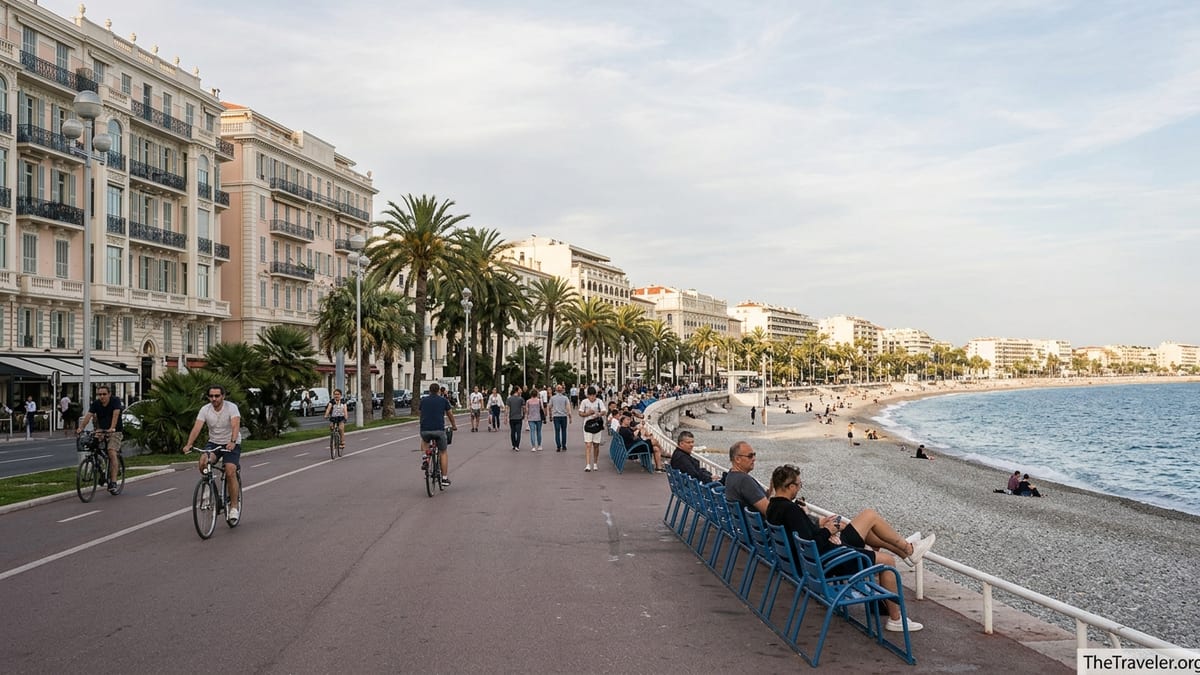
The southern edge of Carré d’Or spills directly onto the Promenade des Anglais, the famous waterfront boulevard that curves along the Bay of Angels. A simple walk here is one of the best things to do in the area, especially at sunrise when joggers and dog walkers outnumber visitors, or in the blue hour before dinner when the light softens and the façades of palace hotels start to glow. You can walk west toward the airport or east toward the Old Town, but even a twenty-minute loop from Carré d’Or and back gives you classic Riviera scenery without any ticket or reservation.
Between the promenade and the sea, a row of private beach clubs occupies much of this stretch of coast. Iconic spots like Ruhl Plage, which has operated in various forms for decades, or the Negresco Beach Club opposite the famous hotel, offer sun loungers on the pebbles, changing cabins and full restaurant service. Expect to pay in the region of 25 to 40 euros per person for a standard lounger and umbrella in peak summer, with towels and front-row spots often costing more. Cheaper public sections of beach sit between the private concessions, so you can experience the same water and views with just a rented beach mat and a picnic from a nearby supermarket.
Many visitors treat these beach clubs as a full-day base. A common routine is to reserve two loungers for late morning, have a simple lunch such as grilled fish or a niçoise salad at your club’s restaurant, then linger through the afternoon with swims and people-watching. In July and August, several clubs add live DJs toward sunset and serve cocktails right on the beach, so you can turn a lazy day into an easygoing night without ever leaving the water’s edge. If your budget is limited, consider booking one shared lounger and alternating swims and reading time, or arrive later in the day when some clubs reduce prices for the final hours.
Discover Belle Époque Elegance at Musée Masséna
For a sense of Nice beyond the beach, head to Musée Masséna, just off the Promenade des Anglais on Rue de France at the southern fringe of Carré d’Or. This villa, built in the late 19th century, is one of the best-preserved Belle Époque residences in the city and now serves as a museum of local art and history. Inside, frescoed ceilings, chandeliers and period furniture give a glimpse into the lifestyle of the Riviera elite during the early 1900s.
Exhibits span from the annexation of Nice to France in the 19th century through to the boom years when European aristocrats and artists flocked to the coast. You might see portraits of the Maresciallo Masséna family, displays about the development of the Promenade des Anglais, or temporary shows focused on Riviera painting and photography. The museum is typically open from late morning to early evening, closing one day per week, and city museum passes that cover several institutions over seven days are often available for around 20 euros, which can be good value if you plan to visit other sites such as the Matisse Museum or the Museum of Modern and Contemporary Art elsewhere in town.
Do not skip the gardens. The building is set in landscaped grounds that open directly onto the promenade, with shaded benches and sea views filtered through palm trees. Locals sometimes duck in here with a takeaway coffee or sandwich to enjoy a quiet break away from the traffic. As it sits just a few minutes’ walk from Rue de France and the main Carré d’Or streets, Musée Masséna is an easy cultural stop to add before or after a swim.
Live Like a Local on Rue de France and the Pedestrian Zone
Behind the seafront, Rue de France runs parallel to the promenade and forms a busy spine for neighborhood life. Parts of it are pedestrianized or limited to local traffic, and many side streets in Carré d’Or, including Rue Masséna and Rue du Congrès, are fully car-free. This “zone piétonne” is where daily errands and casual dining unfold. You will find supermarkets, independent clothing and shoe shops, Italian trattorias, crêperies and ice-cream counters serving late into the evening.
A typical day might start with a coffee and croissant at a corner café near Place Magenta, where outdoor tables fill quickly around 9 am as residents stop by on their way to work. Later in the morning, a queue may form outside a popular boulangerie for fresh baguettes and pastries. In the evening the same streets transform into a buzzing strip of terraces, with pizzerias offering fixed-price menus and wine bars pouring Provence rosé by the glass. Prices are usually lower a block or two north from the promenade; for example, a margherita pizza might be around 10 to 13 euros on the pedestrian zone compared with several euros more at a seafront restaurant.
Because the area attracts both tourists and locals, you get an interesting mix of languages and styles. Families with strollers, students from nearby language schools and retirees who have lived in Nice for decades share the same pavements. If you are staying in Carré d’Or for several days, choosing a regular café or bakery and greeting the staff with a simple “bonjour” and “merci” can quickly turn anonymous streets into a neighborhood that feels familiar.
Terrace Cafés, Aperitif Culture and Nightlife
Nice is not a city of giant nightclubs, and Carré d’Or fits that pattern. Instead, its evenings revolve around terrace cafés, wine bars and small cocktail spots that line Rue Masséna, Rue de France, Rue de la Liberté and the side streets between them. From around 6 pm onward, the after-beach aperitif hour begins. Locals order an apérol spritz, a glass of chilled white wine or a classic pastis, often accompanied by a small bowl of olives or crisps. Prices for an apéritif typically range from 7 to 12 euros depending on the bar and location, with seafront venues at the higher end.
For a relaxed start to the night, pick a brasserie with outdoor seating on the pedestrian zone and simply watch the flow of people. Street musicians often perform along Rue Masséna in high season, which adds to the atmosphere. If you want a more refined evening, hotel bars along the promenade, including those inside Belle Époque properties, serve cocktails in plush lounges or on terraces looking over the bay. Ordering one drink in such a setting is an affordable way to enjoy five-star surroundings without paying for a room.
Later at night, some bars in and around Carré d’Or turn up the volume with DJs or live bands, while others stay focused on conversation. If you are sensitive to noise, choose accommodation on streets slightly north of the pedestrian zone or closer to Boulevard Victor Hugo, which tend to be quieter after midnight. Ride-hail cars and late trams make it easy to reach livelier nightlife in the Old Town or Le Port district if you prefer more energy, but many visitors find that Carré d’Or’s mix of sociable terraces and easy walking distances suits them well.
Food Experiences From Picnics to Fine Dining
Eating well in Carré d’Or does not have to mean white tablecloths or high prices, although both are available. Small supermarkets and fruit shops scattered around Rue de France and Rue de la Buffa make it easy to assemble a simple picnic for the beach or for the lawn of the nearby Promenade du Paillon, the green park that separates central Nice from the Old Town. A baguette, local cheese, cherry tomatoes and a tub of olives can come to under 10 euros per person and provide a more relaxed meal than a crowded seafront terrace.
At the same time, the neighborhood has plenty of sit-down options. Italian influences are strong, with pizza, fresh pasta and gelato on almost every block. Many restaurants run two-course or three-course fixed menus at lunchtime that are cheaper than à la carte dinner options. For example, a midday formula might offer a starter and main for around 18 to 25 euros, while dinner with a main dish, dessert and wine can easily rise above 35 euros per person, especially on the promenade.
For regional flavors, look for menus that feature socca, a chickpea-flour pancake, or dishes like stuffed vegetables, daube niçoise (a slow-cooked beef stew) and pan bagnat, the famous tuna and vegetable sandwich. These specialties often cost less in snack bars just north of Carré d’Or or in the Old Town, so one strategy is to use the neighborhood’s cafés for breakfast and aperitif and range further afield for main meals. Vegetarians and vegans will find more options than in the past, from salad-focused cafés on Rue de France to plant-forward bistros closer to Avenue Jean Médecin.
Easy Access to Culture, Parks and Day Trips
One of Carré d’Or’s big advantages is how easily you can reach other parts of Nice and the wider Riviera. The neighborhood sits a short walk from Avenue Jean Médecin, where tram lines and bus routes converge. From here, modern trams run to the main train station and to Nice Côte d’Azur Airport, often in under thirty minutes. That makes it realistic to base yourself in Carré d’Or and plan day trips to nearby towns like Antibes, Cannes or Menton without renting a car.
Within the city, you are also well placed for cultural outings. A ten to fifteen minute walk east through the Promenade du Paillon brings you to the edge of the Old Town, with its Baroque churches, Cours Saleya flower and food market, and a dense network of bars and small restaurants. Bus routes from central Nice climb up to the Matisse Museum in Cimiez, which showcases the artist’s work in a villa surrounded by olive trees and Roman ruins, or across to residential hills with panoramic viewpoints.
Closer to home, green spaces like Jardin Alsace-Lorraine and the tree-lined sections of Boulevard Victor Hugo provide shade and benches within a few blocks of most Carré d’Or addresses. These spots are popular with families and older residents in late afternoon, when the sun is softer. For children, the water features and playgrounds in the Promenade du Paillon are an easy outing, and the walk there from Carré d’Or, via Boulevard Victor Hugo or Rue de la Liberté, takes around ten to twenty minutes depending on where you start.
The Takeaway
It is easy to think of Carré d’Or purely as a destination for shopping, with its designer storefronts, polished façades and grand hotels along the Promenade des Anglais. Spend a little time in the neighborhood, however, and a more rounded picture emerges. This is a compact, central district where you can walk from a Belle Époque museum to the beach in minutes, pick up groceries on Rue de France, join the locals for an evening apéritif on the pedestrian zone and still be within easy reach of Nice’s main cultural sights and transport links.
Whether you base yourself here for a week or simply wander over from the Old Town for an afternoon, Carré d’Or rewards slow exploration. Look beyond the shop windows to the side streets, gardens and cafés where everyday life unfolds. The combination of seaside access, urban energy and understated local routines is what makes this part of Nice appealing for travelers who want more from the Riviera than just luxury bags and brand names.
FAQ
Q1. Is Carré d’Or a good place to stay in Nice for first-time visitors?
Yes, Carré d’Or suits first-time visitors who want to be close to the beach, central transport links and everyday amenities. You can walk to the Promenade des Anglais in a few minutes, reach the Old Town in around fifteen to twenty minutes and access tram lines and the main shopping artery on Avenue Jean Médecin without needing a car.
Q2. How expensive is Carré d’Or compared with other neighborhoods in Nice?
Accommodation and restaurant prices in Carré d’Or are generally higher than in more residential districts further from the sea, reflecting its central location and popularity. That said, you can manage costs by choosing streets a little north of the promenade, using supermarkets and bakeries for some meals and reserving seafront venues for occasional treats rather than every lunch and dinner.
Q3. Are there things to do in Carré d’Or if I am not interested in shopping?
Yes, plenty. You can visit Musée Masséna for local history and Belle Époque architecture, walk or cycle along the Promenade des Anglais, spend time on the beach or at a beach club, enjoy café terraces, explore nearby parks and use the neighborhood as a base for cultural outings and day trips.
Q4. Is Carré d’Or noisy at night?
Streets in and around the pedestrian zone, such as Rue Masséna and parts of Rue de France, can be lively until late in high season, especially near bars and restaurants. Quieter options exist a few blocks north toward Boulevard Victor Hugo or in the neighboring Musiciens area. When booking accommodation, check recent reviews and look at a map to see how close you will be to the busiest terraces.
Q5. Can I access public beaches easily from Carré d’Or?
Yes. The seafront in front of Carré d’Or mixes private beach clubs with free public stretches where anyone can swim and sunbathe. From most streets in the neighborhood, you can walk to a public section of beach in five to ten minutes. Remember that the shore here is made of smooth pebbles, so many people bring or buy water shoes.
Q6. Do I need to reserve beach clubs in advance?
In peak summer, it is wise to reserve loungers at popular beach clubs, especially on weekends and for front-row spots near the water. Some clubs accept same-day bookings by phone or at their reception desks on the promenade, while others recommend booking at least a day ahead. Outside the busiest months, you can often walk in, particularly for afternoon or late-day visits.
Q7. Is Carré d’Or safe to walk around at night?
Carré d’Or is generally considered safe and is busy well into the evening, with many people out on terraces or walking to and from the promenade. As in any city, normal precautions apply: keep an eye on your belongings, avoid leaving valuables on café tables and use well-lit streets for late-night walks. Solo travelers often appreciate the steady foot traffic and central location.
Q8. How do I get from Carré d’Or to Nice Airport?
From Carré d’Or, you can walk or take a short ride to the nearest stops on tram lines that run directly to Nice Côte d’Azur Airport, typically taking under thirty minutes depending on the line and time of day. Taxis and ride-hail services are also readily available and offer a more direct but more expensive option, with journey times that vary based on traffic.
Q9. Are there supermarkets and everyday shops in Carré d’Or?
Yes. In addition to fashion boutiques, the neighborhood has several small supermarkets, bakeries, pharmacies and convenience stores, mainly along Rue de France and intersecting streets. This makes it easy to self-cater some meals, buy picnic supplies or pick up essentials without leaving the area.
Q10. When is the best time of year to enjoy Carré d’Or?
Late spring and early autumn often offer the best balance of pleasant weather, open beach clubs and manageable crowds. July and August bring long beach days and a lively atmosphere but also higher prices and more visitors. Winter is quieter, with many terraces still open on sunny days, and can suit travelers who prefer mild temperatures and fewer people over swimming.