


Few hikes in Shenandoah National Park look as easy on paper yet surprise so many first-time visitors as Dark Hollow Falls. The trail is short, the waterfall is beautiful, and the access from Skyline Drive is simple. Yet rangers, frequent park visitors, and tired families in the parking lot all tell the same story: this is a steeper, more crowded, and less forgiving outing than most people expect. Understanding what you are really in for can mean the difference between a rushed, slippery slog and a memorable Blue Ridge waterfall walk.
Get the latest updates straight to your inbox!
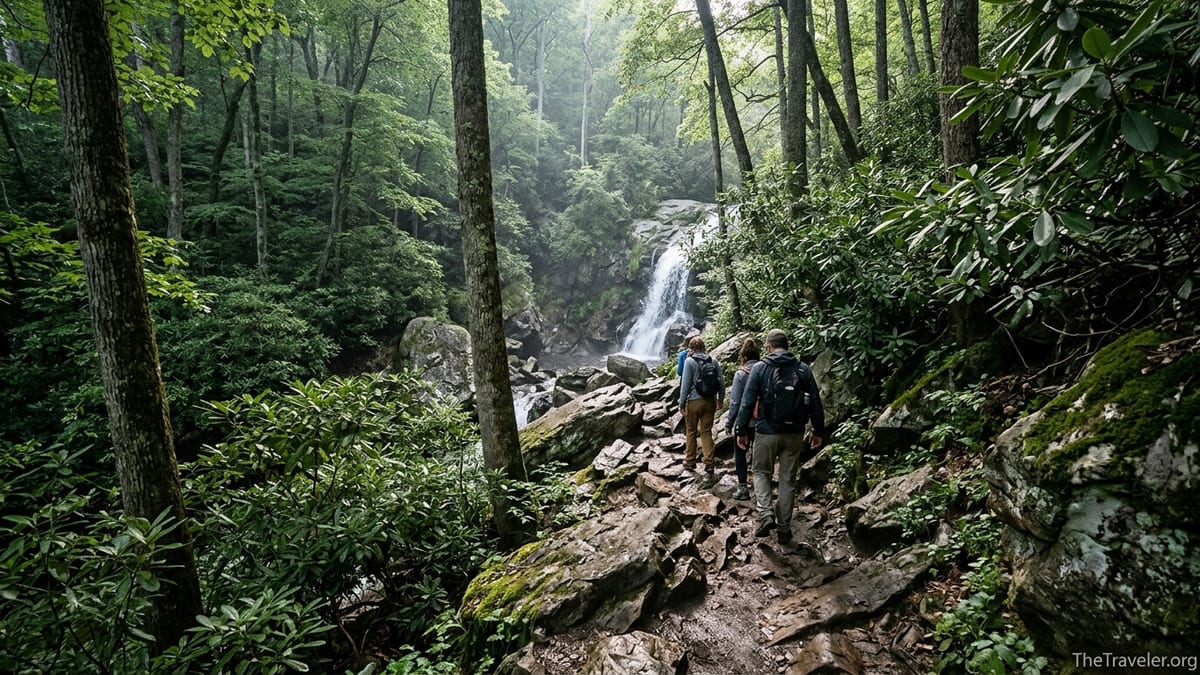
Dark Hollow Falls Is Short, But Not “Easy”
On a map, Dark Hollow Falls looks like the perfect casual stroll. The National Park Service lists it as about 1.4 miles round trip with roughly 440 feet of elevation gain, starting at the Dark Hollow Falls parking area around mile 50.7 on Skyline Drive. The reality many people forget is that this is a hike where you go downhill first and pay the price on the way back. Almost every step to the waterfall is a step you will have to climb later, often on rocky, uneven terrain that feels much tougher when your legs are already tired.
Visitors often arrive straight from an air-conditioned car, glance at the distance sign, and set off in flip-flops with a small bottle of water. On the descent, this can feel fine. The trouble starts on the return when the grade steepens, the humidity of a Virginia summer kicks in, and the once-chatty group suddenly spreads out. It is common to see hikers stopping to catch their breath every few minutes, especially on busy summer weekends. For anyone used to flat city walks, that 440 feet of climbing in less than a mile back to the car can feel surprisingly strenuous.
Families with young kids are often caught off guard. Children usually bound down enthusiastically to the falls and then struggle up, which leaves parents carrying both tired kids and extra gear. Many experienced Shenandoah hikers suggest treating Dark Hollow the way you might treat a much longer mountain trail: start early, make sure everyone in your group is comfortable with continuous uphill walking, and be honest about fitness levels before committing to the full descent.
Put simply, if you would not normally choose a steep, stair-filled gym workout, you will want to slow down, take breaks, and give yourself more time than the “one hour and fifteen minutes” estimate suggests. The hike is well worth the effort, but it rarely feels like the easy waterfall detour many visitors expect when they first pull off Skyline Drive.
Crowds, Parking, And Why Timing Matters
Another thing most visitors wish they knew ahead of time is just how popular this trail is. Dark Hollow Falls is one of Shenandoah’s signature waterfall hikes and sits just minutes from Big Meadows, a central hub in the park with lodging, camping, and a visitor center. On a sunny Saturday in October or a peak summer weekend, the small parking lot at mile 50.7 can fill not long after 9 a.m., and cars begin circling or lining up along Skyline Drive, adding stress before the hike even begins.
Experienced park-goers often plan their Dark Hollow visit like a restaurant reservation: early or late. Arriving shortly after sunrise can mean snagging a spot in the main lot, enjoying cooler temperatures, and sharing the trail with just a handful of photographers and birdwatchers. Late afternoon, after 4 p.m., often sees a second lull, when day trippers heading back toward Washington, D.C. or Charlottesville have already cleared out. At these quieter times, you may actually hear the creek and birdsong instead of just the chatter of other hikers.
For travelers based at Big Meadows Lodge or the Big Meadows Campground, it is easy to combine an early-morning or late-day hike with a stop for breakfast or dinner at the lodge. Many visitors who try to squeeze Dark Hollow Falls into a busy midday itinerary, after Skyline Drive viewpoints and before a long drive home, end up stressed by parking delays and crowds at the waterfall itself. Planning this hike as a focused outing with a clear time window usually leads to a better experience.
Crowds also affect safety. When the trail is busy, people cluster in narrow spots near the falls to take photos, often stepping onto wet rocks to get a better angle. Combined with impatient groups trying to pass on steep sections, this can create a chaotic scene. Arriving at off-peak times not only feels more peaceful, it also means fewer distractions when you need to focus on your footing.
Trail Conditions, Footing, And Staying Safe Near The Falls
At first glance, the Dark Hollow Falls Trail looks friendly. It is a broad path that follows a lively mountain stream, with stone steps and switchbacks in the steepest sections. What first-timers often underestimate is how quickly the mix of loose rock, roots, and water can turn treacherous. After a rainstorm, the trail can feel like a series of slick staircases, and even in dry weather the shaded sections stay damp longer than you might expect.
Every season brings its own challenges. In spring, snowmelt and seasonal rains can swell the creek, making side paths muddy and tempting people to cut corners or step onto wet boulders. In summer, moss-covered rocks and roots stay slick under shady overhangs. In winter and early spring, patches of ice can linger on shaded steps long after the rest of Skyline Drive feels clear. Rangers regularly warn visitors that falls and twisted ankles along this trail are more common than people think, especially for those hiking in casual sneakers, flat-soled fashion boots, or open sandals.
A sturdy pair of trail shoes or light hiking boots with actual tread makes a real difference here. Visitors who pack the same footwear they would wear on a grocery run are often the ones inching down steep segments sideways, clinging to trees for balance. Trekking poles are not essential but can be very helpful for older hikers, anyone with knee issues, or parents balancing a child on their hip.
At the waterfall itself, the most important safety rule is one most people ignore until they see someone slip: stay off wet rocks and do not climb on the ledges around the falls. The rocks that look grippy in photos are often coated with a thin film of water and algae. Several visitors each season end up bruised or injured after sliding while trying to pose closer to the cascade or hop across the stream. It is worth reminding kids, teenagers, and even over-enthusiastic adults in your group that a scenic photo is not worth a sprained ankle or worse.
Water, Weather, And What To Bring (Even For A “Short” Hike)
Because the hike is under two miles, many people show up with practically nothing: a phone, car keys, and maybe a half-full convenience store water bottle. By the time they are slogging up the final switchbacks, those same hikers often wish they had treated Dark Hollow more like a real mountain trail. Summers in Shenandoah are humid and often warmer than forecasted once you leave the breezy Skyline Drive overlooks and drop into a sheltered hollow.
A realistic packing list for most adults is simple: at least one full liter of water per person in warm weather, a small snack, and a lightweight layer in spring or fall when clouds and elevation can make the air feel cooler than expected. A compact daypack is helpful so that hands stay free for balance. If you are coming from Big Meadows, filling reusable bottles at the lodge or campground before you drive over is both cheaper and more sustainable than relying on single-use bottles from the wayside shop.
There are no toilets or water fountains at the Dark Hollow Falls trailhead itself. Restrooms, food, and water are available a short drive away at Byrd Visitor Center and Big Meadows Lodge, and many experienced visitors plan a bathroom stop there before heading to the trail. Parents in particular wish they had known this ahead of time, since arriving with kids who suddenly need a restroom can mean an unplanned backtrack along Skyline Drive and a missed parking spot.
Weather can also reshape the character of this hike. After a few days of heavy rain, the falls are at their most dramatic, but trail sections may be muddy and stream crossings more delicate. In late summer, the flow can drop, leaving a more delicate cascade. Either way, checking the day’s forecast at the visitor center or on the park’s information boards before committing to the hike is smart. Thunderstorms are common in the Blue Ridge, and the steep canyon-like terrain near the falls is not where you want to be during lightning or intense downpours.
Rules, Pets, And Respecting The Park
One of the most surprising facts for many first-time visitors is that pets are not allowed on the Dark Hollow Falls Trail. Shenandoah is generally a dog-friendly park, with many trails open to leashed pets, but Dark Hollow is one of the exceptions. The combination of steep grades, tight switchbacks, and heavy foot traffic has led the National Park Service to prohibit dogs here. This catches many people off guard, especially road trippers who arrive with their dogs already in the car. Rangers have to turn families around at the trailhead when they discover the rule on the posted sign.
If you are traveling with a dog, you will need to choose a different hike, such as nearby trails that specifically list pets as allowed, or plan to leave someone in your group with the dog at a shaded picnic area while others hike. Bringing a pet on this trail can result in a citation, and it also adds to congestion and safety concerns on the steep, narrow path. Reading the park’s pet regulations before you set out saves time and frustration at the trailhead.
Dark Hollow is also a place where Leave No Trace principles matter more than most visitors realize. Because the trail is short, people are more likely to carry food and drinks without thinking about the impact of trash, spilled snacks, or discarded tissues. On busy days, rangers and volunteers often report picking up energy bar wrappers, disposable coffee cups from the Big Meadows wayside, and even orange peels along the route. Packing out everything you bring in, staying on the established path instead of cutting switchbacks, and keeping noise levels moderate all help preserve the experience for others and protect the plants and wildlife that cluster along the creek.
Finally, it is important to respect temporary closures or reroutes. Heavy rain events have washed out sections of the Dark Hollow Falls Trail in the past, leading the park to close parts of the route for repairs. When that happens, rangers may direct visitors to alternative waterfall hikes, such as the Rose River Loop, which passes several cascades and pools and can be accessed from a nearby point on Skyline Drive. Ignoring closure signs not only risks your safety but also slows the repair work that keeps the trail open for everyone in the long run.
Pairing Dark Hollow With Other Nearby Sights
Because the Dark Hollow Falls trailhead sits so close to Big Meadows, many visitors choose to make a half-day or full-day loop of this central section of Shenandoah. A common pattern is to start with Dark Hollow in the cool of the morning, then move on to the easy one-mile Story of the Forest Trail or a gentle walk through the open Big Meadows itself. This gives tired legs a break after the steep climb from the falls while still allowing for wildlife watching and wide valley views.
More experienced hikers sometimes extend their outing by connecting Dark Hollow with the Rose River Loop to create a longer waterfall circuit. This combination can turn a short 1.4-mile excursion into a four- to six-mile route with significantly more climbing, putting it in an entirely different category of difficulty. Visitors who have underestimated the original Dark Hollow hike often say they wish they had tried the basic out-and-back first, then saved the longer loop for a future visit once they knew how the terrain and elevation felt.
For photography enthusiasts, pairing an early hike with time at nearby overlooks can be especially rewarding. Sunrise or early-morning fog over Big Meadows followed by soft light on Dark Hollow Falls creates a series of very different Blue Ridge scenes without much driving. Later in the day, families might cap things off with ice cream or a simple meal at the Big Meadows wayside, turning the effort of the climb back from the falls into something of a celebratory achievement.
If you are short on time, it is better to do Dark Hollow well than to rush it as a quick stop between viewpoints. Many travelers trying to “do the park” in a single day end up frustrated by crowded parking, fatigue, and a sense that they never truly enjoyed the waterfall. Giving this hike its own defined spot in your itinerary, even if it is just a focused two- to three-hour block, usually leads to a more relaxed experience.
The Takeaway
The most important thing to understand about Dark Hollow Falls is that its popularity and short distance hide the real nature of the hike. This is a steep mountain trail to a waterfall, not a casual sidewalk stroll from a scenic overlook. If you arrive expecting a bit of effort, some sweat, and sections of uneven footing, you are far more likely to appreciate the mossy rocks, tumbling creek, and seventy-foot cascade that make this one of Shenandoah’s most beloved spots.
Visitors who prepare even modestly carry enough water, wear shoes with real traction, start early or late to avoid the biggest crowds, and respect the no-pets rule and any temporary closures. They tend to return to their cars tired but satisfied rather than surprised and frustrated. On the other hand, those who show up in flip-flops at noon with one shared water bottle and a dog in tow often end up cutting the hike short or slogging out an unpleasant final climb.
If you are planning a trip to Shenandoah National Park, treat Dark Hollow Falls as a highlight worthy of intention. Give yourself time. Stop to listen to the water and the birds. Take breaks on the way back up and look over your shoulder at the layers of blue ridges that gave the mountains their name. Go in with realistic expectations, and this short, steep trail can become one of your most vivid memories from the Skyline Drive.
FAQ
Q1. How long does it really take to hike Dark Hollow Falls?
Most visitors should expect about 1.5 to 2 hours for the round trip, including time to enjoy the waterfall and take breaks on the steep climb back to the parking area.
Q2. Is Dark Hollow Falls suitable for young children and older adults?
Yes, but only if everyone is comfortable with steep, sustained uphill walking on uneven terrain. Plan extra time, bring plenty of water, and be ready to turn around early if anyone in your group struggles on the descent.
Q3. Are dogs allowed on the Dark Hollow Falls Trail?
No. Pets are not permitted on this trail. If you have a dog with you, you will need to choose another hike where pets are allowed or have someone stay with the dog away from the trail.
Q4. When is the best time of day to hike Dark Hollow Falls?
Early morning and late afternoon are the best times. You are more likely to find parking, avoid the biggest crowds, and enjoy cooler temperatures on the climb back up.
Q5. Do I need special hiking gear for this trail?
You do not need technical gear, but sturdy shoes or hiking boots with good traction are highly recommended. A small backpack, water, and a light snack make the hike much more comfortable.
Q6. Is the trail open year-round?
Dark Hollow Falls is generally accessible most of the year, but sections may close temporarily after storms or for maintenance. Check current conditions with Shenandoah National Park or at the nearest visitor center before you go.
Q7. Is there a fee to hike Dark Hollow Falls?
There is no separate fee for the trail, but you must pay the standard Shenandoah National Park entrance fee or use a valid national parks pass to drive Skyline Drive and reach the trailhead.
Q8. Are there restrooms or water fountains at the trailhead?
No. There are no toilets or water sources at the Dark Hollow Falls parking area. Use the facilities and refill water at Big Meadows Lodge, the campground, or the Byrd Visitor Center before heading to the trail.
Q9. Can I swim or wade in the pools at Dark Hollow Falls?
Wading is strongly discouraged. Rocks are slick, currents and depths can be unpredictable, and entering the water increases the risk of slips, injuries, and environmental damage around the falls.
Q10. What should I do if the Dark Hollow Falls Trail is closed?
If the trail is closed, follow posted signs and ask rangers about alternatives. Nearby options often include other waterfall hikes like the Rose River Loop or easier walks near Big Meadows that still offer scenic views and streams.