


Most visitors arrive at Park Güell with one picture in mind: the colorful mosaic terrace looking out over Barcelona. Yet what many travelers remember most afterward are the quieter paths, stone viaducts, shady viewpoints and small encounters that unfold far from the famous serpentine bench. Hidden in plain sight, these are the places where Gaudí’s hilltop park feels less like a postcard and more like a living, breathing piece of the city.
Get the latest updates straight to your inbox!
The Slow Ascent: Viaducts, Porticos and Storybook Paths
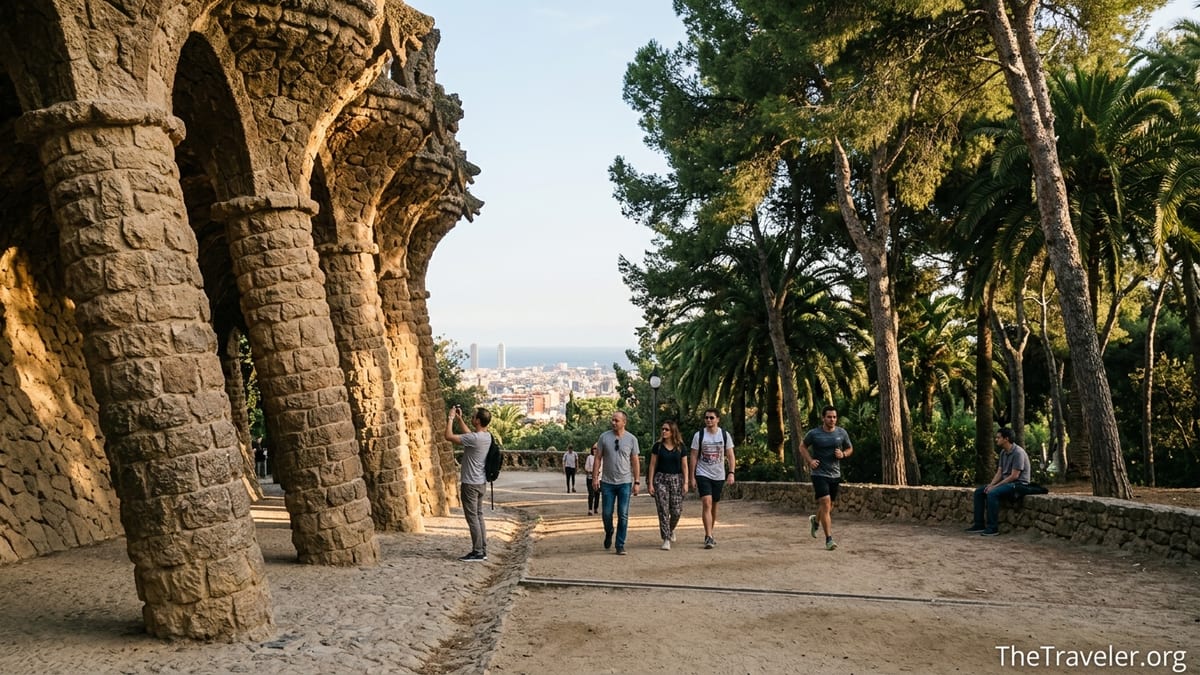
For many travelers, the real magic of Park Güell starts long before they reach the terrace. Winding up through the park’s stone viaducts and colonnaded walkways, you get a sense of how Gaudí originally imagined this as a residential garden city rather than a single viewpoint. The broad, elevated paths carried carriages for wealthy residents; today they carry families with strollers, visitors stopping to photograph the rough stone arches, and locals jogging in the early morning. Walking these viaducts at a relaxed pace, you feel the park open up in layers rather than in a single dramatic reveal.
One of the most loved sections is the so called Laundry Room Portico, a sloping arcade of tilted stone columns that seems to melt into the hillside. Travelers often describe how stepping into its shade on a hot afternoon feels like walking into a cave and a sculpture gallery at the same time. You may see a street musician playing classical guitar at the far end, taking advantage of the portico’s natural acoustics as people drift past. Even visitors who arrive focused on “seeing the dragon and the terrace” frequently linger here, surprised by how textured and intimate this part of the park feels compared with the crowds above.
These lower paths are also where independent travelers can still improvise their visit. Some choose the gentler, zigzagging ramps that climb gradually; others follow the older, steeper stairways that cut more directly up the hill. Along the way, small viewpoints appear unexpectedly between columns and pine trees, offering framed glimpses of the Sagrada Família or the Mediterranean. Many experienced visitors suggest arriving 30 to 45 minutes before your timed ticket so you can wander these approaches slowly, rather than rushing straight to the terrace.
Nature Square and the Hypostyle Room: More Than a Viewpoint
While the mosaic terrace is Park Güell’s most photographed feature, travelers often fall in love with what lies directly underneath: the Hypostyle Room. This forest of Doric columns, designed as a covered market for the unbuilt residential estate, is where Gaudí’s practical engineering meets a surprisingly serene atmosphere. On warm days, people naturally gravitate here to escape the sun, watching light filter down through round mosaic medallions set into the ceiling. The space can be busy, but if you wait a few minutes between tour groups, it briefly feels like an open air temple.
Above, on what is now called Nature Square, visitors discover that the terrace is not only a viewpoint but also the park’s social heart. The undulating form of the bench, shaped to support the curve of the human back, makes it unexpectedly comfortable to sit for a long time. Travelers talk about impromptu conversations with strangers here: a couple from Mexico sharing restaurant tips with a family from Canada, or a solo traveler sketching the skyline while a local explains which neighborhood is which. The panoramic view is spectacular, but many people remember these quiet interactions just as vividly.
Beyond the postcard angle, the square is a place to pause and notice details that most people rush past. Tiny ceramic fragments include coffee cups, plates and tiles recycled from Catalan factories, a patchwork that kids enjoy spotting as a kind of scavenger hunt. Guides sometimes point out that the terrace’s slight slope and hidden drainage system were designed to collect rainwater and funnel it down into underground cisterns, a sustainable solution that feels strikingly modern to travelers used to more decorative, less functional landmarks.
Austria Gardens and Gaudí House Museum: Domestic Scale Delight
Step a little away from the monumental zone and Park Güell suddenly becomes more domestic in scale. The Austria Gardens, once a plant nursery and later landscaped with trees donated from Austria, are a favorite surprise for travelers who feel overwhelmed by crowds near the main entrance. Here, the paths are wider and quieter, and you can sit on simple benches among cypress and palm trees while looking back at the park’s iconic gingerbread like gatehouses from a distance.
Many visitors pair a stroll through the gardens with a stop at the Gaudí House Museum, located in one of the original show homes built when the park was still intended as a private estate. Although the museum requires a separate ticket and timed entry, travelers who make room for it often describe it as one of the most human moments of their visit. Instead of grand symbolic structures, you see door handles, chairs and bed frames that Gaudí designed for everyday use. The modest bedrooms and narrow staircases help people imagine what it might have been like actually to live in this experimental hillside enclave in the early 1900s.
Not everyone chooses to enter the museum, but even walking around its exterior gives a different perspective on the park. The house’s warm pink walls, green shutters and small garden feel almost like a country villa, a sharp contrast to the busy terrace. Couples often sit on nearby benches to share a snack from a bakery in Gràcia or to check photos before exploring the rest of the hill. For many, this mix of domestic charm and grand design is what makes Park Güell feel more like a neighborhood space than a closed monument.
Hill of the Three Crosses and Wild Viewpoints Above the Crowds
Travelers who keep climbing beyond the terrace discover another side of Park Güell that rarely appears on postcards: the rugged summit known as the Hill of the Three Crosses. The final stretch involves a network of dirt paths and stone steps that wind past agaves, pines and hardy Mediterranean shrubs. Here, the landscaping is deliberately less manicured, and visitors often comment that it feels more like a natural hillside park than a designed attraction. The reward is a series of wide open viewpoints where the city spreads out like a map, from the Port of Barcelona to the Collserola hills.
At the top, three stone crosses crown a rocky outcrop, a simple structure that many travelers describe as unexpectedly powerful. People sit on the surrounding rocks to watch the light change in the late afternoon, away from the music and chatter of the main terrace. On clear winter days, when the air is crisp, photographers appreciate the visibility from here, while in summer, early morning climbers enjoy relatively cool temperatures and soft light before heat and crowds build up below.
Scattered around the upper park are smaller lookout spots and unmarked benches where independent travelers often end up spending more time than they expected. You might find a group of students sketching the skyline for an architecture class, or a local walking their dog in the off season. Some paths lead to Mirador Joan Sales and the edges of neighboring hills, areas that blur the line between the official monumental zone and the wider green spaces that wrap around it. For those willing to keep exploring, Park Güell gradually dissolves into a larger network of urban nature that belongs as much to residents as to tourists.
Everyday Park Life: Joggers, Dog Walkers and Local Routines
One of the aspects travelers frequently mention in reviews and travel journals is the sensation of watching local life unfold alongside sightseeing. Outside the ticket controlled monumental zone, Park Güell remains a free public park with playgrounds, dog walking areas and jogging routes. Early risers often share paths with Barcelona residents starting their day: an older man reading the paper on the same bench every morning, teenagers cutting through the park on their way to school, or neighbors chatting while their dogs circle one another near the grassy areas.
Visitors who stay in nearby neighborhoods such as El Carmel, La Salut or Vallcarca sometimes use the park as their own temporary backyard. They might walk through at sunrise with a takeaway coffee before the gates to the monumental zone open, or come back at sunset with a supermarket picnic once most day trippers have left. Over a stay of several days, the same travelers begin to recognize regulars, from the vendor who sells water near a particular corner to the violinist who plays on weekends in the same shaded spot.
These everyday scenes can be as memorable as the official highlights. A family from northern Europe might remember their children sharing a playground with local kids and figuring out games with only a handful of shared words. A solo traveler might recall the moment an older woman walking her terrier pointed out an unmarked shortcut to a viewpoint. In a city where many attractions feel tightly curated, this layer of unscripted park life makes Park Güell feel more porous and alive.
Sounds, Seasons and Small Sensory Details
Beyond its architecture, Park Güell is a place that travelers remember through small sensory impressions. The soundscape shifts constantly as you move: birds calling from pine branches, the scrape of skateboard wheels on a distant path, a busker’s saxophone echoing softly off stone columns, the murmur of multiple languages blending on the terrace. In the early morning, the park can be surprisingly quiet apart from gardeners at work; by midday, the atmosphere is livelier but rarely uniform, with each corner holding its own rhythm.
Seasonality plays a big role in how visitors experience the park. In spring, travelers notice fresh green growth between rocks and the smell of damp earth on shaded paths after a rain shower. Summer visitors talk about the intense sun on the open terrace, contrasted with the cool relief under the Hypostyle Room or deep within the viaducts. Autumn brings softer light and fewer tour groups, making it easier to pause at viewpoints without feeling rushed. Even in winter, on clear days, the low sun can make the mosaics glow and the sea stand out sharply against the horizon.
Other details stick in people’s memories: the coarse texture of the stone balustrades under your hand, the way shards of broken plates in the mosaics still show parts of logos and floral patterns, the faint smell of pine resin when you stop in the upper park. Parents often recall their children running their fingers along the scales of the mosaic dragon at the main staircase, or solemnly dropping a coin into a street musician’s open guitar case. These micro moments might not appear on any official map, but they are what many travelers replay when they think about Park Güell long after they have left Barcelona.
Practical Moments Travelers Appreciate
Travelers also come away with a strong impression of the practical side of visiting Park Güell, which can significantly shape their overall enjoyment. The park operates with timed entry slots for the monumental zone, and tickets often sell out, especially from late spring through early autumn. Many visitors who book in advance mention the relief of bypassing long queues at the entrance and walking straight in at their scheduled time. Others, who tried to buy tickets on arrival only to find their preferred slot unavailable, frequently advise future travelers to secure tickets at least a few days ahead during busy months.
Reaching the park itself becomes part of the story. Some travelers take city buses up to the stops on Travessera de Dalt and then walk 10 or so minutes uphill, passing local bakeries and corner stores as the city streets gradually turn into a hillside residential area. Others opt for a taxi or rideshare to save energy, especially if traveling with children or older relatives. There are a few outdoor escalators on the steepest streets from the Vallcarca side, but visitors rightly note that you should not rely on them completely, as they can be out of service. The walk, however, gives you a sense of the park’s elevation and helps explain why the views from the top feel so earned.
Inside, travelers appreciate the basic amenities that make a couple of hours in the park more comfortable. There are several restroom facilities, small kiosks selling water and snacks, and shaded seating areas where you can take a break between exploring the monumental area and the upper paths. Families in particular value the combination of structured sightseeing and unstructured playtime, often splitting the visit so that children can run freely in the outer park after a focused hour or so near the central monuments. Many visitors also highlight the staff presence: uniformed personnel checking tickets at control points, but also offering directions or suggesting less crowded routes at peak times.
The Takeaway
Ask returning travelers what they loved most about Park Güell, and relatively few will stop at “the famous terrace.” Many will mention instead a shaded stone walkway where a guitarist was playing softly, a quiet bench in the Austria Gardens, a breezy rock at the Hill of the Three Crosses, or a chance conversation with a local walking their dog. Others will remember the feeling of finally reaching the top after a long uphill walk, the surprise of seeing everyday park life unfold around a UNESCO site, or the way Gaudí’s architecture seems to grow out of the earth rather than sit on top of it.
In that sense, the park rewards visitors who treat it as more than a single photo stop. Booking a timed ticket, arriving a little early, and planning time to wander beyond the mosaic terrace gives space for these unscripted experiences to happen. Whether you approach it as an open air museum, a neighborhood park, or a hillside hike with architectural interruptions, Park Güell reveals different layers at different speeds. The terrace might draw you there in the first place, but it is the quieter paths, upper viewpoints and everyday moments that many travelers carry home.
FAQ
Q1. Is Park Güell worth visiting if I have already seen the famous mosaic terrace in photos?
Yes. Most travelers say the photos do not capture the atmosphere of the viaducts, upper viewpoints, Austria Gardens and everyday park life that make the visit feel special.
Q2. How much time should I plan to explore Park Güell beyond the terrace?
Many visitors recommend around two to three hours. This allows time for the monumental area, a slow walk through the viaducts and Hypostyle Room, and a climb to the Hill of the Three Crosses or other viewpoints.
Q3. Do I need to book tickets in advance, or can I just show up?
Timed entry for the monumental zone often sells out, especially in spring, summer and early autumn. Travelers frequently report a smoother experience when they book tickets online at least a few days in advance.
Q4. What are the best times of day to avoid the biggest crowds?
Early morning entry slots and late afternoon visits tend to be more comfortable. Midday, especially on weekends and during school holidays, is usually the busiest period.
Q5. Is Park Güell suitable for visitors with limited mobility?
The park is built on a steep hillside, but there are some gentler ramps and less steep routes. Even so, many paths and viewpoints involve uneven surfaces and slopes, so visitors with mobility challenges may prefer to focus on the lower monumental area and plan carefully.
Q6. Can I visit parts of Park Güell without paying for a ticket?
Yes. The areas outside the monumental zone remain a free public park. Many locals use these sections daily for walking, jogging and dog walking, and visitors can enjoy them without a ticket.
Q7. Are there places to buy food and drinks inside the park?
There are small kiosks and a café style area offering drinks and light snacks. Most travelers still recommend bringing a refillable water bottle and a small snack, especially in warmer months.
Q8. Is it better to explore Park Güell on my own or join a guided tour?
Both options work well. Independent travelers appreciate the freedom to wander and linger at viewpoints, while guided tours can add context about Gaudí’s symbolism and the park’s history. Some visitors choose a short guided tour and then stay on to explore at their own pace.
Q9. What should I wear and bring for a comfortable visit?
Comfortable walking shoes are essential, as paths can be steep and uneven. A hat, sunscreen, a light layer for cooler months and a small bottle of water will make the experience more enjoyable.
Q10. Can I find quieter spots for photos and relaxation even in peak season?
Yes. While the main staircase and terrace can be crowded, the viaducts, upper hillside paths and Austria Gardens usually offer calmer corners where you can sit, take photos and enjoy the views with more space.