


Few places in Barcelona are as instantly recognizable as Park Güell, with its mosaic dragon, storybook gingerbread gatehouses and sweeping views over the city to the Mediterranean. It is also one of the city’s most polarizing attractions. Some travelers come away calling it the highlight of their trip; others are surprised by the steep hills, rigid ticket system and higher prices. Before you lock Park Güell into your Barcelona itinerary, it is worth weighing the real pros and cons in practical, on-the-ground terms rather than postcard fantasies.
Get the latest updates straight to your inbox!
The Magic: Why Park Güell Still Captivates Travelers
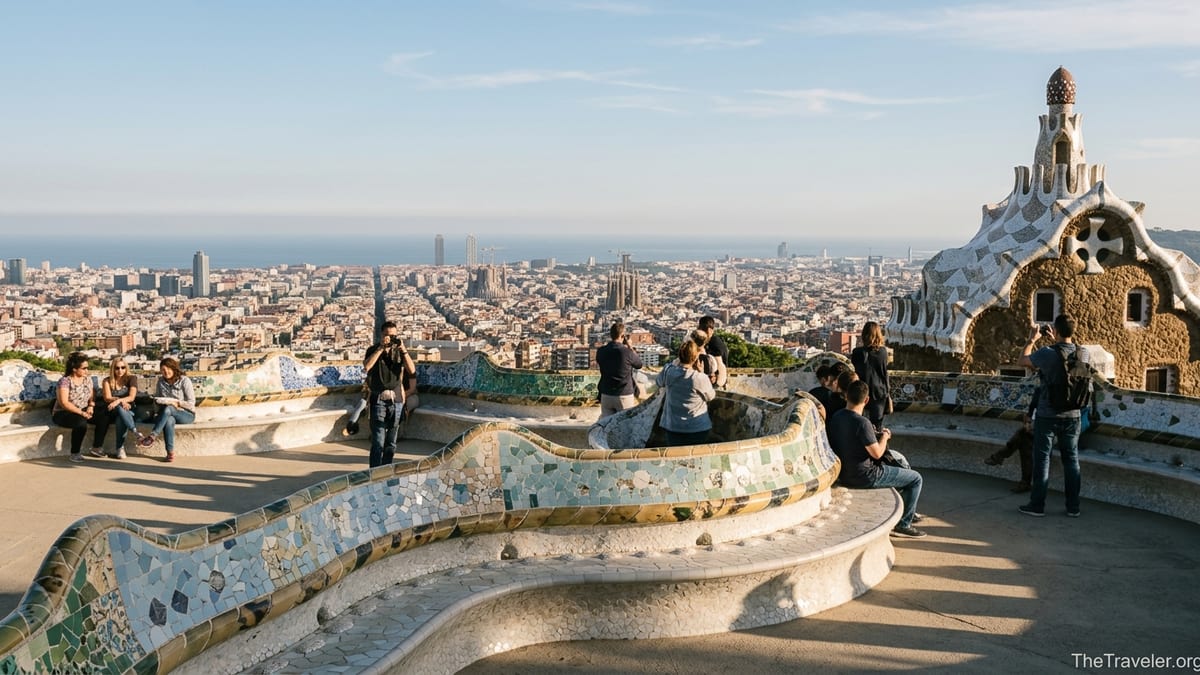
Park Güell is one of Antoni Gaudí’s most ambitious creations, a hilltop garden-city experiment begun in 1900 that never quite became the residential enclave it was meant to be. Today, it functions as a hybrid: part landscaped park, part open-air architectural museum. For many visitors, the main draw is the Monumental Zone, where Gaudí’s work is at its most theatrical and photogenic. This is where you find the sinuous mosaic bench that frames a panoramic terrace, the famous ceramic salamander at the grand staircase, and the forest of columns in the Hypostyle Room.
If you are a fan of architecture or design, Park Güell offers something different from more formal Gaudí sites like Casa Batlló or Casa Milà. Here, his organic curves and trencadís mosaics are integrated into pine groves, stone viaducts and rough rock colonnades. Walking under the Portico of the Washerwoman, for example, you see columns tilted like tree trunks; at the viaducts, random stone blocks become sculptural supports for elevated walkways. These details can be savored slowly, which is a luxury compared with the tighter circuits inside many indoor attractions.
The views are another powerful reason people put Park Güell on their must-see list. On a clear day, the terrace gives you a near 180-degree sweep over central Barcelona, from the Sagrada Família’s towers across the Eixample grid to the port and the sea. Travelers often time their visit for late afternoon in spring or autumn, when the light is softer and the colors of the tiled bench and gingerbread gatehouses feel less harsh than under midday sun.
Finally, Park Güell can feel like good value when you think in terms of time spent on site. Once you have entered during your time slot, you can stay until closing as long as you do not exit the Monumental Zone. Many visitors easily spend two hours moving between viewpoints, exploring the free forested upper areas, and simply sitting on a bench watching street musicians and sketch artists work.
The Real Costs: Tickets, Time Slots and Value for Money
As of mid 2026, the standard adult ticket to Park Güell purchased through the official channel is about 18 euros, a substantial jump from the 10 euro price that held for years. The increase brought it closer to other major Barcelona monuments, but it also changes how travelers see its value, especially for families. A family of four with two teenagers now spends around 60 to 70 euros just to enter, depending on age categories, which for some visitors feels high for what is still largely an outdoor park.
The park operates on a timed-entry system with capacity controls. Your ticket is tied to a specific 30-minute entry window, and you are expected to arrive at the access point during that slot. In practice, this means that if your ticket is for 10:30, you need to be at the gate area by roughly 10:30 to 11:00. Arrive too early and you may be asked to wait; arrive after the window and staff can refuse entry. There is no re-entry, so a quick step outside for a coffee is not an option.
For independent travelers, this rigidity can be frustrating. If your morning metro is delayed or you linger too long over breakfast in Gràcia, you may find yourself rushing uphill to avoid missing your slot. During busy months from March through October, popular hours in the morning and just before sunset often sell out a few days in advance. Travelers routinely report turning up at the park and discovering that same-day tickets for convenient times are gone, leaving only late evening or not at all. Booking at least a few days ahead is increasingly sensible if Park Güell is a priority for you.
On the other hand, the time-slot system is part of what makes a visit more enjoyable. Compared with a decade ago, there are fewer uncontrolled bus groups pressing into the terrace at once, and you are more likely to find a spot on the mosaic bench without waiting long. If you are willing to commit to a specific time and buy online, you benefit from the crowd management that your ticket helps maintain.
Location and Logistics: Beautiful but Not Effortless
Park Güell sits on Carmel Hill above the Gràcia district, roughly 4 kilometers from Plaça de Catalunya. On a map it does not look far from the city center, but in reality the last stretch is steep. No metro station sits directly at the entrance. The closest stops on Line 3, Lesseps and Vallcarca, still require a 15 to 20 minute uphill walk, partly on residential streets and in some sections by outdoor escalators that are occasionally out of service.
For many visitors, the most straightforward public transport option is a city bus to the Carretera del Carmel entrance. Bus 24 from Plaça de Catalunya or Passeig de Gràcia is a commonly recommended route, as it takes you much closer to the park’s main gate than the metro does. In recent years, a dedicated shuttle bus from Alfons X metro station on Line 4 has also become popular, especially for those with limited time or mobility. However, it operates only for ticketed visitors and at specific hours, so you need to check the current timetable when planning your day.
Taxis and ride-hailing services are widely used to reach Park Güell, especially early in the morning. From central Barcelona, fares are typically in the 10 to 15 euro range one way, depending on traffic and exact starting point. For a couple or small group, this can be a worthwhile splurge to avoid the climb before a long day of sightseeing. Conversely, driving yourself is usually a poor idea. Street parking around the park is scarce and often reserved for residents, and enforcement is strict.
All of this means that visiting Park Güell requires more logistical thought than attractions closer to the center, like Casa Batlló or the Picasso Museum. You need to factor in not just the 90 minutes to two hours on site, but also at least 30 to 45 minutes of travel each way from the Eixample or the Gothic Quarter. That can have real consequences if you are trying to plan a tight day that also includes timed tickets for the Sagrada Família or another major site.
Crowds, Atmosphere and the Trade-Offs of Popularity
Park Güell’s global fame comes with an unavoidable downside: crowds. In peak months from April to October, and again around Christmas and Easter, the Monumental Zone can feel constantly busy from mid-morning until early evening. Travelers often describe a slow-moving flow of people queuing to take photos with the mosaic dragon, inching along the bench, and clustering under the colonnades.
The timed-entry system and resident-only early hours have reduced the worst excesses, but they have not turned Park Güell into a tranquil secret garden. If your mental image is of wandering nearly alone along the tiled bench, you are likely to be disappointed unless you visit in the cooler months and at the very start or end of ticketed hours. In summer, the atmosphere is closer to a small outdoor festival: street musicians performing, vendors selling trinkets just outside the controlled area, and tour groups in multiple languages crisscrossing the terrace.
For some travelers, that lively scene is part of the charm. Sitting on the bench and people-watching while a guitarist plays and the city spreads out below can feel like a quintessential Barcelona moment. For others, especially those sensitive to noise or who dislike jostling through selfie sticks, the density of visitors can be draining. It is worth asking yourself how you tend to react to very popular attractions elsewhere. If you found the Trevi Fountain in Rome or Montmartre in Paris overwhelming, you may feel similarly at Park Güell during busy times.
The good news is that it is still possible to find quieter corners within the park, particularly in the upper forested areas beyond the Monumental Zone. These sections do not require a ticket and attract more locals on morning walks or runners cutting across the hill. Many visitors who feel overwhelmed on the terrace are surprised to discover, just a few minutes’ walk away, paths lined with pines, lizards sunning themselves on walls and occasional viewpoints where there might be only a handful of people.
Accessibility, Comfort and Weather Considerations
Because Park Güell is built on a hillside, accessibility is a genuine concern. Even with taxis or buses dropping you near an entrance, the interior of the park features multiple levels, sloping paths and some staircases. There are designated accessible routes that avoid the steepest sections and staff are generally helpful in pointing them out, but travelers with mobility challenges, knee issues or who use wheelchairs should plan carefully and allow extra time.
The outdoor escalators that connect some residential streets to the upper approaches can be tempting, but they are not always operational. Travelers occasionally report arriving expecting an effortless ride up, only to discover that part of the escalator chain is out of service, turning what was meant to be a mechanical assist into a stair climb. This is another reason why a taxi to the main gate or the dedicated shuttle from the metro can be the better option if you are unsure of your stamina.
Weather also plays a big role in how enjoyable Park Güell feels. In summer, the exposed terrace can be intensely hot and bright, especially around midday. There is limited shade immediately around the bench, and the white and pastel tiles reflect the sun, which can be tiring on the eyes. Bringing water, a hat and sunscreen is essential. By contrast, in winter months the hilltop setting means it can be a few degrees cooler and breezier than the city center, so a light layer is wise even on sunny days.
Facilities on site are adequate but not luxurious. There are public toilets near the main entrances and in parts of the Monumental Zone, as well as small cafés and kiosks selling coffee, soft drinks and simple snacks. Prices for refreshments are higher than at neighborhood bars down in Gràcia, so if you are on a budget it makes sense to eat beforehand or plan a proper meal in the district after your visit rather than lunching in the park.
When Park Güell Belongs on Your Itinerary (and When It Might Not)
Whether Park Güell is right for you depends on your interests, your schedule and your tolerance for hills and crowds. If you are deeply interested in Gaudí or architecture in general, it is hard to argue against going. The way the park integrates built forms with the natural contours of Carmel Hill makes it one of the best places to understand his approach. Travelers who loved the Sagrada Família often find Park Güell a complementary experience, showing Gaudí’s ideas in a freer, more playful context.
If you enjoy photography, Park Güell can be a highlight as well. The combination of patterned tiles, rough stone, framing archways and long views gives you many opportunities for distinctive angles. Early-morning tickets offer soft light and fewer people; late evening slots in summer let you see the city begin to glow as lights flick on below. Those willing to wake up early and book the first time slot of the day often come away with a sense of calm that others do not experience.
By contrast, if your time in Barcelona is very limited, Park Güell may not be essential. On a one-night stay or even a packed two-day itinerary focused on the historic center and the Sagrada Família, the time and logistics required to reach the park can make it less efficient than other sights. Similarly, if steep walks are a serious issue for someone in your group and you are not keen to rely on taxis, it might be more comfortable to focus on centrally located Gaudí buildings that have elevators and shorter approaches.
Budget can be another deciding factor. For a solo traveler choosing between Park Güell and a guided interior visit to the Sagrada Família or Casa Batlló, the marginal cost difference is not large, but the experiences are very different. Some backpackers opt to enjoy the free viewpoints and streets on the hills above Gràcia instead, saving the ticket money for a special meal or a concert while still getting sweeping views over Barcelona.
The Takeaway
Park Güell is neither a simple city park nor a conventional museum. It is a world-famous, carefully managed site perched on a hill at the edge of central Barcelona, with all the advantages and complications that implies. The pros are substantial: a unique concentration of Gaudí’s work in an outdoor setting, memorable views across the city, and the chance to experience one of Barcelona’s defining images in person rather than on a screen.
The cons are equally real. Ticket prices are no longer negligible, the timed-entry system demands some advance planning, and the combination of hills, crowds and weather can make a visit more tiring than many travelers expect. For those with just a day or two in the city, or with limited mobility and a low tolerance for logistical hassle, Park Güell may not offer the best return on time and energy.
If you decide to go, treat it as a half-day outing rather than a quick stop. Book your ticket a few days ahead, aim for the earliest or latest slots available in your travel season, budget for taxis if the hills worry you, and plan to follow your visit with a relaxed meal in Gràcia. Approached on its own terms, Park Güell can still deliver the mixture of whimsy, cityscape and Catalan modernism that has made it an icon for more than a century.
FAQ
Q1. Is Park Güell worth visiting if I am already seeing the Sagrada Família?
If you are interested in Gaudí’s work, yes, because Park Güell shows a different side of his style in an outdoor setting. While the Sagrada Família focuses on monumental, spiritual architecture, Park Güell reveals his integration of nature, landscape and whimsical design. Many travelers who love the basilica find the park a valuable complement, though if your time is extremely limited, you may prioritize the Sagrada Família and a single central Gaudí house instead.
Q2. How far in advance should I book Park Güell tickets?
In busier months from spring through early autumn, it is sensible to book at least a few days in advance for popular morning and late-afternoon time slots. During quieter winter periods, you might find same-day availability, especially for midday. However, because capacity is controlled and peak hours often sell out, you should not assume you can buy tickets at the gate on the day, particularly if you have a fixed schedule.
Q3. What is the best time of day to visit Park Güell?
The first entry slots of the morning and the last ones before closing generally offer the most pleasant experience. Early mornings tend to be cooler, with softer light and fewer people, which suits photography and quieter contemplation. Late afternoon or early evening in summer can be beautiful for views as the city lights up, though it may still be busy. Midday, especially in high season, is typically the hottest and most crowded period.
Q4. Can I visit the free parts of Park Güell without a ticket?
Yes, the outer areas of the park, including many of the wooded paths and some viewpoints, remain free to access. The Monumental Zone, where most of Gaudí’s signature structures and the famous terrace are located, requires a paid ticket and controlled entry. Some budget-conscious travelers choose to explore only the free areas for a taste of the setting and views, but this does not include the mosaic bench, dragon staircase or Hypostyle Room.
Q5. How long should I plan for a visit to Park Güell?
Most visitors are comfortable with about 90 minutes to two hours inside the Monumental Zone, plus additional time if you want to wander the free wooded sections. When you factor in travel from central Barcelona and the uphill approaches, it is wise to allocate at least half a day in your schedule. Rushing through in under an hour is possible but tends to feel unsatisfying, especially given the cost and effort to reach the park.
Q6. Is Park Güell suitable for travelers with limited mobility?
Park Güell has designated accessible routes and staff who can advise on the least steep paths, and the main entrance area can be reached by taxi or shuttle bus to reduce the climb. However, the park is inherently hilly, with sloping paths and some unavoidable inclines. Travelers who use wheelchairs or have significant mobility issues can visit parts of the Monumental Zone, but may not find the entire site comfortable. In such cases, centrally located Gaudí buildings with elevators might be easier to enjoy fully.
Q7. What should I wear and bring for a visit to Park Güell?
Comfortable walking shoes are essential, as you will be on your feet on uneven surfaces and slopes. In warmer months, bring water, sun protection such as a hat and sunscreen, and consider sunglasses because the tiled surfaces can reflect strong light. In cooler seasons, a light jacket or layer is useful, as the hilltop can feel breezier than the city center. A small daypack is fine, but very large bags may be inconvenient on crowded paths.
Q8. Can I combine Park Güell with the Sagrada Família on the same day?
Yes, many travelers visit both on the same day, but it requires careful timing. Typically, you would schedule a morning ticket for one site and a late-afternoon ticket for the other, allowing for travel time, a meal break and some flexibility. Public transport or taxis connect the two areas in roughly 20 to 40 minutes, depending on your choices. Avoid stacking time slots too closely together, as delays or the uphill walk to Park Güell can quickly eat into your margin.
Q9. Are guided tours of Park Güell worth it?
Guided tours can be worthwhile if you are interested in history, symbolism and Gaudí’s design process. A good guide will point out details you may otherwise overlook, such as the engineering behind the viaducts or the water-collection system built into the terrace. However, tours are more expensive than standard entry and follow a set route and pace. Independent travelers who prefer to explore at their own speed may be satisfied with an audio guide or a well-researched guidebook instead.
Q10. Is Park Güell a good place to visit with children?
Many families enjoy Park Güell with children, who are often captivated by the dragon fountain, quirky shapes and open spaces. The park offers room to move and explore, and the lack of indoor constraints can be liberating compared with traditional museums. That said, parents should be prepared for uphill walking, manage expectations about crowds, and keep an eye on younger kids near railings, staircases and busy viewpoints. Bringing snacks and scheduling a rest break in the shade can help make the visit more enjoyable for everyone.