


Few cities are as defined by a single architect as Barcelona is by Antoni Gaudí. For most visitors with limited time or budget, the real dilemma is not whether to see Gaudí, but which Gaudí experience to choose. Park Güell and the Basílica de la Sagrada Família are the two heavyweights. Both are UNESCO World Heritage Sites, both are crowded, and both shape how travelers remember the city. Yet they deliver very different moods, logistics and price points. This guide breaks down how each site actually feels on the ground in 2026 so you can decide which one deserves your time, money, and camera battery.
Get the latest updates straight to your inbox!
First Impressions: Nature Fantasy vs Sacred Skyline
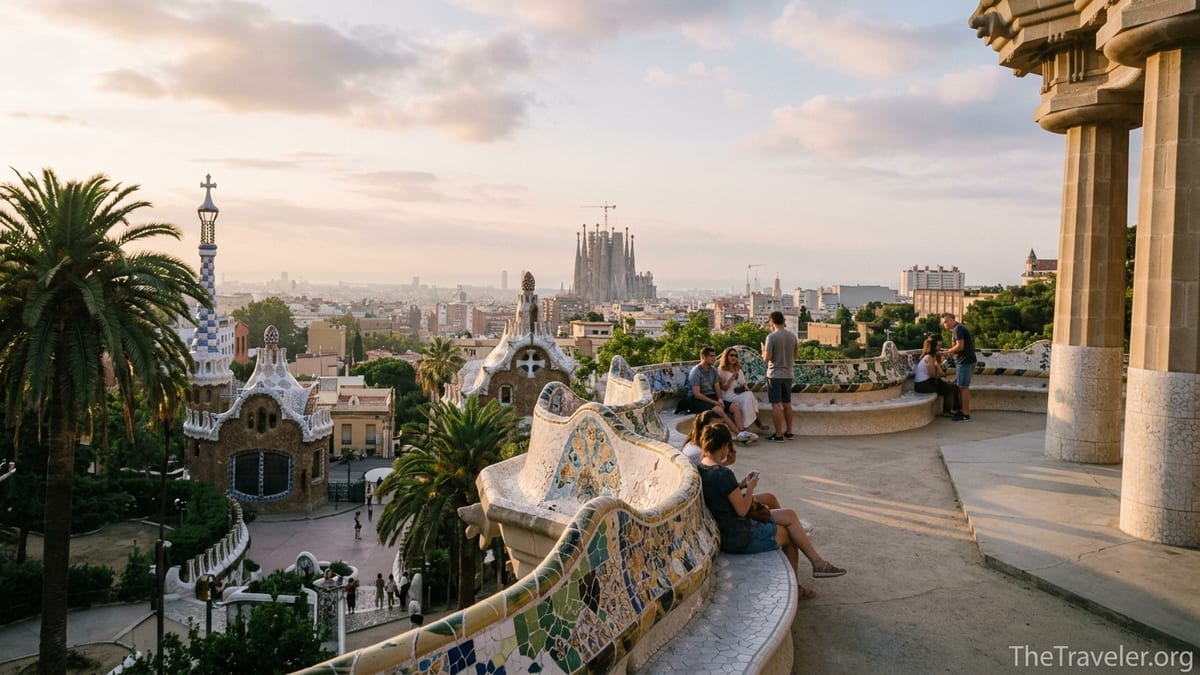
Walking into Park Güell, your first impression is likely color and air. You pass pine trees and scrubby Mediterranean greenery, then suddenly hit Gaudí’s famous mosaic terrace, where the tiled serpentine bench curls around a wide viewing platform and the blue-and-gold lizard (the “drac”) guards the staircase. You are outdoors, hearing birds and buskers, kids chasing bubbles, and the swell of Barcelona’s skyline below. It feels playful and social, somewhere between a sculpture garden and a neighborhood park.
Arrival at the Sagrada Família is the opposite in tone. You emerge from the metro at Sagrada Família station and the basilica is simply there in front of you, stone towers spearing the sky above apartment blocks. In 2026 its central tower is finally complete and the basilica now dominates the skyline in a way that no photo quite prepares you for. The street buzz drops away as you step inside and the space erupts into height and filtered light, like walking into a stone forest where the branches have become stained glass.
In practice, Park Güell feels like a relaxed outdoor half-day with architecture as a backdrop to city views, while Sagrada Família feels like an intense, primarily indoor, once-in-a-lifetime monument. If you imagine your ideal Gaudí moment as sun on your skin and views over Barcelona, Park Güell wins. If you imagine being floored by sheer scale and spiritual atmosphere, Sagrada Família is hard to beat.
For many travelers, especially first-timers to Europe, Sagrada Família delivers the bigger emotional shock. Travelers who have already seen large cathedrals or who prefer open spaces often come away preferring the park. Your own reaction will hinge on whether you tend to feel more alive in wide landscapes or awe-inspiring interiors.
Cost, Tickets and Value for Money in 2026
As of mid 2026, Park Güell is clearly the cheaper Gaudí, but the gap has narrowed. A standard adult ticket booked on the official system is now around 18 euros after a steep price rise that took effect on January 1, 2026, bringing it closer to other major European attractions. Third-party sites sometimes add audio guides or transport and charge a bit more, but you should budget roughly 18 to 22 euros per adult if you want at least a basic digital guide.
Sagrada Família tickets start higher. A basic self-guided adult entry purchased directly is typically in the high twenties per person, with common examples around 26 to 30 euros depending on options and visitor category. Add a guided tour and you are often in the 30 to 35 euro range per adult. Tower access is always extra and must be selected at booking; it commonly pushes a ticket into the mid 30s or higher per person. For a couple wanting a guided visit with tower access, it is realistic to expect a total around 70 to 90 euros before any extras.
Value is about more than price, and this is where travelers differ. At Park Güell, you are buying two to three hours of access to the Monumental Zone, including the terrace, gingerbread-like gatehouses, and the main staircases. Many visitors also wander the larger surrounding green areas, which are free. You might sit on the mosaic bench for 20 minutes watching the city, climb to the higher viewpoints like the Turó de les Tres Creus, and leave feeling that you have had a generous amount of time in the space relative to what you paid.
At Sagrada Família, you are paying more for a shorter time window, but for many it feels like a more concentrated “wow” experience. A common pattern is 60 to 90 minutes inside the basilica, plus 30 minutes in the small museum and shop. If you climb a tower, add about 45 minutes. When you consider that the basilica has been under construction for more than a century and is now the tallest religious building in the world, many visitors consider the ticket one of the best uses of money in Barcelona. On a tight budget, Park Güell stretches your euros further; if you can afford to splurge on one big Gaudí moment, Sagrada Família is the stronger candidate.
Crowds, Timing and How the Visits Actually Flow
Both sites now operate on timed tickets and both sell out, especially in spring and autumn. Park Güell’s tickets are slotted in specific entry times, typically every few minutes, and in peak months you will see popular morning and late afternoon slots disappear several days in advance. The city has cracked down on the old trick of slipping into the Monumental Zone outside official hours, so you should assume that you need a ticket for any meaningful visit.
Sagrada Família works similarly. Timed entry operates throughout the day, from roughly 9 in the morning until early evening, with the first hour after opening and the last hour before closing usually the least crowded. Tickets tend to go on sale a couple of months out and tower slots are limited. It is now normal in 2026 to find some tower times already gone several weeks ahead during busy periods, particularly around events like the centenary commemorations of Gaudí’s death or the recent papal visit marking the completion of the main tower.
In terms of how crowded they feel, Park Güell disperses people across terraces, paths and viewpoints, but choke points form at the mosaic lizard, the main staircase and the classic terrace photo spots. On a sunny April afternoon, you may wait several minutes just to get a turn for a clear bench shot and you will likely have strangers in the background of your photos. Early morning slots, especially those before 9:30, are more comfortable and cooler, with softer light and fewer tour groups.
Inside Sagrada Família, crowding is intense at specific interior viewpoints, like the central nave just past the entrance gates and the areas under the stained glass where people stop to take photos of the colored light on the floor. Lines form at the elevators for tower access and at the confessionals and museum entrance. However, the vertical scale and wide nave mean you can usually find a corner to stand quietly and look up without feeling jostled. A typical flow is entry, a slow walk up the right-hand side of the nave, time spent in the transept and apse, and then a loop through the museum and gift shop before exiting to the park across the street for exterior photos.
Architecture, Atmosphere and the “Gaudí-ness” Factor
Park Güell shows Gaudí in a playful, almost experimental mood. The famous mosaic work uses broken ceramic tiles in bright colors to create fantastical creatures and patterns, from the serpentine bench to the ceiling medallions in the Hypostyle Room. Pathways twist around pillars shaped like tree trunks, viaducts curve past pine trees, and the houses at the main entrance look like something out of a Catalan fairy tale. It is Gaudí responding to terrain and vegetation, creating a hilltop garden-city that never quite materialized as planned.
Sagrada Família, by contrast, is Gaudí’s spiritual manifesto. Outside, the Nativity façade is dense with Christian symbolism and stone animals, while the Passion façade is stark and angular. Inside, columns splay at the top like branches to form a stone canopy, and light pours through stained glass panels that shift from cool morning blues and greens to fiery evening reds and oranges. The building has become a living timeline of Catalan and international stonework, as different generations of craftsmen and architects have continued Gaudí’s vision after his death.
If you are primarily interested in Gaudí’s coloring, mosaics and whimsical use of everyday materials, Park Güell is the better fit. Many travelers who visit multiple Gaudí sites note that the park, together with Casa Batlló, gives the clearest sense of his imaginative use of ceramics and organic shapes. On the other hand, if you are fascinated by engineering and the idea of a structure that pushes gravity and geometry to the edge, Sagrada Família is unmatched. Even those who are not religious often describe the interior as one of the most powerful architectural spaces they have ever experienced.
From a photographic standpoint, Park Güell offers more classic wide cityscapes and colorful foregrounds, ideal for travel portraits and social media shots. Sagrada Família rewards patience and a tripod-level steady hand: vertical shots that capture the full height of the nave, abstract close-ups of stone and glass, and long exposures of the interior light. Travelers who love experimenting with photography often come away more satisfied from the basilica, while casual phone shooters may find Park Güell’s terrace the more instantly rewarding backdrop.
Location, Transport and Accessibility
Park Güell sits on the slopes above the Gràcia district, at the edge of the Collserola hills. Getting there involves more effort. The closest metro stops, such as Vallcarca or Lesseps on line 3, leave you with a 15 to 20 minute uphill walk, sometimes via steep streets and outdoor escalators. City buses and neighborhood shuttles can drop you closer, but many visitors still end up climbing. For someone with limited mobility or traveling with a stroller, that last stretch can feel long on a hot afternoon, even though once inside the Monumental Zone there are plenty of benches and shade.
Sagrada Família could not be more central by comparison. It sits on a flat, gridded intersection in the Eixample neighborhood, directly on two major metro lines, with frequent buses and taxis passing in front. From Plaça de Catalunya, a metro ride takes roughly 10 to 15 minutes, and walking from the central Passeig de Gràcia area takes about 25 minutes along mostly level streets. For travelers staying near the Gothic Quarter or Eixample, this makes it easy to pair Sagrada Família with other sights or meals without losing time in transit.
Accessibility also plays into the decision. Sagrada Família’s interior is largely step-free for visitors who are not doing the towers, with ramps and elevators in key places, and accessible restrooms. The towers themselves involve elevators up but narrow spiral stairs down, which can be challenging for anyone with knee issues or vertigo. Park Güell’s Monumental Zone includes sloping paths, some stepped sections and uneven stone surfaces. Certain elevated viewpoints require modest climbs on dirt tracks. For a visitor using a wheelchair or someone who tires easily, the basilica will usually be the more manageable option, provided they skip the towers.
In practical terms, if you only have one full day in Barcelona and want to minimize logistics, Sagrada Família wins. If you are spending three or four days and are comfortable with uphill walks or bus rides, Park Güell’s location becomes less of an issue and can be pleasantly combined with wandering Gràcia’s cafes and squares afterward.
Which One Suits Your Travel Style?
If you are a first-time visitor to Barcelona and like iconic landmarks, Sagrada Família is the safer bet. It is the image most people carry of the city today and, after the recent completion of the main tower and high-profile religious ceremonies, it has taken on a new status as a finished, rather than perpetually incomplete, masterpiece. For many travelers, skipping it would feel like skipping the Eiffel Tower in Paris or the Colosseum in Rome. Add a tower visit if you are comfortable with heights and stairs and want panoramic views that feel more intimate than typical city observation decks.
Budget-conscious backpackers, families with energetic kids, and travelers who crave outdoor time often lean toward Park Güell. A morning there can double as a gentle hike and picnic with world-class architecture built into the hillside. Realistically, a couple with two children can enter Park Güell for significantly less than Sagrada Família, and the kids can run around more freely. The whimsical mosaics, the dragon fountain and the shaded colonnades are engaging for children who might not tolerate a solemn basilica visit.
Photo-focused travelers should ask themselves what kind of images they want to bring home. If your dream shot is sitting on the mosaic bench at golden hour with the Sagrada Família and the Mediterranean in the background, Park Güell is the only place to get it. If you are more drawn to shafts of colored light and soaring interiors, Sagrada Família will give you more unique frames than almost any other European church. In practice, serious photography enthusiasts often try to visit both: Park Güell near sunrise or late in the day, and Sagrada Família midday when the light is strongest through the stained glass.
Finally, consider your tolerance for crowds and structure. Sagrada Família requires more planning: pre-booked tickets, set time slots, security check, and often a firm exit time. Park Güell, while also timed, feels looser once you are inside; you can dawdle on a bench, wander side paths, or linger at viewpoints without being shepherded along. Travelers who dislike strict schedules and indoor queues might feel more at ease in the park.
Can You Do Both, and In What Order?
For many visitors, the ideal answer is not Park Güell or Sagrada Família, but Park Güell and Sagrada Família. On a typical two- or three-day city break, it is possible to see both comfortably without feeling rushed, provided you pre-book and think about the order. A popular pattern for spring and autumn is Park Güell in the early morning, followed by a relaxed lunch in Gràcia, then a mid-afternoon Sagrada Família visit when the interior light is strong.
In summer heat, you might invert that pattern. Start with Sagrada Família at opening time to avoid the strongest sun and have more energy for the interior, then head up to Park Güell later in the day when temperatures drop a little and the low sun improves views. Evening slots at the park, especially those in the last 90 minutes before closing, can offer softer light and fewer school groups, though they remain popular with photographers.
From a narrative point of view, beginning with Park Güell gives you a sense of Gaudí’s language in a relaxed, open-air setting. When you then step inside Sagrada Família, you recognize familiar motifs: the branching columns, the organic shapes, the interplay of structure and nature. The basilica feels like the culmination of ideas you first saw sketched on a hillside. Many architecture fans find that this sequence deepens their appreciation of the church.
If your schedule forces a choice, a simple rule of thumb for a first-time visitor in 2026 is this: choose Sagrada Família if you can only do one. It is the more singular experience and less easily compared to anything else in Europe. Park Güell is magical and memorable, but there are other hilltop parks and viewpoint gardens in the world. There is only one Sagrada Família, and now that its main silhouette is completed, this decade is a particularly historic moment to see it.
The Takeaway
Both Park Güell and the Sagrada Família are essential parts of Gaudí’s Barcelona, but they serve different kinds of trips and travelers. Park Güell is an open-air, colorful, and relatively budget-friendly way to experience his playful side, with the city laid out like a mosaic below. It asks a little more effort to reach and rewards you with views, fresh air and the freedom to wander.
Sagrada Família is Gaudí at full intensity: a monumental, finished basilica that anchors Barcelona’s skyline and offers an interior unlike any other. It requires more money, more planning and more patience with lines, yet it is also the place where many visitors report their most powerful memory of the city. In 2026, with the central tower now complete and major ceremonies drawing international attention, it is living history in real time.
If you are selecting just one Gaudí experience and you care about architecture or the story of Barcelona, the balance tilts toward Sagrada Família. If your priority is relaxed time outdoors with views and color without spending too much, Park Güell may suit you better. And if you possibly can, arrange your days to experience both sides of Gaudí’s genius. Together they tell a story of a city and an architect that neither could fully tell alone.
FAQ
Q1. If I have time for only one, should I choose Park Güell or Sagrada Família?
Sagrada Família is generally the better single choice, especially for a first visit. It is more expensive, but its scale, interior light and current historical moment as a nearly completed basilica make it harder to replace with any other experience.
Q2. How much time do I need at each site?
Most visitors spend about two to three hours at Park Güell, including time to walk up to viewpoints and sit on the terrace. At Sagrada Família, plan at least 90 minutes inside plus 30 minutes for the museum and exterior photos, and add another 45 minutes if you book a tower.
Q3. Which is better for travelers on a tight budget?
Park Güell is usually better value for money. Standard adult tickets are significantly cheaper than Sagrada Família and you can extend your time on the hill by exploring the free surrounding park areas before or after your timed entry to the Monumental Zone.
Q4. Which is better with young kids?
Park Güell is often easier with small children. They can move more freely, there are open spaces and shady corners, and the dragon fountain and mosaic animals tend to hold their attention. Inside Sagrada Família, you will need to manage noise and keep a closer eye on them in crowds.
Q5. Are both places accessible for visitors with limited mobility?
Sagrada Família’s main interior is generally more accessible, with step-free routes and elevators. The tower visit, however, involves narrow stairs. Park Güell includes hills, uneven paths and steps, and while some areas are manageable, reaching the best viewpoints can be challenging.
Q6. Which offers better views of Barcelona?
Park Güell offers broader, more panoramic city views from its terrace and hilltop viewpoints, with Sagrada Família visible in the distance. The towers at Sagrada Família provide more vertical, close-in views over the Eixample grid and nearby rooftops rather than the whole city.
Q7. Do I need to book tickets in advance for both?
Yes. In 2026, both Park Güell and Sagrada Família commonly sell out popular time slots, especially in spring, summer and autumn. Booking online several days to a few weeks ahead is strongly recommended, and tower tickets at Sagrada Família often disappear first.
Q8. Can I visit both in one day without feeling rushed?
Yes, many travelers comfortably visit both in one day. A typical plan is Park Güell in the early morning, lunch in Gràcia, then Sagrada Família in mid-afternoon. If it is very hot, you might reverse the order to see Sagrada Família first and the park closer to sunset.
Q9. Which is better for photography?
For classic Barcelona views and colorful foregrounds, Park Güell is better. For dramatic interiors and stained glass light, Sagrada Família is superior. Serious photographers often plan for both, timing Park Güell around sunrise or sunset and Sagrada Família for strong midday light inside.
Q10. Are there any dress code or behavior rules I should know?
At Sagrada Família, modest dress is requested, including covered midriffs and avoiding very short shorts or swimwear-style tops, and visitors are expected to behave quietly inside. Park Güell is more relaxed, with standard public-park behavior and sun-appropriate clothing generally accepted.