


Few places in Barcelona blend visionary architecture with wide open skies quite like Park Güell. Perched high on Carmel Hill, Antoni Gaudí’s hillside park gives travelers a rare combination: close-up encounters with organic, almost dreamlike design and far-reaching panoramas that stretch from the Sagrada Família to the Mediterranean. For visitors who care as much about lines, curves, and colors as they do about a commanding city view, Park Güell is one of Europe’s most rewarding detours.
Get the latest updates straight to your inbox!
Gaudí’s Hilltop Experiment: Why the Setting Matters
Park Güell was never meant to be just a pretty park. Around the turn of the 20th century, industrialist Eusebi Güell commissioned Antoni Gaudí to design an exclusive garden city on the steep slopes above Barcelona. The project failed as a real estate venture, but the location was no accident. The southern flank of Carmel Hill, part of the Collserola range, overlooks the city at more than 180 meters above sea level, creating a natural balcony that Gaudí could treat as both canvas and viewpoint.
From the outset, Gaudí worked with the hillside instead of against it. Instead of flattening the terrain, he wove paths, arcades, and terraces into the existing topography, using the park’s altitude to frame the skyline. Today, travelers walking uphill from the main entrances sense this design immediately. As you climb toward the central terrace, the view widens step by step: first nearby rooftops in the Gràcia district, then the unmistakable silhouette of the Sagrada Família, and finally the distant shimmer of the sea.
This careful use of elevation is what makes Park Güell such a natural fit for visitors who love both architecture and panoramas. Where other hilltop viewpoints offer bare rock, railings, and a snack bar, Gaudí offers sculpted colonnades, tiled benches, and whimsical gatehouses that feel purpose-built to guide the eye toward the horizon.
Signature Architecture You Can Walk Through and Touch
For travelers drawn to architecture, Park Güell is a rare chance to step into Gaudí’s imagination at human scale. Much of the park’s most recognizable work lies in the Monumental Zone, the paid central area that contains his most elaborate designs. Here, the famous Dragon Staircase greets visitors with an undulating double staircase flanked by organic stone walls, leading up from the fairy-tale gatehouses at the main entrance. The brightly colored mosaic lizard that anchors the stairway has become one of Barcelona’s most photographed details.
Above the stairway, the Hypostyle Room reveals Gaudí as both architect and engineer. This forest of nearly one hundred stone columns was originally intended as a market for the residential estate. Light filters down from circular openings in the ceiling, illuminating white mosaic tiles and creating a cool, cavernous atmosphere. From an architectural perspective, it is a masterclass in how to carry the weight of a terrace above while disguising structure behind organic forms and ornament.
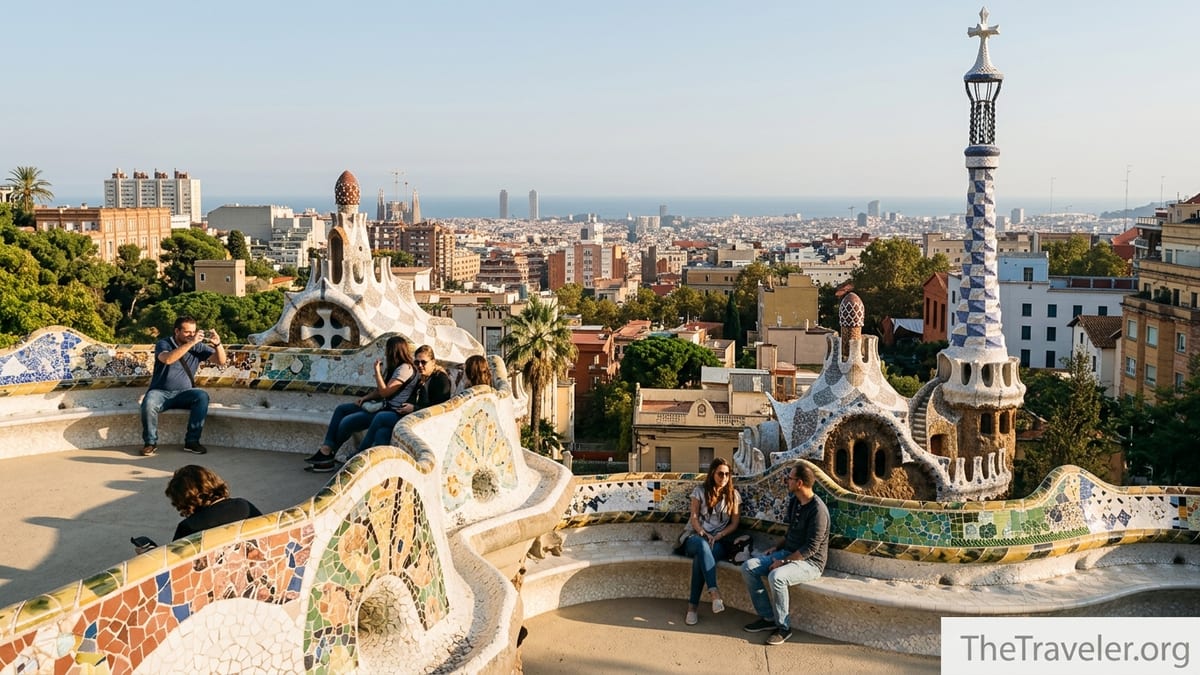
Step up another level and you reach the Plaça de la Natura, or Nature Square. This huge terrace is framed by Gaudí’s serpentine bench, a sinuous seat clad in broken-ceramic trencadís mosaics. Visitors run their hands along the irregular tiles, sit among curves that hug the body, and watch how the bench’s line echoes the distant coastline. For design-focused travelers, it is a practical lesson in how decoration, ergonomics, and city views can be fused into a single architectural element.
What makes all of this particularly appealing is that the architecture is not roped off like a sculpture in a museum. You sit on the mosaics, walk under the viaducts, and stand on the terrace Gaudí engineered. Photographers can shoot details of a column capital one minute and a wide panorama the next, without leaving the same structure.
Where to Find the Best Panoramic Views Inside the Park
Although almost every path in Park Güell seems to reveal another glimpse of the city, a few spots consistently stand out for travelers seeking the most rewarding vistas. For many, the logical starting point is Plaça de la Natura. From the edge of this terrace, framed by the serpentine bench, Barcelona spreads out in a textbook skyline: the gothic bulk of the Cathedral, the cranes around the Sagrada Família, the distant Agbar Tower, the low ridge of Montjuïc, and the blue line of the Mediterranean sea. Early in the morning or around sunset, soft light and long shadows make this view particularly photogenic.
Above the terrace, the park continues to climb toward the Turó de les Tres Creus, or Hill of the Three Crosses. This rocky outcrop, crowned by three stone crosses, sits at the park’s highest point and functions as a natural lookout. The ascent involves uneven paths and stone steps, but the payoff is a 360-degree panorama: on clear days you can see the dense urban carpet of Eixample to the south, the coastal line to the east, and the wooded slopes of Collserola behind you. Many visitors who have already been to other viewpoints, such as the Bunkers del Carmel, appreciate that Tres Creus offers a similarly broad panorama but with Gaudí’s park at their feet.
A third, often quieter vantage point lies along the upper viaducts and paths that trace the park’s hillside perimeter. These raised walkways were originally designed for carriages and now serve as elevated promenades. From some of the stone balustrades, you get framed views between pine trees, with the tiled roofs of the porter’s lodges below and central Barcelona in the distance. This is a good area for travelers who prefer partial shade and less crowded photo spots.
For photographers, these viewpoints allow a variety of compositions without leaving the park: wide shots from Tres Creus, classic terrace panoramas with the serpentine bench in the foreground, and medium-distance views that juxtapose Gaudí’s stone viaducts with the grid of Eixample below.
How Ticketing, Timed Entry, and Crowds Shape the Experience
Because Park Güell is both a UNESCO-listed architectural site and a popular viewpoint, its success has created a challenge: managing crowds on a hillside that was never meant to handle mass tourism. In response, the city introduced timed tickets for the Monumental Zone and, in January 2026, increased the standard adult entry price to about 18 euros. Tickets are sold in 30-minute slots, and official visitor numbers per hour are capped to reduce overload on fragile mosaics and narrow paths.
For travelers, this system can actually improve the experience if used well. Booking a timed entry early in the day often means sharing the terrace with fewer groups and having more space along the bench edge for photographs. A late-afternoon slot, especially outside peak summer months, can deliver golden-hour light with a slightly calmer atmosphere than the midday rush.
The current pricing also makes it more important to understand what is and is not included. The Monumental Zone ticket covers access to Gaudí’s most famous spaces: the entrance staircase, Hypostyle Room, central terrace, and the closest surrounding structures. The broader forested zone of the park, with its pine groves and some higher paths, remains free and accessible without a ticket. Budget-conscious visitors sometimes explore the free areas first, then decide whether the specific architectural elements justify paying to enter the core.
Guided tours and audio guides have become more popular now that information signage in the park remains relatively minimal. An audio guide, which usually adds only a few euros to the base ticket price, can help travelers interested in architecture understand why certain curves, columns, or drainage solutions matter, and how Gaudí used structural tricks to anchor terraces into the hillside without eroding the slopes that support those panoramic viewpoints.
Experiencing Architecture and Views at Different Times of Day
Because Park Güell sits on an east-facing hillside, the way travelers experience both architecture and panorama changes with the sun. The park typically opens early in the morning, and the first two hours after opening are often the quietest. At this time, soft light grazes the mosaics, temperatures are lower in warmer months, and the city below is still waking up. Architects, photographers, and serious design enthusiasts often choose this window to study details on the columns, ceramic work, and stone textures without constant foot traffic in their frame.
Late morning and midday bring sharper light and larger tour groups. While this can make photography more challenging, it also highlights the bright colors of the mosaics and the playful forms of the porter’s lodges. Travelers who enjoy people‑watching will find the terrace lively at this time, as visitors from around the world crowd the serpentine bench, posing with the skyline behind them. For many, this is when Park Güell feels most like an urban stage set on a hill.
In the late afternoon, especially in spring and autumn, the light turns golden and shadows lengthen across the terrace. From Plaça de la Natura, the sun angles behind or to the side of the city, softening contrasts and making building silhouettes stand out against a warmer sky. This is an ideal moment for panoramic shots and relaxed strolls along the outer paths. However, evening entry slots can sell out quickly in high season, so travelers focused on sunsets should book ahead.
After closing time, access to the Monumental Zone gates is restricted, but some surrounding streets and lower viewpoints outside the paid area still offer partial city views. This can be a useful backup option if tickets are sold out, though it lacks the full combination of Gaudí’s structures and unobstructed skyline.
Practical Tips for Reaching the Views Without Wearing Yourself Out
Part of Park Güell’s appeal, a hillside location, also makes it physically demanding for some visitors. The climbs from the lower neighborhoods involve steep residential streets, and while a series of public escalators help on certain approaches, they can be out of service at times. To preserve energy for exploring the park itself, many travelers opt for public transport or a short taxi ride rather than walking all the way from central Barcelona.
One of the most straightforward approaches for independent visitors is to take the metro to Alfons X station on the yellow line and then use the dedicated shuttle bus that runs to the park entrance. The shuttle is included with some ticket types and drops passengers near the main access, significantly reducing uphill walking. City buses, such as the lines that connect Plaça de Catalunya with the Gràcia area, also stop within walking distance of the park, though routes typically require a final climb on foot.
Inside the park, the terrain mixes paved paths, stone steps, and sloping ramps. Visitors with reduced mobility can follow a recommended accessible itinerary published by the park, which suggests gentler gradients and avoids the steepest sections. Even for those without specific mobility needs, pacing is important. Many travelers plan two to three hours for a visit, allowing time to reach higher viewpoints like Turó de les Tres Creus without rushing and to pause at shaded spots beneath stone viaducts.
Comfortable footwear and water are essential, especially in summer when temperatures on the exposed terrace can climb quickly. Those who want to enjoy the panoramic views without crowding might consider pairing an early timed entry with a late breakfast in the nearby Gràcia district, or visiting on slightly overcast days when light is softer and fewer visitors are tempted by park photos under a completely blue sky.
Comparing Park Güell to Other Barcelona Viewpoints
Travelers who prioritize panoramic views often weigh Park Güell against other well-known viewpoints across Barcelona. The Bunkers del Carmel, for example, sit slightly higher on a neighboring hill and offer a sweeping, largely unobstructed 360-degree vista. However, they have almost no built infrastructure or shade, and the experience is more improvised, with visitors sitting on old concrete batteries. In contrast, Park Güell balances views with designed spaces: mosaic seating, planned terraces, and shaded colonnades.
Another popular vantage point is the rooftop of the Barcelona Cathedral or the towers of the Sagrada Família. These provide striking vertical perspectives from within the city grid, looking out between spires and over gothic rooftops. The difference is that Park Güell gives you a more detached, cinematic overview of the entire urban layout. From the terrace or Turó de les Tres Creus, you can see how the Eixample grid stretches toward the coast and how landmark towers punctuate the skyline, all while standing among Gaudí’s sculpted stone and ceramic work.
Montjuïc, with its castle and museum terraces, offers broader horizons over the harbor and industrial port, but views there are more maritime than urban. Park Güell, by contrast, feels unmistakably inner-city despite its greenery. You hear distant traffic, spot familiar towers, and watch sunlight creep across neighborhoods as the day progresses. For many visitors, this mix of greenery, architectural fantasy, and recognizable landmarks makes Park Güell the most balanced single stop when time in Barcelona is limited.
For architecture-focused travelers in particular, the key distinction is that Park Güell does not ask you to choose between design and view. You come for the mosaics and columns but inevitably linger longer than planned because of the horizon line stretching beyond them. Few other viewpoints in the city allow you to photograph a UNESCO-listed architectural icon and a full city panorama without changing locations.
The Takeaway
Park Güell appeals so strongly to travelers who love architecture and panoramic views because it was conceived from the start as a union of both. Gaudí used a steep, challenging hillside as a laboratory for ideas about structure, ornament, and landscape, while ensuring that every major space opened outward toward Barcelona’s skyline. Visitors today move through a sequence of designed experiences: climbing a theatrical staircase, crossing a shaded forest of columns, emerging onto a tiled terrace, and finally reaching a rocky summit crowned with crosses.
In practice, this means that an afternoon at Park Güell offers more than a checklist of famous Gaudí motifs. It is also a lesson in how architecture can choreograph how we look at a city. Whether you arrive with a detailed understanding of Catalan modernism or simply a wish to photograph Barcelona from above, the park rewards curiosity at every level. For many travelers, the most lasting memory is not a single viewpoint or structure, but the feeling of standing in a work of art that seems to lean forward and present the city, framed by ceramic curves and pine trees.
FAQ
Q1. Do I need a ticket to enjoy the architecture and views at Park Güell?
Yes, you need a paid ticket to enter the Monumental Zone, which includes Gaudí’s main architectural features and the central terrace with its classic panoramas. The surrounding forested areas remain free but offer fewer of the iconic structures and framed viewpoints.
Q2. When is the best time of day to visit for architecture photography?
Early morning is usually best for serious architectural photography. Light is softer, crowds are thinner, and you can capture details of mosaics, columns, and stone textures before the midday rush.
Q3. Where is the single best spot for panoramic views inside the park?
Most visitors find the Plaça de la Natura terrace and the Turó de les Tres Creus hill to be the strongest viewpoints. The terrace offers a classic skyline framed by the serpentine bench, while Tres Creus provides a higher, more expansive 360-degree panorama.
Q4. How long should I plan for a visit if I care about both design and views?
Allow at least two to three hours. This gives you time to explore the Monumental Zone, walk up to the higher viewpoints without rushing, and pause for photographs or short breaks in shaded areas.
Q5. Is Park Güell very crowded, and how can I avoid the worst of the crowds?
Yes, it can be very busy, especially in high season and around midday. Booking the first timed entry of the day or a late-afternoon slot outside peak months is the most reliable way to enjoy more space and calmer viewpoints.
Q6. How difficult is the walk to reach the main viewpoints?
The park is on a hill with a mix of paved paths, ramps, and steps. Reaching higher points like Turó de les Tres Creus can be moderately strenuous, but most reasonably fit visitors manage it with comfortable shoes and occasional breaks.
Q7. What is the easiest way to get to Park Güell from central Barcelona?
Many travelers use the metro to Alfons X station on the yellow line and then take the dedicated shuttle bus to the park entrance. This combination minimizes steep uphill walking and is straightforward even for first-time visitors.
Q8. Is Park Güell a good choice in bad or cloudy weather?
Cloudy weather can actually be helpful for architecture and city photography, as it softens shadows and reduces harsh contrast. However, heavy rain makes the paths less pleasant and can obscure long-distance views toward the sea.
Q9. Can I see the famous mosaic lizard and serpentine bench without a guide?
Yes. Both the mosaic lizard on the Dragon Staircase and the serpentine bench around the main terrace are accessible with a regular Monumental Zone ticket. Guided tours can add context but are not required to reach or photograph these landmarks.
Q10. How does Park Güell compare to the Bunkers del Carmel for views?
The Bunkers del Carmel offer a slightly higher, more open 360-degree panorama but almost no facilities or architectural features. Park Güell balances strong city views with Gaudí’s designed spaces, mosaics, and shaded structures, making it a better all‑round choice for travelers who value both architecture and scenery.