


Choosing where to stay in Crete can feel harder than choosing Crete itself. The island is large, with two main airports, several characterful towns and long strips of beach resorts in between. This guide focuses on the big-picture decision: which region and which main base will suit your trip, so you can then pick specific accommodation with confidence.
Get the latest updates straight to your inbox!
West, Central or East Crete: The Big Picture
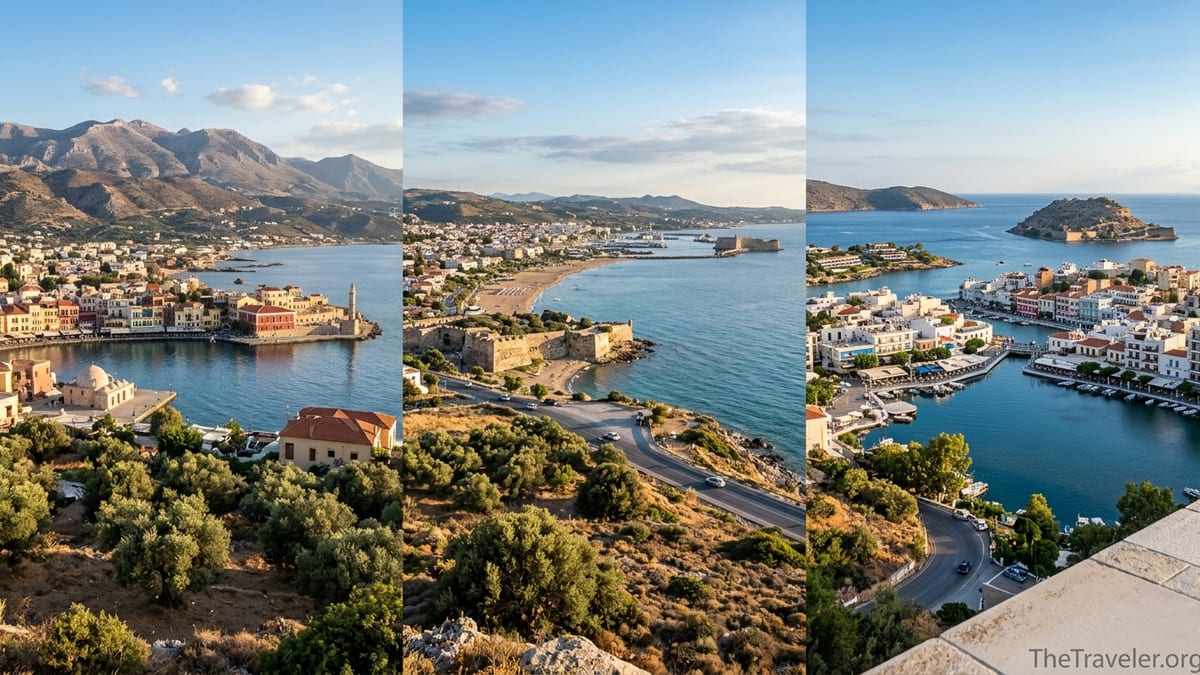
For trip planning, it helps to divide Crete into three broad regions along the north coast, plus a handful of south-coast pockets. Western Crete centres on Chania and has some of the island’s best-known beaches and mountain scenery. Central Crete is anchored by Rethymno and Heraklion, the capital and main transport hub. Eastern Crete revolves around Agios Nikolaos and Elounda, with quieter coves and many of the island’s most upmarket resorts.
Arrival airport matters. Crete’s two main international airports are Heraklion and Chania. Heraklion Airport is the busier of the two and the logical gateway for Heraklion itself, the resort belt towards Hersonissos and Malia, and the east around Agios Nikolaos and Elounda. Chania Airport works best if you are staying in Chania town, the nearby beach suburbs and the west, or planning to visit Balos, Falassarna, Elafonissi and the Samaria Gorge.
For a one-week holiday, most travellers will be happiest with a single base in the west or central north. With 10 nights or more, splitting your time makes sense, for example Chania plus Agios Nikolaos, or Rethymno plus a south-coast village. Moving base always costs you at least half a day, so the payoff should be a meaningfully different landscape or style of stay rather than two similar towns.
Think first about how you will get around. Without a car, it is simplest to base in one of the main towns on the north coast, which have bus stations, organised excursions and walkable centres. With a car, you can be more adventurous, using a smaller resort or village as a base and driving to beaches, gorges and archaeological sites.
Chania Town and Nearby Beaches
Chania is often recommended as the best overall base for first-time visitors who want character plus access to western Crete’s beaches and mountains. Its Venetian harbour and old town alleys are atmospheric and compact, with plenty of tavernas and small hotels inside restored mansions. The atmosphere is lively from late spring to early autumn, with a strong evening promenade culture rather than intense nightclubs.
The town itself has small urban beaches, but most visitors pair Chania with one of the nearby sandy stretches to the west. Nea Chora is within walking distance of the old town and suits travellers who want a town-and-beach feel. Further along the coast, the beach suburbs of Agioi Apostoloi, Kalamaki, Agia Marina and Platanias offer broader sandy bays, family-friendly swimming and many mid-range hotels and apartments. Staying there gives you quieter nights and easier beach access, while Chania’s old town remains a short bus or taxi ride away.
Chania is the most practical base for day trips to Balos, Falassarna and Elafonissi beaches, and to the Samaria Gorge for hiking, whether by tour or self-drive. Organised excursions run frequently in high season, and the regional bus company connects Chania with most western towns, though schedules thin out off-season. Within Chania town you can easily explore on foot, and a car is helpful but not essential unless you plan multiple independent day trips.
At peak times Chania’s old town can feel crowded and accommodation sells out far in advance, especially small boutique hotels around the harbour. If you are visiting in July or August, it is wise to book several months ahead, particularly if you need family rooms or parking. First-time visitors who value atmosphere and restaurant choice, and who are content to make a few longer day trips, will rarely regret choosing Chania as their main or only base.
Rethymno Town: Central Charm with a Long Beach
Rethymno sits roughly halfway between Chania and Heraklion, which makes it a strategic base for travellers who want to see a little of everything without changing hotels too often. The old town has a Venetian harbour, fortress and a dense tangle of lanes filled with small guesthouses, shops and tavernas, giving it a similar historic feel to Chania but on a smaller scale. The atmosphere is relaxed and friendly, busy in high season but slightly less intense than Chania’s harbourfront.
One clear advantage of Rethymno is its long sandy town beach, which runs for kilometres eastwards from the harbour. Staying in or just behind the old town lets you walk to the beach in minutes, while accommodation further along the strip provides a more resort-like feel with easy sea access. The sand here is not as postcard-perfect as some western coves, but the convenience of having a proper beach attached to a characterful town is a major draw, especially for families.
From Rethymno it is feasible to visit both west and east on day trips, though distances are still significant. Buses and tours connect to Chania, Heraklion and Knossos, as well as to south-coast spots such as Plakias. Many travellers without a car base here for a week, enjoying the walkability and using the bus station and excursions for occasional forays further afield. With a car, you can range into the interior villages or towards dramatic gorges while still returning to a lively waterfront each evening.
Rethymno is particularly suitable for second-time visitors who have already stayed in Chania, or for those who want one central base that balances old-town charm, a usable town beach and reasonable access to both airports. It is less ideal for travellers whose top priority is ticking off the headline beaches at the far western or far eastern ends of the island, which still require long driving days.
Heraklion City and the North-Coast Resort Belt
Heraklion is Crete’s capital and by far its busiest city, with substantial ferry traffic and the island’s largest airport. The main reasons to stay in Heraklion are convenience and culture rather than a classic seaside holiday. The outstanding Archaeological Museum and the Palace of Knossos just outside the city make it the best base for visitors whose priority is Minoan history and museum time, or who have early or late flights and short stays.
The city centre is dense, walkable and urban in feel, with lively local food scenes, shops and a working harbour. It lacks a wide sandy town beach in the way Rethymno has, although there are small swimming spots and beach suburbs to the west and east. Heraklion suits travellers comfortable in a slightly gritty, authentically Greek city environment. It is not the gentlest introduction to Crete for those imagining a village or resort experience.
Just east and west of Heraklion lies one of the island’s main resort belts. Places such as Gouves, Analipsi, Hersonissos, Stalis and Malia offer long, mostly sandy or sand-and-shingle beaches, family-oriented hotels and many all-inclusive options. These strips are very convenient for straightforward sun-and-sea holidays, and they are among the easiest areas for organised excursions to Knossos, Heraklion city and various boat trips. Nightlife ranges from low-key bars to livelier scenes, especially around Malia and parts of Hersonissos.
Public transport along this stretch is frequent, and many visitors manage without a car by combining beach time with a handful of tours. A car becomes useful if you want to access less developed coves, explore the interior plateaus or avoid relying on tour schedules. First-time visitors who are primarily interested in a resort stay with simple logistics, especially families with young children, often choose this area when flying into Heraklion, accepting that they will not see as much of western or southern Crete.
Agios Nikolaos and Elounda in the East
Agios Nikolaos is the main town in eastern Crete, set around a photogenic harbour and lake with a relaxed, slightly artistic feel. It offers a good balance of town amenities and small nearby beaches, with waterfront cafes, restaurants and a pleasant promenade. The atmosphere is more low-key than the resort belt west of Heraklion, and it tends to attract couples and independent travellers rather than large package groups.
Elounda, a short drive north along the coast, has grown into the most upmarket resort area on the island, with several luxury and five-star hotels spread along the bay and on nearby peninsulas. The vibe here is quieter and more self-contained, with many guests spending much of their time within resort grounds. Beaches are typically smaller, sheltered bays or hotel-front strips rather than long continuous sands, but the sea here is calm and clear.
Both Agios Nikolaos and Elounda are the natural bases for visiting the island of Spinalonga, reached by short boat ride from Plaka, Elounda or Agios Nikolaos itself. Day trips further east to Ierapetra or to the palm forest beach of Vai are also possible, though longer drives. Public buses serve the main towns reliably, but a car is helpful if you want to explore villages inland or combine multiple beaches in a day.
This eastern region works best either for travellers who have already experienced western Crete and now prefer a calmer, more upscale setting, or for visitors whose flights use Heraklion Airport and who do not mind a transfer of around an hour or more to reach their base. It is also a strong choice for honeymooners and couples seeking higher-end hotels and a slower pace after a few busy days elsewhere on the island.
Representative South-Coast Villages
The south coast of Crete feels more remote and less developed than the north, with smaller villages, fewer large hotels and a wilder landscape where mountains drop steeply into the sea. For the purposes of choosing a base, two of the most practical hubs are Paleochora in the southwest and Plakias in the central south. Both have enough accommodation, tavernas and services to support a stay of several days without a car, although having your own transport opens up far more beaches and walking options.
Paleochora sits on a small peninsula with beaches on both sides, giving you some shelter from prevailing winds and a choice of sand or shingle. It is a laid-back place with a strong independent-traveller following, especially in shoulder seasons when the climate is still warm but the north coast is starting to cool. Boat links connect Paleochora with other south-coast spots such as Sougia and occasionally with the route towards Loutro and Sfakia, which appeals to hikers using the E4 trail.
Plakias lies in a wide bay backed by steep hills, with a long beach that is partly sandy and partly shingle, and several smaller coves nearby. The village has a good spread of small hotels, rooms and tavernas. It is commonly used as a base by walkers exploring the surrounding gorges and plateaus, and by travellers who want a quieter seaside stay after time in one of the north-coast towns. A bus from Rethymno connects Plakias to the north, though services are more limited than on the main coastal highway.
These south-coast hubs are best suited to hikers and nature lovers or to repeat visitors who have already seen the main archaeological and urban sights. They are less convenient for first-time travellers without a car who want to tour the whole island, because reaching major attractions usually involves long bus journeys or private transfers. If you do choose a south-coast base, it makes sense to combine it with a more central or northern stay rather than using it as your only base.
Choosing by Travel Style and Trip Length
Length of stay strongly influences the smartest choice of base. For a one-week holiday, it is usually simpler and more relaxing to choose a single base in the west or central north and plan day trips from there. Chania, Rethymno and the resort belt near Heraklion all work well for this pattern. For trips of 10 nights or more, splitting between two bases can give you two quite different experiences, for example Chania plus Agios Nikolaos, or Rethymno plus a south-coast village such as Plakias or Paleochora.
First-time visitors without a car generally do best in Chania, Rethymno or Heraklion. These are the places with central bus stations and the widest choice of organised excursions to beaches, archaeological sites and gorges. Chania offers the strongest mix of charm and west-coast access, Rethymno a gentler version with a town beach, and Heraklion maximum convenience for Knossos and onward transport. For families wanting an easy beach with nearby facilities, the beach suburbs west of Chania, the long strip east of Rethymno, and the resort towns between Heraklion and Malia all provide shallow waters, supermarkets and casual dining.
Nightlife-focused visitors may prefer Chania town, Rethymno or the livelier sections of Hersonissos and Malia, where bars and clubs stay open late in high season. Hikers and nature lovers are better served by Chania and the west, with access to the White Mountains and the Samaria Gorge, or by a south-coast base like Paleochora or Plakias where trails begin almost on the doorstep. Travellers seeking quieter villages and a slower pace might consider Agios Nikolaos, smaller beach suburbs near Chania rather than the old town itself, or one of the south-coast hubs outside the July and August peak.
When deciding whether to move base, ask how different the second place truly is and how much you are prepared to pack, unpack and transfer. Shifting from Chania to Rethymno, for example, gives you two broadly similar old towns on the same coast, which some travellers feel is not worth the disruption on a short trip. In contrast, combining Chania with Elounda, or Rethymno with a south-coast village, offers a clearer contrast between city and resort, or between busy north and quieter south.
Accommodation Types and Practical Booking Tips
Across Crete you will find a mix of city hotels in the main towns, resort hotels and all-inclusives along the beach belts, and villas or apartments in both coastal and rural settings. In old towns such as Chania and Rethymno, many properties are small boutique hotels or guesthouses in restored buildings, often with limited room numbers and high demand. Beach suburbs and resort strips tend to have a broader range from simple studios with kitchenettes to full-service hotels with pools, kids’ clubs and half-board options.
Legal short-term rentals and villas in Greece are required to display a registration or license number issued by the authorities, and platforms increasingly highlight this detail. When booking a villa or apartment, especially in rural or hillside locations, it is important to confirm access conditions, parking and driving times to the nearest town or beach. Some attractive-looking properties are reached by steep or unpaved roads, which can be challenging for nervous drivers or in smaller rental cars.
Greek authorities apply a per-night climate resilience fee on accommodation, which varies by property category and season. Exact amounts and brackets can change, so travellers should check current information close to their travel date. As of early 2026, higher-category hotels tend to attract higher nightly fees than simpler rooms, which can be noticeable on longer stays. It is also wise to verify whether this fee is included in quoted prices or payable on arrival.
Booking patterns on Crete vary by region. In July and August, and around major holidays, small properties in Chania and Rethymno old towns, upscale resorts in Elounda and well-located villas across the island can sell out months ahead. For these periods, booking three to six months in advance is prudent, particularly for families needing multiple bedrooms. Shoulder seasons such as May, June, September and early October are more forgiving, though south-coast villages with limited beds still reward early planning. The practical details in this section reflect information available to early-season planners in 2026 and should be checked against current advice when you book.
Summary: How to Decide Your Crete Base
In the end, choosing where to stay in Crete is about matching your priorities to the island’s geography rather than hunting for a single “best” spot. Chania and its nearby beaches suit most first-time visitors and beach road trips in the west. Rethymno offers a central compromise with a long town beach and easy atmosphere. Heraklion works well for short, culture-heavy stays and as a gateway to the resort strips east and west. Agios Nikolaos and Elounda provide a calmer, often more upscale east-coast base, especially appealing to couples and repeat visitors. South-coast villages such as Paleochora and Plakias add a wilder, more remote dimension for those with extra time.
For a week, consider one primary base near your arrival airport and plan a mix of local exploring and one or two longer day trips. For 10 nights or more, think about pairing a town base with a resort or village that offers a distinct change of scene. Keeping transfers between regions to one or at most two legs will help your holiday feel like a break rather than a constant relocation exercise.
Whichever base or combination you choose, it is worth sketching your must-see experiences first, from Samaria or Balos to Knossos or Spinalonga, then checking how realistic they are as day trips from your chosen town. By starting with region and travel style before drilling down to individual hotels, you give yourself the best chance of a stay on Crete that matches both your imagination and the island’s real distances.