


Choosing where to stay on Korčula can completely change how you experience this Dalmatian island. Compact yet surprisingly varied, Korčula offers car-free medieval lanes, sandy family beaches, vineyard-fringed coves, quiet fishing villages and convenient ferry ports, often less than an hour’s drive apart. This guide compares the main areas and villages, with real-world examples of what it is like to base yourself in Korčula Town, Lumbarda, Vela Luka, Žrnovo, Brna, Prigradica and smaller settlements, so you can match your accommodation to the trip you actually want.
Get the latest updates straight to your inbox!
How to Choose the Right Base on Korčula
Korčula is only around 47 kilometres long, linked by a single main road between Korčula Town in the east and Vela Luka in the west, yet the feel of each settlement is very different. Before you book a stay, decide whether you want to walk everywhere without a car, chase the best beaches, explore wineries and small coves, or use the island as a ferry hub during a longer Dalmatian itinerary. A couple arriving by catamaran from Split with backpacks will have very different priorities to a family of four driving a rental car from Dubrovnik.
Accommodation on the island ranges from stone-walled boutique hotels in Korčula Town’s Old Town to family-run guesthouses in Lumbarda’s vineyards, simple rooms above konoba taverns in Brna and Prigradica, and modern apartments on the hillsides around Žrnovo. In high summer, a mid-range double in Korčula Town typically runs from the equivalent of around 150 to 250 euros per night, whereas an apartment with a balcony in a quieter village can often be found for 90 to 140 euros if you book ahead. Prices outside July and August drop noticeably, which can make even Old Town stays more accessible.
Transport is another key factor. The main car ferry links from the mainland are at Korčula (to Orebić on the Pelješac Peninsula) and Vela Luka (to Split), while catamarans for foot passengers connect Korčula Town with Split, Hvar, Mljet and Dubrovnik in season. There is a local bus that runs along the island spine and to Lumbarda, but most small bays are easier with a car, scooter or taxi. Knowing where your ferry arrives and departs, and whether you plan to drive, is central to picking the right base.
Finally, think about your noise and nightlife tolerance. Korčula Town’s seafront promenade can stay busy until late in July and August, with cocktail bars on the city walls and restaurants filling the alleys. In contrast, Brna or Prigradica may quieten down by 10 or 11 pm, with the loudest sound coming from cicadas and the clink of cutlery at a single waterfront restaurant. Reading recent guest comments on noise levels and parking ease can be just as useful as the view photos when deciding your base.
Korčula Town: Best for First-Timers and Car-Free Stays
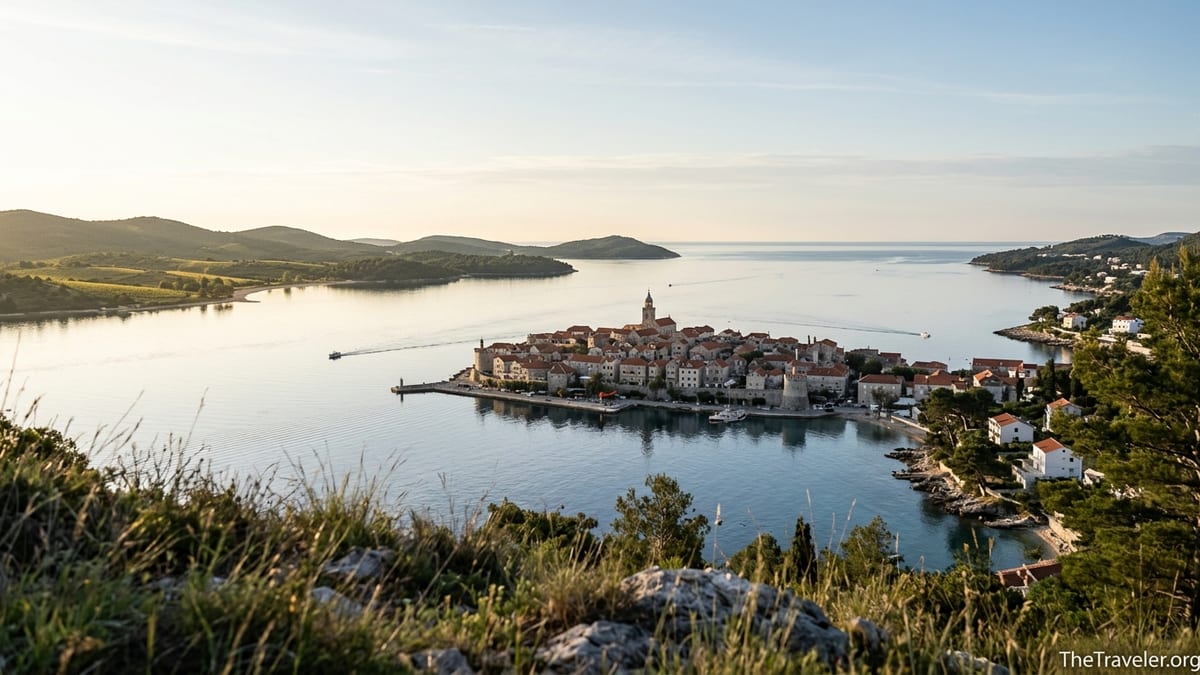
Korčula Town is the island’s main urban hub and the easiest base for visitors without a car. The historic Old Town occupies a small peninsula ringed by medieval walls and towers, with narrow stone lanes that are fully pedestrian. Most first-time visitors choose to stay either inside these walls or within a 10 to 15 minute walk along the waterfront in areas such as Sveti Nikola or Luka Korčulanska Bay. If you arrive by catamaran from Split, Hvar or Dubrovnik, you can often wheel your suitcase to your accommodation in under 10 minutes.
Staying here puts you within a short stroll of coffee bars on Plokata square, long-running konobe such as Adio Mare, and rooftop cocktail spots perched on the towers, plus small town beaches like Banje and Luka Korčulanska where you can cool off without leaving town. A typical Old Town guesthouse might be a 15th-century stone house converted into three or four rooms with exposed beams and modern bathrooms, where a summer double with sea glimpse sells out months ahead. Slightly outside the walls, modern apartments often offer better value and easier access for luggage, something to consider if you are concerned about stairs.
Korčula Town also works well as a hub for day trips. Water taxis run in season to nearby islets like Badija and Vrnik, where you can swim from rocky platforms and have lunch at simple beach bars. A hop-on hop-off style taxi boat service often connects Korčula Town with Lumbarda, allowing you to split days between the Old Town and sandy beaches without renting a car. Local agencies in town also arrange excursions to Mljet National Park, wine tastings in Smokvica and Čara, or boat trips to the tiny Proizd islet off Vela Luka.
The main drawbacks are crowds and price. In late July and early August, Old Town lanes get busy in the evenings as cruise groups and independent travellers converge for dinner and sunset drinks. Restaurants may ask you to wait for a table, and some smaller beaches can feel full by mid-morning. If you value quiet above atmosphere, look just outside the centre in areas like Medvinjak or Žrnovska Banja, which still allow you to walk or take a short taxi into town for dinner.
Lumbarda: Sandy Beaches, Vineyards and Easy Family Days
Lumbarda sits around 6 kilometres from Korčula Town on the eastern side of the island and is the go-to base for travellers who care more about beach days than historic stone lanes. It is unusual by Croatian standards because it offers genuinely sandy beaches, including Vela Pržina on the south-facing side of the village and Bilin Žal on the north-facing coast, alongside smaller coves and pebble stretches. Families with children often choose to stay here so kids can play in shallow sand-bottomed water instead of clambering over rocks.
Accommodation in Lumbarda spreads between the compact harbour area, the vine-covered interior, and the seafront lanes leading to the main beaches. You will find everything from small, modern hotels with pools overlooking the bay to self-catering apartments in old stone houses surrounded by Grk vineyards. In high season, a family apartment within walking distance of Vela Pržina might cost roughly 130 to 220 euros per night depending on size and facilities, while inland vineyard stays can be a bit cheaper and quieter, albeit with a longer walk to the shore.
Lumbarda works particularly well for relaxed, car-free trips. In summer, water taxis and local buses connect it to Korčula Town in about 15 to 20 minutes. Many visitors start the day with a coffee at the small harbour, then walk or drive down to Vela Pržina, where they can rent loungers and umbrellas, have a simple lunch at the beach bar, and stay until the light softens in late afternoon. Others favour Bilin Žal for its shallow entry and views across to the Pelješac Peninsula, followed by a late-afternoon wine tasting at nearby producers who specialise in the indigenous Grk grape.
The trade-off is that Lumbarda’s village centre is quieter and more dispersed than Korčula Town. Nightlife typically means a relaxed dinner at a konoba overlooking the bay and perhaps a glass of Grk or Pošip at a winery terrace, rather than bar-hopping. Outside of July and August, some beach bars and restaurants may operate limited hours. If you want to mix late-evening buzz with sandy beach days, you might sleep in Lumbarda but plan several evenings in Korčula Town, using taxis to move between the two.
Vela Luka: Western Gateway and Nature-Focused Base
Vela Luka at the western end of the island is Korčula’s other main town and the key car ferry port for services to Split. This makes it a practical base for travellers driving through Croatia who plan to connect on to other islands or to the mainland without backtracking. The town itself curls around a long sheltered bay, backed by low hills. It feels less medieval than Korčula Town, with wider streets and a more workaday, local atmosphere, but has its own cultural sights and coastal appeal.
Accommodation in Vela Luka is a mix of waterfront hotels, family-run pensions and private apartments on the slopes above the bay. Prices tend to run a bit lower than comparable stays in Korčula Town, so you might find a sea-view room here for what an inland room costs in the east. Many stays include parking, a key advantage for road-trippers. From town you can reach coves like Gradina and Pičena by car or bike, and in summer small boats shuttle visitors out to Proizd, an uninhabited islet known for its vivid turquoise shallows and smooth rock plateaus that feature in many local tourism photos.
Vela Luka also attracts travellers interested in walking and history. Above the town lies Vela Spila, a large cave with archaeological significance and wide views over the bay, reachable on foot for those willing to tackle a steady uphill climb. The coastal path around sections of the bay offers low-key strolling with frequent swimming stops, and the sunsets facing west across the Adriatic can be spectacular on clear evenings. A few taverns along the waterfront serve grilled fish, local olive oil and wines from inland Korčula villages, giving you a taste of the island’s agricultural side.
The main limitation is distance from Korčula Town and Lumbarda. Driving between Vela Luka and Korčula Town along the island road typically takes around 45 to 60 minutes depending on traffic, and public buses may only run a few times a day outside peak season. If you mainly want Old Town ambiance or easy access to Korčula’s eastern archipelago of islets, base yourself in the east and visit Vela Luka as a day trip instead. Choose Vela Luka as a base if you value easier ferry connections to Split, slightly lower prices, and access to Proizd and quieter western coves.
Žrnovo and the Hillside Hamlets: Quiet but Close to Town
Žrnovo is a hillside village about 3 to 4 kilometres inland from Korčula Town, spread across several hamlets such as Postrana and Prvo Selo. It offers a more rural, local feel while still being just a short drive or taxi ride from the Old Town’s restaurants and ferries. Olive groves, stone terraces and small vegetable gardens surround the houses, and in the evenings you are more likely to hear neighbours chatting on doorsteps than music from bars.
Accommodation around Žrnovo includes renovated stone houses with pools aimed at families or groups, as well as simpler apartments rented by local residents. Rates can be attractive compared with in-town stays, especially if you are willing to be a 10-minute drive rather than a short walk from the seafront. A three-bedroom villa with a private pool and parking might cost not dramatically more than two standard hotel rooms in Korčula Town during peak season, which can make hillside bases good value for extended stays or multi-generational trips.
Žrnovo is also handy for travellers who prioritise some of the island’s best-known wild beaches. The road to Pupnatska Luka, a deep cove on the south coast with striking blue water and a pebble beach, branches off not far west of the village. From a Žrnovo base you can drive there in around 20 to 25 minutes, arrive early enough to find parking above the bay, and spend the day swimming and renting loungers from the simple beach bars tucked behind the pebbles. Other south-coast bays, as well as the Kočje nature area of moss-covered rocks and oak forest, are similarly accessible.
The compromise is that you will need a car or be happy to rely on taxis and limited buses. Walking from Žrnovo to Korčula Town is possible for fit travellers along roadside paths, but not ideal at night or in high heat. If you choose to stay here without a car, look closely at bus timetables and consider the cost of taxis when comparing accommodation prices with in-town stays. For those who enjoy peaceful evenings, rural views, and occasional forays into town rather than nightly bar-hopping, Žrnovo strikes a pleasant balance.
Brna, Prigradica and Other Small Coastal Villages
On the south and north coasts of central Korčula, a series of small bays and fishing hamlets offer low-key seaside stays far removed from the bustle of Korčula Town. Brna, on the south coast near the village of Smokvica, and Prigradica, on the north coast below Blato, are two of the more established examples. Each has a compact harbour, a ribbon of seafront houses and apartments, and a handful of cafés and konobe that cater primarily to staying guests and returning regulars.
In Brna, a typical stay might be a one- or two-bedroom apartment with a balcony overlooking the bay, where you can watch fishing boats come and go in the morning and swim from concrete terraces or small pebble beaches just below the promenade. Some properties advertise access to nearby Istruga Bay with its shallow, sheltered waters. In Prigradica, many apartments sit just above the rocks, with guests climbing down stone steps for a morning dip. These villages often attract repeat visitors from Central Europe who drive down with a car full of groceries and spend most of their time swimming, reading and barbecuing on their terraces.
Prices in these smaller villages are typically lower than in Korčula Town or Lumbarda, particularly for longer stays. Week-long bookings are common, and hosts may offer discounts outside of peak weeks. Because there are fewer stand-alone hotels, the experience depends heavily on your chosen property. Reading recent reviews about the quality of air conditioning, Wi-Fi reliability and the number of steps to the sea is essential, especially if you are travelling with older relatives or small children.
The trade-off for tranquillity is isolation. Public transport can be limited to a few buses a day, and evening options may be restricted to one or two local restaurants and a small supermarket. Travellers without a car might feel constrained after a couple of days, particularly if the weather turns. These villages suit those who plan a slow, seaside holiday and are comfortable driving to attractions like Pupnatska Luka, Smokvica’s wineries or Korčula Town for a change of scene.
Beaches, Bays and Matching Them to Your Travel Style
Korčula’s coastline is a patchwork of small pebble coves, rocky platforms and the rare sandy stretches around Lumbarda. Choosing where to stay by beach preference can be just as useful as thinking in terms of towns. If soft sand and shallow water for children are priorities, basing yourself in Lumbarda near Vela Pržina or Bilin Žal makes day-to-day life simple. You can walk or take a short drive to the sand, rent umbrellas from beach bars, and be back at your apartment for an afternoon rest without worrying about parking along narrow coastal roads.
For couples or groups who value dramatic scenery and clear water over sand, south-coast bays like Pupnatska Luka, Bačva and Žitna are compelling. These are generally reached by winding access roads and involve parking above the beach then walking down. Many travellers choose to base themselves in Korčula Town, Žrnovo or Smokvica and drive out to these coves earlier in the day to beat the crowds and secure a spot. A typical day might see you leave town after breakfast, arrive at Pupnatska Luka before mid-morning, spend the day swimming from pebble shallows and flat rocks, then return to Korčula Town for dinner.
If you prefer low-key swimming spots without a big beach scene, consider accommodations that front small local swimming areas rather than destination beaches. In Medvinjak, just outside Korčula Town, or in Prigradica and some bays near Vela Luka, you might have a simple ladder from the rocks in front of your building leading straight into deep blue water. This suits strong swimmers and snorkellers who are happy to forgo sand and facilities in exchange for quiet and immediate access.
Finally, remember that winds and exposure matter. Lumbarda’s two main sandy beaches face different directions, which locals often use to escape wind or waves on one side of the village. Similarly, north-coast coves can feel cooler and more shaded later in the day, while south-facing beaches stay sun-soaked and can be hotter in high summer. When choosing your base, check which direction nearby beaches face and how much natural shade there is, especially if you are travelling with children or plan to visit in July or August.
Car-Free vs Car-Based Stays and Ferry Convenience
Whether you arrive on Korčula with a car strongly influences the best place to stay. For travellers without a car, Korčula Town and Lumbarda are the most practical bases. Both are connected by catamarans or local buses, and from either you can reach beaches and neighbouring islets using water taxis, organised excursions, e-bikes or occasional public buses. A typical car-free week might involve staying in Korčula Town, using the hop-on hop-off boat to Lumbarda for sandy beach days, taking a taxi boat to Badija for swimming and walking among tame deer, and booking one organised day trip to Mljet.
A car-based stay opens up far more options. With your own vehicle, basing in Žrnovo, Brna, Prigradica or inland villages like Smokvica or Blato becomes realistic. You can drive to a different cove each day, visit inland wineries such as those producing Pošip around Čara and Smokvica, and pop into Korčula Town for evening strolls and dinners. Fuel stations exist in the main towns, but it is still wise to top up before long drives and to note that some coastal roads are narrow and winding, so nervous drivers might prefer to stick to the main spine road and a few well-trodden access routes.
Ferry convenience is worth weighing if Korčula is one stop in a longer island-hopping trip. Foot passengers using high-speed catamarans from Split, Hvar, Mljet or Dubrovnik will almost always dock in or very near Korčula Town, making a town or nearby Lumbarda base the most logical if you are carrying luggage. Car ferries, by contrast, serve Korčula (to Orebić) and Vela Luka (to Split). If you plan to arrive from Split with a car and leave towards central Dalmatia again, a stay in Vela Luka or nearby bays may cut down on cross-island driving.
When planning, check current ferry and catamaran schedules, which change between low and high season and can be affected by weather. Consider booking your first and last nights close to your arrival and departure ports. For example, a traveller arriving on a late afternoon catamaran into Korčula Town might spend the first night in a nearby guesthouse before transferring to a more remote bay the next day, avoiding the stress of navigating dark rural roads or arranging a long taxi ride after dark.
The Takeaway
There is no single “best” place to stay in Korčula, only better or worse matches for the trip you have in mind. Korčula Town is unbeatable for atmosphere, dining and car-free convenience, making it the strongest choice for first-timers, short stays and travellers relying on catamarans. Lumbarda excels for easy family beach days and vineyard evenings, particularly if you value sand and shallow water. Vela Luka and the central villages appeal to those with a car who want quieter nights, easier access to certain ferries and proximity to wild coves and the islet of Proizd.
Žrnovo and inland hamlets balance rural calm with reasonable access to Korčula Town and south-coast beaches like Pupnatska Luka, suiting longer stays and groups. Small bays such as Brna and Prigradica reward travellers seeking slow, seaside living where the biggest daily decision is whether to swim before or after lunch. As you compare accommodation, look beyond view photos to practicalities like distance to the nearest shop, how you will reach the beach, ferry timings and parking or luggage logistics.
If you sketch out a rough plan for your days on the island before you book, the right base often becomes obvious. Ask yourself where you want to be able to walk in five minutes, whether you are comfortable driving narrow access roads, and which ferry you will realistically catch at the end of your stay. With those answers in hand, Korčula’s mix of medieval town, sandy bays, pine-fringed coves and quiet fishing villages becomes a set of tailored options rather than a confusing list of names on a map.
FAQ
Q1. If I am visiting Korčula without a car, where should I stay?
Korčula Town is the most practical base without a car, as most catamarans arrive here and you can walk to accommodation, restaurants, small beaches and water taxis. Lumbarda is a good second option thanks to buses and taxi boats linking it to town.
Q2. Which area of Korčula is best for families with young children?
Lumbarda is usually best for families because of its sandy beaches like Vela Pržina and Bilin Žal, shallow water and relaxed village feel. Family apartments within walking distance of the beach are common and many have parking and kitchens.
Q3. Is Korčula Town very noisy in summer?
Korčula Town can be lively in July and August, especially along the seafront and in Old Town lanes at dinner time and later evening. If you are sensitive to noise, pick accommodation on the edge of the Old Town or in nearby areas like Medvinjak or Žrnovska Banja and walk in for dinner.
Q4. Do I need a car to reach beaches like Pupnatska Luka?
Having a car makes reaching Pupnatska Luka and other south-coast coves much easier, as access roads are narrow and buses are infrequent. Taxis can work for a single beach day, but costs add up if you plan multiple trips, so a rental car or scooter is more flexible.
Q5. How far is Lumbarda from Korčula Town and can I commute between them?
Lumbarda is roughly 10 to 15 minutes by car or taxi from Korčula Town, and around 15 to 25 minutes by local bus or taxi boat depending on the service. Many travellers stay in one and commute to the other for beaches or dinners, especially in summer when schedules are fuller.
Q6. What is the best base if I am arriving by car ferry from Split?
If you are arriving on the car ferry from Split into Vela Luka and plan to continue back towards Split or central Dalmatia, staying in Vela Luka or nearby bays can minimise driving. If your focus is Korčula Town and Lumbarda, factor in around an hour’s drive from Vela Luka across the island.
Q7. Are there truly quiet places to stay on Korčula in July and August?
Yes. Villages such as Brna, Prigradica, some bays near Vela Luka, and hillside hamlets around Žrnovo or Smokvica remain relatively quiet even in peak season. These work best if you have a car and are content with a small local choice of restaurants and shops.
Q8. How many nights should I plan on Korčula to justify staying in a quieter village?
If you are staying only one or two nights, Korčula Town or Lumbarda make logistics easier. For four nights or more, basing in a quieter village such as Žrnovo, Brna or Prigradica can be rewarding, especially with a car, as you have time for both local relaxation and day trips.
Q9. Can I split my stay between two different areas of the island?
Splitting a week between, for example, Korčula Town and Lumbarda, or Korčula Town and Vela Luka, is quite common. It lets you experience both Old Town atmosphere and a quieter bay or sandy beach base, though you will need to move luggage and coordinate check-in and checkout times.
Q10. Is it better to book accommodation close to the ferry port?
Booking your first and last nights within easy walking or driving distance of your arrival or departure port can reduce stress, especially with early or late sailings. In practice this means staying near Korčula Town if you are using catamarans, and near Vela Luka or Korčula ferry ports if you are driving on and off the island.