


Korčula rewards the effort it takes to reach it, but the mix of ferries, catamarans and car ferries can feel confusing at first glance. The good news is that once you understand the main routes from Split, Dubrovnik and Orebić, getting to the island becomes straightforward. This guide walks you through the real options that travelers actually use today, with practical tips on tickets, cars, luggage and peak summer crowds so you can step off the boat in Korčula relaxed instead of frazzled.
Get the latest updates straight to your inbox!
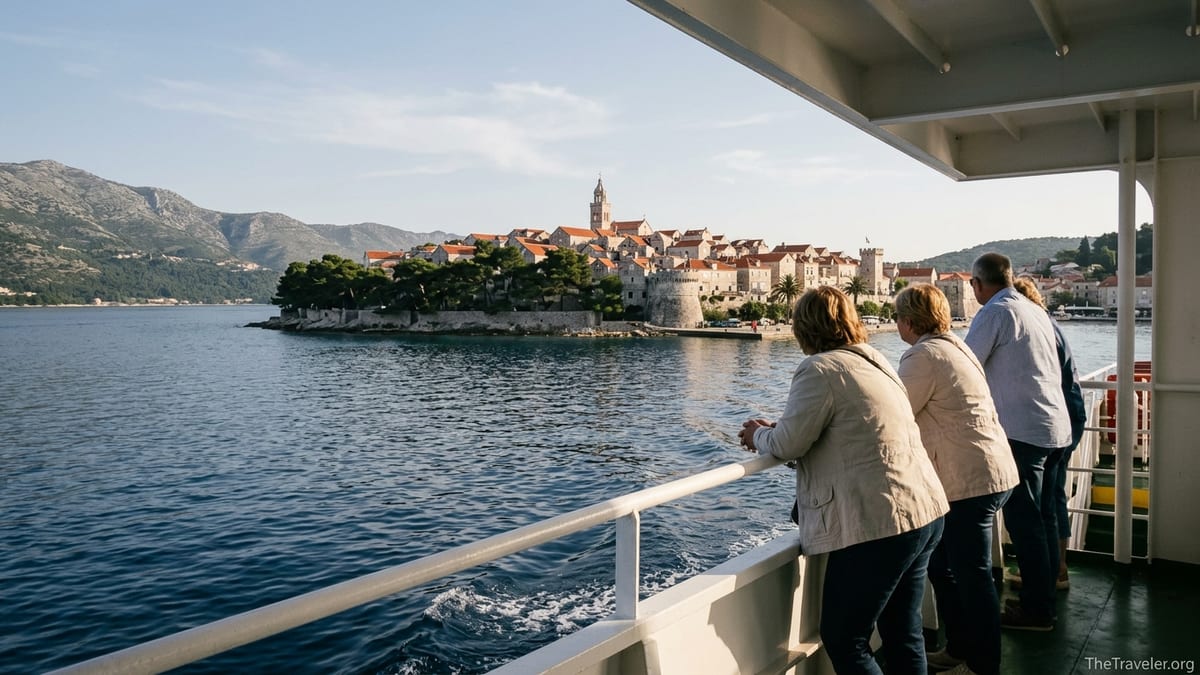
The Main Ways to Reach Korčula Today
Most travelers reach Korčula using a combination of Croatia’s national ferry operator Jadrolinija and fast catamaran companies such as Krilo (Kapetan Luka) and TP Line. In practice, you will almost always arrive via one of three gateways: Korčula Town on the eastern end of the island, Vela Luka on the western end, or the small car ferry port of Dominče just outside Korčula Town. Each serves a different type of traveler. Foot passengers tend to use catamarans that run along the Split–Hvar–Korčula–Mljet–Dubrovnik corridor, while drivers generally arrive via the short car ferry crossing from Orebić on the Pelješac peninsula or the longer Split–Vela Luka route operated by Jadrolinija.
A typical example: a couple without a car traveling from Split in July might book a morning Krilo catamaran that stops in Hvar and reaches Korčula Town around lunchtime, then walk the five minutes from the pier into the Old Town with small suitcases. By contrast, a family on a Croatia road trip often drives the new coastal highway and Pelješac bridge, then follows signs for Orebić and boards the fifteen to twenty minute car ferry to Dominče, arriving close enough to Korčula Town to drive to their apartment in ten minutes. Choosing the right gateway is less about price than about whether you are on foot, traveling with a car, and how much time you want to spend on the water versus driving.
When planning, remember that Croatia’s coastal ferries are seasonal. Core connections run all year, but the busiest catamaran lines that many visitors rely on operate mainly from about May to October, with the densest schedules in late June, July and August. Always check the timetable for your exact travel date and do not assume that a June departure exists in April or November.
From Split to Korčula: Ferries and Fast Catamarans
Split is the main northern gateway to Korčula, with both car ferries and passenger-only catamarans. For drivers, the key route is the Jadrolinija car ferry from Split to Vela Luka on the western side of the island. In a typical summer season this crossing operates once daily or more, with a journey time of roughly three to three and a half hours. Travelers often report morning departures from Split around 10:15–10:30, arriving early afternoon in Vela Luka, which gives enough time to drive the scenic D118 state road across the island to Korčula Town in about 45 minutes.
On foot, most visitors choose a high-speed catamaran. Krilo (also known as Kapetan Luka) and TP Line both run fast catamarans that link Split with Hvar, Korčula and often continue to Mljet and Dubrovnik. On a typical summer day you might see one or two morning departures from Split that reach Korčula Town just after midday, plus an afternoon or early evening sailing. These boats are popular with island hoppers who spend a few nights in Split, then move on to Hvar, then Korčula, and finally Dubrovnik without ever needing a car.
In price terms, recent seasons have seen one-way adult catamaran tickets on the Split–Korčula leg commonly falling in the range of 20 to 35 euros depending on operator, season and exact route, while the longer Split–Vela Luka car ferry is usually priced by vehicle length plus separate passenger fares. A small rental car and two adults in peak season often end up in the rough range of 60 to 100 euros in total for this crossing. Because these are only examples and prices change, you should always confirm current fares directly with the operator before booking.
In summer it pays to treat Split’s ferry port like an airport. Catamaran departures are tightly timed, luggage storage is limited on board, and queues form early. Arriving at the pier 45 to 60 minutes before departure is sensible in July and August, especially if you still need to pick up tickets from an agency counter. If the morning catamaran is sold out for your date, check whether the other company has availability or consider taking a later sailing and having lunch on the Riva waterfront while you wait.
Using the Orebić to Dominče Car Ferry
The workhorse route for travelers with cars is the short Jadrolinija car ferry connecting Orebić on the Pelješac peninsula with Dominče on Korčula. The crossing itself takes about 15 to 20 minutes, and in peak season the ferry often runs roughly every hour or even more frequently during busy periods. For many Croatians and repeat visitors this is the default way to access the island, especially when driving south along the coast from Split or north from Dubrovnik.
To use this route, you drive along the Pelješac peninsula following signs for Orebić and the car ferry to Korčula. Once in town, you will see lanes marked for vehicles queuing for the Dominče ferry. You buy a ticket at the Jadrolinija kiosk or office near the pier, then park in the marked lane according to staff instructions. Tickets are sold per vehicle and per passenger, with small cars paying considerably less than vans or campervans. A common real-world scenario is a rental hatchback with four friends paying somewhere in the region of 20 to 40 euros total for the short crossing in high season, though actual fares vary by year and should always be checked in advance.
One advantage of this route is its flexibility. Unlike long-distance car ferries, the Orebić–Dominče line usually sells tickets that are valid for the day rather than a specific departure time. If you miss the ferry you intended to take, you simply queue for the next one, space permitting. This helps if you are driving down from Split, where traffic and rest stops can make arrival times unpredictable. The flip side is that queues can become long on Saturdays in July and August, especially in the late morning and early evening when accommodation check-in and check-out patterns create natural peaks.
Once you arrive at Dominče, you follow the island’s main D118 road toward Korčula Town or Vela Luka. Korčula Town is about 3 kilometers from the ferry dock, usually a 5 to 10 minute drive depending on traffic, while Vela Luka lies on the opposite end of the island around a 45 minute drive away. If your accommodation is in Lumbarda, Žrnovo or Račišće, landlords often send detailed driving directions that start from the Dominče ferry ramp, since that is the primary entry point for cars.
Catamarans Linking Dubrovnik, Hvar and Korčula
If you are traveling without a car and planning a classic Dalmatian route such as Dubrovnik–Korčula–Hvar–Split, high-speed catamarans are your best friend. Krilo and TP Line both operate popular lines between Dubrovnik and Split that stop at Korčula and usually at Hvar and one or two other islands along the way. In season, it is common to find at least one daily Dubrovnik–Korčula morning departure and a Korčula–Dubrovnik afternoon return, though exact times shift each year.
In practice, many travelers stay two or three nights in Dubrovnik, then board a mid-morning catamaran to Korčula Town. They wheel suitcases along Dubrovnik’s Gruž harbor, follow signs for their boat, and store luggage in racks on the lower deck before finding seats upstairs or outside. Two to three hours later, they step off directly onto the promenade beneath Korčula’s city walls. A few days after that, they take another catamaran on to Hvar, usually in the morning, reaching Hvar Town by midday and using the afternoon to check in and explore.
Ticket prices for these routes have varied by operator, but in recent years a one-way adult fare for Dubrovnik–Korčula or Korčula–Hvar typically falls in a similar range to other long catamaran routes, often between roughly 25 and 45 euros depending on season and demand. Because the boats are smaller than big car ferries and cater heavily to summer tourism, popular dates in July and August can sell out several days in advance. It is wise to secure these segments early, especially if you are coordinating them with pre-booked accommodation.
Catamarans are passenger-only; you cannot take a car or motorbike on them. If you are moving between islands with a vehicle, you usually need to backtrack via the mainland using car ferries such as Orebić–Dominče and Split–Vela Luka, or adjust your route so that you pick up and drop off your rental car on the mainland. Many visitors structure trips so that the car rental begins in Split and ends in Orebić or vice versa, then complete the rest of the journey by foot and boat.
Tickets, Booking Strategies and Summer Crowds
Ticket strategies differ significantly between car ferries and catamarans. For catamarans, advance booking is now the norm in high season. International agencies, local travel offices and the operators’ own websites all sell e-tickets that you either print or display on your phone. For example, a traveler planning a July Dubrovnik–Korčula–Hvar–Split route might buy all three catamaran legs in May, securing preferred departure times and then booking accommodation around those fixed transport dates.
Car ferries such as Split–Vela Luka and Orebić–Dominče work more like a rolling queue. Some long-distance routes in Croatia offer limited car reservations, but on many services your place on board is decided by when you arrive at the port and line up. In peak season, it is common for local drivers heading to Korčula to aim for a ferry several hours earlier than the one they strictly need, just in case the line fills. On a Saturday in August you might see cars queuing in Orebić an hour or more before a departure, especially in the late afternoon when people are returning from their holidays.
A practical tactic is to treat long car ferry crossings as half-day commitments. If you plan to take the morning Split–Vela Luka ferry, do not schedule a wine tasting in Lumbarda for early afternoon unless you are prepared for delays. Likewise, when leaving the island, locals often plan to arrive in Orebić or Vela Luka a ferry earlier than necessary, then use the extra time on the mainland for lunch if everything runs smoothly.
For both ferries and catamarans, keep an eye on weather. Strong bora or jugo winds can occasionally cause cancellations or schedule changes, particularly outside mid-summer. It is uncommon for services to be disrupted for more than a day, but it happens. Signing up for email or SMS alerts from the operator, checking notices at the port and leaving a small buffer before onward flights in Split or Dubrovnik will protect you against most problems.
Luggage, Cars and Onboard Practicalities
On catamarans, luggage policies are typically generous but not unlimited. Operators expect each passenger to bring a suitcase and a smaller bag or backpack, and you will usually find a luggage rack near the entrance where large cases are stacked. In practice, mid-size suitcases in the 15 to 20 kilogram range are standard among tourists. Very large or numerous bags might incur a small extra fee, decided at the operator’s discretion, so traveling light makes boarding and disembarking much less stressful, especially when the boat is crowded.
On board, catamarans feel more like airplanes than cruise ships. Seating is usually airline-style with rows facing forward, air conditioning that can run cool, and limited outdoor space. You may find a small bar counter selling bottled water, soft drinks, coffee and snacks such as crisps or chocolate bars, but you should not expect a full restaurant. It is wise to bring your own water bottle, especially on midday sailings when the sun is strong, and a light sweater for the air conditioning even in August.
Car ferries are more spacious and relaxed. Once you drive your vehicle on board and set the handbrake, passengers either stay in the car for the short Orebić–Dominče crossing or walk up to the passenger deck on longer routes like Split–Vela Luka. Here you will find open decks, indoor seating areas and basic cafes selling coffee, beer, sandwiches and pastries. Many families treat the crossing as part of the holiday, letting children explore the decks while adults enjoy a coffee with views of the Pelješac vineyards or Korčula’s pine-fringed coastline.
It is essential to remove valuables from the car before leaving it unattended on the vehicle deck, especially on longer crossings. While theft is not a common complaint, the usual travel common sense applies. Bring passports, money, electronics and medication up with you, along with anything you might need for the next few hours such as sunscreen or a hat if you plan to stay on the open deck.
Timing Your Trip: Seasons, Weekends and Local Patterns
Transport to Korčula follows clear seasonal rhythms. From roughly late June to early September, routes are busiest and timetables densest. Catamarans often run daily, sometimes with more than one departure in each direction between major hubs, while car ferries increase frequency to match demand. Shoulder months such as May, early June, late September and early October can be delightful, with fewer crowds on board and in port, but you will normally see fewer daily sailings and sometimes days of the week without a particular route.
Within each week, Saturdays and changeover days are the stress points. This is when many rental apartments require check-out and new guests arrive, which funnels large numbers of cars and passengers onto the same ferries. On the Orebić–Dominče line, for example, queues of rental cars often build up mid-morning on a late July Saturday as one wave of visitors leaves and another arrives. Traveling on a Tuesday or Wednesday, especially outside high season, usually feels calmer and less rushed.
Time of day also matters. Morning departures from Split, Dubrovnik and Korčula are favorites for families and those connecting with flights, while late afternoon and early evening services catch people who have spent the day on the beach and are moving on to their next stop. If you are flexible, choosing a midday catamaran or a mid-afternoon car ferry can mean shorter queues and a more relaxed experience. For instance, some travelers deliberately choose a midday Dubrovnik–Korčula sailing so they can avoid the early morning rush and still arrive in time for a late afternoon swim in Korčula’s town beaches.
Finally, build in buffers around critical connections. If you have a flight from Split, do not plan to arrive on a same-day morning car ferry from Vela Luka in the middle of summer with only an hour to spare. Instead, travel to Split the day before and enjoy an evening on the Riva. Similarly, when leaving Korčula for Dubrovnik by catamaran and connecting to an afternoon international flight, consider staying one night in Dubrovnik to remove stress and give yourself time to explore the city.
The Takeaway
Reaching Korčula is less complicated once you break the journey into clear choices. With a car, you will probably either sail directly from Split to Vela Luka or, more commonly, drive down the Pelješac peninsula and hop across to Dominče on the short Orebić car ferry. Without a car, you will rely on fast catamarans that weave between Split, Hvar, Korčula, Mljet and Dubrovnik, turning your transport days into mini coastal cruises.
The key is to respect the island’s summer rhythms. Book catamarans early for July and August, arrive in good time for departures, and avoid planning tight, same-day connections with flights. Treat long crossings as part of the holiday, enjoy the views from the deck and pack light so that boarding and disembarking are easy. With a bit of forethought, your journey to Korčula can be as memorable as your time wandering its medieval streets and swimming in its sheltered coves.
FAQ
Q1. Do I need to book ferries to Korčula in advance in summer?
For catamarans between Split, Hvar, Korčula and Dubrovnik it is strongly recommended to book in advance for travel from late June to early September, as popular departures often sell out a few days ahead. For short car ferries like Orebić–Dominče, tickets are usually sold for the day rather than a specific time and cannot always be reserved, so arriving early to queue is more important than booking.
Q2. Is it better to arrive in Korčula via Vela Luka or Korčula Town?
If you are on foot and staying in or near Korčula Town, arriving directly at Korčula Town on a catamaran is easiest because you can walk straight to many accommodations. If you have a car and are coming from Split, Vela Luka is convenient for driving across the island, while drivers approaching from Dubrovnik usually prefer the short Orebić–Dominče crossing, which lands closest to Korčula Town.
Q3. Can I take my rental car on the catamaran to Korčula?
No. The high-speed catamarans that connect Split, Hvar, Korčula, Mljet and Dubrovnik are passenger-only and do not carry vehicles. To bring a car to Korčula you must use a car ferry, typically the Jadrolinija routes Split–Vela Luka or Orebić–Dominče, or adjust your trip so that you return the car on the mainland before boarding a catamaran.
Q4. How early should I arrive at the port for my ferry?
For catamarans in peak summer, arriving 45 to 60 minutes before departure is sensible, especially in Split and Dubrovnik where ports are busy and ticket counters can have lines. For car ferries, locals often aim to be in the queue at least an hour before departure in July and August and even earlier on Saturdays or when boarding a limited-number long-distance ferry such as Split–Vela Luka.
Q5. What happens if my ferry or catamaran is canceled due to weather?
If a sailing is canceled, operators normally allow passengers to use the same ticket on the next available departure or offer a refund if no suitable alternative exists. In practice, strong winds occasionally disrupt services for a day, particularly outside high summer. It is wise to keep your email or phone contact handy for alerts, check notices at the port and avoid planning tight connections to same-day flights.
Q6. Are there luggage limits on ferries and catamarans to Korčula?
Most operators allow standard holiday luggage without strict weight checks, typically one suitcase and a smaller bag per person, and they provide racks on board for larger cases. Oversized or unusually heavy items, such as sports equipment, may incur a small extra fee or require prior confirmation with the operator. Traveling with compact, wheeled suitcases makes boarding and disembarking much easier, especially when catamarans are full.
Q7. Is it possible to visit Korčula on a day trip from Dubrovnik or Split?
It is technically possible in high season using early and late catamaran departures, but it makes for a rushed day with little margin for delays. Most visitors who want to enjoy Korčula’s Old Town, beaches and wineries choose to stay at least one night, and many plan two or three nights to allow for a more relaxed pace and some flexibility if sea conditions affect timetables.
Q8. What is the best way to get from Korčula to Hvar?
The easiest way is by direct catamaran in season, typically operated by companies such as Krilo or TP Line on routes that run Dubrovnik–Korčula–Hvar–Split or the reverse. These boats usually take around one to two hours for the Korčula–Hvar leg, depending on the route. If no direct sailing is available on your date, you may need to route via Split or Dubrovnik or adjust your itinerary by adding an extra night.
Q9. Can I buy ferry tickets on the day of travel?
For short car ferries like Orebić–Dominče, buying on the day at the port ticket office is normal and often the only option. For catamarans and some long-distance car ferries, same-day tickets are sometimes available outside peak dates, but in July and August this can be risky as boats frequently sell out. If you are traveling on fixed dates or have onward connections, pre-purchasing tickets is safer.
Q10. Are there food and drink options on board the ferries?
Most car ferries have simple cafes serving coffee, soft drinks, beer, sandwiches and pastries, which is generally enough for the few hours between Split and Vela Luka or the short hop from Orebić. Catamarans usually have more limited offerings, often just drinks and packaged snacks. Bringing your own water and a small snack is sensible, especially if you are traveling with children or have dietary restrictions.