


Taksim Square is the modern heart of Istanbul and a natural reference point when you are choosing where to stay. The surrounding neighborhoods of İstiklal, Cihangir, Pera and Galata all orbit this busy square, each with a distinct personality, noise level and price range. For a first-time visitor, the choice can be confusing, especially if you want easy transport to Sultanahmet while still enjoying Istanbul’s restaurants and nightlife. This guide breaks down the main areas around Taksim with concrete examples so you can match a neighborhood to your travel style, whether you are a family, night owl, or short-stay visitor.
Get the latest updates straight to your inbox!
Why Base Yourself Near Taksim Square
Staying near Taksim Square means placing yourself in one of Istanbul’s main transport hubs. Below the square, Taksim metro station connects to the M2 line, which runs south toward Şişhane (for Galata) and Yenikapı, and north toward Levent and business districts. The F1 funicular links Taksim with Kabataş, where you can board the T1 tram toward Sultanahmet and the historical peninsula, typically reaching the Hagia Sophia and Blue Mosque area in around 25 to 30 minutes door to door in normal traffic conditions. This combination makes Taksim one of the easiest bases for first timers who want both nightlife and quick access to major sights.
Beyond transport, the broader Beyoğlu district around Taksim is where much of the city’s contemporary life happens, with restaurants ranging from simple kebab shops to chef-led meyhanes, plus rooftop bars, live music venues and small galleries. For example, visitors often pair a morning in Sultanahmet with an evening back around Taksim, having dinner on a side street off İstiklal Caddesi or a quieter café terrace in Cihangir. Compared with staying in the old city, where many streets go quiet after dark and restaurants cater heavily to tour groups, Taksim and its neighboring districts offer a more local, year-round city atmosphere.
Hotel choice is also wider here. Around the square you will find large international chains and mid-range business hotels, while just ten or fifteen minutes’ walk away in Cihangir or Galata you can find smaller design hotels, serviced apartments and guesthouses. Typical nightly rates for a well-reviewed mid-range double room in the Taksim area vary widely by season but often fall into a moderate band compared with similarly central districts in other European cities, allowing you to upgrade space or comfort without leaving the core of Istanbul.
On the downside, Taksim itself is intense. The square hosts demonstrations from time to time, and the streets closest to İstiklal Caddesi can be crowded and noisy late into the night. Sirens, street music and late-night revelers are common background sounds. For this reason many travelers, especially light sleepers and families, prefer to stay a short walk away, using Taksim as a transport node and orientation point rather than sleeping directly on the square.
Staying Right on Taksim Square: Convenience vs Noise
Hotels directly on or overlooking Taksim Square appeal to visitors who prioritize convenience above all. Properties of this type usually offer straightforward access to the metro, airport buses, the F1 funicular and the nostalgic tram that runs along İstiklal. A typical scenario is arriving on a late flight into Istanbul Airport, riding the airport bus or shuttle that terminates near Taksim, and walking just a few minutes with your luggage to a hotel facing the square. For travelers with heavy bags or mobility issues, this simplicity can outweigh other concerns.
The trade-off is noise and crowds. The square itself rarely goes quiet. Street performers, traffic, loudspeakers and large gatherings can continue well past midnight, especially in high season or on weekends. Even with double glazing, some rooms that face the square or main avenues can pick up honking, music and voices. Guests at larger hotels sometimes comment that they sleep best in interior or higher-floor rooms, or on sides of the building facing away from the square. If you are sensitive to noise, it is worth contacting your hotel in advance to request a quiet-facing room and traveling with earplugs or a white-noise app.
In terms of feel, the blocks immediately around the square are functional rather than charming. You will find global fast-food chains, currency exchange offices, mobile phone shops and souvenir stands. Prices for very tourist-facing services, like last-minute tours sold on the street, can be higher here than just a few blocks away. Many repeat visitors treat the square like a transit hub and landmark, then walk five to fifteen minutes into adjoining neighborhoods like Cihangir, Pera or down toward Galata Tower for meals and evenings in more atmospheric surroundings.
For first-time visitors staying only one or two nights with tight schedules, a big-box hotel at Taksim can still be efficient. You can wake up, ride the funicular and tram directly to Sultanahmet for a full day of sightseeing, then return on autopilot at night. Just be realistic about the urban environment: this is a busy, central square in a city of more than 15 million people, not a tranquil plaza.
İstiklal Caddesi: Lively Spine for Night Owls and Shoppers
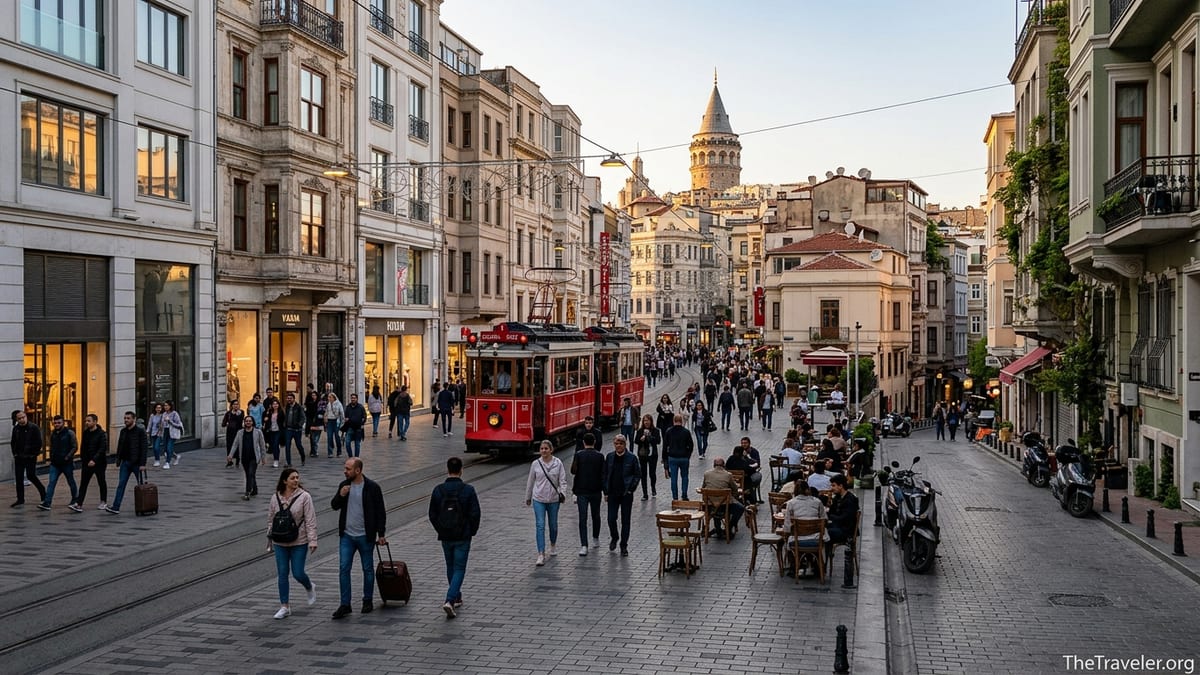
İstiklal Caddesi is the pedestrian avenue running from Taksim Square down toward the historic Tunnel funicular near Galata. It is lined with shops, chain cafés, cinemas, churches, consulates and a dense network of side streets filled with restaurants and bars. For travelers who want to step out of their hotel into a busy city scene, this can be one of the most exciting places to stay. In the evenings, many visitors wander İstiklal, browse bookstores and music shops, then duck into a meyhane on a side street such as Nevizade or head to a rooftop bar near Asmalımescit for views across the Golden Horn.
Accommodation along İstiklal and its lateral streets ranges from compact boutique hotels in old buildings to modern apartments with small kitchenettes. Many do not have large lobbies or extensive facilities, but they make up for it with location. A typical mid-range apartment hotel behind the avenue might offer one-bedroom units with washing machines, small balconies and weekly cleaning. This setup can work well for digital nomads or couples spending a week in the city, who value both nightlife and self-catering options.
The downside is again noise. Even if your room does not face the main avenue, steep side streets can channel sound upward. Live music from bars, clattering of dishes from meyhanes, and the tram bell from the nostalgic red tram running along İstiklal can all carry into the early hours, especially on Thursdays, Fridays and Saturdays. Guest reviews often mention that ground and first-floor rooms are noisier, while higher floors or rooms at the back are quieter. When booking, it is wise to read the most recent reviews for mentions of specific bars or construction projects nearby, as venues can open or close from one year to the next.
For first-time visitors primarily interested in culture and nightlife, İstiklal offers unmatched access. You can walk from many hotels here to the Pera Museum, contemporary art spaces, music venues and independent cinemas without relying on taxis. However, if you are traveling with young children, are a very light sleeper, or prefer quiet evenings, you may be more comfortable just beyond the busiest blocks, in districts like Cihangir or upper Pera where residential streets soften the intensity.
Cihangir: Bohemian, Residential and Good for Longer Stays
Cihangir lies on the slopes between Taksim Square and the Bosphorus, within walking distance of both İstiklal and the tram and ferry connections near Kabataş. The neighborhood has a more residential, bohemian feel, with cafés, small grocery shops, neighborhood bakeries and tree-lined corners where locals walk their dogs. Over the past decade it has become popular with Istanbul creatives and foreign residents, which in turn has attracted stylish coffee shops, brunch spots and yoga studios. Travelers often describe it as a softer, slower-paced alternative to the square while remaining central.
Accommodation in Cihangir is dominated by smaller design hotels, serviced apartments and Airbnb-style rentals tucked into historic buildings. A typical example is a restored townhouse divided into four or five apartments, each with a compact kitchen, washing machine and living area. Nightly rates can be slightly higher than similar units closer to Taksim’s main avenues, reflecting the neighborhood’s desirability, but they are still competitive compared with equivalent bohemian quarters in Western Europe. For remote workers or travelers staying a week or more, Cihangir’s combination of cafés with good coffee, small markets and relative calm can be ideal.
No neighborhood in central Istanbul is completely quiet, but Cihangir’s side streets are usually calmer at night than those around İstiklal. Many streets are residential, and while you will find wine bars and casual restaurants, the dominant rhythm is local rather than touristy. Families often appreciate being able to stroll for ice cream in the evening without navigating dense bar crowds. At the same time, a ten to fifteen minute uphill walk brings you back to Taksim Square or İstiklal, while downhill routes lead to Fındıklı tram stop or Kabataş, where you can hop on the T1 tram to Sultanahmet or ferries across the Bosphorus.
The main practical caveat is the topography. Cihangir’s charm comes with steep streets and stairs. Rolling a heavy suitcase from Taksim down to a rental on a side street can be testing, and walking back up in summer heat requires a basic level of fitness. Travelers with mobility issues, very young children in strollers or those unaccustomed to hills may find this tiring. In those cases, choosing accommodation closer to the flat streets just off the square, or along the main avenues in Pera, might be more comfortable while still visiting Cihangir for its cafés and views.
Pera and Upper Beyoğlu: Culture, Classic Hotels and Balanced Vibes
Pera refers broadly to the upper parts of Beyoğlu stretching along İstiklal away from Taksim toward the Tunnel end, anchored by landmarks like the Pera Palace Hotel and the Pera Museum. The streets here combine 19th-century European architecture with embassies, boutique hotels and quieter residential blocks just one or two streets away from the main avenue. For many first-time visitors, this zone offers a useful middle ground: close to Taksim and İstiklal, but slightly removed from the thickest crowds and late-night street noise.
Classic hotels in this area, some in grand former consular buildings, appeal to travelers who enjoy a sense of history. A stay in or near one of these properties often comes with high ceilings, tall windows and interiors that nod to Istanbul’s late Ottoman and early republican eras. Alongside them, newer mid-range hotels offer modern rooms with reliable Wi‑Fi, elevators, and breakfast rooms overlooking the city. For example, a mid-range hotel near the Pera Museum might advertise soundproofed rooms facing side streets, allowing guests to sleep more easily while remaining a short walk from İstiklal and the Şişhane metro station.
Pera’s cultural density is a major advantage. Guests can spend a morning at the Pera Museum, stroll through passages filled with antique shops, then head down to Galata Tower or across to Karaköy’s waterfront galleries and cafés. At night, there are plenty of restaurants within a ten-minute walk, from traditional meyhanes on side streets to contemporary bistros. Yet many of the smaller streets here go reasonably quiet after midnight, especially those without late-opening bars, making this area appealing to couples and older travelers who want ambiance without constant noise.
Transport is straightforward. Depending on your exact location, you may use either Taksim or Şişhane metro stations. From Şişhane, it is one stop to Taksim or an easy walk downhill to Karaköy to catch the T1 tram to Sultanahmet. Airport access is slightly less direct than staying on Taksim Square, but in practice most guests either take a taxi or use a combination of metro and transfer services. For short stays of three to five nights, Pera often emerges as a favorite compromise: central, walkable, with character and culture, but not as overwhelming as sleeping directly on the square.
Galata: Historic Tower, Romantic Streets and Steep Hills
Galata, centered around the iconic Galata Tower, lies downhill from İstiklal and roughly a fifteen to twenty minute walk from Taksim Square depending on your route. Its narrow cobbled streets, stone staircases and views over the Golden Horn make it one of the most atmospheric places to stay near Taksim. Many restored buildings here house boutique hotels and guesthouses, some with rooftop terraces that look toward the tower or across to the Old City skyline. Couples on a first visit often choose Galata for its romantic feel and café culture.
The neighborhood’s central landmark, Galata Tower, creates a natural orientation point. Around it, streets are filled with coffee shops, design boutiques and small restaurants. In the evening, you can sit at a café near the base of the tower, then wander down toward Karaköy for dinner by the water or cross Galata Bridge toward Eminönü. For nightlife, Galata itself is more low-key than Taksim, but within walking distance of both the busier bar zones around İstiklal and the growing number of wine bars and cocktail spots in Karaköy.
From a practical standpoint, Galata offers strong transport connections. Şişhane metro station at the top of the hill links to the M2 line, and Karaköy tram stop at the bottom connects to the T1 tram toward Sultanahmet. The historic Tunnel funicular also runs between the upper and lower ends, which some travelers use to avoid repeatedly climbing the steepest sections. This means you can commute to the historical peninsula in roughly the same time as from Taksim, while enjoying a different atmosphere around your hotel.
However, the steep terrain is not trivial. Some streets are cobbled, and inclines can be sharp. Rolling heavy suitcases from tram or metro to a hotel can be awkward, and people with knee or mobility problems may struggle with daily climbs. Street noise in Galata is more localized than around Taksim, but during high season, crowds near the tower can remain active into the late evening, and some bars play music late. As with İstiklal, reading recent reviews can help you choose a property on a quieter side street if restful nights are a priority.
Noise, Nightlife, Safety and Transport: Matching Areas to Traveler Types
Choosing where to stay near Taksim ultimately comes down to how you balance nighttime atmosphere, noise tolerance, and ease of transport. If you are a night owl who wants to walk home from bars or live music venues at 2 a.m., staying close to İstiklal or on the Taksim side streets will minimize taxi use and put you in the heart of the action. You might book a compact hotel a block or two back from the avenue, accepting some street noise in exchange for being steps from venues. Younger groups of friends on a long weekend often find this trade-off worthwhile.
For families or travelers who prioritize sleep, Cihangir, Pera and some corners of Galata generally provide a calmer base while remaining within walking distance of Taksim and major transport links. A family with a toddler, for example, might choose a two-bedroom serviced apartment on a quiet Cihangir street, where parents can put children to bed and still sit on a small balcony in the evening without loud bar music outside. Similarly, an older couple might choose a room facing an internal courtyard in a Pera hotel, spending days exploring museums and evenings at nearby restaurants, then retreating to a peaceful room.
Safety near Taksim is similar to other busy central districts in large European cities. Petty theft can occur, particularly in crowded nightlife streets and on public transport, so it is wise to use cross-body bags, keep phones out of back pockets and be cautious if strangers approach late at night offering “special” bars or clubs. These are usually attempts to funnel visitors into high-pressure, overpriced venues. Most travelers feel comfortable walking around Taksim, İstiklal, Cihangir, Pera and Galata until late, especially on main streets, but as always, staying aware of your surroundings and avoiding very dark side alleys is sensible.
Regarding daily logistics, staying near Taksim or any of the connected neighborhoods makes reaching other parts of the city straightforward. A typical day for a first-time visitor might involve taking the F1 funicular from Taksim to Kabataş, then the T1 tram to Sultanahmet to visit Topkapı Palace, the Basilica Cistern and the Blue Mosque. In the afternoon, you could ride the tram back to Karaköy, walk uphill to Galata Tower, then continue along İstiklal to Taksim, having dinner in Pera on the way. Using an Istanbul transport card, fares remain modest, and connections are frequent enough that you rarely wait more than a few minutes outside rush hour.
The Takeaway
For a first-time visitor, staying near Taksim Square means trading the postcard quiet of some old-town streets for connectivity and local city life. Taksim itself offers maximum transport convenience but also the most noise and crowds. İstiklal suits travelers who want nightlife and shopping at their doorstep, while Cihangir and Pera provide a gentler, more residential rhythm with easy access to cafés, culture and the tram to Sultanahmet. Galata, with its tower and cobbled streets, combines romance and centrality if you are comfortable with hills.
There is no single “best” neighborhood for everyone. The right choice depends on whether you picture your evenings in rooftop bars, quiet apartments, or classic hotels; how much hill walking you are comfortable with; and whether children or light sleepers are in your group. By understanding the character, pros and cons of Taksim, İstiklal, Cihangir, Pera and Galata, you can pick an area that matches your preferences and build an Istanbul stay that feels both efficient and enjoyable.
FAQ
Q1. Is Taksim Square a good base for first-time visitors to Istanbul?
Taksim Square is a strong base if you want easy public transport and plenty of restaurants and nightlife, and you do not mind a busy, urban environment.
Q2. How long does it take to get from Taksim to Sultanahmet by public transport?
Most visitors reach Sultanahmet in around 25 to 30 minutes by taking the funicular from Taksim to Kabataş and then the T1 tram toward the Old City.
Q3. Which area near Taksim is best for families with children?
Cihangir and quieter streets in Pera are often best for families, offering calmer residential surroundings while still being close to Taksim and main transport lines.
Q4. Is İstiklal Caddesi too noisy to stay on?
Staying directly on or just off İstiklal can be noisy, especially on weekends, but rooms facing inner courtyards or higher floors are often quieter; checking recent reviews helps.
Q5. Is Galata safe to walk at night?
Galata is generally considered safe for walking at night on main streets, though as in any big city you should stay aware, avoid very dark alleys and keep valuables secure.
Q6. Are the hills in Cihangir and Galata difficult to manage?
The slopes in Cihangir and Galata are steep enough to be tiring with heavy luggage or mobility issues, but many visitors manage them fine by taking their time and using funiculars.
Q7. Which area is best if I want a quieter stay but still be central?
Pera and parts of Cihangir usually provide a quieter, more residential feel while keeping you within walking distance of Taksim Square, İstiklal and major transport connections.
Q8. Do I need a taxi at night if I stay near Taksim?
If you stay in or around Taksim, İstiklal, Cihangir, Pera or Galata, you can usually walk home from many central restaurants and bars, using taxis mainly for late or distant trips.
Q9. Are hotels near Taksim more expensive than in Sultanahmet?
Prices vary by season, but mid-range hotels around Taksim, Cihangir, Pera and Galata are often comparable to Sultanahmet, with more variety in style and room types.
Q10. Is it easy to reach the Asian side of Istanbul from Taksim?
Yes, you can ride the funicular from Taksim to Kabataş or walk downhill to Karaköy, then take frequent ferries across the Bosphorus to areas like Kadıköy or Üsküdar.