


By the time the call to prayer fades and the sky over Beyoğlu turns inky blue, Taksim Square and nearby Istiklal Street switch into their night shift. Neon signs flicker on, chestnut vendors roll their carts into position and the red nostalgic tram clangs its way through a river of people that often feels as busy at 10 p.m. as it does at 2 p.m. For many visitors, this is when central Istanbul feels most alive. It is also when questions about crowds, safety, taxis and late-night transport matter the most. This guide breaks down what Taksim is really like after dark, with concrete examples of where to eat, how to move, what to watch out for and how different it feels from the daytime crush.
Get the latest updates straight to your inbox!
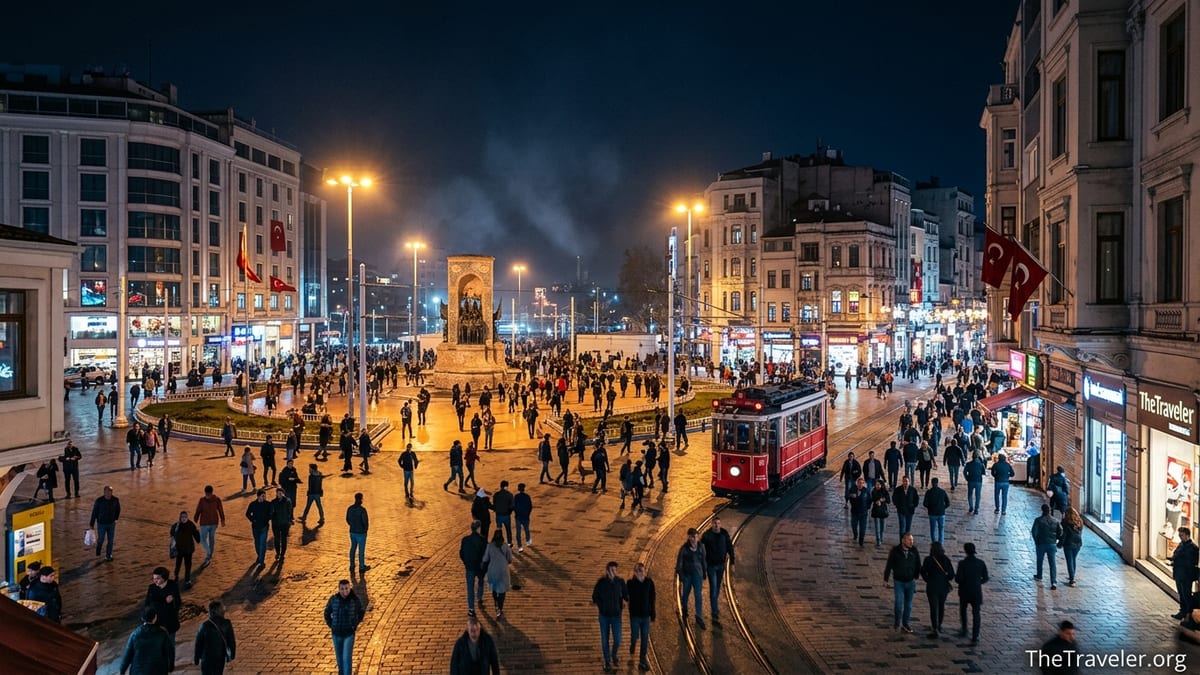
How Taksim Square Feels After Dark
Taksim Square is one of Istanbul’s main gathering points and transport hubs, anchored by the Republic Monument and framed by large hotels and fast-food chains. In the evening, especially from Thursday to Sunday, it stays busy well past midnight. You will see families with children licking ice creams, office workers cutting across the square on their way home, teenagers clustered around street musicians and tourists lining up for photos in front of the nostalgic tram. The atmosphere is urban and energetic but rarely menacing. Uniformed police are a constant presence around the monument and metro entrances, which many visitors find reassuring.
The energy intensifies as you step off the square and onto Istiklal Street, the 1.4-kilometre pedestrian avenue that runs downhill toward Galata. At night its mix of clothing chains, kebab houses, bars and patisseries stays open late, and crowds can feel shoulder-to-shoulder between about 8 p.m. and midnight. On a warm Saturday in June, for example, it is not unusual to have to weave around a live band performing in front of a church, a line at a döner stand and a street vendor selling mussels at the same time. If you dislike crowds, the upper section nearest Taksim is usually the busiest; quieter pockets lie in the side streets and the lower half of Istiklal as you move toward Galata.
That said, the vibe shifts as the night wears on. By 1 or 2 a.m., many families and shoppers have gone, and the people still out are mostly bar-hoppers, restaurant staff heading home and workers changing shifts. The square never feels completely empty because late-night buses, dolmuş minibuses and taxis keep coming and going, but there is more space to breathe. On weeknights in winter, you may find parts of the square blustery and half-empty by midnight, with only a handful of food carts and smokers outside hotels breaking the stillness.
Compared with the day, the main difference is sensory. In the afternoon Taksim is dominated by car horns, protest banners and the rumble of suitcases. At night it is coloured by music spilling from bars, the smell of grilling meat and the shimmer of LED signs above side-street meyhanes, or traditional taverns. If you are used to European city centres, Taksim at 10 p.m. will feel more like Madrid or Athens than like a business district that shuts down after work.
Crowds, Noise and When to Go
If your priority is atmosphere, the peak evening window is from around 8 p.m. to 11:30 p.m. On Friday and Saturday, this is when Istiklal can feel almost like a festival: buskers outside Galatasaray High School, queues at famous dessert shops and the tram bell ringing every few minutes as it inches through the mass of people. On weekdays, crowds thin slightly but the area is still lively; you might find it easier to get a table at a popular meyhane without a reservation.
For travellers who prefer a more relaxed experience, early evening is ideal. Arrive in the square around 6:30 or 7 p.m., watch the sky fade over the Republic Monument, then walk partway down Istiklal before dinner. At this time many boutiques are still open, but the late-night bar crowd has not yet arrived, so the pace feels closer to a busy shopping street than a party zone. Solo travellers and families often find this slot the most comfortable for taking photos and getting a feel for the neighbourhood without being jostled.
Noise levels are an important consideration if you are staying in a hotel just off the square. Some streets in and around Taksim, such as those leading toward Nevizade or Asmalımescit, are packed with bars that play loud music until 2 or 3 a.m. If you book accommodation here, expect to hear bass and shouting from the street late into the night, especially on weekends. By contrast, hotels facing directly onto the square may have more traffic noise but slightly less bar noise, and rooms on higher floors tend to be quieter.
Season also matters. In July and August, evenings can be hot and humid, and locals often head out later; you might see the square busiest at 10 or 11 p.m. In November or February, a cold wind sweeping across the open plaza can make it feel harsher at night, and crowds thin earlier. If you are visiting in winter and want to experience a lively Taksim without the chill, consider spending more time in covered passages such as Çiçek Pasajı or in rooftop bars that shelter you from the weather.
Safety After Dark: What Feels Safe and What Does Not
For most visitors, Taksim Square and the top section of Istiklal Street feel broadly safe at night, thanks to constant police presence and the sheer number of people. Violent crime against tourists in these central areas is rare, and it is common to see women walking alone, couples holding hands and older locals catching late buses even after midnight. Many travellers report feeling more comfortable here than in quieter residential districts where there are fewer eyes on the street.
The main risks in and around Taksim are opportunistic rather than violent: pickpocketing in dense crowds, bag snatching from distracted visitors and scams that target solo travellers, especially men. Pickpockets tend to operate around choke points such as the entrance to the nostalgic tram, subway escalators and tightly packed knots around street performers. Keeping your phone in a front pocket, wearing a cross-body bag and avoiding setting your backpack on the ground while you eat at outdoor tables are simple precautions that make a real difference.
Side streets require more judgment. Just a few metres off Istiklal, the character can change quickly. Streets sloping downhill toward Tarlabaşı can become much quieter and more run-down at night, with fewer pedestrians and less lighting. Streets sloping toward Cihangir are generally more residential and lined with cafes and bars, but even there, turning a corner can suddenly put you on a dim lane with little foot traffic. Many locals and expats advise sticking to well-lit streets where other people are walking, especially after midnight, and avoiding short cuts through unfamiliar alleys.
One pattern that comes up frequently in traveller reports is that incidents often begin with a friendly stranger making contact on or near Istiklal Street. Someone may ask where you are from, offer to show you a “local bar” or insist on buying you a drink in a place they know nearby. The interaction starts in the busy, well-policed main street, but the real problem begins when they persuade you to follow them into a side street and up a staircase to a nearly empty bar or club. This is where many of the more serious scams and overcharging stories take place.
Common Scams, Pavyon Bars and How to Avoid Trouble
The most notorious nighttime risk around Taksim is the so-called “friendly local” or “bar invitation” scam. It typically unfolds like this: you are approached by one or two well-dressed men, often speaking good English, who strike up a conversation about football or travel. After a few minutes, they suggest grabbing a drink together at a nearby bar they claim is popular with locals. Once inside, drinks arrive without you seeing a menu, snacks you did not order appear on the table and at the end of the night you are presented with a bill that can be hundreds of euros. If you protest, large men suddenly appear, and you are pressured to pay by card or escorted to an ATM.
Many of these venues are known locally as pavyon-type bars: upstairs clubs hidden behind an unmarked or nearly unmarked door, with aggressive pricing and sometimes women employed to sit and drink with customers. They cluster in some of the side streets off Istiklal and downhill from Taksim. They are not places you would ever stumble into by accident while looking for a casual beer. The key warning sign is any stranger trying hard to steer you toward a specific bar or club. Decline politely, do not argue and keep walking. Legitimate venues in Taksim do not need freelance “recruiters”.
Another issue that crops up in visitor reports is subtle overcharging in seemingly normal bars. This can range from a cocktail being slightly more expensive on the bill than on the menu, to a hidden “service fee” that suddenly appears when you ask to pay. To reduce this risk, choose busy venues that clearly display their prices and give you a printed receipt. Popular bar streets like Nevizade, Asmalımescit or Cezayir Street have many legitimate meyhanes and pubs where prices are in line with central Istanbul standards. If something feels off when you sit down, such as staff avoiding your request to see a menu, it is fine to leave immediately.
There are smaller scams to watch for too. A classic one involves someone “accidentally” dropping a shoe brush or wallet and then engaging you in conversation that leads to a request for money. Another is a stranger asking for help to change money or split a taxi fare who then disappears once you pay. The simplest defence is not to engage beyond a brief “no, thank you” and to keep moving. In a lively area like Taksim, genuine requests for assistance from strangers are vastly outnumbered by attempts to separate tourists from their cash.
Taxis, Transport and Getting Back to Your Hotel
Transport is one of the biggest practical concerns for evening visitors to Taksim. The square sits on the M2 metro line, which connects to Şişli, Levent and Yenikapı, and it is also linked to the Bosphorus tram and ferry network via the F1 funicular down to Kabataş. In recent years the metro and funicular have typically run until around midnight, with the last services leaving close to 12 a.m., but exact times can vary by day and season. If you plan to rely on rail, check current operating hours on arrival in Istanbul and aim to be on a train before 11:30 p.m. to avoid surprises.
After the metro closes, your options are taxis, night buses and dolmuş minibuses. Istanbul’s official yellow taxis are plentiful around Taksim, especially near the main taxi stands on the edges of the square. However, complaints about overcharging and route-padding are common, particularly at night when demand is high and many passengers are tourists. Examples include a driver refusing to turn on the meter and insisting on a flat price that is double what the ride should cost, or taking a deliberately long route from Taksim to Sultanahmet to increase the fare.
To minimise problems, always insist that the meter be turned on as soon as you get in, and be prepared to step out if the driver refuses before the car moves. Having a rough idea of the correct fare helps: a late-night taxi from Taksim to Sultanahmet, for instance, is usually within a modest price band for a central-city ride, not a long-distance journey. Using an official taxi app or ride-hailing service available in Istanbul can also reduce friction, as the fare is tracked and drivers are more accountable. Avoid getting into unmarked cars or taxis that approach you aggressively while you are still walking; instead, walk to a marked rank.
Night buses and dolmuşes can be a useful alternative if your hotel is in a popular district like Beşiktaş, Şişli or Kadıköy. Many routes radiate from or pass near Taksim, and services often run well after midnight, though with lower frequency. You will see people queuing at bus stops on the downhill road toward Gümüşsuyu or on the streets edging the square, even after most shops have closed. If you are not comfortable interpreting the schedules, ask your hotel which specific night bus number connects Taksim with your area and where to catch it, then take a daytime trial run so you recognise the stop at night.
Eating Around Taksim at Night: From Street Food to Rooftops
Food is one of the best reasons to be in and around Taksim after dark. On the square itself, you will find familiar international chains for a quick bite, but the more interesting options start as soon as you turn the corner onto Istiklal Street. Streets like Şehit Muhtar, Nevizade and Asmalımescit are lined with meyhanes serving meze spreads, grilled fish and raki, often at tables that spill onto the pavement. A typical mid-range meyhane dinner might involve a selection of cold meze like eggplant salad and stuffed grape leaves, followed by grilled sea bream, with a bill that feels similar to what you might pay for a sit-down dinner in a major European city centre.
For budget travellers, lokantas and casual eateries around Taksim stay open late and offer hearty, home-style food at lower prices. A place with a steam counter of stews and rice, where you point to what you want, can provide a filling plate of beans, pilaf and vegetables for the cost of a coffee and pastry in Western Europe. One well-known style of lokanta in the area specialises in trays of casseroles, and is popular with local workers heading home from late shifts. Expect basic decor but quick service and a largely Turkish clientele.
Street food is a major part of the nighttime experience around Taksim. Simit sellers with glass cases of sesame-encrusted bread rings, carts steaming with sweetcorn, and vendors stacking mounds of midye dolma, or stuffed mussels, appear along Istiklal and at the square’s edges. Many stay out until the early hours, especially on weekends. It is common to see groups of friends standing around a cart at 1 a.m., tossing back mussels with a squeeze of lemon. As always with street food, choose busy vendors with a steady stream of local customers, which is usually a reliable indicator of both taste and safety.
If you are looking for views, Taksim and Beyoğlu have several rooftop restaurants and bars atop hotels and historic buildings just off Istiklal. These venues typically pair creative cocktails or modern Turkish cuisine with panoramas of the Bosphorus, the Golden Horn and the city’s night-time skyline. Many require reservations on Friday and Saturday nights, and dress codes can be slightly smarter than in casual bars on the street level. Prices for mains and drinks in rooftop spots tend to be higher than average, reflecting both the view and their popularity with visitors.
Nightlife, Bars and How the Mood Compares to Daytime
By global standards, the nightlife around Taksim is diverse and dense. Within a 10 to 15 minute walk of the square you can find everything from rock bars with live bands to cocktail lounges, traditional meyhanes, LGBTQ-friendly venues and Turkish pop clubs. Istiklal itself has seen some of its older taverns replaced by clothing chains, but the surrounding lanes in neighbourhoods like Asmalımescit, Nevizade and Cihangir carry much of the after-dark buzz. Many locals in their twenties and thirties still choose to meet in Beyoğlu on Friday nights for bar-hopping before moving on to a club in Karaköy or Kadıköy.
Compared with the daytime, when most people in Taksim are shoppers, commuters and tour groups, the nighttime crowd skews younger and more local, especially after 10 p.m. The shift is noticeable: you may see more people dressed for a night out, more small groups of friends and fewer families with strollers. Around midnight, certain streets are packed with people smoking outside tiny bars, their music spilling into the lane. That can feel chaotic but also convivial, and foreign visitors often comment on how easy it is to blend in as one more night owl among many.
Dress codes are generally relaxed. In casual bars and live-music venues, jeans and trainers are standard for both locals and visitors. Some upscale rooftops and hotel bars expect slightly smarter attire, such as closed shoes and collared shirts for men, though even there the mood is usually more smart-casual than formal. Solo travellers typically find it easy to drop into a bar, sit at the counter and strike up a conversation with bartenders or other guests, particularly in venues that cater to an international crowd.
Despite the abundance of bars, public drunkenness on the street is less visible than in many European party districts. You will see people who have clearly had a long night, but outright rowdiness is relatively rare in the main pedestrian areas, in part because of the police presence and in part because many locals still head home on public transport rather than staying out until dawn. Most bars start to quieten by 2 or 3 a.m., though a few clubs and late-night lokantas keep going for those who want a final drink or bowl of soup before bed.
Practical Tips to Stay Comfortable and Confident
A few simple habits will help you enjoy Taksim at night with confidence. First, plan your route in advance, especially if you are staying outside the immediate area. Know where the nearest metro or funicular station is, what time the last train runs and which street you will use to walk back to your hotel if you miss it. Taking a screenshot of an offline map can prevent fumbling with your phone in a crowded spot, which is when pickpockets are most active.
Second, manage your valuables strategically. Carry only the cash you expect to use for the evening, keep one card tucked away in a secure pocket and leave passports and larger sums locked up at your accommodation. When dining outdoors, keep your bag on your lap or with the strap wrapped around your leg, rather than dangling on the back of a chair. If you need to use your phone for navigation or photos, step to the side of the main flow of people rather than stopping in the middle of a dense crowd.
Third, trust your instincts about people and places. If a bar, alley or interaction feels off, you do not owe anyone your time or politeness. A brief “No, teşekkürler” and walking away is enough. This applies not only to potential scams but also to unwanted attention in bars or on the street. Most locals are friendly and curious about visitors, but the same rules you would use in any big city apply here too: meet new acquaintances in public places, keep an eye on your drink and let someone know where you are going if you head to a late-night venue.
Finally, balance caution with openness. It is easy to become so focused on avoiding scams and taxi issues that you forget to enjoy what makes Taksim special at night: musicians playing in front of historic churches, the smell of roasted chestnuts in winter, lively conversations that spill from meyhanes into the street. With a few basic street-smart habits, most visitors experience Taksim after dark as it is for locals: a noisy, sometimes chaotic, but deeply memorable slice of Istanbul life.
The Takeaway
Visiting Taksim Square and Istiklal Street at night is one of the most vivid experiences Istanbul offers. The area remains busy and largely safe until late, with constant foot traffic, visible police and an enormous range of restaurants and bars to choose from. The atmosphere is very different from the daytime’s shopping and sightseeing rush: after dark, Taksim feels more like a social living room for the city, a place where people come to eat, walk, talk and listen to music.
The flip side of that energy is the need for basic caution. Crowds create opportunities for pickpockets, and the side streets harbour a small minority of predatory bars and scammers who target unwary visitors, particularly solo men. Taxis can be another pain point if you are not firm about using the meter or an app. Yet none of these issues need to overshadow the experience if you prepare for them realistically.
With a clear plan for getting home, a shortlist of reputable places to eat and drink and an awareness of the common tricks used around the square, you can enjoy Taksim at night much as locals do. Whether you are grabbing a simple street snack on your way back from the Bosphorus or spending an evening moving from rooftop views to a cosy bar, the district offers countless ways to experience Istanbul’s nocturnal rhythm. Treated with common-sense respect, it is a part of the city that rewards lingering after dark rather than rushing through.
FAQ
Q1. Is Taksim Square safe to visit at night for solo travellers?
It is generally considered safe for solo travellers, including women, to visit Taksim at night as long as you stay on well-lit main streets, avoid following strangers into bars and use the same precautions you would in any large city.
Q2. What time do restaurants and cafes around Taksim usually close?
Many casual restaurants and cafes stay open until about 11 p.m. or midnight, while some meyhanes, dessert shops and fast-food outlets remain open even later on weekends, especially along Istiklal Street.
Q3. Are the metro and funicular still running late in the evening?
The M2 metro line to Taksim and the F1 funicular to Kabataş typically run until around midnight, though schedules can vary, so it is wise to check current operating hours when you arrive in Istanbul.
Q4. How can I avoid taxi scams when leaving Taksim at night?
Use only official yellow taxis or an authorised ride-hailing app, insist that the meter is turned on before the car moves, refuse flat fares that seem high for short central journeys and avoid getting into unmarked vehicles.
Q5. What kind of scams should I watch out for near Taksim at night?
The most common involve friendly strangers inviting you to a “local bar” that turns out to be an overpriced pavyon-type club, as well as pickpocketing in crowds and minor overcharging in some bars, all of which can be avoided by declining invitations and choosing busy, reputable venues.
Q6. Is it okay to walk from Taksim down Istiklal Street late at night?
Walking along Istiklal Street itself is usually fine until late because it remains busy and well-lit, but you should be more cautious about turning into unfamiliar side streets, especially downhill toward quieter areas.
Q7. What should I wear for a night out around Taksim?
Most bars and casual restaurants accept relaxed dress such as jeans and trainers, though some rooftop bars and hotel lounges prefer smart-casual clothing; formal attire is rarely necessary.
Q8. Are there good budget food options open late near Taksim Square?
Yes, you will find lokantas serving affordable home-style meals, döner shops and street food carts selling simit, corn and stuffed mussels that stay open late, particularly on Fridays and Saturdays.
Q9. Does Taksim feel very different at night compared with the daytime?
Yes, the daytime mix of shoppers and commuters gives way to a more local, social crowd at night, with music from bars, fuller restaurants and a generally more relaxed, nighttime atmosphere.
Q10. Is it better to base myself in Taksim or just visit in the evening?
That depends on your priorities: staying in Taksim puts nightlife and late food on your doorstep but can be noisy, while staying elsewhere and visiting in the evening may suit travellers who prefer quieter nights.