


Walking from Taksim Square down İstiklal Avenue toward Galata is one of Istanbul’s classic urban experiences. It is noisy, crowded, and at times overwhelming, but it also offers a concentrated slice of the city’s history, street life and café culture in a relatively compact 2–3 kilometer walk that most visitors can cover in 30 to 45 minutes of pure walking time, or two to three hours if you stop often to explore.
Get the latest updates straight to your inbox!
Getting Oriented: The Classic Route in Context
The most straightforward route begins at the Republic Monument in the center of Taksim Square and follows İstiklal Caddesi almost all the way to its lower end at Tünel. From there, you can continue along Galip Dede Caddesi down to Galata Tower. In total, the route is roughly 2.5 kilometers, mainly flat or gently downhill until you reach the steeper streets around Galata. Most travelers walk it north to south, from Taksim downhill toward the Golden Horn, to avoid climbing back up.
Taksim Square itself is a transport hub, so it is easy to reach the starting point. The M2 metro stops directly underneath, and the F1 funicular connects the square to Kabataş on the Bosphorus, which in turn links to the T1 tram for the historic peninsula. Airport buses and multiple city buses also terminate near the square, so even a first-time visitor can reliably treat Taksim as a navigational anchor for Beyoğlu.
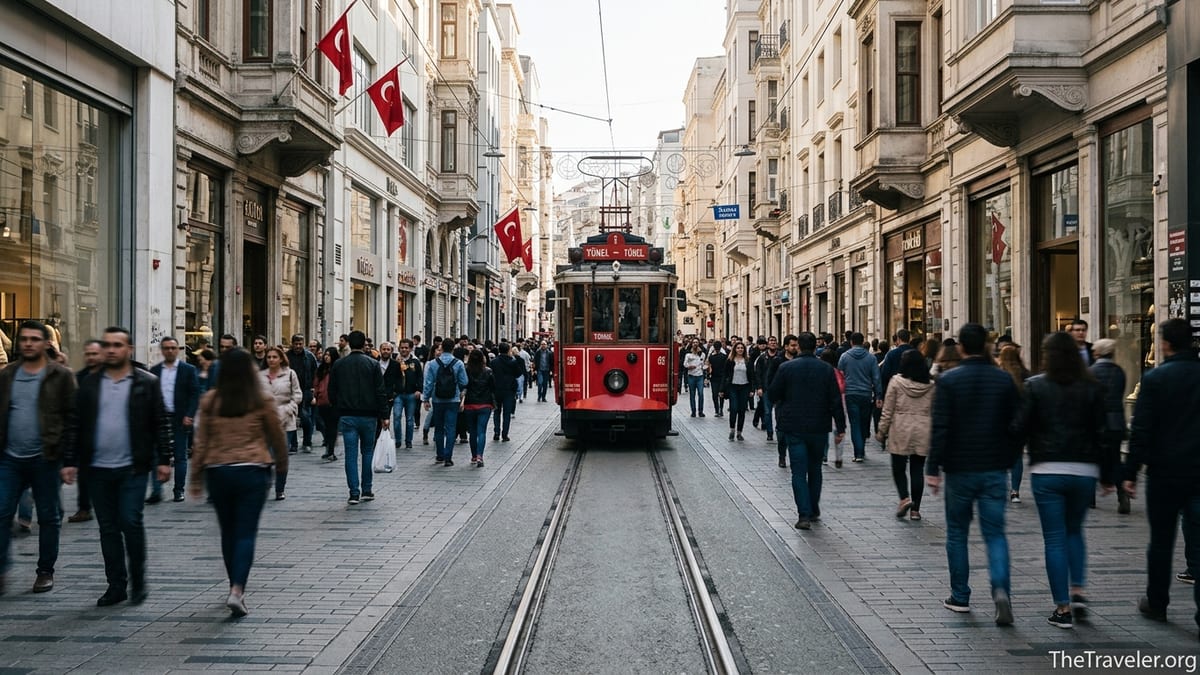
Once you have oriented yourself at the monument, face south with the long pedestrianized İstiklal Avenue stretching in front of you. The red nostalgic tram line runs along this axis, though in practice it is often packed and moves slowly. Think of it less as transport and more as a moving landmark you can use to gauge where you are on the street while you walk.
In terms of time, a brisk walker could cover the Taksim to Galata Tower route in under an hour, but most visitors will want to allow at least half a day if they intend to explore passages, step into churches, stop for coffee, and do some shopping. Late afternoon into early evening tends to be the busiest, particularly on weekends, when the walk becomes not just a route but a full-on urban performance.
From Taksim Square to the Top of İstiklal
As you leave Taksim Square and step onto İstiklal, your first landmark is the large domed church of Hagia Triada, tucked slightly back from the main avenue on your right. This late 19th-century Greek Orthodox church is one of Beyoğlu’s most visible non-Muslim religious buildings, its twin bell towers and central dome rising above the square. Its presence is a useful reminder that the district historically housed diverse communities, from Greeks and Armenians to Levantine Catholics and Jews.
The first few hundred meters of İstiklal are lined with familiar international chains, Turkish clothing brands, and mid-range cafés. Prices here tend to be higher than in back streets. For example, a basic coffee at a global chain near Taksim might be similar to what you would pay in a Western European capital, while a Turkish tea in a side-street tea house a few minutes away will usually cost a fraction of that. This section is useful for quick, predictable purchases, like picking up a local SIM card from a major operator store or grabbing a takeaway snack if you are in a hurry.
Traffic here is human rather than vehicular. On a summer Saturday evening, the pavement can feel like a slow-moving river of people, with street musicians contributing to a constant soundtrack of guitar, clarinet, or sometimes traditional instruments. If you want to move faster, use the edges of the street, but accept that this is not a place for a hurried commute. Many travelers find it easier to relax into the rhythm, stopping for a Turkish ice cream or a freshly pressed pomegranate juice from one of the small stands that appear seasonally along the way.
Security and police presence are common at the Taksim end of İstiklal, especially around public events or national holidays. Bag checks at metro entrances and occasional police vehicles parked on the square should not alarm you; they are part of the city’s normal routine. For visitors, the main practical concern is pickpocketing in dense crowds, especially near the square and close to popular street performers, so keep phones and wallets secure and avoid leaving bags hanging loosely from chairs at outdoor cafés.
Mid-İstiklal: Passages, Churches and the Galatasaray Area
Roughly ten minutes’ walk from Taksim you reach the Galatasaray High School, whose imposing historic façade and large courtyard gates act as a natural midpoint marker on İstiklal. Many locals informally divide the avenue into “Taksim to Galatasaray” and “Galatasaray to Tünel.” The stone building dates to the 19th century and still houses one of Turkey’s most prestigious high schools, a reminder that this street has long been associated with education and modernity.
Opposite and around Galatasaray, İstiklal’s famous passages begin to cluster. Çiçek Pasajı, originally the Cité de Péra built in 1876, is a glass-roofed arcade whose arched entrance opens just off the main street. Today it houses a row of meyhanes, or taverns, with tables spilling under the ornate ceiling. The quality and prices of the food here are mixed by local standards, but it remains a popular place to sit under the historical vaults with a plate of meze and a glass of rakı, particularly in the evenings when its lights glow above the constant buzz.
Just behind Çiçek Pasajı is the Balık Pazarı, or Fish Market, a compact network of stalls and simple eateries. Even if you are not shopping for seafood, it is worth a short detour to see displays of fish on ice, spice shops selling sumac and pul biber, and grills turning out midye tava, fried mussels, and stuffed mussels sold by the piece. Around here, you will also find small lokantas offering set lunch plates and rakı houses that fill up later in the day with groups sharing grilled fish and salads.
Another notable passage in this stretch is Avrupa Pasajı, or European Passage, a 19th-century shopping arcade with neoclassical details and mirrored interiors. Its small shops now sell souvenirs, jewelry, and decorative items. You might see visitors bargaining over traditional-style lamps or chess sets, but prices will often be higher than in less central neighborhoods. Use this passage more as an atmospheric pause than as a dedicated shopping strategy, unless you are comfortable paying extra for the convenient location.
Hidden Faith: The Churches of İstiklal
Second only to the constant crowds, the most striking feature of İstiklal for many visitors is the number of churches tucked just off the avenue, a testament to the area’s long cosmopolitan history. These buildings are easily missed if you focus only on the main shopfronts, so it is worth slowing down and watching for gateways and side alleys.
The most prominent is the Church of Saint Anthony of Padua, commonly called Sent Antuan, located in the Galatasaray to Tünel section. Its red-brick Neo-Gothic façade stands back from the street behind a small courtyard, accessible through an archway on İstiklal. Built in the early 20th century, it serves the local Catholic community and is usually open during the day for quiet visits. The interior, though not large by European cathedral standards, offers a welcome contrast to the busy avenue outside, with stained glass and candles framing the central nave.
Further up the avenue toward Taksim, between the Dutch and Russian consulates, lies Santa Maria Draperis, one of Istanbul’s older Catholic churches associated with the city’s Levantine heritage. The entrance on İstiklal leads you down a staircase to a sanctuary set below street level, reflecting historical restrictions that once limited how visible non-Muslim religious buildings could be from the main thoroughfares. The church has undergone multiple reconstructions due to fires and earthquakes, and its current form combines simple interior lines with a sense of being slightly hidden from the city around it.
Near the lower end of İstiklal, not far from Tünel, stands the Crimean Memorial Church, sometimes simply called the Crimean Church. Located on a quieter side street rather than directly on the avenue, it is an Anglican church originally built in the 19th century in memory of British soldiers who died in the Crimean War. Its English Gothic architecture, stone walls, and small churchyard are distinctive in the Istanbul context. If you are walking toward Galata and have time, a short detour here adds another layer to the story of how many communities once shared this hillside.
Cafés, Bites and Side Streets: Where to Pause
One of the pleasures of walking İstiklal is choosing how to punctuate the journey with food and drink. Instead of relying only on the main avenue, consider stepping into side streets that run perpendicular to the tram tracks. Around Asmalımescit and off Nevizade, for example, narrow lanes host clusters of meyhanes and small bars that tend to come alive in the evening with live music and shared plates. Prices here are mid-range by Istanbul standards: expect to pay a moderate amount for a simple meze spread and drinks for two, less than upscale Bosphorus venues but more than a no-frills lokanta.
For coffee, there is a mix of long-established Turkish cafés and newer specialty coffee shops. A traditional option might serve Turkish coffee in small cups accompanied by Turkish delight, while third-wave cafés in side alleys offer pour-over brews and espresso-based drinks similar in price to those in other major European cities. If you are watching your budget, look for places where locals queue for takeaway tea in tulip-shaped glasses at a counter; these usually charge just a small amount and are a good way to stay refreshed without sitting down for a full break.
Street food is part of the route as well. Vendors sell simit, the circular sesame bread ring, from red carts along the avenue, particularly near Taksim and Galatasaray. In the evenings, you may encounter stands offering roasted chestnuts, corn on the cob, or kokoreç, a seasoned offal dish served in bread, which is popular with some locals and an acquired taste for many visitors. Balık Pazarı and the surrounding lanes are convenient if you want a quick fish sandwich or fried mussels while standing at a high table rather than committing to a full restaurant meal.
Side streets also provide a way to briefly escape the heaviest crowds. From mid-afternoon to late evening, the main spine of İstiklal can feel packed shoulder to shoulder, especially on weekends and holidays. Ducking down a side alley toward Cihangir or back toward Çukurcuma not only introduces you to more residential neighborhoods and antique shops, but it also drops the noise level significantly within a few minutes’ walk. Many travelers find it worth alternating between the main avenue and these lateral detours to keep the experience pleasant rather than exhausting.
Navigating Crowds, Noise and Practicalities
The density of people on İstiklal is part of its appeal but also its primary challenge. Weekday mornings are comparatively quiet, with more locals commuting to work or opening their shops, while evenings and weekends can feel like a festival, with musicians, protesters, families, and tourists all sharing the same pavement. If you prefer a calmer experience, starting your walk before midday on a weekday and reaching Galata before the evening rush is a reasonable strategy.
Noise is another constant companion. Between live music, recorded shop soundtracks, calls from restaurant touts, and the bell of the nostalgic tram, silence is rare. Earplugs or noise-reducing earbuds can help sensitive travelers, especially children. If you carry a stroller, be prepared for frequent stops and slightly uneven paving stones in some older sections and passages; locals do push prams here, but it requires patience.
From a safety perspective, the main risks for visitors are minor thefts and simple fatigue. Keep valuables in front pockets or a money belt, and avoid displaying large amounts of cash when paying street vendors. Many mainstream shops, cafés, and even smaller eateries around İstiklal now accept card payments, including contactless, which reduces the need to carry large sums. Stay hydrated, especially in summer when the combination of crowds and heat can be draining; small markets and kiosks selling bottled water and soft drinks are scattered along the route.
Public restrooms directly on İstiklal can be limited, but many shopping centers, some passages, and larger cafés provide facilities for customers. It is common practice to buy a small drink in a café to use the bathroom, and this is generally accepted as long as you do not linger excessively during peak times. Near Taksim, larger malls and the metro station provide additional options, while closer to Galata, small cafés and bakeries fill that role.
From Tünel to Galata: How to Continue the Walk
İstiklal Avenue gradually slopes down to a small square centered on the Tünel funicular station, which has connected the hilltop to the Karaköy waterfront since the 19th century. At this point, many locals end their definition of “İstiklal,” but for visitors heading toward Galata Tower, the walk is not yet complete. Standing with your back to the Tünel entrance, look for Galip Dede Caddesi, the downhill street lined with music shops and souvenir stores; this is your route to the tower.
Galip Dede begins gently, then drops more steeply as you move downhill. The sidewalks here are narrower than on İstiklal proper, and vehicle access is more frequent, so pay attention to cars and delivery vans as you walk. Music shops selling bağlamas, ouds, and guitars, as well as stores with Turkish cymbals and percussion instruments, line the street, giving it a distinct identity. Many travelers find it hard to resist stepping into at least one shop to hear a few notes being demonstrated.
After roughly 5 to 10 minutes on Galip Dede, depending on your pace and how often you stop, the stone cylinder of Galata Tower begins to appear between buildings ahead of you. The streets start to fan into a small plaza at the base of the tower, surrounded by cafés, ice cream stands, and souvenir shops. This area can be extremely crowded at sunset during peak season, when many visitors time their ascent to coincide with the changing light over the Golden Horn.
If your goal is to go up the tower, be prepared for queues, particularly in high season and on clear days. Some travelers choose to come here early in the morning and then walk up İstiklal toward Taksim to avoid both the line and the heat. Even if you decide not to climb the tower, the streets that radiate from the plaza are pleasant to wander. From here you can either continue downhill to Karaköy and the Galata Bridge, or circle back up toward Şişhane metro if you prefer not to retrace your steps.
The Takeaway
The walk from Taksim Square down İstiklal Avenue to Galata weaves together multiple layers of Istanbul in the space of a single afternoon. Modern retail chains and global coffee brands sit beside 19th-century passages; hidden churches share the same block as neon-lit bars; and a nostalgic tram glides through crowds checking their smartphones. Few other routes in the city offer the same concentration of history, commerce, and everyday life in such a short distance.
Approached with the right expectations, this is less a point-to-point transfer and more a moving urban stage. You may not find the city’s best food bargains or quietest corners directly on İstiklal, but you will find a dense cross-section of local routines and visitor rituals. Stepping into Balık Pazarı for a snack, pausing in the courtyard of Sent Antuan, or detouring down Galip Dede to the base of Galata Tower turns a simple walk into a sequence of distinct scenes.
For many travelers, the best way to experience this route is to combine it with other parts of the city: arrive from the historic peninsula by tram and funicular, walk İstiklal and Galata in the afternoon, then descend to Karaköy for dinner by the water. Whether you visit once or return on several evenings, the Taksim to Galata walk tends to reveal something different each time, depending on the light, the crowds, and your own willingness to step off the main avenue.
FAQ
Q1. How long does it take to walk from Taksim Square to Galata Tower?
Most visitors take around 30 to 45 minutes of continuous walking from Taksim Square down İstiklal and Galip Dede to Galata Tower, but allowing two to three hours gives you time to explore passages, churches and cafés along the way.
Q2. Is the route from Taksim to Galata safe to walk at night?
The Taksim to Galata route is generally busy and feels reasonably safe into the late evening, especially on weekends, but standard big-city precautions apply, such as watching your belongings and avoiding very quiet side streets if you are alone late at night.
Q3. When is the best time of day to walk İstiklal Avenue?
Weekday mornings are calmer and better for photography, while late afternoon and early evening offer the most atmosphere but also the heaviest crowds; choose according to whether you prioritize space or liveliness.
Q4. Can I take the nostalgic tram instead of walking all of İstiklal?
Yes, the nostalgic tram runs between Taksim and Tünel, but it is often crowded and slow; many travelers ride it one way for the experience and walk the other to see more of the street.
Q5. Are there many places to eat along the Taksim to Galata route?
There is a wide range of options, from street food like simit and roasted chestnuts to meyhanes in Çiçek Pasajı and simple fish eateries around Balık Pazarı, as well as numerous cafés and bakeries on both the main avenue and side streets.
Q6. Do I need to dress modestly to visit the churches on İstiklal?
While dress codes are generally more relaxed than in mosques, it is respectful to wear clothing that covers shoulders and knees when entering churches such as Saint Anthony of Padua or Santa Maria Draperis, and to speak quietly inside.
Q7. Is the walk suitable for children and strollers?
The route is technically stroller-friendly, as it is mostly pedestrianized and paved, but heavy crowds, uneven stones in some passages, and occasional steep sections near Galata can make it tiring; families often plan extra breaks and avoid the busiest evening hours.
Q8. How can I continue after reaching Galata Tower?
From Galata Tower you can walk downhill to Karaköy and the Galata Bridge, connect to ferries and the tram toward the historic peninsula, or head back uphill toward Şişhane metro if you prefer a shorter loop.
Q9. Are prices on İstiklal higher than elsewhere in Istanbul?
Prices for food, drinks and souvenirs on İstiklal and near Galata are usually higher than in more residential neighborhoods; stepping a few streets away from the main avenue often brings more local-oriented options and slightly lower prices.
Q10. What should I watch out for in terms of scams or hassles?
The most common issues are inflated tourist prices, overly persistent restaurant touts and occasional bar scams in side streets; avoid entering unfamiliar bars where someone pressures you to join them, always check menus before ordering and feel free to decline offers politely but firmly.