


Azerbaijan’s second city, Ganja, often sits quietly in the shadow of Baku’s skyscrapers and Sheki’s mountain charm. Yet for some travelers, Ganja is exactly the right fit: a lived-in regional hub with old caravanserais, leafy parks and easy access to lakes and vineyards. For others, time may be better spent in places like Gabala, Sheki or Lankaran. This guide breaks down who should seriously consider visiting Ganja, who might treat it as an optional stop, and which types of travelers are usually happier in other Azerbaijani cities.
Get the latest updates straight to your inbox!
Getting Oriented: What Ganja Actually Offers Travelers
Ganja is a medium-sized, workaday city in western Azerbaijan with a population of roughly a few hundred thousand, recognized as the country’s second-largest urban center. It functions as the anchor of the wider Ganja–Gazakh tourism region, which also includes Naftalan, Shamkir and the lake district around Goygol. In practical terms, that means Ganja combines city services and transport connections with relatively quick access to rural landscapes, vineyards and mountain lakes.
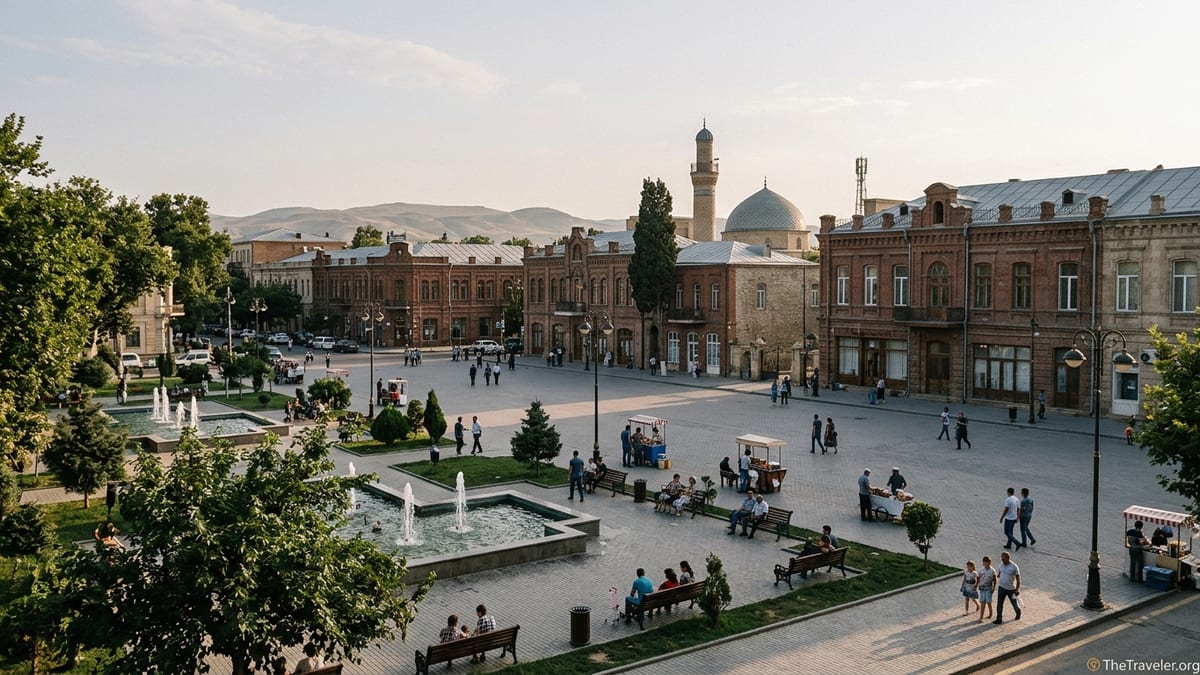
The city’s atmosphere is quite different from Baku’s waterfront capital energy. In Ganja you are more likely to stroll past Soviet-era apartment blocks and low-rise houses than ultra-modern towers. Central streets are tree-lined and busy during the day but feel local and relaxed, especially in the evenings when families gather in parks near fountains and tea houses. For many visitors this everyday feel is precisely the point: Ganja lets you see an Azerbaijani city that is not primarily oriented toward international tourism.
Tourism infrastructure exists but is not dominant. You will find a handful of mid-range hotels, a few newer business-style properties and several budget guesthouses near the center. Prices for a clean mid-range room typically run noticeably lower than in Baku, and informal homestays or small hotels can be very good value for travelers comfortable with simpler standards and limited English. Cafes serving kebabs, qutab and local pastries are plentiful, while more international dining choices remain limited.
Ganja is also a gateway. Buses and minibuses head out to Naftalan’s mineral oil spas, Shamkir’s wine country and Goygol National Park, home to the deep blue Lake Goygol and other mountain lakes. Many travelers who do come to Ganja use the city as an overnight base for a day trip to the lakes or as a stop on a westward route toward Georgia.
Who Will Get the Most Out of a Visit to Ganja
City travelers who enjoy watching ordinary life unfold rather than ticking off major sights are usually the ones who appreciate Ganja most. If you like lingering in local parks, riding city buses just to see where people live, and browsing produce at neighborhood markets, Ganja offers an authentic slice of urban Azerbaijan without the tourist gloss. For instance, a morning spent around the central bazaar, tasting fresh cheeses and dried fruits, followed by tea in a simple çayxana is a very typical Ganja day that appeals to slow travelers.
History-minded visitors may also find Ganja rewarding when combined with some homework. The city traces its roots back more than two millennia and has served as a regional capital for different states. On the ground, that translates into a mix of historic mosques, caravanserai courtyards and a few museums. Architecture fans can spend a couple of hours around the Shah Abbas Mosque complex and the old caravanserai buildings, then continue to the more modern Heydar Aliyev Park complex to see how public spaces have been reimagined in recent decades.
Travelers interested in regional culture rather than headline attractions are another good match. Ganja was named European Youth Capital in 2016, bringing a wave of youth projects and cultural events. Today you can still feel that energy in the city’s youth centers, street art pockets and occasional open-air concerts or festivals, especially in summer. Independent travelers who enjoy striking up conversations, attending a local football match, or dropping into a modest cultural center for a small exhibition will find Ganja surprisingly engaging.
Finally, budget-conscious visitors planning longer trips across the Caucasus might include Ganja as a practical, affordable base in western Azerbaijan. Groceries, city transport and simple restaurant meals often cost less than in Baku. Travelers moving overland between Baku and Tbilisi sometimes break the journey here, using one full day to see the city’s main spots and perhaps another to visit Goygol National Park before continuing west.
Types of Travelers Who Might Prefer Other Azerbaijani Cities
Not every traveler will find Ganja essential. Those who want a compact destination rich in headline historic sites and photogenic old quarters may feel more satisfied in Sheki. Sheki’s caravanserai guesthouses, cobbled streets and the elaborately decorated Sheki Khan’s Palace create a concentrated dose of history and architecture that Ganja spreads more thinly across a broader, modern cityscape.
Visitors whose main goal is mountain scenery, cable cars and resort facilities will almost certainly prefer Gabala or the northern resorts like Shahdag and Quba. Gabala has become one of Azerbaijan’s most popular destinations after Baku, thanks to attractions such as the Tufandag ski and cable car complex, an amusement park, and lakeside leisure areas. If you are picturing alpine views, organized adventure activities and resort-style hotels, those cities align more closely with that vision than Ganja’s urban parks and distant mountain backdrop.
Travelers chasing sea air and subtropical greenery are also better served in the south. Lankaran and the surrounding region combine Caspian coastline with tea plantations, citrus groves and nearby Hirkan forests. These places are a natural fit for visitors interested in food-focused trips, coastal walks and day tours to hot springs or forest reserves, experiences that Ganja itself cannot offer.
Lastly, short-stay city-break tourists with only three or four nights in Azerbaijan will almost always get more out of focusing on Baku and perhaps one additional region such as Sheki or Gabala. Given travel times, slotting Ganja into a very tight itinerary can mean long hours on the road for experiences that, while authentic, are more subtle than spectacular. In such cases, Ganja often makes more sense as a stop on a longer regional journey rather than a primary destination in its own right.
Comparing Ganja With Baku, Sheki, Gabala and Lankaran
Compared to Baku, Ganja feels considerably quieter and less polished. Baku delivers a full big-city package: a walled Old City listed among the country’s top cultural attractions, a museum scene with topics ranging from carpets to miniature books, and a waterfront boulevard where international brands line the shopping streets. Public transport, restaurant variety and nightlife options are far more extensive. If this is your first visit to Azerbaijan and you enjoy museums and city energy, Baku will likely command the majority of your time.
Sheki and Ganja provide useful contrasts for travelers deciding between them. Sheki sits within the Sheki–Zagatala tourism region and is frequently cited as one of Azerbaijan’s top non-capital destinations, especially for international visitors. Its historic center, with traditional houses, workshops and the palace complex, creates a storybook setting ideal for photography and walking. Ganja, by contrast, is more of a lived-in regional capital. You are more likely to remember an evening stroll through a neighborhood park or chatting with shopkeepers rather than a single iconic monument.
Gabala’s appeal lies heavily in its modern resort and mountain offerings. Families from across the region come for cable car rides at Tufandag, amusement rides at Gabaland and lakeside cafes around Nohur Lake. Prices at resort hotels can be significantly higher than in Ganja, but the trade-off is access to organized activities and facilities like ski rentals, zip lines or children’s play zones. Solo travelers focused on culture rather than outdoor activities sometimes find Gabala a bit purpose-built, while Ganja can feel more like a real regional city where people live and work.
In Lankaran, the atmosphere shifts again. The city and surrounding districts form a distinct tourism region oriented toward coastal and ecological tourism. You might spend a day touring tea fields, trying local dishes rich in herbs and citrus, and visiting forested areas within reach of the city. For travelers who imagine Azerbaijan as a crossroads of cuisines and climates, Lankaran shows a different side of the country than Ganja’s continental, inland character.
Practicalities: Transport, Time and Costs
Reaching Ganja is reasonably straightforward. From Baku, intercity buses and minibuses connect the capital to Ganja along the main highway, with travel times typically around five to six hours depending on traffic and stops. There are also train services on the east–west rail corridor, which some travelers prefer for comfort and the opportunity to move around. Domestic flights have existed in various periods, but schedules and availability can change, so it is wise to check current options or rely on ground transport for planning purposes.
Inside the city, public transport relies primarily on buses and minibuses, which are inexpensive and cover most neighborhoods. Taxis ordered via local ride-hailing apps or hotel reception are common and affordable for most visitors, especially when shared among two or three people. Compared to Baku, where distances and traffic can lengthen ride times, getting around Ganja is relatively quick, which makes it easy to combine several sights and a market visit within a single day.
Accommodation costs in Ganja typically undercut those of the capital. While exact room rates fluctuate with demand and season, travelers generally find that similar-quality hotels charge less in Ganja than in Baku’s central districts. Food costs are comparable or slightly lower, especially if you eat where locals do, ordering grilled meats, soups and salads at simple cafes rather than seeking out international cuisine. Day trips to Lake Goygol, Naftalan or Shamkir can usually be arranged via local agencies, hotel desks or taxi drivers for moderate prices, especially if you split costs among a small group.
When planning, it is practical to allow at least one full day to see Ganja itself and one additional day if you intend to visit nearby lakes or vineyards. Travelers who enjoy slow pacing often extend to three nights, using downtime to relax in city parks or catch up on work while still feeling they have stepped beyond the most common tourist route. Those on very tight schedules may opt for just a single overnight stop en route to or from Georgia, particularly if they are already prioritizing Sheki, Gabala or other regional centers.
What Ganja Is Like on the Ground: Atmosphere and Experiences
Ganja’s cityscape is a mix of older neighborhoods, Soviet planning and newer public projects. In the central area you will find broad avenues, public squares and parks with fountains, while side streets host small shops, bakeries and family-run restaurants. The absence of a highly commercialized tourist core means that prices in many places are set for locals, and encounters with other foreign tourists may be relatively infrequent, especially outside peak summer periods.
Daily life provides much of Ganja’s charm. On a typical evening, families wander along park paths, children play near illuminated fountains, and groups of friends gather at open-air tea houses. Visitors who enjoy people-watching can easily spend hours observing these routines. Early risers might explore side streets to see bread being delivered, market stalls setting up and local cafes serving breakfast to workers and students before the city fully wakes up.
For culture, you are more likely to attend modest events than grand productions. Small theaters, music schools and cultural centers host performances and exhibitions that primarily serve residents. Language can be a barrier, especially outside hotels and a few central businesses, but patience and basic phrases in Azerbaijani or Russian go a long way. Many younger people study English and appreciate the chance to practice, which can lead to spontaneous conversations and invitations to local cafes.
Crime rates against tourists in Ganja are generally perceived as low, and the city often feels safe to walk in the main areas during the evening. As in any urban environment, it is still sensible to watch your belongings in crowded transport and avoid deserted areas late at night. Travelers should also stay aware of broader regional developments through official advisories, but for most visits, day-to-day safety concerns in Ganja resemble those of other mid-sized cities in the region.
When Ganja Belongs in Your Itinerary – and When It Does Not
Ganja deserves serious consideration if you are planning a week or more in Azerbaijan and want to see at least one substantial city beyond Baku. It works particularly well in itineraries that emphasize diverse regions, such as a loop from Baku through Sheki and the northwest, then down through Ganja and on toward Naftalan or Mingachevir before returning east. In this context, Ganja serves as both a cultural stop and a practical transport hub for the western corridor.
It also fits well for overland travelers linking Azerbaijan with Georgia. Some routes between Baku and Tbilisi naturally pass within reach of Ganja, making the city an appealing overnight break rather than pushing through a very long bus journey in one day. Spending even 24 hours on the ground offers a chance to walk the central streets, sample local cuisine and, if time permits, arrange a half-day outing toward nearby lakes or hilltop viewpoints.
On the other hand, if you have fewer than six days in the country, you may struggle to justify including Ganja unless you have a specific reason such as visiting friends or attending an event. In such short trips, focusing on Baku plus one high-impact region like Sheki, Gabala or the Quba area typically yields a clearer sense of Azerbaijan’s variety without long detours. In these scenarios, Ganja becomes more of a “second- or third-trip” destination once you have experienced the core highlights.
Ganja is also less suitable as a pure resort or leisure destination. Visitors seeking poolside relaxation, spa packages and organized entertainment on-site will likely prefer purpose-built resorts in Gabala, Shahdag or Naftalan. While the broader Ganja–Gazakh region includes Naftalan’s health resorts and scenic lake districts, these experiences often involve leaving Ganja itself and basing in specialized facilities or smaller towns.
The Takeaway
Ganja is not Azerbaijan’s flashiest or most photographed city, and that is exactly why some travelers love it. It offers an honest look at daily life in the country’s western heartland, anchored by parks, markets and a modest yet real cultural scene. For patient visitors who value local encounters and are willing to invest a little travel time, Ganja can become a memorable stop and a useful base for nearby lakes, wine country and health resorts.
At the same time, many visitors with limited days and a focus on dramatic scenery or dense historic quarters will be better served by concentrating on Baku, Sheki, Gabala or Lankaran. Thinking carefully about what you enjoy most in a trip is key. If you prioritize seeing how a regional Azerbaijani city functions beyond the capital, Ganja may well deserve a place on your itinerary. If your heart is set on mountains, beaches or ornate palaces, it will likely remain a name on the map that you pass on the way to somewhere else.
FAQ
Q1. Is Ganja worth visiting on a first trip to Azerbaijan?
It can be, especially if you have at least a week and want to see a large city beyond Baku. With only a few days, most travelers get more out of focusing on Baku plus one standout region like Sheki or Gabala.
Q2. How many days should I spend in Ganja?
One full day is usually enough to see central Ganja, with two days recommended if you want to include a side trip to Lake Goygol, nearby vineyards or Naftalan’s health resorts.
Q3. Is Ganja safe for solo travelers?
Central areas of Ganja generally feel safe, including in the evening, and serious crime against tourists is uncommon. Normal city precautions apply, such as watching valuables in crowded buses and using licensed taxis or trusted ride-hailing services at night.
Q4. Can I visit Ganja as a day trip from Baku?
In practice, it is too far for a comfortable day trip by road or rail. Travel times between Baku and Ganja are typically several hours each way, so an overnight stay is strongly recommended if you want to see more than the bus or train station.
Q5. Which city should I choose if I want historic architecture and an old town feel?
If your priority is a compact, atmospheric historic center, Sheki is usually a better choice than Ganja. Sheki’s caravanserais, palace complex and traditional houses create a stronger old-town experience.
Q6. Where should I go instead of Ganja if I mainly want mountain views and cable cars?
Gabala and northern resort areas like Shahdag or the Quba region are better suited to travelers seeking mountain scenery, cable car rides and organized outdoor activities, all of which are more limited in and around Ganja.
Q7. Is Ganja a good base for visiting Lake Goygol?
Yes. Many visitors use Ganja as a convenient base for day trips to Goygol National Park and nearby lakes. Local agencies, hotels and taxi drivers can usually help arrange transport for a half-day or full-day excursion.
Q8. How does the cost of visiting Ganja compare with Baku?
Accommodation and everyday expenses in Ganja tend to be lower than in central Baku, especially for mid-range hotels and local restaurants. Luxury options and international dining are more limited, so value is best for travelers comfortable with simpler services.
Q9. Should I choose Ganja or Lankaran if I want nature and food experiences?
For coastal landscapes, tea plantations and subtropical dishes, Lankaran is a stronger match. Ganja works better if you want an inland city atmosphere with access to lakes, vineyards and regional markets rather than seaside settings.
Q10. Is it easy to combine Ganja with Georgia in one trip?
Yes. Overland routes between Baku and Tbilisi often pass within reach of Ganja, and many travelers use the city as a break in the journey. It is a practical stop for those crossing the region by bus or train rather than flying between capitals.