

The first clue that Albania was different came with a cup of coffee. I had just stepped off an overnight bus into Tirana, bleary-eyed and clutching my backpack, when a barista set down a perfect macchiato and a glass of water. I slid a couple of coins across the counter, expecting a raised eyebrow. Instead, he waved me on. The bill came to just over one euro. In a Europe where many travelers now think twice before ordering a second latte, Albania felt like a quiet loophole in the continent’s inflation story.
Discovering Europe’s Last Great Value Secret
I had come to Albania almost by accident. Friends in Greece had been grumbling that island prices were edging out backpackers, and a fellow traveler in Thessaloniki leaned across a hostel kitchen table and said, "If you want the old-school Europe-on-a-budget feeling, take the bus to Tirana." A week later, I found myself watching the sun rise over the Adriatic as we crossed the border into a country that has gone from near-total obscurity to one of Europe’s fastest-growing tourism stories.
Tourism numbers here have surged in recent years, with international arrivals more than doubling since before the pandemic, yet prices still sit well below neighboring Italy, Greece, and Croatia. You feel it the moment you start adding up real costs: a hostel bed in Tirana for around 12 to 18 euros a night, a filling breakfast of byrek and yogurt for 2 to 3 euros, intercity buses that rarely crack the 10-euro mark. While Albania is no longer "dirt cheap," it hits a rare sweet spot where what you get for your money feels slightly out of proportion to what you pay.
Travel writers sometimes talk about "value" in abstract terms, but in Albania it is disarmingly concrete. One afternoon I took a three-hour bus from Tirana to the Ottoman-era town of Berat, checked into a stone guesthouse overlooking the river for about 30 euros, and sat down to a dinner of grilled trout, salad, bread, and local wine. My total spend for the day, including transport, lodging, and food, came in under 70 euros. In much of coastal Western Europe, that might cover a single restaurant meal for two.
What makes Albania so compelling right now is that it does not feel like a country built only for bargain hunters. The infrastructure is improving, boutique hotels are quietly opening in once-forgotten villages, and international hotel brands are investing along the coast. Yet the core equation holds: labor remains affordable, local food is still reasonably priced, and tourism demand, while rising fast, has not yet pushed everything into "resort town" territory.
A Daily Budget That Still Stretches Surprisingly Far
On my first morning in Tirana, I decided to treat the city like an experiment in real-world budgeting. How much could I do in a single day without feeling like I was counting coins? I started with a dorm bed in a centrally located hostel, booked the night before for 14 euros. It came with a generous breakfast, solid Wi-Fi, and a terrace where I ended up trading tips with travelers from Poland and Argentina.
For lunch, I wandered into a workers’ grill tucked behind a busy avenue. The menu was in Albanian, but the owner pointed to plates coming out of the kitchen: qofte meatballs, grilled vegetables, fresh bread. I ordered a plate of meatballs, a salad, and a mineral water. The bill was just under 6 euros. Later that afternoon, I joined a small-group city walking tour for 15 euros, climbing into the once-secret bunkers built during Albania’s communist era and finishing in the pastel-painted streets of Blloku, the neighborhood that used to be off-limits to ordinary citizens.
By the time I added up dinner at a cozy tavern (homemade raki, stuffed peppers, and a shared dessert for about 10 euros) and a local bus ride back to my hostel, I had spent roughly 45 euros in total. That included a paid activity, three solid meals, and comfortable, if simple, accommodation. Travelers who prefer a private room in a guesthouse or budget hotel can expect to spend closer to 50 to 80 euros a day for a mid-range experience, with breakfast often included and the occasional taxi ride or rental car day folded in.
The real savings reveal themselves as you move around. Intercity buses link Tirana with major destinations like Shkodër, Berat, Gjirokastër, Vlorë, and Sarandë. A four-hour ride from Tirana to the Riviera hub of Sarandë typically costs around 10 to 15 euros, depending on the route and vehicle. Coastal towns like Himarë and Dhërmi see higher summer pricing, but even there you can find family-run rooms in June or September for 35 to 60 euros a night, a fraction of what a comparable view would cost across the water in Corfu or on Croatia’s Dalmatian coast.
From Alpine Peaks to Riviera Bays on a Shoestring
Albania’s geography reads like a wish list: jagged mountain ranges in the north, Unesco-listed stone towns in the interior, and a coastline that slips from pebbly coves to white-sand bays as you head south. What makes it powerful for budget travelers is that many of the star experiences here are either free or very low cost, especially once you have paid to get yourself to the trailhead or beach.
In the Albanian Alps, I joined a group of hikers doing the classic trail from Valbonë to Theth. A shared minibus from Shkodër to the Komani Lake ferry, the boat ride itself, and onward transport to Valbonë came to roughly 25 to 30 euros in total. My guesthouse in Valbonë charged 30 euros per person for a room, dinner, and breakfast, and another 7 to 8 euros for a packed lunch for the trail. The hike, with its switchbacks and sweeping valley views, was free. In many alpine regions of Western Europe, a night in a similar mountain lodge can easily run double that before you have even ordered dinner.
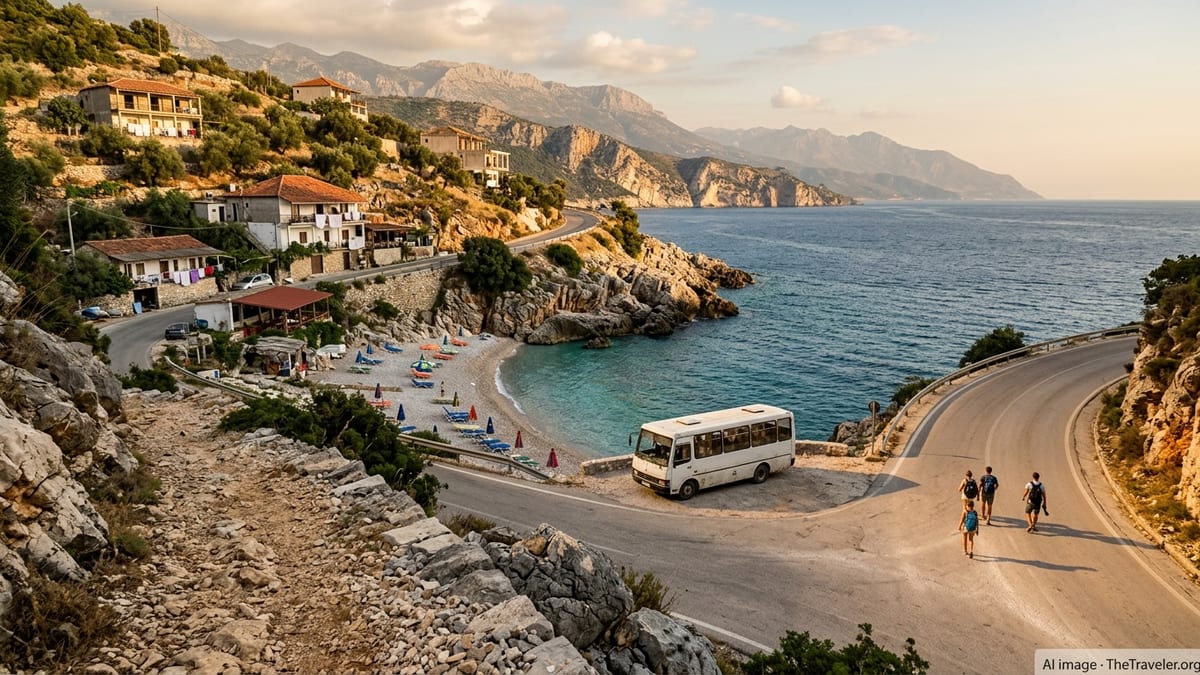
Down south on the Riviera, the pattern repeats. In Himarë, I rented a sun lounger and umbrella on a pebble beach for around 7 euros and spent the day swimming in water as clear as anything I have seen in the Cyclades. Lunch was a plate of grilled sardines and a cold beer at a seafront taverna for about 9 euros. At nearby wild beaches, you can skip the lounger entirely and throw a towel on the sand for free. Local buses and seasonal minibuses knit together coastal villages, and many travelers choose to rent a car for a few days to explore hidden coves and hilltop monasteries. Split between two or three friends, a compact rental car can work out to 20 to 30 euros per person per day, fuel included, for the freedom to explore.
Even in the country’s most famous heritage sights, entry fees are rarely punishing. The hilltop castle above Gjirokastër, with its sweeping views of the Drino valley, cost me around 4 euros to enter. At Butrint, the ancient city set among lagoons and forests near the Greek border, the ticket price was higher but still under what many travelers have grown used to paying for big-name archaeological sites in Western Europe. It is entirely possible to spend several days hopping between beaches and ruins, eating well and sleeping in comfortable rooms, on a budget that might cover a single day’s spending in Paris or Rome.
How Albania Stays Affordable While Growing Fast
Walking through Tirana today, it is clear that Albania is not some frozen-in-time bargain. Construction cranes dot the skyline, new boutique hotels open each season, and global hotel brands are appearing both in the capital and along the coast. Tourist arrivals have climbed into the millions, and locals will tell you that each summer now feels busier than the last.
So why does the country still work so well for budget-conscious travelers? Part of the answer lies in wages and the still-developing nature of the tourism economy. Average income levels are lower here than in the European Union, which keeps the labor component of hotels, restaurants, and tours more affordable. At the same time, many ingredients on your plate are locally sourced: olives, vegetables, mountain cheeses, fresh-caught fish. Markets in inland towns are geared as much to residents as to visitors, which helps prevent the sharp price spikes you see in purely tourist economies.
That does not mean nothing is changing. Coffee that once cost 50 cents now hovers closer to 1 euro in many cafes. Rooms on the most Instagram-famous stretch of the Riviera can double in price between May and August. Inflation and rising demand are nudging Albania away from its "cheapest country in Europe" reputation towards something more nuanced: a place where, with some planning, you still get noticeably more for your money than in better-known Mediterranean destinations.
Travelers who time their trips and spend smartly feel this most. Visiting in late May or September avoids the highest accommodation prices and the worst traffic. Choosing an inland base like Vlora’s hill villages instead of the busiest beachfronts can shave 20 to 30 percent off your nightly rate. Eating a plate of qofte or fërgesë in a neighborhood grill two streets back from the seafront, rather than on the promenade itself, can halve your lunch bill without sacrificing quality. Albania rewards those who are willing to walk a few extra blocks.
What Day-to-Day Life Looks Like on the Ground
More than any spreadsheet, it was the rhythm of daily life in Albania that convinced me this was a dream trip for travelers watching their spending. In Tirana, mornings began with strong espresso at a sidewalk cafe for about 1 euro, followed by a stroll through New Bazaar, where stalls sagged under piles of cherries, tomatoes, and herbs. For a few euros I could assemble a picnic of bread, cheese, olives, and fruit, then decamp to the city’s Grand Park to watch families and retirees making slow loops around the lake.
Public transport is cheap and, in its own way, part of the cultural experience. City buses within Tirana cost well under 1 euro per ride, and even taxis, while more expensive, are reasonable for short hops, especially if you are splitting the fare. In smaller towns, shared minibuses and furgons act as both transport and social hub, with drivers remembering regulars and detouring to drop people near home. Schedules can be fluid, so flexibility is key, but the upside is that you rarely pay more than a handful of euros for a significant journey.
Food is where budget travelers often fear they will have to compromise, but in Albania the opposite tends to be true. I ate memorable meals in no-frills restaurants where handwritten menus listed grilled meats, stews, and seasonal vegetables at prices that made it easy to order an extra dish "just to try." A seafood pasta on the Riviera might run 8 to 12 euros, generous salads around 3 to 5, and a glass of local wine 2 to 3. House wines are usually excellent value, produced in nearby hills rather than shipped in from afar.
Crucially for long-term travelers, everyday essentials do not deliver nasty surprises. A local SIM card with a month of data costs significantly less than equivalent packages in Western Europe. Laundry services in guesthouses are often offered for a modest flat fee per load. Museums, bus tickets, snacks, and coffee breaks all stack up into a pattern: this is a country where you can maintain a rich, full travel day without feeling like every decision carries a financial penalty.
Making a Budget Trip Here Work Even Harder
Albania might feel relaxed on your wallet, but the difference between a merely cheap trip and a genuinely great-value one lies in how you plan. I learned quickly to think in seasons. July and August on the Riviera bring higher prices and denser crowds, so shifting my beach days to June and early September cut both accommodation costs and the time spent hunting for a free patch of sand. In the mountains, shoulder seasons brought crisp days and quieter trails, though I packed layers for chilly nights.
Booking strategies make a difference too. In Tirana and larger towns, I used online platforms to secure the first night or two, then negotiated directly with guesthouse owners for longer stays. Many were happy to shave a few euros off the nightly rate if I committed to three or four nights, and in smaller destinations I was occasionally offered dinner or breakfast "on the house" as part of the deal. Weekly or monthly apartment rentals in cities like Tirana or Shkodër can pull nightly costs down further for digital nomads and slow travelers.
Transport is another area where small choices add up. Renting a car in peak summer for an entire trip can quickly eat through a budget, but using public buses for long hops and picking up a rental only for a focused three- or four-day coastal or mountain loop kept my costs under control. Sharing rides with other travelers I met in hostels not only split fuel and rental fees but turned travel days into rolling conversations about hidden coves and favorite bakeries.
Perhaps the biggest saving, though, comes from embracing Albania’s local way of life. Shop in morning markets rather than tourist mini-marts, drink raki and wine produced within a short drive rather than imported spirits, eat where you see families and construction workers rather than laminated photo menus. Budget travel here is less about sacrifice and more about alignment: the more you live like an Albanian for a week or two, the more your expenses and experiences both improve.
The Takeaway
Sitting on a balcony in Gjirokastër on my last evening in Albania, I watched the sun sink behind the mountains and tried to tally what the past two weeks had cost me. Even including a splurge night in a boutique hotel, a guided hike in the Alps, and a few too many seaside dinners, my average daily spending hovered well below what I typically pay in other parts of Europe. More important than the numbers, though, was how rarely I had to think about them. I ordered the extra side dish, took the bus out to a remote village, stayed an extra night when a place felt right.
Albania is not a secret anymore, and prices will almost certainly keep inching upwards as more visitors arrive and more coastal land is developed. Yet right now, in 2026, it occupies a rare space: a European country where budget travelers can still string together mountain trails, Unesco towns, and turquoise bays without constantly refreshing their banking app. For anyone who has watched their dream Mediterranean trip recede under the weight of hotel quotes and restaurant prices, this small, often misunderstood nation deserves a place at the top of the list.
If there is a lesson from my time here, it is this: the dream trip does not always look like a five-star resort or a business-class ticket. Sometimes it looks like a shared plate of grilled fish on a quiet beach, a bus winding into the mountains, a guesthouse owner pressing a glass of homemade wine into your hand and refusing to let you pay for it. In Albania, at least for now, those moments come with a price tag that makes them easy to say yes to.
FAQ
Q1. Is Albania really cheaper than other European beach destinations?
Yes, in most cases. Accommodation, food, and transport along the Albanian Riviera generally cost less than in nearby Greece, Italy, or Croatia for similar experiences.
Q2. How much should I budget per day as a backpacker in Albania?
A typical backpacker can often get by on about 30 to 50 euros per day, including a hostel bed, local meals, public transport, and one paid activity.
Q3. What about costs for a more comfortable mid-range trip?
For guesthouses or budget hotels, restaurant meals, some taxis or car rental days, and a few tours, many travelers spend around 50 to 80 euros per person per day.
Q4. When is the best time to visit Albania to save money?
Late May, June, and September usually offer lower prices and fewer crowds than July and August, especially on the Riviera, while still providing good weather.
Q5. Are buses and public transport reliable for budget travelers?
Yes, though schedules can be flexible. Intercity buses and minibuses are inexpensive and cover most main routes, but allow extra time and confirm departure times locally.
Q6. Is food in Albania affordable if I eat out every day?
Generally yes. Simple local restaurants and bakeries offer filling meals for modest prices, and even seafood and grill houses are often cheaper than in Western Europe.
Q7. Do prices vary a lot between different parts of the country?
They do. Coastal hotspots in peak summer and very trendy areas of Tirana can be noticeably more expensive, while inland towns and villages remain more budget-friendly.
Q8. Can I travel Albania on a budget without staying in hostel dorms?
Often yes. Private rooms in guesthouses and simple hotels can be good value, especially outside the busiest weeks, making a budget-friendly trip possible without dorms.
Q9. How can I keep my costs down on the Albanian Riviera?
Travel in shoulder season, stay a few streets back from the beachfront, share rental cars, and eat at local grills just off the main promenade to avoid peak prices.
Q10. Is Albania still a good value if prices keep rising?
Prices have increased, but compared with many nearby countries, Albania remains strong value. Careful timing and local choices help keep it a budget-friendly destination.