


More news on this day
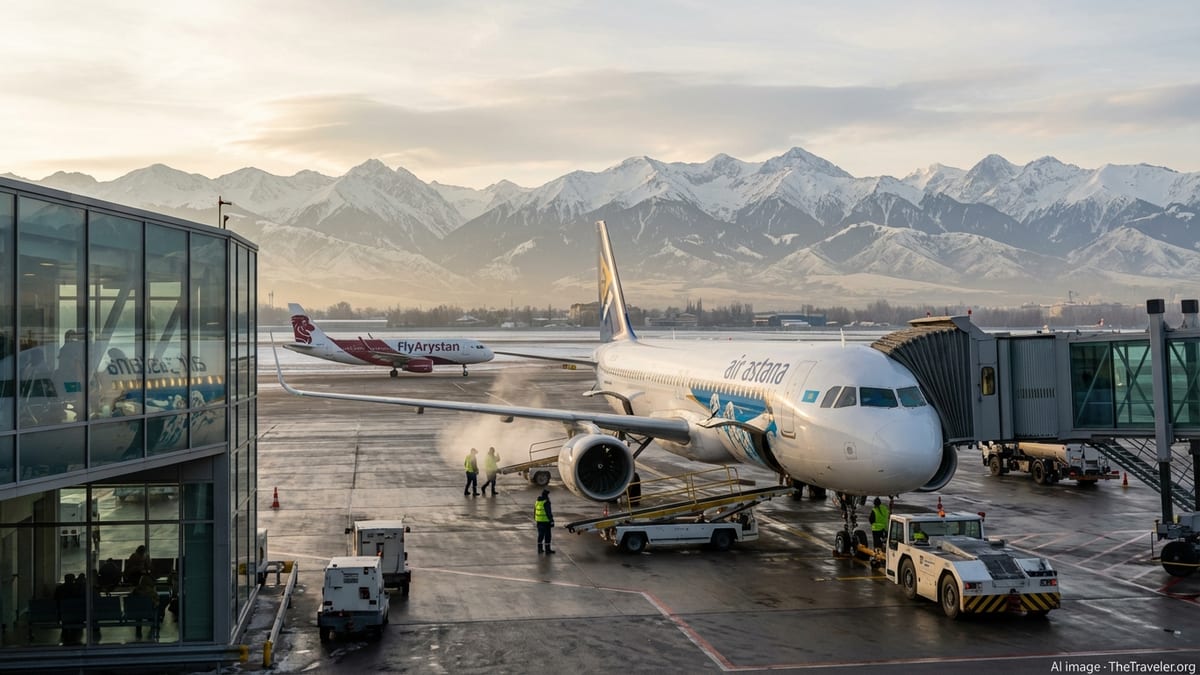
Kazakhstan’s flag carrier Air Astana has begun operating from Frankfurt Airport’s new Terminal 3, marking a significant step in its strategy to deepen connectivity with Europe’s largest economy and the wider region.
Get the latest news straight to your inbox!
Strategic Move Into Europe’s Newest Terminal
Publicly available information shows that Air Astana transferred its Frankfurt operations to the newly opened Terminal 3 in early May 2026, becoming one of the first Central Asian airlines to use the facility. The move follows Frankfurt Airport’s multibillion-euro expansion, which officially brought Terminal 3 into passenger service on April 23, 2026.
Reports indicate that the airline shifted from the older Terminal 1 to the purpose built complex on May 5, aligning its schedules with the airport’s phased airline relocation program. The decision positions Air Astana inside Europe’s newest major terminal at a time when competition for long haul transfer traffic through Central Europe is intensifying.
Industry observers note that Frankfurt is a critical gateway for Air Astana’s European ambitions, linking Kazakhstan to one of the continent’s busiest hubs and a dense network of onward connections. By moving into Terminal 3, the carrier is seeking to lock in its relevance for both point to point passengers and transfer traffic between Europe and Central Asia.
The relocation underscores how emerging flag carriers are using infrastructure upgrades at established hubs to sharpen their profiles in the European market. For Air Astana, enhanced brand visibility and a more streamlined ground product at Frankfurt are central elements in that push.
Terminal 3: A High Tech Stage for Growth
Frankfurt’s Terminal 3 was designed to handle around 19 million passengers annually and is described in airport documentation as one of Europe’s most technologically advanced terminal complexes. Featuring new G, H and J gate areas, the building incorporates extensive self service check in, fast bag drop systems and a modernized security and boarding layout aimed at reducing bottlenecks.
Public information from the airport operator highlights that the terminal is connected to Terminals 1 and 2 by a newly built SkyLine people mover, running every few minutes with a transfer time of roughly eight to ten minutes. This airside link is particularly important for airlines such as Air Astana that depend on passengers making onward connections on other carriers within the wider Frankfurt network.
The terminal’s design emphasizes generous natural light, high ceilings and expanded retail and dining areas, elements that airport planners see as key to encouraging longer dwell times and higher non aeronautical revenue. For airlines, this environment is also a marketing asset, as a more pleasant ground experience can support premium positioning on competitive routes.
For Air Astana, operating from a state of the art terminal with next generation processing technology is expected to improve overall journey times and reliability, strengthening its value proposition on routes linking Kazakhstan with Germany and beyond.
Implications for Connectivity Between Kazakhstan and Europe
Air Astana has gradually built up its presence in Frankfurt in recent years, adding non stop services from Kazakhstan’s main hubs to Germany’s financial capital. Earlier company communications highlighted the importance of early morning arrivals in Frankfurt to provide connections onto a broad range of European and North American destinations.
With operations now centered in Terminal 3, those itineraries will increasingly flow through the new facility. Improved wayfinding, shorter transfer distances between gates and more predictable security processing are expected to reduce minimum connection times for some passengers, according to travel industry commentary.
Stronger connectivity via Frankfurt also comes at a time when Kazakhstan is promoting itself as a bridge between Europe and Asia, with Almaty and Astana positioned as transfer points to destinations across Central Asia, the Caucasus and parts of China and South Asia. A modernized Frankfurt base gives Air Astana a more competitive platform from which to market these multi leg journeys to European travelers.
Analysts suggest that the move may support further schedule adjustments or additional frequencies on the Frankfurt route over time, especially if demand continues to grow on Europe Central Asia corridors. The upgraded passenger experience at both ends is likely to be a factor in how corporate and leisure travelers choose among competing routings.
Competitive Landscape at Frankfurt’s New Hub
Frankfurt Airport’s Terminal 3 has been conceived as a long term growth engine, with a staged airline migration that initially brings in a mix of full service and leisure carriers from across Europe, the Middle East and Asia. Early deployments include long haul operators from the Gulf and Asia Pacific, with more airlines due to move from Terminal 2 over the course of 2026.
Air Astana’s arrival adds a Central Asian dimension to the tenant mix, broadening the geographic reach available directly from the new terminal. The presence of airlines from multiple alliances and independent carriers in the same building is expected to create opportunities for interline and codeshare cooperation, even where formal alliance ties do not exist.
From a competitive perspective, Air Astana will be rubbing shoulders with carriers that are heavily focused on premium transfer traffic and long haul leisure flows. The shared environment in Terminal 3 could sharpen pricing and product competition on overlapping markets, particularly routes touching Central and Eastern Europe, Central Asia and the Middle East.
At the same time, media coverage of the terminal’s opening has noted that its spacious layout and expanded gate capacity should help ease congestion that has long been cited as a challenge at Frankfurt. A calmer, more predictable hub operation could provide a relative advantage for airlines such as Air Astana that seek to attract travelers wary of complex transfers at older European terminals.
Passenger Experience and Future Prospects
Travel reports from the first weeks of Terminal 3 operations describe a noticeably different experience compared with Frankfurt’s older facilities, with shorter walking distances, clearer signage and more intuitive connections between security, gates and commercial areas. For Air Astana customers, this shift may be particularly welcome on tight connections or overnight itineraries.
The terminal’s modern architecture and open spaces also offer carriers greater scope for brand presentation, from check in zones to boarding gates. Airline marketing specialists point out that such environments can play a subtle but important role in shaping passenger perceptions of service quality and reliability.
Looking ahead, industry analysis suggests that the combination of a high capacity, technologically advanced terminal and a fast growing Central Asian carrier positions Frankfurt as a more prominent node between Europe and Kazakhstan. As Air Astana continues fleet renewal and route expansion, Terminal 3 provides a scalable infrastructure base capable of absorbing additional flights and passenger volumes.
The move into Frankfurt’s Terminal 3 therefore marks more than a simple change of check in counters for Air Astana. It represents a calculated step to align the airline’s European operations with a new generation of airport infrastructure, reinforcing its bid to be a key connector between Germany, wider Europe and the emerging markets of Central Asia.