


More news on this day
A spiraling conflict centered on Iran and Israel is rippling across some of the world’s busiest aviation corridors, pushing up airfares, triggering emergency visa measures in the Gulf and straining hub airports from Istanbul to Dubai, Doha and Cairo as airlines race to adapt to sudden airspace closures and fast changing risk assessments.
Get the latest news straight to your inbox!
Airspace Closures Sever Core Europe Asia Corridors
Closures or severe restrictions of airspace over Iran, Iraq, Syria, Lebanon, Israel, Kuwait, Qatar and Bahrain in early 2026 have effectively cut through the heart of traditional great circle routes linking Europe and Asia. Publicly available flight tracking data and airline advisories show that long haul services which would normally fly over the northern Gulf and Mesopotamia are being rerouted via the Caucasus, Central Asia, Egypt or Saudi Arabia, adding hours to flight times and forcing complex rescheduling.
Industry assessments released in recent weeks indicate that the reconfiguration of routings is not a short term diversion. Analytical reports on the Iran conflict’s impact on aviation describe a structural hit to capacity on the Europe Asia market as carriers burn more fuel and reduce frequencies to maintain schedules that avoid closed or high risk airspace. With some corridors repeatedly shut at short notice, airlines are building in additional buffers that further constrain available seats.
In parallel, several governments across the region have issued formal airspace notices that limit overflights or impose altitude and routing restrictions even where skies are not fully closed. This has produced choke points along remaining open corridors, where aircraft are stacked into narrower bands of airspace and controllers must meter flows conservatively to preserve safety margins.
The resulting congestion has led to rolling delays and missed connections at major hubs far beyond the immediate conflict zone. Airports in Europe and East Asia report aircraft arriving off schedule from the Middle East and eastern Mediterranean, with local operations then absorbing secondary disruption as aircraft and crews fall out of rotation.
Gulf and Turkish Hubs Grapple With Gridlock
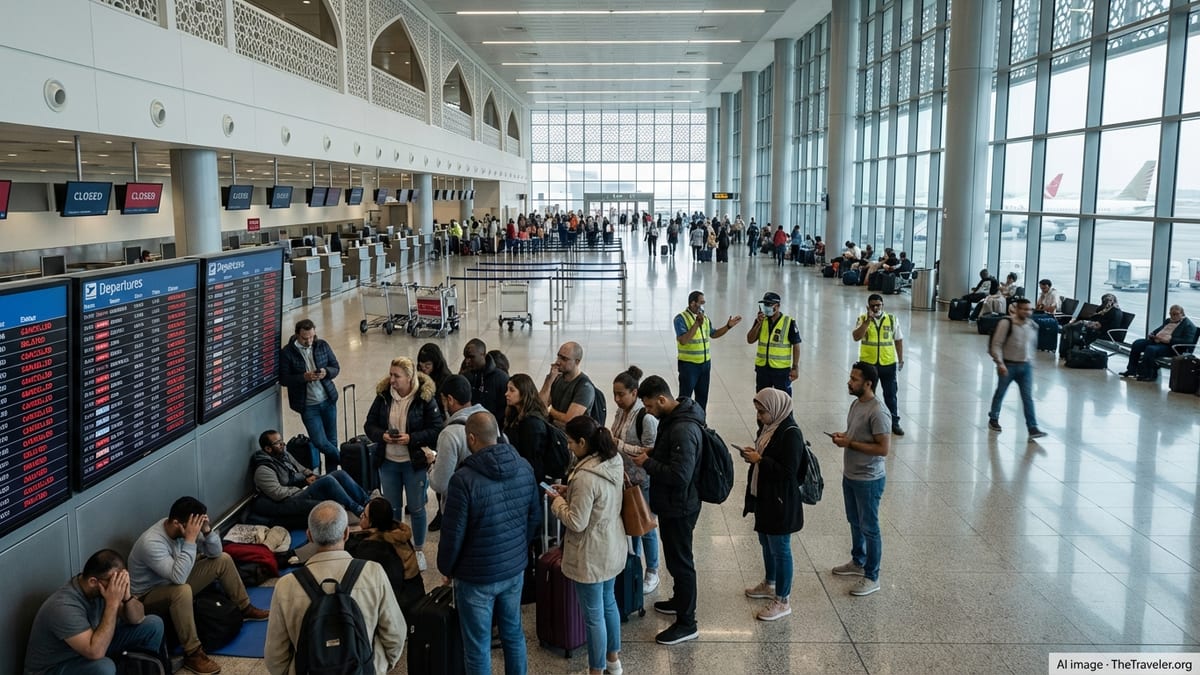
Major connecting hubs in the Gulf and Turkey are feeling the strain acutely. Istanbul Airport, which handled more than 80 million passengers in 2025 and ranks among the world’s busiest international gateways, has seen departure and arrival boards fill with cancellations and long delays on routes touching the Middle East and South Asia as airspace closures cascade through Turkish Airlines and Pegasus schedules.
Travel trade advisories and local industry bodies in Turkey have documented extended suspensions of flights to Iran, Iraq, Syria, Lebanon and Jordan, with additional disruptions affecting services to Gulf states including Qatar, Kuwait, Bahrain and the United Arab Emirates at different points in March 2026. Notices indicate that multiple aircraft from regional carriers remain parked at Turkish airports awaiting safe routing options back to their home bases or alternative destinations.
In the Gulf, hubs in Doha, Dubai and Abu Dhabi remain operational, but published coverage shows airlines scaling back frequencies, re-timing services or using longer routings that bypass closed airspace. This has turned what are normally high frequency shuttle corridors into scarce connecting links, concentrating pressure on the flights that do operate and increasing the risk of missed onward connections when disruption occurs upstream.
Reports from travelers and aviation specialists highlight crowded transfer zones, extended queues at transfer desks and ad hoc rebooking processes as carriers attempt to re-thread disrupted itineraries through a shrinking network of viable routes. Even where airports are not directly under threat, their role as waypoints in a fractured regional network has made them highly vulnerable to knock on effects.
Soaring Fares on Europe Asia and Australia Routes
With capacity constrained and routings lengthened, fares on many Europe Asia and Europe Australia routes have climbed sharply. Data cited by regional travel agencies and fare tracking platforms indicates that one way economy tickets between key Asian cities and European capitals are pricing at several times their historical averages for departures in the coming weeks, particularly in markets that previously relied heavily on Gulf and Turkish hubs.
Examples highlighted in recent aviation coverage show limited or no availability in lower fare buckets on some long haul routes until mid March, with last minute one way fares exceeding 2,500 US dollars where typical off peak prices later in the month fall closer to the 600 to 800 dollar range. Travel retailers in Australia and Southeast Asia report a spike in calls from passengers seeking alternative routings or emergency assistance after their original Gulf or Levant connections were cancelled.
Given the higher fuel burn and extended block times associated with airspace detours, analysts suggest that elevated prices are not simply a short term response to shock, but reflect a new cost base for operating many long haul services while the conflict persists. Airlines are also attempting to rebuild balance sheets after years of pandemic and supply chain disruption, leaving little incentive to release large volumes of discounted inventory in a period of constrained capacity.
Corporate travel managers are beginning to flag budget overruns on routes touching the Middle East and nearby regions, while leisure travelers face difficult trade offs between accepting higher prices, postponing trips or choosing entirely different destinations that are less exposed to the current chokepoints.
Emergency Visa Steps and Transit Relief in the UAE and Gulf
As flights are cancelled or heavily delayed, immigration authorities and regulators in the United Arab Emirates and other Gulf states have moved to introduce temporary relief mechanisms for stranded passengers. Tax and immigration advisories circulated to multinational companies in March 2026 describe special grace periods and flexibility for visitors whose tourist or visit visas expired while they were unable to depart due to flight disruptions.
These measures build on broader visa policy changes that the UAE began rolling out in late 2025, when the federal identity and citizenship authority updated visit visa categories and conditions in a bid to enhance the country’s attractiveness as a tourism and transit hub. In the current crisis, that framework has given officials room to extend stays, waive penalties in some cases and streamline processes for passengers rebooked onto later flights or diverted to alternate airports inside the federation.
Publicly available information from regional travel agencies also indicates that some Gulf carriers have introduced limited relief flights and additional short haul sectors to reposition passengers from secondary airports to main hubs where more long haul options are available. These services are often announced with minimal lead time and operate under tight operational constraints, reflecting both the volatile security environment and finite spare capacity in airline fleets.
For travelers, the combination of flexible visa policies and ad hoc rescue flying has reduced the risk of becoming technically overstayers while stuck in the region. However, experts caution that rules vary by country and can change quickly, making it essential for passengers to monitor official advisories and confirm their status with airlines and local immigration channels before making firm plans.
Egypt and North Africa Absorb Spillover Traffic
As Gulf and Turkish hubs adjust to the crisis, airports in Egypt and parts of North Africa are absorbing spillover traffic. Published coverage of rerouted operations notes that carriers are increasingly using Cairo and, to a lesser extent, other Egyptian airports as waypoints for services that would normally overfly the eastern Mediterranean or northern Arabian Peninsula, particularly when detouring around closed corridors to the east.
These added flows have brought additional congestion to terminals that were already recovering strongly from the pandemic era downturn. Airline schedules show more widebody movements through Cairo on select Europe Africa and Europe Asia pairings, with passengers sometimes required to make unconventional double connections compared with pre crisis itineraries via the Gulf.
Beyond Egypt, some European and Asian carriers are stitching together routings via the central Mediterranean, North Africa or the Caucasus to maintain links without entering high risk airspace. While these paths can restore connectivity on paper, they often extend total journey times significantly and depend on a delicate web of overflight permissions that may be revised with little notice if the regional security picture changes.
Aviation outlook reports published in April 2026 suggest that if the Iran conflict and associated tensions continue through the northern summer, capacity via alternative hubs in Egypt, Saudi Arabia and Türkiye will remain tight, keeping fares elevated and leaving passengers exposed to ongoing disruption across multiple points in their journeys.