


For most visitors, Cannes means two frenzied weeks in May when the Croisette fills with limousines, step-and-repeat backdrops and the world’s most famous red carpet. Yet once the last Palme d’Or photo call is over, cinema does not pack up and leave town. In fact, the day-to-day film culture that locals experience the other 50 weeks of the year is held together by a far more discreet player: Cannes Cinéma, the city-backed association that quietly makes sure Cannes remains a place to watch, learn and talk about films long after the festival lights go out.
Get the latest updates straight to your inbox!
Cannes Beyond the Red Carpet
Spend a few days in Cannes outside festival season and you quickly see the contrast. The Palais des Festivals stands still on the waterfront, the red carpet rolled away, and luxury boutiques along the Croisette trade film posters for beachwear. Yet if you look a little closer at noticeboards in La Bocca or the residential streets around Avenue Michel-Jourdan, you will find flyers for retrospective screenings, debates with directors and school workshops. Many carry the same modest logo: Cannes Cinéma. This local association, supported by the city and the Provence-Alpes-Côte d’Azur region, coordinates much of Cannes’s year-round cinema activity, from one-off events for visitors to long-term projects in schools.
For travelers, this matters because it changes what Cannes feels like once the festival is over. Instead of a film theme park that opens for two weeks and then shutters, the city has become a place where you can catch an Iranian drama in VO at a neighborhood theater in November or an outdoor classic on a housing-estate square in July. Cannes Cinéma sits at the center of this web, brokering partnerships between the municipality, cinemas, schools and major cultural institutions so that the energy of the festival filters into the everyday life of the city.
That role is not just symbolic. According to recent activity reports published by the city and the association, Cannes Cinéma now runs or co-runs dozens of initiatives spread across the calendar, many of them designed explicitly to open up the Festival de Cannes and its parallel sections to local residents and visiting film lovers. The result is a small but tangible shift: Cannes is not only where cinema descends each spring, it is where cinema is patiently cultivated, watched and discussed all year.
From Festival Showcase to Local Screens
The clearest sign that Cannes Cinéma matters is how it re-routes the exclusive world of the festival back through local venues. During May, the association co-organizes the “Cannes Cinéphiles” program, which gives cinephile and student audiences access to festival titles in a network of city theaters such as Théâtre La Licorne, Studio 13, the Raimu cinema and the Alexandre III theater. For people who are not producers or critics but are willing to queue and plan their days around screenings, this is often the most realistic way to see official selection titles with a public crowd.
Those same venues stay active once the festival closes. A traveler visiting in October, for example, may stumble upon a Cannes Cinéma-curated cycle at La Licorne dedicated to contemporary African cinema, or a series of screenings around a theme like climate and the sea timed with environmental events on the Riviera. The programming frequently echoes the concerns or discoveries of the previous festival edition, giving films a second life with local audiences who might have missed them in May or never had accreditation in the first place.
The association also acts as a bridge between the Festival’s institutional ecosystem and the broader public. Partnerships with sections such as the Quinzaine des Cinéastes, ACID and Cannes Ecrans Juniors feed into masterclasses and youth screenings in municipal theaters during and after the festival. In practical terms, that might mean a school class in Cannes-la-Bocca watching a prizewinning junior title with a teacher in November, or university students attending a moderated discussion with a director whose film premiered in a parallel section a few months earlier. For visitors staying in town longer than a few days, dropping into one of these sessions can be a way to experience Cannes as a film city rather than just a festival brand.
Education à l’image: How Cannes Raises Future Cinephiles
One of the less glamorous but most influential missions of Cannes Cinéma is education à l’image, roughly translated as image or media literacy. As a regional hub in the French network of image-education “pôles,” the association coordinates programs that introduce thousands of children and teenagers to film language, history and critical thinking. This work reaches far beyond Cannes’s postcard seafront into classrooms and youth centers in less touristy neighborhoods.
For instance, Cannes Cinéma participates in national schemes such as École et cinéma, Collège au cinéma and Lycéens et apprentis au cinéma, which bring carefully chosen films into school timetables. A typical day might see a group of primary pupils bussed to a local screen in the morning to watch a silent Buster Keaton comedy, guided by teaching materials prepared in partnership with the Ministry of Culture, followed by a workshop on how editing shapes emotion. A few kilometers away, high-school students could be discussing a recent Cannes competition film, using it as a springboard to talk about social issues or visual storytelling.
The association’s training initiatives also target adults. During the festival, a “Cinéduc” marathon brings teachers from the wider Nice academy into Cannes for several days of intensive screenings and masterclasses, often with filmmakers and festival programmers. They leave not just with autographs but with pedagogical tools and programming ideas that will shape how they use moving images in class for years to come. While most travelers will never attend these sessions, their impact is visible in the kind of informed, curious young audiences you encounter at public screenings throughout the year.
For a visiting family, this educational dimension can translate into very concrete experiences. A parent staying in Cannes in early spring might find an advertised matinee screening introduced by a mediator who gently explains to children why a black-and-white Japanese film still matters today. Another might join a vacation workshop where kids learn to storyboard and shoot a short film on tablets before seeing their work projected in a small municipal theater. In subtle ways, Cannes Cinéma helps ensure that a day at the movies in Cannes remains more than just popcorn entertainment.
Neighborhood Screens and Outdoor Nights
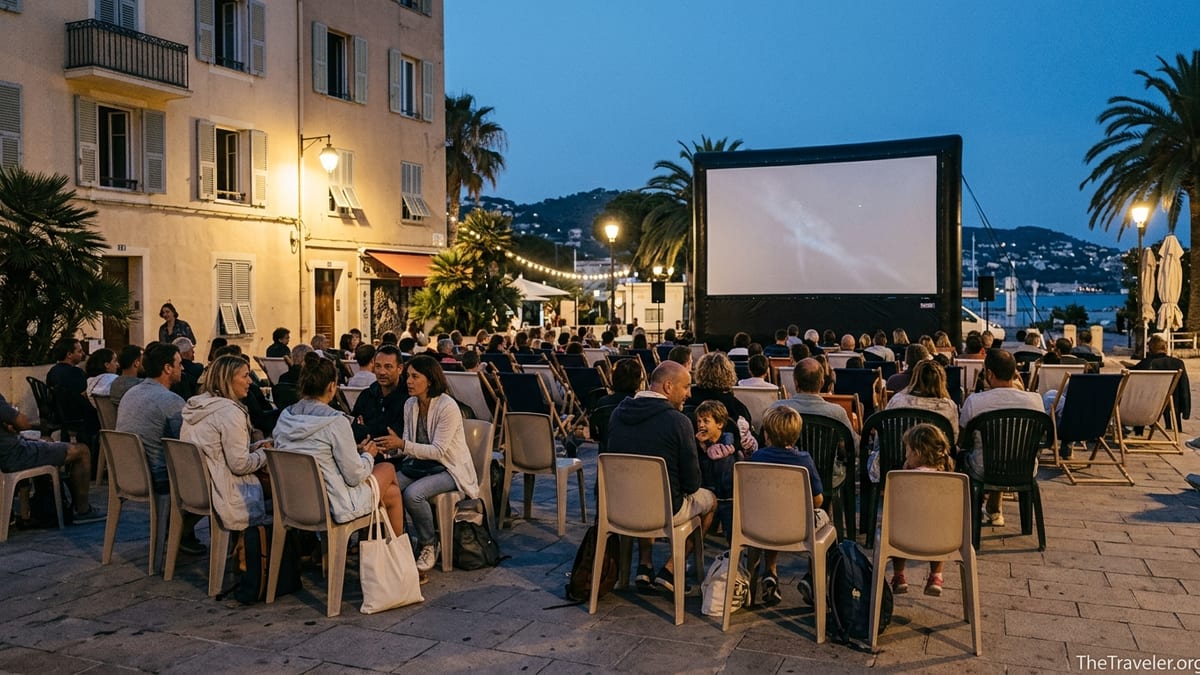
Ask locals what makes cinema feel alive outside the Palais and many will mention the summer “Ciné-quartier” evenings. These are open-air screenings organized by the city with programming support from Cannes Cinéma, held across different neighborhoods from June through August. Instead of concentrating everything on the Croisette, giant temporary screens pop up in local squares, parks and even directly on the sand, turning parts of La Bocca, Le Suquet or residential estates into communal movie theaters under the stars.
For travelers on a budget, Ciné-quartier is one of the most accessible ways to enjoy cinema in Cannes. Screenings are typically free, with deckchairs or rows of plastic seats set up from around 9 pm and films starting once the sky has darkened. One evening might feature a recent French comedy popular with families; another might showcase an animated film or a beloved classic that ties into the Riviera setting. Visitors staying in hotels away from the Croisette, especially in La Bocca, often discover these nights simply by hearing sound carry over from a nearby square and wandering over to see what is playing.
These neighborhood screenings serve a deeper purpose than summer fun. They bring cinema to residents who may not go into the center often, building habits of collective viewing and conversation. They also extend the festival’s ethos of seeing films together in the best possible technical conditions. Projection and sound equipment are high quality, often comparable to that used for the official seaside “Cinéma de la Plage” screenings during the festival in May. For an international visitor who only knows Cannes through images of tuxedos and paparazzi, sharing a July evening with local families watching a film outdoors can be a quietly transformative experience.
Art-House Screens and the Cineum Multiplex
Cannes Cinéma does not run commercial theaters directly, but it is closely linked to the city’s exhibition landscape, which has changed significantly in recent years. On one side are smaller venues and municipal spaces that host specialty programming, retrospectives and school sessions. On the other is the gleaming Cineum multiplex in Cannes La Bocca, a twelve-screen complex designed by star architect Rudy Ricciotti, which opened to bring cutting-edge projection technology and a wider range of mainstream and international titles to the western side of town.
Throughout the year, Cineum’s line-up looks familiar to any traveler: American studio releases, French comedies and genre films, plus the occasional festival hit that has broken through to wider distribution. Ticket prices are in line with other French multiplexes, with standard adult seats usually in the low-teens in euros and reduced rates for children or weekday matinées. What sets Cineum apart in the context of Cannes is how it plugs into the festival ecosystem. During the Festival de Cannes and the Marché du Film, its state-of-the-art rooms host industry screenings and buyer showcases, but for the rest of the year locals simply treat it as their neighborhood cinema.
At the same time, Cannes Cinéma’s partnerships help sustain a more art-house-oriented offer elsewhere in town. The association is a member of French and international arthouse networks and collaborates with the AFCAE and other bodies to bring less commercial films and curated series to Cannes screens. A visitor in January might find a week-long focus on a Latin American director at a small theater, complete with introductions from critics and printed program notes. The coexistence of a multiplex like Cineum with these smaller, curated spaces means travelers can choose between catching the latest blockbuster in immersive sound one night and an intimate documentary with a Q&A the next.
For many visitors, this balance is what makes Cannes’s cinema scene feel unusually rich for a city of its size. You can spend the afternoon wandering the Marché Forville, then head to a neighborhood screening of a festival discovery introduced by a local programmer. Or, if you prefer comfort and spectacle, you can book a recliner seat at Cineum and watch a major release only a short bus ride from the Croisette.
Why It Matters for Travelers
All of this begs a key question: why should a traveler care about Cannes Cinéma when planning a trip? The answer lies in the kind of experiences it quietly makes possible. Without the association’s mediation, festival films would likely remain locked within a professional bubble, schools would have fewer links to international cinema, and neighborhood screenings would be sporadic rather than a predictable part of the local calendar. With it, the city offers visitors the chance to intersect with cinema in more grounded, human ways.
If you visit in late May but do not have professional accreditation, you might still catch Official Selection or parallel section titles through Cannes Cinéphiles screenings in municipal theaters, queuing alongside local students and film buffs rather than industry insiders. If you come in summer, an outdoor Ciné-quartier night lets you experience the Riviera’s evening light and community spirit at once. During the quieter months, a retrospective or debate organized with Cannes Cinéma’s support may give you an excuse to duck into a neighborhood theater on a rainy weekday and discover a filmmaker you had never heard of.
Cannes Cinéma also shapes the tone of the city’s film culture. Because so much of its work is grounded in education and access, the events it curates tend to be welcoming and affordable. Screenings linked to educational programs often have modest ticket prices, and some open-air or festival-related sessions are free. For travelers who love cinema but feel intimidated by the festival’s red-carpet image, these initiatives offer an approachable entry point into the same broader universe of films and ideas, without the dress code or professional pressure.
Perhaps most importantly, Cannes Cinéma helps ensure that the world’s biggest film festival leaves a legacy that you can feel even if you arrive months later. The conversations started on stage at the Palais do not disappear entirely when the closing ceremony ends; they ripple outward through school projects, local screenings and themed programs that visitors can occasionally tap into. In that sense, a ticket you buy on a random Tuesday in November is still, in a very real way, connected to the Cannes that the world sees on television each spring.
The Takeaway
Seen from afar, Cannes may look like a city that lives for a fortnight of flashbulbs and then falls asleep. Spend a little time following the traces of Cannes Cinéma, however, and a different picture emerges: one of modest municipal theaters, school classrooms, outdoor screens and multiplex seats all stitched together into a living film culture. The association does not command global headlines, but it plays an outsized role in making sure that cinema in Cannes is not just a spectacle that arrives from elsewhere, but an experience that belongs to residents and visitors all year round.
For travelers, that means there is more to do than photograph the Palais steps or hunt for celebrity sightings in May. You can plan a trip around neighborhood open-air screenings, drop into a retrospective curated with festival partners, or simply see how local audiences respond to the same films that critics debated on the Croisette a few months earlier. Cannes Cinéma is the quiet infrastructure that keeps those possibilities alive. In a city defined by its festival brand, it is the reason cinema still matters on an ordinary Tuesday night in February just as much as on opening day in May.
FAQ
Q1. What exactly is Cannes Cinéma?
Cannes Cinéma is a local cultural association, supported by the city and regional partners, that coordinates film screenings, education programs and partnerships to keep cinema active in Cannes all year, not just during the Festival de Cannes.
Q2. Can visitors access screenings organized by Cannes Cinéma during the festival?
Yes. Through the Cannes Cinéphiles program and screenings in venues like Théâtre La Licorne, Studio 13 or Alexandre III, non-industry audiences with the appropriate passes can see many festival titles without formal professional accreditation.
Q3. Are there film events in Cannes outside May?
Yes. Throughout the year Cannes Cinéma helps organize themed cycles, retrospectives, debates and education-linked screenings in municipal theaters and partner cinemas, so visitors in autumn or winter can still find film events in town.
Q4. What is Ciné-quartier and is it open to tourists?
Ciné-quartier is a series of free open-air screenings across Cannes neighborhoods each summer. It is open to everyone, including tourists, and is a relaxed way to watch movies outdoors with local residents.
Q5. How does the Cineum multiplex fit into Cannes’s cinema scene?
Cineum in Cannes La Bocca is a modern twelve-screen multiplex showing mainstream releases and some festival titles. It hosts industry screenings in May but operates as a regular cinema the rest of the year for locals and visitors.
Q6. Are screenings and events in Cannes mostly in French?
Many films, especially French titles, screen in French, often with French subtitles. However, festival films and many international releases play in their original language with subtitles, so English-speaking visitors can usually find accessible screenings.
Q7. Is it expensive to go to the cinema in Cannes?
Standard multiplex tickets are broadly similar to prices elsewhere in France, with reduced rates for children and some weekday sessions. Neighborhood open-air screenings like Ciné-quartier are typically free, and some municipal events have modest entry fees.
Q8. Can children and families take part in Cannes Cinéma activities?
Yes. Cannes Cinéma runs or supports numerous education à l’image projects, family-friendly screenings and workshops. While many are school-based, some vacation workshops and public matinees welcome visiting families.
Q9. Do I need to book in advance for Cannes Cinéma events?
For festival-period screenings and special previews, advance registration or a specific pass is often required and queues can be long. For many off-season municipal screenings, tickets can usually be bought on the day, though popular events may sell out.
Q10. How can I find out what Cannes Cinéma is showing when I visit?
Once in Cannes, check cultural listings from the tourist office, posters outside municipal theaters and local press. Staff at hotels or the tourism desk can usually point you to the current Cannes Cinéma program and neighborhood screenings.