


For many visitors, Oslo reveals its character before they even leave the airport. Minutes after stepping off a long-haul flight at Oslo Airport Gardermoen, travellers can be seated on Flytoget, the dedicated airport express train, watching forests, farmland and the Oslofjord glide past. Twenty minutes later they are stepping onto the concourse at Oslo Central Station. The speed and ease of that journey are no accident. Flytoget is the product of deliberate planning, heavy investment and an almost obsessive focus on punctuality, and it has become one of the fastest and most convenient ways to reach an airport anywhere in Europe.
Get the latest updates straight to your inbox!
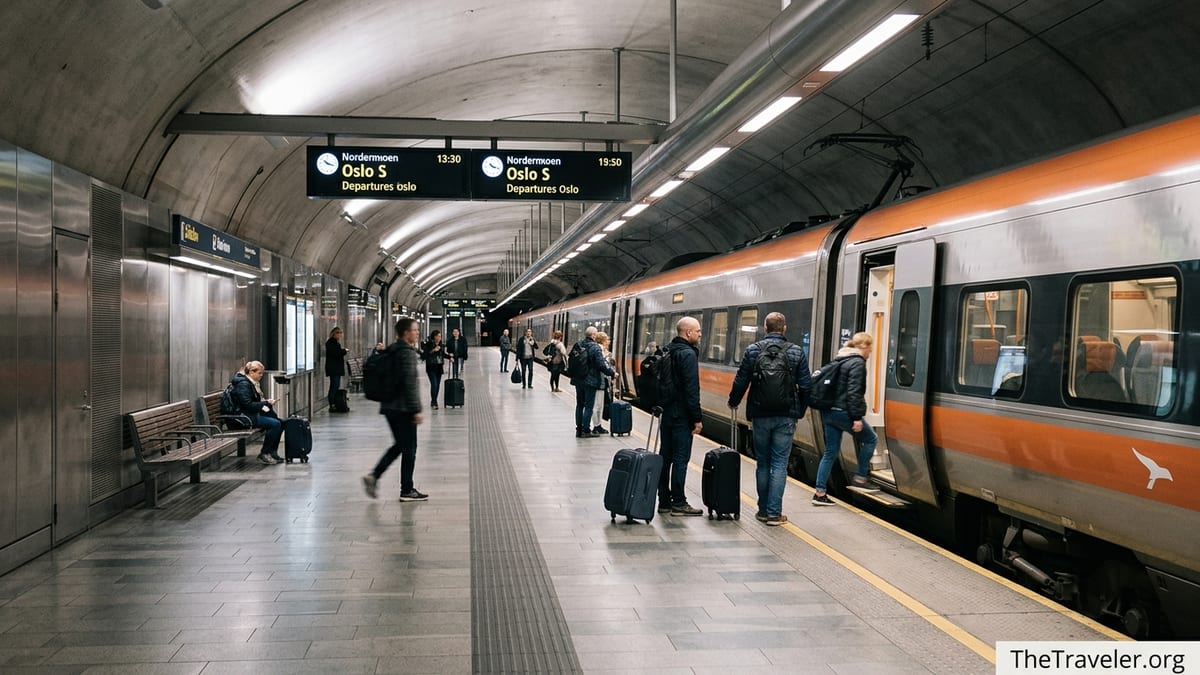
A High-Speed Answer to a Growing Capital
Oslo Airport moved from its former Fornebu site to Gardermoen in 1998, shifting the main gateway for Norway’s capital to a location about 50 kilometres north of the city centre. Road traffic between Oslo and Gardermoen was already heavy, and planners knew that simply adding more motorway lanes would not be enough. From the outset, the new airport was designed around a rail connection, the Gardermoen Line, built for high speed and intensive use. Flytoget, literally “the airport train,” was created to run fast, frequent services on this line between Oslo Airport Station directly under the terminal and Oslo Central Station.
The new line cut the rail distance and allowed higher speeds than the existing conventional tracks. While Norwegian intercity trains typically run at up to around 160 kilometres per hour on older lines, the Gardermoen Line was designed for speeds of about 210 kilometres per hour. In practice, this engineering choice meant that Flytoget could comfortably deliver a city centre to terminal journey in about 20 minutes, competitive not only within Norway but across Europe.
When the airport opened, many locals still expected to drive. Over time, the reliability and speed of Flytoget changed behaviour. Today, Oslo is often cited in transport reports as one of the European capitals with the highest share of air travellers using public transport to reach the airport, and Flytoget is at the heart of that success, working alongside regular Vy regional trains and airport buses.
For the average traveller arriving from London, New York or Dubai, these planning decisions are invisible. What they experience is simply walking out of customs, following clear “Train to Oslo” signs, buying a ticket from a kiosk in English and stepping onto a modern train that feels more like a regional express than a commuter shuttle. The strategic rail-first approach is what makes Flytoget one of the fastest options in real-world use.
How Flytoget Beats the Car, Taxi and Bus
The headline advantage of Flytoget is time. The journey from Oslo Airport to Oslo Central Station generally takes about 20 minutes. This is a consistent timetable figure, not just a best-case scenario. For comparison, the dedicated airport bus services usually quote around 40 to 45 minutes to the city centre, depending on traffic. Taxis and private transfers can vary even more. In light afternoon traffic, a taxi might make the trip in 35 minutes, but in winter rush hour with snow and congestion it can easily stretch beyond an hour.
Concrete examples make the difference clear. A traveller landing from Amsterdam at 16:30 on a weekday who wheels their luggage straight to the train station level can often be on a Flytoget departure within 10 minutes. With departures roughly every 10 minutes during much of the day, the worst case is a short wait on the platform. That same traveller would likely still be queuing in a taxi line or threading their way through the bus terminal when the train is already pulling into Oslo Central Station. For business travellers with an early evening meeting near the Opera House or Barcode district, those 20 to 30 saved minutes can be decisive.
Unlike road transport, Flytoget operates entirely on a dedicated high-speed rail corridor. The line runs largely through tunnels and segregated tracks which are unaffected by motorway accidents, snow on the E6 highway or Friday afternoon traffic leaving the city. Even in harsh Norwegian winters, when locals brace for delays on roads, Flytoget’s operations centre monitors the line and rolling stock so that the train can generally maintain its schedule. Historical company reports have cited punctuality figures in the mid- to high-90 percent range, a performance many airlines envy.
Another practical advantage over buses and taxis is predictability. If you are staying at a hotel near Oslo Central Station, such as the Clarion Hotel The Hub or the Thon Hotel Opera, you can step off Flytoget and walk to the lobby in under five minutes. With a bus, you might be dropped at the main bus terminal and still face a 10 to 15 minute walk or an extra tram ride. With a taxi, you are at the mercy of traffic and potential surcharges, especially late at night or on weekends. The train’s fixed timetable allows travellers to plan connections with regional trains, long-distance coaches or domestic flights with confidence.
Designed for Speed: The Gardermoen Line and Rolling Stock
Flytoget’s speed advantage is not just about frequency. It is built into the tracks and trains themselves. The Gardermoen Line is a high-speed corridor running from Oslo through Lillestrøm to the airport and on towards Eidsvoll. Long tunnel sections shorten the overall route and eliminate the frequent curves and level crossings that slow down older railway lines. This allows both Flytoget and the regular Vy regional services using the line to cruise at higher speeds for longer stretches.
The trains Flytoget uses are specifically adapted for fast airport service. Derived from the Norwegian Type 71 electric multiple units, they feature pressure-tight cabins that prevent uncomfortable ear popping when the train passes quickly through tunnels. Wide doors and level boarding reduce dwell times at stations, which is crucial when you are trying to maintain a reliable 20-minute schedule with several stops en route.
Inside, the layout prioritises luggage space and rapid movement. Overhead racks are generous enough for cabin bags, while larger suitcases can be stored in dedicated luggage areas near the doors. This design means passengers boarding at the airport with trolleys full of ski bags in January or conference materials in June can quickly stow their gear without blocking aisles. Shorter boarding times directly support faster overall journeys.
The signalling and control systems on the Gardermoen Line are also configured for frequent express services. Flytoget typically operates up to six departures per hour between the airport and the city during busy daytime periods. On the same pair of tracks, Vy runs regional and commuter trains that continue beyond Oslo to places such as Lillehammer and Skien. Tight coordination between these services is essential to keeping everything moving at speed, and Norway’s rail infrastructure manager has invested in systems that allow high throughput without compromising safety.
Frequency, Simplicity and Real-World Convenience
One of the reasons Flytoget often feels like the fastest option, even when Vy regional trains on the same line can reach similar journey times, is sheer frequency and ease of use. During most of the day, Flytoget runs roughly every 10 minutes between Oslo Airport and Oslo Central Station. At certain times, some services continue past the central station to stops such as Nationaltheatret and Drammen, which makes life especially simple for travellers staying near the Royal Palace or heading straight out to the western suburbs.
From a traveller’s perspective, this dense frequency means you never really “miss” a train. If you step off the escalator onto the platform just as one Flytoget pulls away, you are likely to see the next one on the departure board in nine or ten minutes. There is no need to study a timetable in detail. For a visitor arriving from North America early in the morning, the first services are running from around 05:30, and late-night travellers landing close to midnight will usually still find departures back into the city.
Ticketing is designed to be straightforward, particularly for international guests. At the airport station, large orange ticket machines clearly marked “Flytoget” allow payment by major credit and debit cards. There is an option to select English, and fare information is displayed transparently for different city stops. Travellers staying near Oslo Central Station will typically pay in the region of a few hundred Norwegian kroner for a one-way adult ticket, while children under a certain age travel free when accompanied by a paying adult. This family policy means that for a couple with two children, the cost difference between Flytoget and the cheaper Vy regional train can narrow significantly.
Real-world experiences underline the convenience. A family landing from Copenhagen at 11:00 with two small children and bulky luggage can exit customs, buy Flytoget tickets in English within a couple of minutes, and be at Oslo Central Station before lunchtime. Navigating to a hotel like the Scandic Byporten or Citybox Oslo from there is a short walk through a pedestrianised area, often faster and less stressful than trying to wrangle children, suitcases and car seats into a taxi or onto a bus making multiple intermediate stops.
Speed Versus Cost: When Flytoget Makes Sense
Flytoget is not the absolute cheapest way to travel between Oslo Airport and the city, and travellers often weigh its speed against ticket prices. As of 2026, Vy’s regional and commuter trains that also connect the airport to Oslo Central Station typically offer lower fares. A one-way adult ticket on a Vy train can be significantly cheaper than a Flytoget ticket, with journey times often only a few minutes longer, around 23 to 27 minutes according to several traveller guides and operator information.
However, price comparisons become more nuanced when you factor in time, convenience and who is travelling. For a solo backpacker arriving at midday with light luggage and no urgent schedule, waiting an extra 10 or 15 minutes for a cheaper Vy train and adding a few minutes to the journey is a logical way to save money. For a business traveller on a tight itinerary, those extra minutes and the less frequent departures can be more costly than the ticket difference. Missing a meeting or arriving late to check in at a centrally located hotel before a work dinner can quickly outweigh a modest saving on transport.
Families can also find Flytoget surprisingly competitive. Because children under a set age travel free with an adult, two parents with two children may pay less overall on Flytoget than on regular tickets for everyone on the Vy trains, especially if they are also using other discounts or advance booking deals. The ease of boarding, generous luggage space and absence of crowding at peak hours can be worth paying for, especially after a long journey with toddlers or teenagers in tow.
Another real-world scenario involves early morning or late evening flights. Night bus services and regular trains may not run at convenient times, whereas Flytoget usually maintains a broad operating window beginning around dawn and stretching to near midnight. For a traveller catching a 07:00 departure to Frankfurt, being able to rely on a fast, frequent train from Oslo Central Station in the early morning reduces the temptation to pay even higher taxi fares in the pre-dawn hours.
Smoother Door-to-Door Journeys
Speed to the city centre is important, but what often convinces repeat visitors to keep choosing Flytoget is the way it improves the entire door-to-door journey. Oslo Central Station is one of Norway’s main transport hubs, sitting at the heart of a network of trams, buses, metro lines and long-distance trains. Stepping off Flytoget, travellers can transfer quickly to the T-bane metro for areas like Majorstuen and Grünerløkka, or board regional trains onward to cities such as Trondheim and Bergen.
For example, a traveller from Stavanger flying into Oslo and continuing by train to Lillehammer for a ski weekend can land at Gardermoen, take Flytoget to Oslo Central Station in about 20 minutes and make a timed connection onto a northbound Vy regional train with a short transfer across the platform. Attempting the same trip by bus or taxi would risk missing the onward train or force the traveller to build in an hour of buffer time, diluting the benefit of flying in the first place.
The station integration at the airport side is just as smooth. Oslo Airport Station is located directly under the terminal building. After collecting their luggage, passengers simply follow signs through the arrivals hall, take an escalator or lift down one level and arrive at the platforms. In bad weather, this entirely indoor walk is a significant advantage over waiting outside for buses or walking to distant car parks. For passengers with reduced mobility, the combination of lifts, level boarding and clear signage makes Flytoget one of the most accessible ways to and from the airport.
The experience is similarly streamlined for those staying outside the central core. Some Flytoget services continue past Oslo Central Station to Nationaltheatret Station, which is closer to hotels such as the Radisson Blu Scandinavia and many embassies. Others extend further west to Drammen, benefiting commuters and residents who live in that corridor. By turning the airport train into a mini high-speed commuter service, Flytoget multiplies its usefulness without sacrificing core journey times.
Norwegian Reliability and Customer Focus
Behind Flytoget’s speed are organizational choices that prioritise reliability and customer satisfaction. Flytoget AS, the company operating the trains, has historically reported customer satisfaction figures at the top of national rankings and punctuality levels around or above the mid-90 percent range in some years. While exact numbers fluctuate and are subject to operational challenges like any railway, this long-standing emphasis on on-time performance and service quality shapes daily decisions, from maintenance planning to staffing.
On a practical level, this focus shows up in everyday experiences. Staff on board are visible and approachable, walking through carriages to answer questions in Norwegian and English. Real-time information screens display the train’s progress, expected arrival times at each station and any minor delays. When disruptions do occur, such as technical issues on the line or severe winter storms, Flytoget typically communicates alternative arrangements and options for passengers via station announcements and digital channels so that people can adjust their plans.
Flytoget also invests in small details that shave minutes off the journey or make those minutes more comfortable. Free Wi-Fi on board allows business travellers to start working immediately, turning the 20-minute ride into productive time rather than dead time in a taxi. Power outlets near seats let passengers recharge phones drained by long flights. Luggage racks near doors reduce the time it takes for boarding and alighting, a subtle operational gain that maintains the tight schedule.
Norway’s broader culture of trust in public institutions plays a role as well. Locals are used to relying on trains, trams and ferries to run near schedule, and visitors quickly notice that ticket checks and station access feel relaxed but orderly. When travellers repeatedly experience Flytoget performing as advertised, they incorporate it into their routines and recommendations, reinforcing its status as the default fastest option to and from Oslo Airport.
The Takeaway
Flytoget did not become one of the fastest ways to reach Oslo Airport by accident. Its 20-minute journey time between the terminal and Oslo Central Station is the visible result of a purpose-built high-speed line, carefully designed rolling stock and an operating model that prioritises frequent, reliable service. In real-world terms, that means travellers spend less time worrying about traffic, taxi queues or bus timetables and more time enjoying Oslo or preparing for their flights.
For some visitors, the slightly cheaper Vy regional trains or airport buses will remain the best fit, especially when budgets are tight and schedules are flexible. Yet for many others, Flytoget’s combination of speed, simplicity and smooth integration with the rest of Oslo’s transport network makes it the standout choice. Whether you are arriving for a weekend of culture at the Munch Museum and the Opera House, or dashing home after a week of meetings, the chances are good that the fastest, least stressful way between city and airport will involve that familiar orange branding flashing past the Norwegian forests.
FAQ
Q1. How long does Flytoget take from Oslo Airport to Oslo Central Station?
The journey usually takes about 20 minutes between Oslo Airport Station and Oslo Central Station, making it one of the fastest airport rail links in Europe.
Q2. How often does Flytoget run between the airport and the city?
During most of the day, Flytoget trains typically depart around every 10 minutes, with slightly less frequent services early in the morning and late at night.
Q3. Is Flytoget faster than taking a taxi or airport bus?
In normal conditions Flytoget is significantly faster. It is scheduled at about 20 minutes, while buses and taxis commonly take 35 to 45 minutes or more depending on traffic.
Q4. Is Flytoget the cheapest way to get from Oslo Airport to the city?
No. Vy regional and commuter trains on the same line usually offer lower fares, while Flytoget focuses on speed, frequency and comfort rather than the lowest price.
Q5. Do children travel free on Flytoget?
Yes, children under a certain age can travel free when accompanied by a paying adult, which can make Flytoget good value for families compared to other options.
Q6. Can I board Flytoget with a regular Oslo public transport ticket?
No. Flytoget is a separate service with its own tickets. Vy regional trains and local services are the ones integrated into the standard Oslo public transport system.
Q7. Where is the Flytoget station at Oslo Airport located?
The station is directly beneath the terminal building. After customs, you follow the train signs, take an escalator or lift down one level and reach the platforms.
Q8. Does Flytoget stop anywhere else besides Oslo Central Station?
Yes. Many services continue past Oslo Central Station to stops such as Nationaltheatret and sometimes further west, which is useful if you are staying in those areas.
Q9. What happens if Flytoget is delayed or cancelled?
Delays are relatively rare, but when they occur, information is given on screens and announcements, and staff will guide passengers to alternative departures where possible.
Q10. Is Flytoget a good option if I have a lot of luggage or sports equipment?
Yes. Carriages have generous luggage racks and level boarding, so travellers with large suitcases, ski bags or other bulky items usually find Flytoget easier than buses or taxis.