


Oslo’s Flytoget Airport Express Train is one of the most convenient airport rail links in Europe. Running between Oslo Airport Gardermoen and central Oslo in under 20 minutes, it is designed to be fast, frequent and easy to use, even if you have just stepped off a long-haul flight. This guide walks you through exactly how to use Flytoget in 2026, from reading the schedules and buying tickets to choosing the best departure for your flight time.
Get the latest updates straight to your inbox!
What Flytoget Is and When It Makes Sense
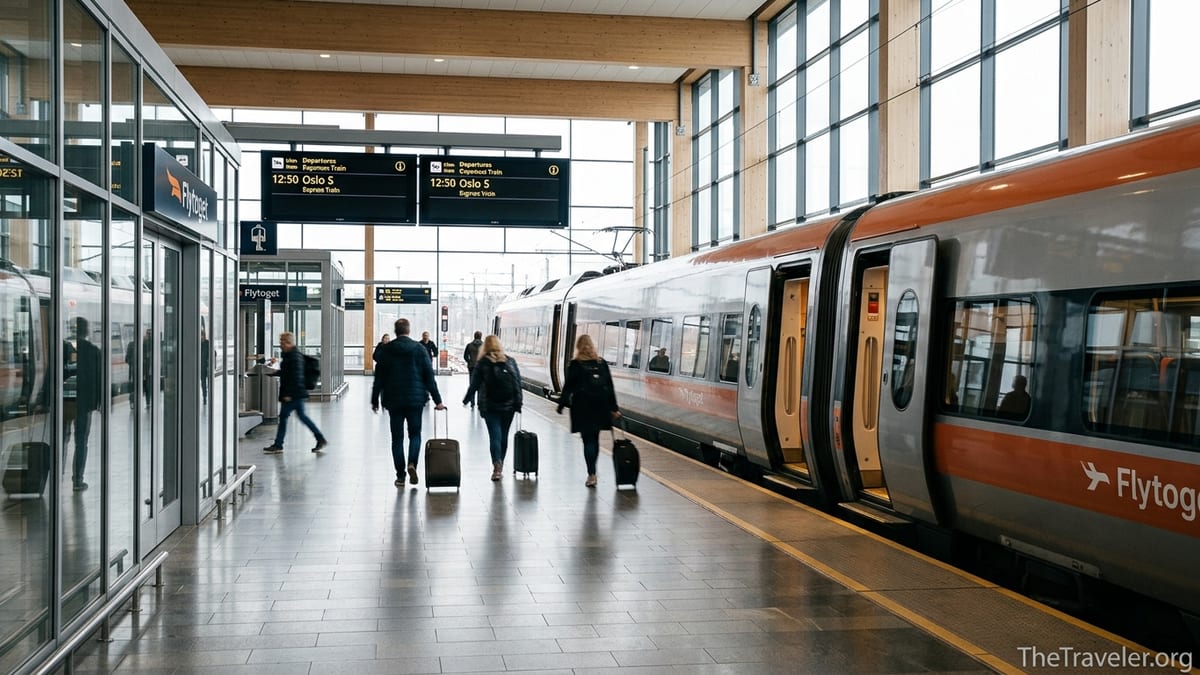
Flytoget is Norway’s dedicated airport express train, connecting Oslo Airport Gardermoen with central Oslo and selected stops west of the city. The service uses the high speed Gardermoen Line and was purpose built to move air passengers quickly between the terminal and downtown. A typical trip from Oslo Airport to Oslo Central Station takes about 19 minutes on Flytoget, compared with roughly 25 to 30 minutes on the regular Vy regional trains that share the same corridor.
In 2026 Flytoget runs as a premium service with its own branding, staff and ticket system, even though it has been brought under the Vy Group and is due to be fully integrated into the wider rail network in late 2027. For now that means you cannot use ordinary Oslo public transport tickets on Flytoget, and Flytoget tickets are not valid on other trains. You are paying for speed, frequency and a fairly stress free experience, which is why many business travelers and short stay visitors still choose it despite the higher fare.
To understand when Flytoget makes sense, imagine landing at Oslo at 07:30 on a winter weekday with a same morning meeting downtown. With hand luggage only, you can be on a Flytoget train about 10 to 15 minutes after stepping off the aircraft and at Oslo S before 08:15. The ability to walk straight through the dedicated Flytoget gates with a contactless payment, skip ticket machines and board a train that almost never sells out is exactly what the service is optimized for.
On the other hand, if you are a family of four starting a longer holiday, the standard Vy train from the same station may cost roughly half as much in total for a journey that is only a few minutes slower. In that case, Flytoget is more about comfort and simplicity than hard savings of time or money, so your priorities will determine whether it is the right choice.
Understanding Routes, Stations and Travel Times
Flytoget serves Oslo Airport Gardermoen directly from a station integrated into the terminal building. From the arrivals hall you follow the clear signs for “Train” and then “Flytoget.” The airport station has separate areas for the airport express and for the regular Vy trains, but the platforms are physically close together. That layout makes transfers intuitive, even if you are jet lagged or carrying skis and winter gear.
Most Flytoget departures run between Gardermoen and Oslo Central Station, with many trains continuing west to stations such as Nationaltheatret, Skøyen, Lysaker and sometimes Drammen. The exact end station and stopping pattern are shown on the departure boards at the airport: for example, one train might be listed as “Flytoget Oslo S” while the next shows “Flytoget Drammen” indicating it continues beyond the central station. Travel time from the airport to Nationaltheatret is typically just a couple of minutes longer than to Oslo S.
As of 2026 the headline travel time is around 19 minutes from the airport to Oslo S, and about 22 minutes to Nationaltheatret. In practice that means if you board a train at 10:00 you can usually step out into the central concourse of Oslo S at 10:19 and be on a tram or metro a few minutes later. Compared with an airport bus that might spend 45 to 60 minutes in traffic, this is often the most time efficient option, particularly during winter or peak commuting hours.
Because Flytoget shares the same high speed line with Vy, major incidents on the rail corridor can still affect both services. Serious disruptions are fairly rare, but when they occur all trains on the Gardermoen Line may experience delays. In routine conditions, though, Flytoget’s tight turnarounds and frequent departures give you multiple backup options if you happen to miss a train by a minute or two.
Schedules, Frequency and Planning Your Connection
Flytoget is designed so that you rarely need to plan around a specific departure. During the main part of the day trains typically leave the airport for Oslo every 10 minutes, which means you can simply head to the platform, glance at the real time board and board the next service. Early in the morning and late at night the frequency is usually reduced to every 20 or 30 minutes, but there are still departures that match most flight banks.
As a practical example, if your flight is scheduled to land at 14:15, immigration and baggage collection at Gardermoen usually take between 20 and 45 minutes depending on the day and how many international flights arrive at once. Planning to board a Flytoget train any time between 15:00 and 15:30 is normally realistic. Since trains are frequent, there is no strong need to rush through the terminal. You can pick up a coffee in the arrivals area and still be downtown by around 16:00.
When you are traveling in the opposite direction, from Oslo to the airport, it pays to be more conservative. For flights within Europe most airlines at Gardermoen recommend arriving at the airport about 2 hours before departure, rising to 3 hours for longer intercontinental flights. If you are staying near Oslo Central Station and your flight to London leaves at 10:00, a Flytoget train leaving Oslo S around 07:30 will typically have you in the check in hall shortly before 08:00. This gives you buffer for minor delays, security queues and time to buy snacks before boarding.
Flytoget’s website and app publish detailed timetables and live departures, and the screens at the station display real time updates including platform, intermediate stops and whether the train continues beyond Oslo S. Closer to your trip, always double check the first and last departures of the day, especially for very early morning flights or late arrivals, as the schedule can shift slightly with season and maintenance work.
Tickets, Prices and How to Pay
Buying a Flytoget ticket is intentionally simple. At the airport station you can pass through the dedicated gates by tapping a contactless bank card, mobile wallet or compatible device. The system registers your entry and automatically charges the standard adult fare for the journey when you exit at your destination station. There is no need to choose a departure time or reserve a seat. For many travelers this tap in, tap out method is the easiest way to start using Flytoget without dealing with machines or ticket counters.
If you prefer a more traditional ticket, there are bright orange Flytoget ticket machines near the platforms and in the arrivals hall. Here you can choose your start and end station, the number of travelers and any discounts such as children, seniors or students where applicable. You then receive either a paper ticket with a barcode or a digital confirmation if you use the Flytoget mobile app. Staff at the station can also help if you are unsure which product to choose, for example if you are traveling with several children or a group.
Prices in 2026 are noticeably higher than on the regular Vy regional trains, particularly for adults traveling alone. While exact fares change with time and promotions, a one way adult trip from the airport to Oslo S on Flytoget commonly costs in the low to mid 200 Norwegian kroner range, while the equivalent Vy regional ticket is roughly half that. However, Flytoget often offers discounts for children traveling with paying adults, as well as reduced rates for youths and seniors, which can make the cost more competitive for families.
One important practical detail is that local Oslo public transport tickets from Ruter, such as 24 hour or 7 day passes, are not valid on Flytoget. If you have bought a zone ticket that covers the airport, you will need to board the Vy regional or commuter trains instead. For example, a visitor staying in Oslo for several days might buy a multi day Ruter pass that covers the airport zone and simply use the regular trains. Someone on a short business trip without a pass might decide that Flytoget’s premium fare is worth paying for the extra convenience.
Using the Flytoget App and Real Time Information
The Flytoget mobile app is a helpful tool if you like having your tickets and travel details on your phone. After a quick registration you can buy digital tickets in the app, store your payment method and see live departure times from both Oslo Airport and the city stations. For regular travelers, the app makes it easy to re use previous journeys and keep track of receipts for expense reports without dealing with paper.
Real time information is particularly valuable in winter, when heavy snow or ice can affect all transport in and around Oslo. While the trains themselves are designed to cope with harsh conditions, severe weather or signaling issues can still cause delays. The app and the airport departure screens will show whether your next train is on time, a few minutes late, or replaced by alternative transport. Having that information before you leave the terminal allows you to adjust your plans, perhaps taking an earlier train or switching to a Vy service if that is running more smoothly.
For example, imagine arriving on a January evening to find that an incident north of Oslo has disrupted some departures on the Gardermoen Line. Checking the Flytoget app, you might see that the next two airport express trains are running but slightly delayed, while several regional services have been canceled. In this situation, sticking with Flytoget could be the more reliable option because the operator often prioritizes airport passengers when recovering the timetable. Conversely, on a calm spring afternoon with clear skies and normal operations, choosing between Flytoget and Vy is mainly about cost, timing and personal preference.
The app also supports features such as push notifications about disruptions on routes you mark as favorites and basic journey planning to help you connect with trams and metro lines in central Oslo. While a separate journey planner like the Ruter app is more comprehensive for city transport, Flytoget’s own tools are sufficient for most straightforward airport transfers.
Integrating Flytoget With the Rest of Your Journey
One of Flytoget’s strengths is how well it connects with the rest of Oslo’s transport network. At Oslo Central Station you step out directly into the city’s main rail hub, where you can transfer to long distance Vy trains, night trains to other parts of Norway, regional services and local commuter lines. Just outside the station forecourt there is a dense web of trams and buses, and the Jernbanetorget metro station is reached via a short underground passage, putting most of the city within a 10 to 20 minute ride.
Travelers whose accommodation is closer to Nationaltheatret, Skøyen or Lysaker may prefer to stay on the Flytoget train beyond Oslo S to avoid an extra transfer. For example, many conference hotels and company offices cluster around Lysaker, west of downtown. In that case you might ride Flytoget directly from the airport to Lysaker, walk to your hotel in 5 to 10 minutes and avoid handling luggage on a crowded tram or bus. Similarly, if you are staying near the Royal Palace or Aker Brygge, continuing to Nationaltheatret reduces your walking distance.
If you are connecting to an early morning regional train, such as a departure to Bergen or Trondheim around 08:00, taking Flytoget to Oslo S can buy you a few more minutes of sleep. Because Flytoget’s travel time is slightly shorter and it offers frequent early departures, you can time your airport to city ride more precisely. Landing from a domestic flight late at night and catching a night train in the same station is also straightforward, as long as you allow for potential delays and give yourself sufficient buffer between arrival and departure.
Families with small children or travelers with bulky gear such as skis, snowboards or bikes often appreciate Flytoget’s spacious luggage areas and wide aisles. The absence of mandatory seat reservations means you can usually find space without much hassle, and there are designated areas for prams and larger items. If you are traveling with a lot of equipment for a ski trip in Lillehammer or Hemsedal, being able to wheel everything straight from the baggage belt onto a train with room to spare can make the start of your holiday far less stressful.
The Takeaway
Flytoget offers one of Europe’s simplest airport rail experiences: frequent departures, a clearly marked station inside the terminal and a sub 20 minute ride to the heart of Oslo. For travelers who value speed, predictability and easy payment, it is often the most comfortable way to begin or end a trip through Oslo Airport Gardermoen. The service is especially attractive for business travelers on tight schedules, visitors staying near Oslo S or Nationaltheatret, and anyone arriving after a long flight who wants to avoid navigating local ticketing systems immediately.
At the same time, Flytoget is not the only option. Regular Vy regional and commuter trains use the same rail line, are only minutes slower and can cost significantly less, especially if you already hold an Oslo public transport pass. The right choice for you will depend on your budget, your schedule and how confident you feel using local transport apps and ticketing rules. A good rule of thumb is that if you are short on time or energy, Flytoget is worth the premium. If you are watching your spending or traveling as a family, checking the Vy alternatives may make better sense.
Whichever you choose, understanding how Flytoget fits into the broader network makes arriving in Oslo much smoother. With your transfer planned before you land, you can step off the plane knowing exactly where to walk, which train to board and roughly when you will be at your hotel. That confidence can turn a potentially stressful airport transfer into an easy, almost automatic part of your journey.
FAQ
Q1. How long does Flytoget take from Oslo Airport to the city?
The journey from Oslo Airport Gardermoen to Oslo Central Station is usually around 19 minutes, with trains to Nationaltheatret taking a few minutes longer.
Q2. How often does Flytoget run?
During the day Flytoget typically runs every 10 minutes between the airport and Oslo, with slightly less frequent departures early in the morning and late at night.
Q3. Do I need to buy a Flytoget ticket in advance?
No. Most travelers either tap a contactless card at the gates or buy a ticket at the station or in the Flytoget app shortly before boarding.
Q4. Can I use my Oslo public transport pass on Flytoget?
Oslo Ruter tickets and passes are not valid on Flytoget. They are valid on Vy regional and commuter trains between Oslo and the airport instead.
Q5. Is Flytoget more reliable than regular trains?
Flytoget and Vy share the same high speed line, so major incidents affect both, but Flytoget is scheduled and staffed with airport passengers as a priority.
Q6. How much does Flytoget cost compared to Vy trains?
Exact prices vary over time, but Flytoget typically costs roughly twice as much as a standard Vy regional ticket for the same airport to Oslo S journey.
Q7. Where does Flytoget stop in Oslo?
Most trains stop at Oslo Central Station, with many continuing to stations such as Nationaltheatret, Skøyen and Lysaker, and some services going as far as Drammen.
Q8. Is there space for luggage and strollers on Flytoget?
Yes. Flytoget trains have generous luggage racks and dedicated spaces for larger items such as suitcases, skis and baby strollers.
Q9. What should I do if my flight is delayed late at night?
Check the Flytoget app or airport departure boards for the last trains of the day. If your new arrival time is close to the last departure, consider backup options such as Vy trains or airport buses.
Q10. Is Flytoget suitable for families with children?
Flytoget is generally very family friendly, with easy boarding, space for prams and clear signage. Discounted child fares often make it more affordable for families.