


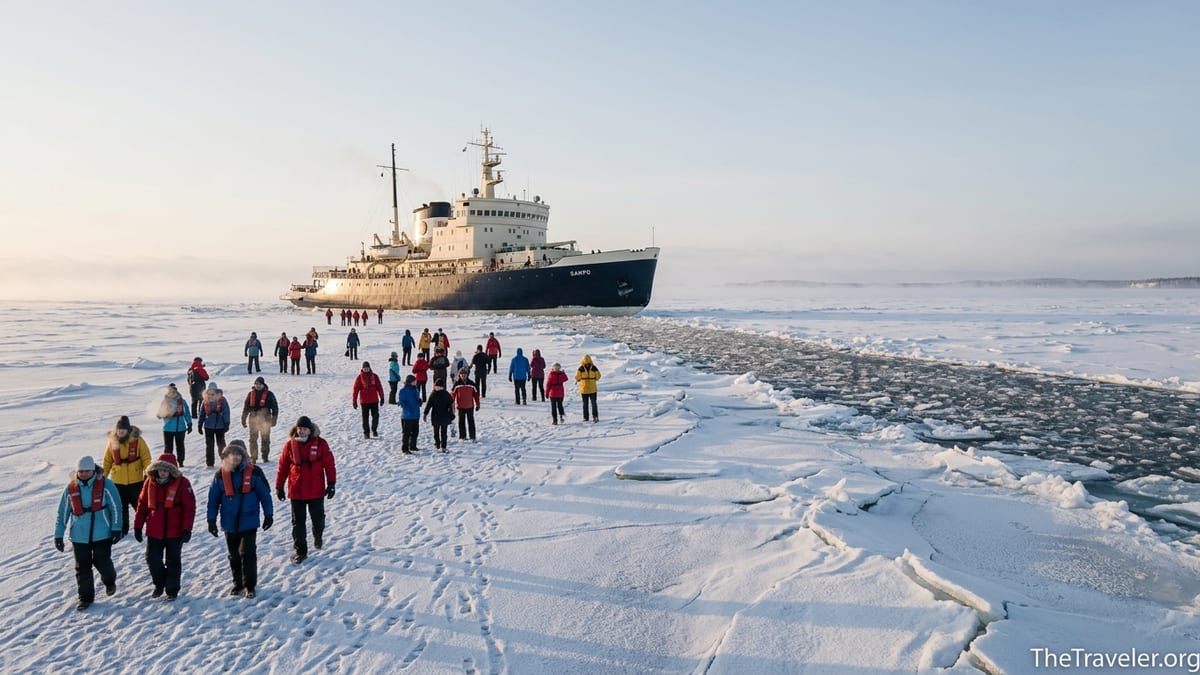
The first time you step off Icebreaker Sampo and onto the frozen surface of the Bothnian Bay, it barely feels real. A few minutes earlier you were standing at the ship’s rail, watching the bow rise and slam down through thick winter ice. Now you are walking where there should be open sea, listening to a strange hollow echo under your boots and staring back at a 75-meter icebreaker parked in the middle of a white desert. It is one of those rare travel experiences that feel almost cinematic, yet every detail is physical and immediate: the bite of the wind off the Gulf of Bothnia, the smell of diesel and snow, the distant calls of crew organizing the next group of swimmers. This is Kemi in northern Finland, and this is what it feels like to walk across a frozen sea behind the legendary Icebreaker Sampo.
Get the latest updates straight to your inbox!
Meeting Sampo in the Edge-of-the-World Port of Kemi
The adventure begins long before you set foot on the ice. Icebreaker Sampo’s home port is Kemi, an industrial town on the northern edge of the Gulf of Bothnia, about a 90-minute drive from Rovaniemi in Finnish Lapland. In midwinter, daylight arrives late and leaves early, so many travelers roll into Kemi in a faint blue twilight, snowbanks piled high along the streets and the harbor road disappearing into blowing spindrift. Tour buses from Rovaniemi hotels, ski resorts such as Levi and Ylläs, and even from Swedish border towns like Haparanda often converge here on cruise day, discharging bundled-up visitors from all over the world.
Sampo herself is not a purpose-built tourist vessel but a retired Finnish state icebreaker built in 1960 and converted into a passenger experience after decades of working winters along the Finnish coast. Today she is operated by a dedicated icebreaking company in cooperation with local tourism officials, and she still feels like a working ship. The hull is thick and industrial, the decks are lined with heavy chains and equipment, and inside you walk through narrow steel corridors to reach the restaurant, engine room, and viewing areas. It is very different from a polished Arctic expedition cruise ship; it feels like stepping into the machinery of winter itself.
Check-in usually takes place either in Kemi’s small terminal building or directly at the gangway, depending on conditions. Staff hand out boarding passes, brief you on the schedule, and remind everyone that the highlight of the trip will be walking on the sea ice and, for those who dare, floating in the ice hole in bright red survival suits. Cruises generally run from late December to early April, but the exact season shifts each year with the ice. In a strong winter, Sampo can operate for nearly four months. When the ice is thinner, the season and routes are adjusted for safety.
Through Breaking Ice: What It Feels Like On Board
Once Sampo pulls away from the harbor and heads toward the outer bay, the transformation from functional port to Arctic wilderness happens surprisingly fast. Within minutes the ship is pushing solid ice aside instead of water. You hear a deep grinding underfoot as the reinforced bow rides up onto the ice sheet and crushes it under the vessel’s weight. In some winters, the sea ice in the northern Bothnian Bay can reach half a meter thick in level areas and more in ridges, and you can feel the resistance in the ship’s slow, powerful motion as she forces a channel through the white plain.
Passengers fan out across the decks and the enclosed panorama lounge. Outside, the air temperature may sit anywhere between -5 and -25 degrees Celsius, and the wind over the deck can make it feel far colder. This is where the reality of Arctic travel cuts through any romantic postcard expectations. Cameras fog when you bring them back in, fingers sting if you remove your gloves for more than a few seconds, and it takes concentration to keep your footing when the ship thumps down through particularly stubborn slabs of ice. At the same time, the view is hypnotic: shattered polygons of ice sliding past, a trailing wake of broken floes and blue-black water closing in behind you, the low winter sun casting long peach-colored shadows across the bay.
One of the defining joys of the Sampo cruise is the freedom to explore the ship. Between photo stops on deck you can follow a guided route down to the engine room, where the old machines still work at full force, and up to the bridge, where officers monitor ice charts, radar, and navigation screens. The crew often explain how an icebreaker hull differs from a regular ship, with a rounded bow that rides up onto ice rather than cutting through it, and massive engines powering the propellers for short bursts of force. Hearing it in the warmth of the wheelhouse while watching the ice field ahead gives the theory a very physical context.
Stepping Onto the Frozen Sea
After roughly an hour or more of steady icebreaking, Sampo will find a stable section of level ice and come to a slow, shuddering stop. The engines quieten, the ship settles, and over the loudspeaker you hear the announcement that walking on the sea ice is about to begin. Crew members in high-visibility jackets deploy a gangway or a set of metal stairs down onto the ice, test the surface, and mark out a safe perimeter with poles or ropes. It is only when you stand at the top of those stairs that you truly register what is happening: you are about to walk off a ship onto the frozen surface of an open sea.
The first steps feel uncannily like stepping off onto a snowy parking lot, except that the ground underfoot subtly moves. In the coldest weeks of winter, the sea ice here can be dozens of centimeters thick, strong enough to support vehicles during official maintenance operations, but it is still a dynamic surface that responds to wind and currents. You might hear occasional distant cracks as the pressure shifts, a reminder that beneath the snow-covered crust lies several meters of dark water. Guides keep guests within a clearly marked area and monitor conditions constantly. Any sign of pressure ridges forming or new cracks spreading, and the shore leave ends.
For most travelers, these twenty or thirty minutes on the ice are among the most memorable of their lives. People scatter to take photos of the ship looming in the background, to lie down and make snow angels in the middle of the bay, or simply to stand and listen to the immense quiet. On calm days the only sounds are cameras clicking and the faint murmur of the ship’s generators. On windier days spindrift races across the surface, scratching at your boots and painting everything with minute crystals. Looking back at the channel that Sampo has cut through the ice, you can see the contrast between the broken floes in the track and the apparently solid white expanse surrounding you. It becomes very obvious why locals, rescue services, and shipping companies treat moving ice with such respect.
The Surreal Ritual of Ice Floating
If walking on the frozen sea feels unreal, floating in a hole cut into that same ice takes the experience to another level. After the initial walk, or in a carefully choreographed rotation, groups are invited below decks to change into insulated survival suits. These bright red or orange suits cover you from feet to neck, with attached boots and hood and seals at the wrists and face. Underneath, you wear your normal winter layers. Crew members help zip you in and check the seals; the suits are designed to provide buoyancy and insulation in water that hovers around freezing.
Out on the ice, staff have opened a pool in the ship’s wake, framed by ladders and watched closely by safety personnel. One by one, guests waddle down in their bulky suits and ease themselves into the dark water. The contrast is striking: above the surface, a field of snow and ice under an Arctic sky; below the surface, black-moving sea. Once you lean back and let the suit hold you, your body relaxes and you simply bob in place, the world narrowed to the rim of ice around your face and the silhouette of Sampo towering above.
The sensation is oddly peaceful rather than shocking. The suit keeps cold water from contacting your skin, and most people report feeling only a gradual chill on the face and hands. Lifeguards guide you through simple floating positions, encourage a short paddle under the supervision of the crew, and then help you climb back up onto the ice. Typically you will spend around 10 minutes in the water, though the exact timing can depend on air temperature, wind, and how quickly groups move. Afterward, hot juice or coffee is served on board, and many travelers find that the adrenaline high hits only once they are back in warm clothes, realizing they have just floated in the Arctic Sea in midwinter.
For anyone nervous about safety, it helps to know that operators in Kemi have decades of experience running this activity. Participation in ice floating is optional, and age, mobility, and health conditions are all taken into account. Crew adjust the size and availability of suits by group, and they cancel the water portion entirely when conditions are marginal, such as periods of extreme wind chill or unstable ice. Insurance requirements and Finnish maritime regulations also underpin how the experience is structured. The result feels controlled and professional, even though the setting might be the most remote-feeling place you have ever stood.
Planning Your Own Sampo Voyage
While the experience of walking across the frozen sea reads like something out of an explorer’s diary, booking it today is refreshingly straightforward. Icebreaker Sampo cruises are offered on specified dates through the winter season, coordinated by the operating company in Kemi and promoted through local tourism boards. Many travelers build Sampo into a broader Lapland itinerary that might include husky sledding near Rovaniemi, reindeer visits in small villages like Sinettä, or chasing the Northern Lights around Saariselkä.
From a practical perspective, it is wise to reserve well ahead, especially for peak weeks in late December, February, and early March when European school holidays and Northern Lights tourism expectations overlap. Prices for the icebreaker cruise itself fluctuate slightly by season and package, and tour operators sometimes bundle Sampo with transfers from Rovaniemi, Kemi railway station, or nearby resorts. In recent winter seasons, travelers have commonly reported paying several hundred euros per adult for the cruise with transfers included, reflecting the highly specialized nature of the experience and the operating costs of running a full-size icebreaker through sea ice.
Most passengers reach Kemi either by train from Helsinki and Oulu or by domestic flight to Kemi-Tornio Airport, though many simply use Rovaniemi as their base and join a day trip north. Standard Sampo cruise durations are typically around three to four hours on the ice, with the overall day including transport stretching to 8 to 12 hours for those coming from farther afield. Since departures depend on ice and weather, last-minute adjustments are possible, and operators communicate schedule changes through hotel partners and email in the days before departure.
Staying Warm and Safe on the Ice
Enjoying the surreal feeling of walking across a frozen sea depends on one basic prerequisite: staying warm enough to actually notice the magic instead of just your freezing toes. The conditions on the Bothnian Bay in midwinter can be severe, with wind chill dragging temperatures far below what the static air reading suggests. Dressing correctly is therefore as much a safety issue as a comfort one, and local guides make no secret of it when you board.
The tried-and-tested Finnish approach involves three layers. Against your skin, wear a moisture-wicking base layer such as merino wool or synthetic thermal underwear. On top of that, add an insulating layer: thick fleece, wool sweater, or a lightweight down jacket. Finally, a windproof and water-resistant shell jacket and pants keep freezing gusts and drifting snow from penetrating. Snow boots with proper insulation and a sturdy sole are strongly recommended. Standard city trainers or thin-soled shoes will quickly turn numb on the ice, especially when you stand still for photos or watch other guests floating in the water.
Accessories make a surprisingly big difference. A fleece-lined hat that covers your ears, a neck gaiter to protect exposed skin around your jaw, and insulated gloves or mittens are essential. Many visitors bring thin touchscreen liners to wear under heavier mittens so they can take photos without exposing bare fingers for more than a moment. For cameras and phones, cold drains batteries fast, so keeping devices in an inside pocket between shots helps. Crew provide the survival suits for the water segment, so you do not need any specialized gear for that, though having a good base layer will keep you more comfortable inside the suit.
Safety guidelines on the ice are strict but reasonable. You must stay within the flagged area on the sea surface, avoid approaching weak spots near the open water around the ship’s hull, and follow the crew’s timing. Children are welcome but should be closely supervised; whether they can participate in ice floating depends on size, suit fit, and the day’s conditions. If winds pick up or cracks in the ice shift, the walk may be shortened or canceled. The fact that decisions are made conservatively, even when guests are eager to continue, is a reassuring sign of how seriously operators treat the environment.
Climate Change, Sea Ice and the Future of Sampo
Spending a few hours surrounded by solid sea ice can feel timeless, but the context around Sampo’s cruises is changing. Long-term studies of Baltic and Bothnian Bay ice have shown a gradual decline in the length and depth of the ice season over recent decades. While strong winters still arrive, with fast ice forming along the coasts and ridges building out in the open bay, the variability from year to year has increased. Locals in Kemi and other coastal towns often speak of the 1980s and 1990s as a time when thick sea ice and extended cold were almost guaranteed each year. Now some winters resemble those memories, while others bring thinner cover and shorter periods of freeze.
For Sampo and similar operations, this means that each season is planned with a watchful eye on ice charts, satellite data, and marine forecasts. The exact dates of operation shift within the December to April window, and itineraries can be adjusted to seek thicker ice or safer conditions. In years when the bay does not freeze as solidly or as early, fewer departures are scheduled. From a traveler’s point of view, that makes advance communication with operators and flexible planning more important than ever. Booking through reputable local companies, confirming that your cruise is conditional on safe ice, and having alternative activities in Lapland in mind can help manage expectations.
At the same time, the very existence of Sampo as a tourist vessel reflects how Finland has adapted its icebreaking legacy. Modern state icebreakers now keep commercial shipping lanes open along the Baltic and Bothnian coasts, while retired vessels like Sampo find a second life showing visitors what sea ice really feels like underfoot. The revenue helps support local economies in towns like Kemi, which have invested heavily in winter tourism projects such as the SnowCastle and guided fishing trips on the frozen sea. As long as there is consistent seasonal ice in the northern bay, there is a strong incentive locally to run the cruises responsibly, balancing visitor demand with environmental limits.
The Takeaway
Walking across the frozen sea behind Icebreaker Sampo is one of those travel experiences that resists neat categorization. It is not just a scenic cruise or a novelty dip in cold water. It is an encounter with a landscape in a very particular state, a reminder that seas can harden and become surfaces, and that technology and human skill make it possible to touch that state safely for a brief window in time. The memory that stays with most people is not just the crunch of the ice or the photo of themselves floating in survival gear, but the feeling of scale: a small human figure in a bright jacket, dwarfed by a black hull and an endless white horizon.
If you are planning a trip to Finnish Lapland in winter, weaving a day with Sampo into your itinerary can transform your understanding of the Arctic. It complements reindeer farms, glass igloo stays, and aurora hunts with something more elemental: time on the ice itself. As conditions shift from year to year in the Bothnian Bay, there is no guarantee that any given winter will be ideal, which in a way only underscores how special it is when everything aligns. On those days, when the bay lies locked in pale armor and Sampo’s bow carves a path into the stillness, walking across the frozen sea really does feel completely unreal.
FAQ
Q1. Where exactly does the Icebreaker Sampo cruise take place?
The cruise operates on the frozen northern Gulf of Bothnia, off the coastal town of Kemi in Finnish Lapland, near the border with Sweden.
Q2. When is the best time of year to walk on the frozen sea with Sampo?
The operating window usually falls between late December and early April, with the most reliable thick ice conditions often in January, February, and early March, depending on the winter.
Q3. Do I need previous cold-weather or ice experience to join the cruise?
No prior experience is needed. Guides brief you on safety, supervise every step on the ice, and manage the ice floating activity so it stays within comfortable limits.
Q4. How cold does it get out on the Bothnian Bay during the cruise?
Air temperatures commonly range from about -5 to -25 degrees Celsius, and wind over the deck can make it feel colder, so proper winter clothing is essential.
Q5. Is the ice floating in survival suits really safe?
The ice floating segment is carefully controlled. You wear certified insulated survival suits, are supervised by trained crew, and spend a limited time in the water under constant monitoring.
Q6. What should I wear and bring for a Sampo icebreaker trip?
Plan on layered winter clothing, insulated boots, hat, neck gaiter, and warm gloves or mittens. Bring spare batteries or a power bank for cameras and phones, as cold shortens battery life.
Q7. Can children participate in walking on the sea ice and floating?
Children are generally welcome on board and can walk on the ice if they stay with adults. Participation in floating depends on their size and the fit of the survival suits, and is decided by the crew on the day.
Q8. What happens if the ice is not thick enough on my scheduled date?
If conditions are unsafe, operators may alter the route, shorten the ice activities, or cancel and offer alternative dates or arrangements. Safety takes priority over sticking to a fixed program.
Q9. How far in advance should I book an Icebreaker Sampo cruise?
For peak winter weeks it is wise to reserve several months ahead, especially if you also need transfers from Rovaniemi or other Lapland resorts, as departures can fill quickly.
Q10. Is the Sampo cruise suitable for travelers with limited mobility?
The ship itself has steep stairways and the ice surface is uneven, which can be challenging. Some travelers with reduced mobility stay on board while others walk the ice. It is best to discuss your specific needs with the operator before booking.