


Carving a path through the frozen Gulf of Bothnia, the historic Icebreaker Sampo offers one of winter Finland’s most distinctive experiences. For many travelers, however, the hardest part is not braving the Arctic wind but working out how the schedules, transfers and booking options actually fit together. This guide brings the latest information into one place so you can plan your Sampo cruise with realistic expectations, concrete timings and practical examples.
Get the latest updates straight to your inbox!
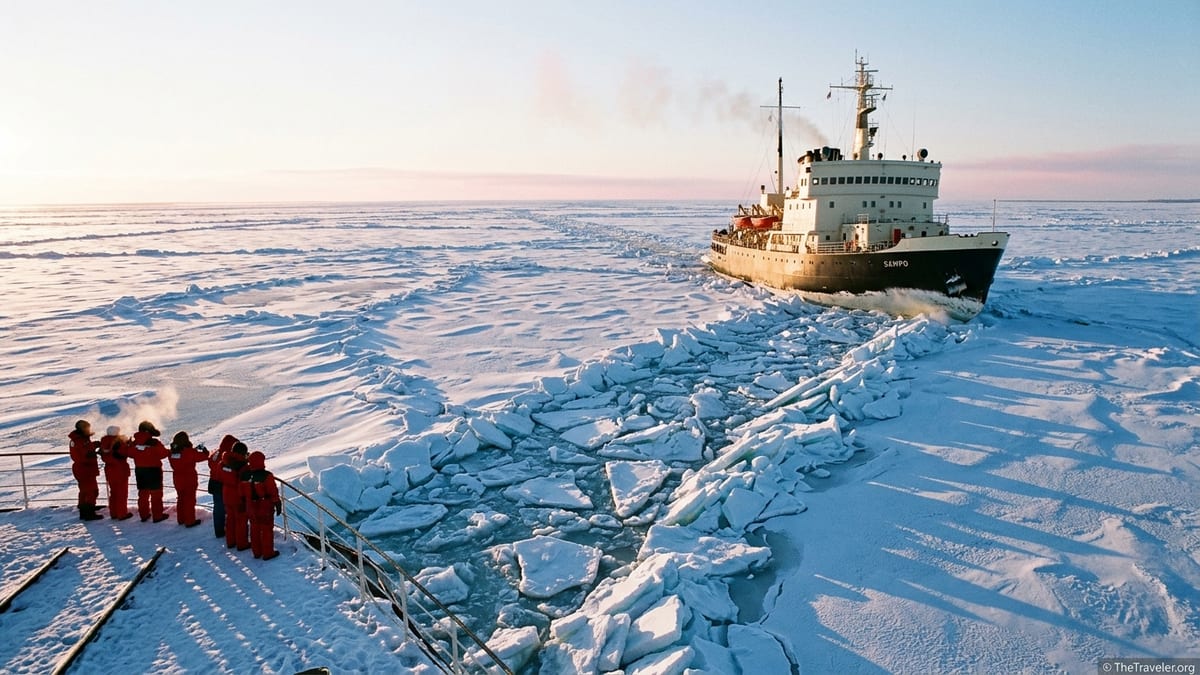
Where Icebreaker Sampo Sails and When the Season Runs
Icebreaker Sampo is based in Kemi, a small coastal city in southern Lapland on the Gulf of Bothnia. In winter it operates as a tourist icebreaker, taking visitors out onto the frozen sea to see how a working icebreaker moves through thick ice. From Kemi, the ship sails out from the industrial port of Ajos, about a 15–20 minute drive from Kemi city centre, then spends several hours breaking ice before stopping for ice floating and a tour of the vessel.
The core Sampo season is in midwinter when the sea ice is at its most reliable. According to the operator, The Icebreaking Company, the upcoming main season runs from 18 December 2026 to 3 April 2027, with departures scheduled most days during the peak months of January, February and March. Outside this period, the ship is not normally available for public icebreaking cruises from Kemi because the sea is no longer solidly frozen.
There are occasional special deployments. In spring 2026, for example, Sampo is scheduled to sail from Kemi to Turku on the south‑west coast for a short visit, including a special May Day cruise on 1 May 2026. These one‑off cruises are marketed separately from the standard winter program and typically book out quickly, so they are worth watching for if you will be in southern Finland in late spring.
Because ice conditions and port operations can change, travelers should treat specific sailing dates as indicative until a reservation is confirmed. Sampo’s season is defined months in advance, but individual departures can still move slightly due to weather or operational reasons, so always verify the exact date and time on your booking confirmation rather than relying solely on a brochure.
Understanding Sampo Cruise Schedules and Daily Timings
Sampo usually operates one to two departures per day in high season. Typical sailings last about 3.5 to 4 hours dock to dock. A common pattern is a morning cruise that may include breakfast or early lunch, and a later cruise that includes lunch or early dinner, with exact meal arrangements depending on the time of departure you choose.
As a practical example, a midwinter day might see a morning cruise leaving the port around 9:00 with check‑in in Kemi roughly an hour earlier, and an afternoon sailing around 13:00. Passengers who buy a package with meals would normally have food served at the SnowCastle of Kemi’s Lumihiutale restaurant either before or after the cruise. Because the daylight window in Kemi is short in December and January, it is common for at least one daily departure to take place largely in twilight or darkness, which can make the ice and ship’s spotlights feel dramatic but also colder.
The cruise itself follows a relatively set pattern. After departure and safety briefing, Sampo steams out into the pack ice and demonstrates various icebreaking maneuvers. At a designated spot, the ship stops and lowers a gangway onto the ice so guests can walk on the frozen sea surface if conditions allow. Those who want to float in the icy water zip into bright red survival suits and are supervised as they gently bob in a pool cleared alongside the ship. A guided tour of the engine room, decks and bridge is usually offered during or after the stop, with time on board for hot drinks and photos.
Exact timings, such as when you float and when you eat, vary according to departure time and the day’s conditions. Families with younger children often prefer the earlier sailing so they are back in town by mid‑afternoon, while photographers sometimes choose the later departure for lower sun angles and the possibility of dusk colors over the ice. When booking, pay attention to the start time, not just the duration, and factor in at least an extra hour at each end for transfers and check‑in formalities.
How to Check Current Schedules and Availability
The most reliable way to see up‑to‑date schedules for Icebreaker Sampo is to consult the official calendar published by The Icebreaking Company, which operates both Sampo and its newer sister vessel Arktis. The online timetable typically lists each day of the season with available departure times, indicating whether the sailing is still on sale, nearly full or sold out. This is the reference used by local tourism offices in Kemi and Rovaniemi when advising travelers.
In practice, many visitors will encounter the schedule first through intermediaries: regional tourism boards such as Visit Rovaniemi, tour operators that bundle transport and excursions, or hotel concierges who access booking portals on your behalf. For instance, a Rovaniemi‑based agency might advertise a “Day Trip to Kemi with Sampo Icebreaker Cruise” that includes a specific sailing on a Saturday in February, even though the underlying availability comes from the same central schedule.
Because seat counts are finite and the ship’s capacity is limited, some peak dates in late December, around New Year, and during Finnish winter holidays in February can sell out weeks or months ahead. Travelers planning a once‑in‑a‑lifetime visit often choose their Lapland dates around confirmed Sampo availability rather than the other way around. This is especially important if you also want to coordinate with other time‑sensitive activities such as Santa experiences in Rovaniemi or an overnight stay in a snow hotel.
If you are already in Kemi or Rovaniemi and trying to book at short notice, the easiest approach is to ask your hotel reception or a local visitor information point to query the system for the next few days of sailings. There are often last‑minute cancellations, but in high season you should be flexible about morning versus afternoon departures and be prepared to switch to the Arktis icebreaker on the same route if Sampo is full.
Tickets, Prices and What Your Cruise Includes
Prices for Icebreaker Sampo vary by season, departure time and whether you buy direct or as part of a package that includes transport and meals. As of the most recent winter seasons, adults booking a basic Sampo cruise without long‑distance transfers can expect to pay in the region of several hundred euros per person, with children typically discounted. Family travelers from Europe often report paying a combined price that covers shuttle bus from Kemi city centre, the 4‑hour cruise, guided tour of the ship, floating in survival suits and a hot buffet meal.
The standard inclusions on a Sampo cruise are remarkably consistent. Every passenger receives warm outerwear if needed, use of the heavy insulated survival suit for the water session, a guided tour from the engine room up to the bridge, and an official “icebreaker diploma” at the end of the trip. Onboard, there is access to heated lounges, viewing decks and a small café or bar where you can buy additional snacks and drinks. Some packages add extras such as pick‑up from specific hotels, a photographer service or a short snowmobile transfer for a more adventurous approach to the port.
Third‑party tour operators often price Sampo as part of a broader Lapland itinerary. For example, a Dutch operator markets a one‑day excursion from Kemi that includes city centre transfer, a four‑hour Sampo cruise, breakfast or lunch depending on departure, ice floating and a diploma, bundled into a single per‑person rate. Similarly, Asian and North American agencies selling Lapland packages may bundle Sampo with nights in glass igloo‑style accommodation or combined excursions with husky safaris.
Because prices can shift with fuel costs, demand and exchange rates, it is wise to treat all quoted figures as approximate until you see an itemized offer from the operator or your travel agent. If your budget is tight, ask specifically about the price difference between Sampo and the more modern Arktis icebreaker on the same route. Travelers who have sailed both note that the core experience is very similar, and Arktis is sometimes priced slightly lower even though the floating, diploma and duration are comparable.
Getting to Kemi and Transport to the Port
For international visitors, the journey to Sampo usually starts with a flight to Helsinki and a domestic connection to either Kemi‑Tornio Airport or Rovaniemi. Kemi‑Tornio sits about 6 km from Kemi city centre, a short taxi or pre‑arranged transfer ride away. Rovaniemi, around 115–120 km inland, is the main gateway to Finnish Lapland and is linked to Kemi by road and rail in roughly 1.5 hours. Many travelers base themselves in Rovaniemi for several nights to enjoy Santa‑themed attractions and northern lights tours, adding Sampo as a long day trip to the coast.
The Icebreaking Company offers shuttle bus transportation from several hubs directly to the Sampo port check‑in. Current routes include Rovaniemi, Kemi, Tornio and Haparanda on the Swedish side of the border. For example, you might book a package that collects you at a Rovaniemi hotel early in the morning, drives to Kemi with a comfort stop, then delivers you to the Icebreaker Sampo terminal in time for the safety briefing. After the cruise, the same bus returns you to Rovaniemi in the evening, making the experience manageable without renting a car.
Within Kemi, there are also shorter shuttle options. Some packages include a round‑trip bus from the central railway station or from city hotels such as Scandic Kemi or Hotelli Merihovi to the port at Ajos. These transfers take about 15 minutes each way and are synchronized with cruise departures and arrivals. Travelers who prefer full independence can drive to the port themselves, but they must follow specific safety instructions for the industrial area, such as designated parking zones and speed limits, which the operator provides in advance.
In winter, road conditions in Lapland can be challenging for drivers who are not used to snow and ice. Rental cars are normally fitted with winter tyres, but you should still plan extra time and use caution, especially on the Kemi–Rovaniemi highway where speed cameras are frequent. For many visitors, the incremental cost of booking an organized transfer is worthwhile for the reduced stress and guaranteed coordination with the ship’s schedule.
Onboard Experience: What It Feels Like to Sail on Sampo
Stepping aboard Sampo is like walking into a living museum of Finnish maritime history. Built in 1960 and retired from active government icebreaking in the late 1980s, the ship retains much of its original character. Narrow steel stairways connect utilitarian corridors, the engine room hums with age‑polished machinery, and the bridge offers commanding views over the ice fields. Although certain areas have been updated for tourism, visitors consistently describe the atmosphere as authentically industrial rather than polished or theme‑park like.
Once the ship begins to push through the ice, you quickly understand why dedicated icebreakers are needed in northern waters. The bow climbs onto the ice sheet, then crashes back down, cracking and shoving slabs aside in a constant, rhythmic motion. On deck, the sound is a mix of grinding, crunching and low mechanical vibration. In sheltered lounges, large windows allow you to watch the broken ice channel stretch behind the ship, with occasional glimpses of seabirds or, more rarely, seals resting on the ice.
The highlight for many guests is the ice‑floating session. After the crew checks conditions and cuts a pool in the sea ice next to the hull, passengers who wish to participate queue to be suited up in thick red survival suits. These suits are fully sealed and buoyant, so even non‑swimmers can safely lie back and float. Groups are then escorted into the water in turns, supervised throughout, and typically spend about 10 to 15 minutes bobbing in the freezing sea. The surreal sensation of being warm and dry while surrounded by ice and snow is one of the reasons travelers compare Sampo to more conventional Arctic cruises.
Back on board, the guided tour provides context. Crew members or guides lead visitors from the engine room, where you can see the massive propulsion systems, up through living quarters to the bridge with its banks of controls and radar screens. Photography is encouraged, and many people choose to have their “captain moment” at the wheel with the ice stretching away in all directions. Before disembarking, guests receive a signed certificate acknowledging that they sailed on an Arctic icebreaker and, if applicable, floated in the Gulf of Bothnia.
Practical Booking Tips and Choosing Between Sampo and Arktis
When searching for dates, you will likely see two names: Icebreaker Sampo and Icebreaker Arktis. Both are operated by the same company out of Kemi and offer broadly similar itineraries in the same waters. The key difference is that Sampo is an older, historically significant icebreaker, while Arktis is a more modern vessel with a somewhat sleeker profile and interior layout. Travelers who value maritime heritage often pick Sampo specifically for its vintage charm, while those who prioritize slightly lower prices or newer facilities may lean toward Arktis.
Bookings can be made directly with The Icebreaking Company or via dozens of partners worldwide. Direct bookings are straightforward if you are comfortable arranging your own transfers to Kemi or if you only need simple shuttle options. Packaged tours may cost more per person but provide language support, additional excursions and the reassurance of having one party responsible for all logistics. As an example, a family from the United States might book a one‑week Lapland break through a Scandinavian specialist that includes flights, five nights in Rovaniemi, husky and reindeer safaris, and a day trip to Kemi with Sampo cruise, all on a single invoice.
Timing your reservation is important. For travel in late December through mid‑February, particularly over Christmas, New Year and school holidays in Finland, Germany and the UK, it is sensible to secure your Sampo date several months ahead. Shoulder periods such as early December or late March can be more forgiving, with occasional last‑minute space. If your goal is to combine the cruise with northern lights photography, aim for mid‑season dates when nights are still long but not completely polar dark, and consider an afternoon departure that returns after dusk.
Finally, think about your own comfort level with cold and motion. Although Sampo is very stable in ice and seasickness is uncommon compared with open‑sea voyages, the combination of wind chill and standing on deck for extended periods can be intense, especially for younger children. Booking a package that includes access to a warm restaurant at the SnowCastle of Kemi before or after the cruise, as well as confirming that appropriate winter clothing is provided, can make the difference between a challenging outing and a highlight of your Lapland trip.
The Takeaway
Icebreaker Sampo is not a conventional cruise but a focused Arctic experience centered on a single, historic ship and a few hours spent on the frozen Gulf of Bothnia. Its schedules are shaped by winter sea ice, with a clearly defined season from December to early April and special one‑off sailings such as the 2026 visit to Turku. Tickets typically include transport options, ice floating, a guided tour and a diploma, with prices reflecting the logistical complexity of operating a heavy icebreaker for tourists in sub‑zero conditions.
For travelers willing to plan ahead, coordinate transfers to Kemi and accept that weather may require minor schedule tweaks, Sampo delivers an experience few other destinations can match. By checking current timetables through The Icebreaking Company, choosing between Sampo and Arktis according to your priorities, and allowing enough time around your chosen sailing, you can fit this memorable cruise smoothly into a broader Lapland itinerary that might also include northern lights chasing, snow safaris and visits to Santa’s hometown.
FAQ
Q1. When does the Icebreaker Sampo cruise season usually run?
The main Sampo season typically runs from around mid December to early April, when the Gulf of Bothnia is reliably frozen and icebreaking cruises are feasible.
Q2. How long is a typical Icebreaker Sampo cruise?
Most Sampo cruises last about 3.5 to 4 hours from departure to return, not including check in time or any bus transfers between Kemi and the port.
Q3. Where does Icebreaker Sampo depart from?
Sampo departs from the port of Ajos in Kemi, Finnish Lapland. The port is about 15 to 20 minutes by shuttle or taxi from Kemi city centre and railway station.
Q4. Is transport from Rovaniemi to Kemi included in the ticket?
Some tickets include round trip shuttle bus transport from Rovaniemi, while others cover only the cruise. Check your chosen package carefully to see exactly what transfers are included.
Q5. What is the difference between Icebreaker Sampo and Icebreaker Arktis?
Sampo is an older, historically significant icebreaker with a classic feel, while Arktis is a newer ship on a similar route. The core experience, including ice floating and a guided tour, is broadly similar.
Q6. Do I have to go into the water during the ice floating session?
No. The ice floating is optional. You can choose to stay on deck or inside the warm lounges while others put on survival suits and float in the sea.
Q7. What should I wear on an Icebreaker Sampo cruise?
Dress in warm layers, including thermal base layers, insulated mid layers, windproof outerwear, hat, gloves and winter boots. The operator provides special survival suits for the water session if you choose to participate.
Q8. Can children join the Sampo cruise?
Yes, children are welcome and usually enjoy the ship tour and walking on the ice. There may be minimum height or age requirements for the survival suits, so families should confirm details when booking.
Q9. How far in advance should I book an Icebreaker Sampo cruise?
For peak dates in late December, January and February, it is prudent to book several months ahead. Outside the busiest periods, you may find availability closer to your travel dates, but space is never guaranteed.
Q10. Is the cruise suitable for people who get seasick?
Sampo operates mostly in solid sea ice, so the motion is different from open ocean swells and many guests find it quite stable. However, if you are very sensitive, you may still want to bring motion sickness medication as a precaution.