


Newark Liberty International Airport can be confusing even for seasoned travelers. With three separate terminals, ongoing AirTrain construction and a web of shuttle buses, it is easy to lose time or miss a connection if you arrive unprepared. Understanding how the terminals, trains and transfers fit together will make your journey smoother, whether you are flying United out of Terminal C, catching an international connection in Terminal B, or meeting family arriving in the new Terminal A.
Get the latest updates straight to your inbox!
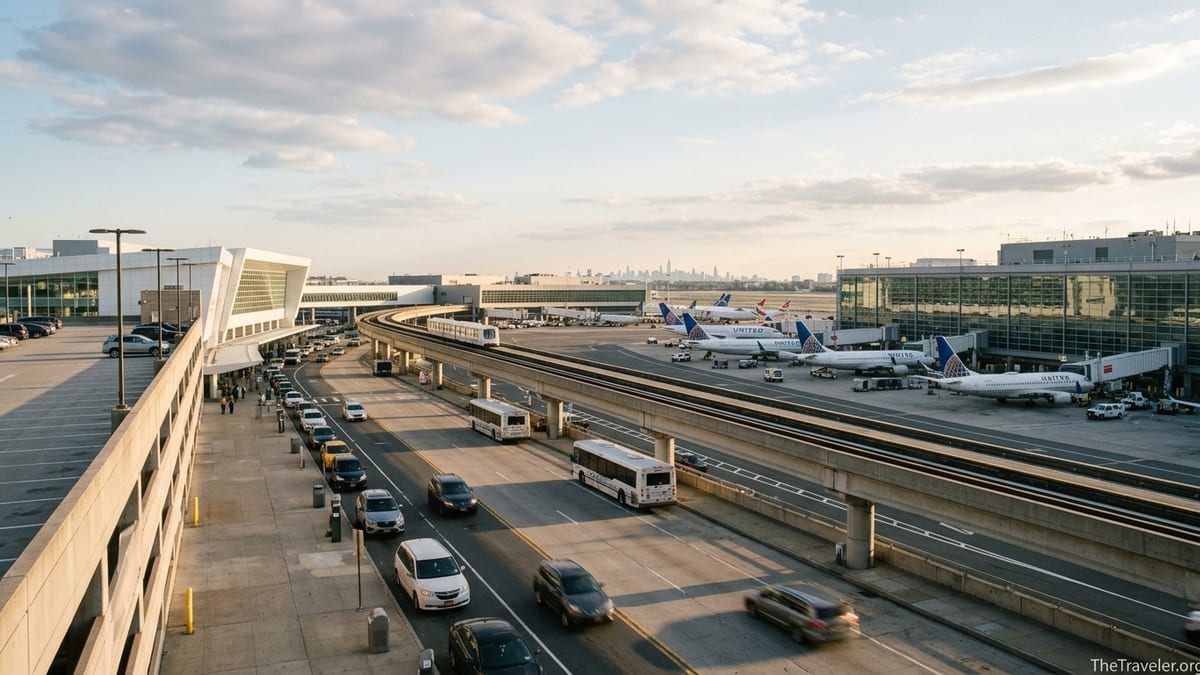
How Newark Liberty’s Terminals Are Laid Out
Newark Liberty International Airport has three main passenger terminals: A, B and C. They sit in a rough arc around the center of the airport, each with its own roadway access, curbside drop-off and security checkpoints. There is no single central hall like you might find at some European airports, and the terminals are not connected airside, so you cannot simply walk from one to another after you clear security.
Terminal A is the newest facility, a modern building that opened in 2023 to replace the original 1970s-era structure. It handles a mix of domestic and some cross-border flights for airlines such as Air Canada, American and JetBlue, along with several other carriers that have gradually moved into the new building. Travelers describe it as brighter and more spacious than the older terminals, with high ceilings, wide windows and more contemporary dining and retail options than the rest of the airport.
Terminal B sits in the middle of the complex and is the main base for many international airlines serving Newark. It handles a mix of long-haul and medium-haul international flights along with some domestic operations. If you are flying a European or transatlantic carrier that is not United, such as British Airways or Lufthansa, you will almost certainly be in Terminal B. The building is older than Terminal A, but it has gone through several rounds of renovation to expand departure halls, improve immigration areas and refresh waiting areas.
Terminal C, on the north side of the airport loop, is the hub of United Airlines and United Express. United dominates Newark and uses this terminal for the majority of its departures and arrivals. The layout features multiple concourses, a dense cluster of gates and an especially busy security area during morning and evening bank periods. If you are connecting between two United flights, there is a good chance you will stay entirely within Terminal C, but some regional and overflow operations may still arrive or depart from Terminals A or B, which is important for connections.
Which Airlines Use Which Terminal in Practice
Knowing your airline and final destination usually tells you where you need to be at Newark. United and United Express overwhelmingly use Terminal C for departures and arrivals, though some flights may use Terminal A or, less commonly, Terminal B at peak times. If you see United listed on your ticket with a departure gate starting with C, you are in United’s main hub terminal and should allow extra time for security queues during busy hours.
Most legacy U.S. carriers other than United use Terminal A or B. For example, American Airlines and JetBlue commonly operate from Terminal A, while Delta and Alaska Airlines typically use Terminal B. If you are flying on a low-cost or ultra-low-cost carrier to leisure destinations, there is a good chance your flight will depart from Terminal B, which has a mix of full-service and budget airlines sharing the same departure concourses.
Internationally, Terminal B handles the bulk of non-United foreign airlines. Long-haul European carriers, Middle Eastern airlines and some Latin American carriers generally arrive and depart from this building, which has the largest dedicated international arrivals and passport control facilities. United’s own transatlantic flights, however, still depart mainly from Terminal C, so do not assume that “international” automatically means Terminal B; always check your booking or boarding pass for the terminal letter.
The new Terminal A has been gradually gaining airlines as leases and gate allocations shift. Some regional partners of larger carriers now use its concourses, and more routes are likely to move there over the next few years as the Port Authority continues to rebalance operations between the three terminals. For now, the practical advice is simple: before you leave for the airport, confirm not just your gate, but your terminal letter, since moving between terminals adds time and complexity.
AirTrain Newark in 2026: Construction, Closures and Workarounds
For many years, the AirTrain monorail has been the backbone of terminal-to-terminal and rail station transfers at Newark. In 2026, it is in the middle of a multi-year replacement project, and service is no longer straightforward. As of mid-2026, weekday daytime service between the terminals and the Newark Liberty International Airport Rail Station is frequently suspended or replaced with buses to allow construction on the new system. Travelers cannot safely assume that they will be able to glide from a New Jersey Transit train to their terminal by hopping on the AirTrain during these times.
In practice, this means that if you arrive at the airport rail station on a weekday between early morning and mid-afternoon, you may be directed to a shuttle bus instead of the train. These shuttle buses typically run between the rail station and the airport’s central parking structures, where you then transfer to separate buses or, at times, a shorter AirTrain segment to reach the individual terminals. The ride that used to take roughly 7 to 10 minutes on a direct AirTrain can easily stretch to 25 to 40 minutes when buses are substituted, especially during peak travel times or in bad weather.
On evenings and weekends, the AirTrain schedule is more stable, but even then, construction-related slowdowns or partial closures are common. You might experience single-tracking, where trains in both directions share the same track, increasing the time spent waiting on the platform and riding between stops. Travelers who recently reported normal 7-minute journeys between the rail station and Terminal C on one trip have described 20-minute or even 50-minute transfers on another when track work forced diversions and bus replacements.
The key for 2026 is to build extra time into any itinerary that relies on the AirTrain. If you are coming from Manhattan on New Jersey Transit through Newark Penn Station, add at least 20 to 30 minutes on top of what you needed a few years ago. If you are making a tight international connection that requires switching terminals and using the AirTrain or shuttle buses, think of that transfer like a short regional flight: allow generous buffer time and have a backup plan, such as being prepared to use an on-airport taxi or app-based ride if the rail connection becomes too slow or crowded.
Moving Between Terminals: Airside Limits and Landside Options
One of the most important things to understand about Newark is that there is no simple, fully connected airside walkway between Terminals A, B and C. After you go through security in one terminal, you cannot walk to another terminal without exiting back to the public side, transferring, and then passing through security again. This is a major difference from some hub airports where all concourses sit inside a single secure zone.
Within the airport grounds, the AirTrain and replacement shuttle buses remain the official way to move between terminals without driving. When service is running normally, you can ride the train from Terminal A to B to C in just a few minutes, with clear signage at each station. During the current construction period, however, some segments may be bus-only, and routes can change week to week. For example, you might take a shuttle from Terminal A to a central parking station, then switch to another bus that loops to Terminal B and C.
There are also limited terminal-to-terminal shuttle buses that operate landside, especially for airline-directed connections. In some cases, United and its partners will direct connecting passengers from a regional arrival in Terminal A to a mainline departure in Terminal C using dedicated buses. These shuttles are typically signed at specific curbside points and not meant as a general public bus, so you should follow your airline’s directions and boarding pass instructions if you are booked on a protected connection.
If you are transferring on your own, such as arriving at Terminal B and later flying out of Terminal C on a separate ticket, the simplest choice may be to follow the official signs to the AirTrain or shuttle bus system. If you are short on time or traveling with a lot of luggage, taking a licensed taxi or app-based ride between terminals is allowed, though it can feel inefficient since the terminals are physically close but separated by a ring of one-way roads. Typical fares for a short on-airport ride are relatively modest compared with the cost of a city transfer, but traffic around the loop road during peak drop-off hours can add 10 to 20 minutes.
Getting To and From New York City and Beyond
Newark’s trains and transfers matter just as much for getting to and from the city as they do for moving around the airport itself. The classic rail option is to take New Jersey Transit or Amtrak to Newark Liberty International Airport Station and then connect to the AirTrain or its replacement buses. When the system runs smoothly, this route is competitive in both time and price compared with taking a taxi or rideshare from Manhattan. A typical off-peak New Jersey Transit fare from New York Penn Station to the airport rail station is often in the mid-teens in U.S. dollars, which can be significantly cheaper than a car service crossing the Hudson.
Because of the ongoing AirTrain replacement, however, that rail-to-terminal transfer has become less predictable. Many local travelers now prefer alternatives such as taking New Jersey Transit only as far as Newark Penn Station, then switching to an airport-bound bus, or using a direct car service from Manhattan neighborhoods where access to the rail network is less convenient. The right choice depends on your tolerance for uncertainty, luggage load and schedule. A solo traveler with a backpack may still favor the train-plus-bus combination, while a family with small children and checked bags might find a door-to-door car worthwhile, even if it takes a similar amount of time during off-peak hours.
By road, Newark Airport is served by a tangle of highways, including the New Jersey Turnpike and Interstate 78. In light traffic, a taxi or rideshare from Midtown Manhattan can reach the terminals in around 35 to 45 minutes, but during evening rush or in bad weather the same trip can easily stretch past an hour. Official yellow cabs and reputable car services typically quote flat or metered rates that, once you add tolls and airport surcharges, can come out to several times the price of a train ticket. For a practical example, a couple traveling from a Midtown hotel might pay something in the range of 80 to 120 U.S. dollars including tolls and tip for a taxi or black car, depending on traffic and service level.
For travelers heading to New Jersey suburbs, the balance often shifts. Towns along the Northeast Corridor or North Jersey Coast Line may be easy to reach by New Jersey Transit from the airport station when connections are running, while destinations elsewhere in the state may be faster by car. If you are catching a cruise out of Bayonne or staying in Jersey City, for instance, many people choose an app-based ride or prebooked shuttle, especially in the current period of AirTrain disruptions, to avoid changing trains and buses with luggage.
Making Tight Connections and Planning Extra Time
Because Newark combines a busy United hub, a major international gateway and a construction-challenged ground system, connection planning is critical. If you are booking a through-ticket on a single airline, the airline’s reservation system will only offer legal connection times that account for typical transfer delays. Even so, if your itinerary shows a domestic-to-international connection of less than 90 minutes and involves changing terminals, consider whether you are comfortable with the risk, especially during peak holiday periods or in winter weather.
For self-connecting passengers traveling on separate tickets, it is prudent to think in terms of three time blocks: time to deplane and reach the curb, time to move between terminals or from the rail station, and time to clear security or immigration. A domestic arrival into Terminal C with only carry-on luggage might see you curbside in 15 to 20 minutes if the aircraft parks at a nearby gate, while a wide-body international arrival into Terminal B with checked bags and a full passport hall can easily take an hour or more before you even reach the public side.
Once you are landside, build in a realistic buffer for transfers. With the AirTrain replacement project in full swing, a conservative estimate for moving from one terminal to another using train segments and shuttle buses is at least 30 minutes, and more during peak times. Security wait times at Newark are highly variable: early morning and late afternoon banks of flights for business travelers can see long lines, while mid-day periods might move faster. If you must clear security at a new terminal as part of your connection, arriving at the checkpoint at least 60 to 90 minutes before departure will reduce the risk of missing boarding.
Concrete scenarios illustrate how quickly time evaporates. A traveler arriving from Chicago on United into Terminal C at 4:30 p.m. with a separate 6:30 p.m. international departure on a European carrier out of Terminal B faces a tight but possible connection. They might spend 20 minutes taxiing and deplaning, 10 minutes walking to the AirTrain or shuttle bus, 20 minutes in transit to Terminal B during a construction-affected period, and then 30 to 40 minutes clearing security and reaching the gate. Any delay at the first step, such as a late arrival or a longer transfer wait, could put the second flight at risk. For this reason, many experienced travelers avoid planning cross-terminal self-connections at Newark with less than three hours of buffer.
Practical Tips for a Smoother Newark Experience
A handful of simple habits can make Newark’s complicated layout and construction easier to manage. First, always confirm your terminal and gate on the day of travel using your airline’s app or a current departure board. Gate assignments at Newark can change within a terminal, and occasionally, flights are reassigned between terminals when operational needs shift, especially in bad weather.
Second, plan your route before you leave home. If you are taking public transportation, look up the latest alerts and advisories specific to Newark Liberty International Airport and New Jersey Transit so that you know whether the AirTrain is partially suspended, replaced by buses, or operating on a modified schedule. A traveler catching a Sunday morning flight might find the AirTrain running more smoothly and choose the rail option, while a weekday mid-afternoon passenger facing a posted closure between the rail station and terminals might opt for a direct taxi from Newark Penn Station instead.
Third, think about baggage and mobility. If you are traveling with heavy suitcases, a stroller or mobility aids, every extra transfer adds physical strain. A family of four arriving at Newark Penn might find that the combination of commuter rail, shuttle bus, and crowded AirTrain platforms is simply too cumbersome with children and bags, making a prebooked van between the station and their hotel a better choice, even if it is slower on paper. Conversely, a solo backpacker can take advantage of rail plus shuttle options that cost less and still arrive on time with some built-in cushion.
Finally, have realistic expectations. Newark in 2026 is a work in progress, with a modern new Terminal A and a long-term AirTrain replacement under way. This means that walking routes, shuttle stops and even parking layouts can change from month to month. Treat signage, announcements and airline instructions as your primary guide once you are at the airport, and remain flexible about using whichever combination of train, shuttle and road transport is working best on the day you travel.
FAQ
Q1. How long does it take to transfer between terminals at Newark Airport in 2026?
Transfer times vary widely because of AirTrain construction. In light conditions with trains running, moving from Terminal A to C can take around 10 to 15 minutes. When shuttle buses replace parts of the route or during peak congestion, you should plan for at least 30 minutes, and longer if you must clear security again in the new terminal.
Q2. Can I walk between terminals at Newark Airport without going through security again?
No. Newark’s terminals are not connected airside, and there is no continuous secure walkway between Terminals A, B and C. To move between terminals, you must exit to the public side, use the AirTrain or shuttle buses or a road vehicle, and then pass through security again at your new terminal.
Q3. Is the AirTrain at Newark completely closed in 2026?
The AirTrain is not completely closed, but it operates on a heavily modified schedule because of the replacement project. At certain hours, especially on weekdays between morning and mid-afternoon, service between the airport rail station and the terminals is often replaced by shuttle buses. At other times, trains run with delays or single-tracking. Always check current airport advisories before relying on the AirTrain for a tight connection.
Q4. Which terminal does United Airlines use at Newark Airport?
United Airlines primarily uses Terminal C at Newark, where it operates its hub, but some United and United Express flights may arrive or depart from Terminal A or, less frequently, Terminal B. Your boarding pass or airline app will show the correct terminal and gate, and you should confirm this on the day of travel in case of reassignment.
Q5. If I take New Jersey Transit from New York City, how do I reach my terminal?
You will get off at Newark Liberty International Airport Station. From there, depending on the day and time, you may transfer to the AirTrain or to a shuttle bus that replaces it for part of the route. Follow station signs and staff directions to board the correct service for Terminals A, B or C, and allow extra time because construction can lengthen the transfer.
Q6. How early should I arrive at Newark for an international flight?
Given the combination of busy security lines, possible AirTrain or shuttle delays and immigration formalities, arriving at the airport at least three hours before a standard international departure is sensible. If you are connecting from another terminal or from the airport rail station, build in additional buffer time on top of that, especially during holiday periods or severe weather.
Q7. Are there free shuttles between Newark Airport terminals?
Yes. The systems that replace or supplement the AirTrain, including shuttle buses, are free to use within the airport complex. They connect the terminals, parking structures and the airport rail station. While these services do not charge a fare, they may be crowded during peak hours and can take longer than the direct AirTrain trips that travelers remember from before construction.
Q8. What is the best way to get from Manhattan to Newark Airport right now?
The best way depends on your priorities. New Jersey Transit trains from New York Penn Station to the airport station remain one of the most cost-effective options, but require a connection to the AirTrain or shuttle buses, which can add uncertainty. Taxis and app-based rides offer a simpler door-to-door journey at a higher cost and are less affected by rail construction, but they can be slow during rush hour traffic and incur tolls and surcharges.
Q9. I have separate tickets that require changing terminals. How much time do I need?
If you must collect luggage, change terminals and check in again, it is wise to allow at least three hours between flights for domestic-to-domestic self-connections, and even more for domestic-to-international or international-to-domestic combinations. This cushion accounts for possible delays in deplaning, baggage claim, shuttle or AirTrain transfers, and security queues.
Q10. Is the new Terminal A easier to use than the older terminals?
Many travelers find the new Terminal A more pleasant, with brighter spaces and upgraded amenities compared with the older terminals. However, it is located slightly apart from the original cluster of buildings, which means transfers can feel longer when AirTrain service is disrupted. If you are departing from Terminal A, make sure you factor in the time needed to reach it from the rail station or other terminals during the ongoing construction period.