


Administrative procedures in Mexico are a recurring friction point for expatriates. Although the country has announced multiple simplification and digitalization initiatives, expats still report long waits, inconsistent requirements, and opaque timelines when dealing with public offices. Understanding why paperwork can move slowly is essential for evaluating the practical feasibility and day‑to‑day predictability of a relocation to Mexico.
Systemic Characteristics of Mexican Bureaucracy
Mexico’s public administration is characterized by complex institutional structures, overlapping jurisdictions, and extensive procedural rules. Various international governance assessments describe the country’s government effectiveness and regulatory quality as moderate relative to OECD levels, indicating that procedures exist but are not always implemented with speed or consistency. For expats, this translates into a system where the legal framework may be clear on paper while the operational delivery of services is uneven.
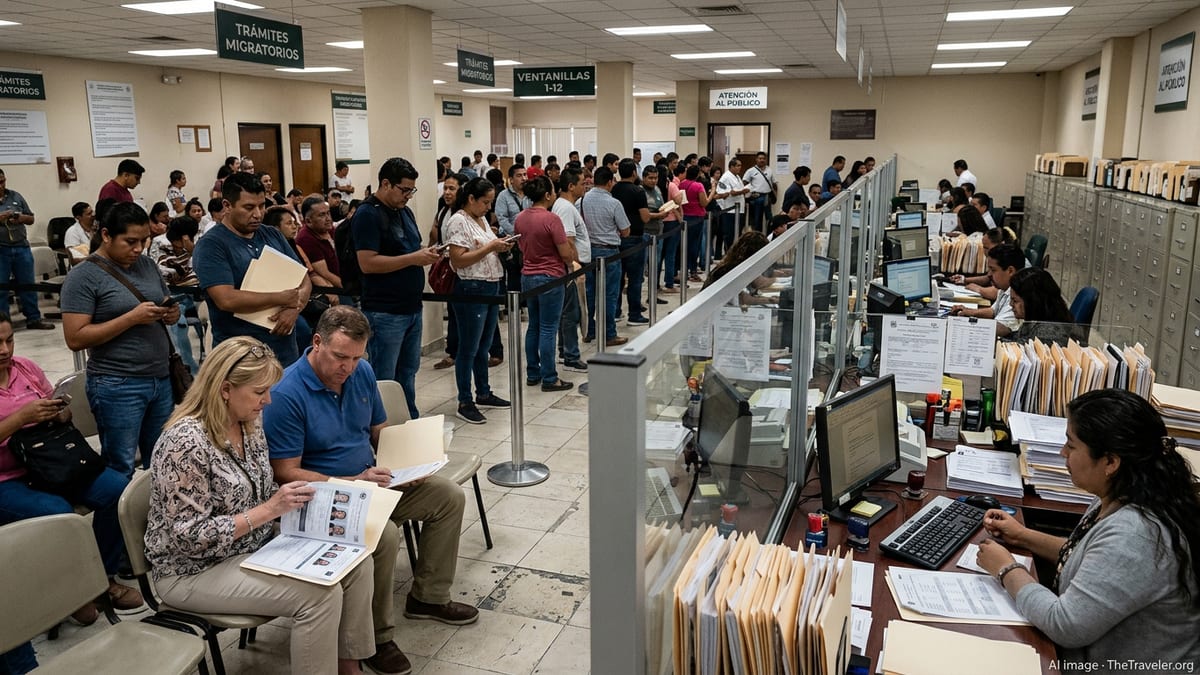
Many procedures relevant to foreigners, such as registration with municipal authorities, driver’s licenses, and some civil registry actions, involve multiple agencies. Each agency may require its own copies of documents, original signatures, or in‑person appearances. This fragmentation creates sequential rather than parallel processing. A file typically has to move step by step through different desks and departments, which increases overall processing time and the risk of bottlenecks.
The legacy of a paper‑based administrative culture also contributes to slowdowns. Offices often maintain both physical and digital records, and clerks may prioritize paper files over electronic submissions. This dual system can lead to backlogs when staff must reconcile records, search archives, or physically route folders for signatures. Expats accustomed to fully digital workflows in their home countries may perceive these lags as exceptional, even though they are structurally embedded in Mexico’s bureaucracy.
Finally, staffing levels and resource allocation are frequently cited as constraints. Public agencies outside major cities may operate with limited personnel and outdated equipment. When workloads increase suddenly due to policy changes, economic shocks, or seasonal demand, offices struggle to absorb additional volume, resulting in longer queues and slower case progression for both locals and expats.
Legal Formalism, Notarization, and Document Requirements
Mexico is a civil‑law country with strong traditions of legal formalism. Many actions that would be handled administratively in common‑law jurisdictions require notarized instruments or detailed documentary evidence. Notaries in Mexico are public officials with quasi‑judicial authority rather than simple witnesses, so their participation often implies more elaborate checks and more lead time to secure appointments and approvals.
For expats, high documentary thresholds can be a major driver of delays. Public offices commonly ask for multiple forms of identification, certified copies, apostilles for foreign documents, and official translations into Spanish by government‑recognized translators. Each of these prerequisites has its own processing time and, in some cases, separate appointment systems. A single missing certification can push an application into a “pending documentation” status that stalls progress for weeks.
Inconsistency in requirements across offices compounds the problem. While national regulations exist, front‑line offices often interpret them differently. Two branches of the same institution in different states or municipalities may request additional forms, specific wording in letters, or extra proofs of address. Expats report needing to redo affidavits or obtain fresh bank letters because the original format did not match local expectations, even though it was technically compliant. This trial‑and‑error dynamic prolongs procedures.
The cautious approach to documentation has rational foundations: public officials are personally accountable for authorizing changes to civil status, residence records, and other sensitive data. To avoid internal audits, they may strictly enforce checklists and decline to exercise discretion, even for minor discrepancies. The result is lower risk tolerance at the counter and a higher likelihood of applications being rejected or delayed for formal defects.
Digitalization Efforts and Uneven Implementation
Mexico has launched national programs to simplify and digitalize administrative procedures, including a drive to reduce the number of federal procedures and the average number of requirements per procedure. Recent measures have reportedly cut the catalogue of federal procedures by roughly half and reduced the average number of requirements from around six to four per procedure, signaling a policy commitment to streamlining. At the federal level, a digital identity system has been introduced to support online transactions with multiple agencies.
However, implementation remains uneven by agency and region. While some federal services now offer full online submission and tracking, others only provide partial digitalization, such as appointment booking or initial pre‑registration, with final validation and document delivery still conducted in person. For expats, this hybrid environment can create unrealistic expectations. A process marketed as “online” may still require several office visits and physical signatures, extending timelines beyond what digital interfaces suggest.
State and municipal governments, which handle many everyday procedures impacting expats, frequently lag behind federal initiatives. Local systems may not be integrated with national platforms, forcing applicants to reenter data or resubmit documents. Technical outages, limited server capacity, and insufficient staff training on new systems can further slow processing. In smaller cities, staff may default to manual workarounds when digital platforms fail, reverting to paper queues that add days or weeks.
Another issue is the transition period during which old and new processes coexist. When an agency revises its forms or migrates to a new platform, there is typically a phase of internal adjustment. During these periods, expats may encounter conflicting information between websites, call centers, and office windows. Files can be delayed while staff verify which rule set applies, leading to unexpected extensions of processing time.
Institutional Risk Aversion, Audits, and Corruption Concerns
Institutional risk aversion plays a significant role in the pace of paperwork. Mexican public officials operate under strict audit regimes and are expected to demonstrate that each step of a procedure complied with regulations. In contexts where corruption has historically been a concern, agencies often respond by adding layers of review and documentation. This can slow honest applications, including those of expats, as files are scrutinized and rechecked.
International research on Mexico’s governance has frequently highlighted bureaucratic inefficiency and corruption risks as obstacles to doing business. Although not all offices are affected equally, the perception that missteps may attract internal sanctions leads many officials to favor procedural safety over speed. Applications may be passed through multiple supervisors for sign‑off, and borderline cases are more likely to be deferred than resolved on the spot.
Expats may also encounter informal expectations that “urgent” handling is exceptional and must be justified. Where discretionary acceleration is permitted, front‑line staff may be hesitant to use it for foreign applicants due to language barriers or fear of appearing to give preferential treatment. As a result, expat files often remain in the standard queue even when applicants present strong reasons for urgency, such as expiring contracts or travel constraints.
It is important to note that while isolated reports of petty corruption persist in some regions, national anti‑corruption campaigns and increased public scrutiny have made direct facilitation through unofficial payments more risky for officials. This can paradoxically slow down processes in the short term as agencies tighten controls and require more thorough documentary support before approving requests.
Operational Factors: Seasonality, Capacity, and Regional Variations
Processing times in Mexico are influenced by operational factors that vary across the calendar year and by location. Certain months, such as March and April for tax‑related procedures or the end of the calendar year for permits and renewals, are peak periods when workloads spike sharply. During these times, offices experience heavier foot traffic, longer appointment lead times, and slower response rates to inquiries. Expats whose cases coincide with peak seasons may see timelines extend significantly beyond published averages.
Capacity constraints are more acute outside major metropolitan areas. Smaller cities and rural municipalities may have only a few staff members authorized to handle specific procedures. If one key official is on leave or reassigned, files can stagnate until their return or replacement. Equipment failures, such as issues with biometric capture devices or card printers, can further delay the issuance of physical documents even when the underlying approval has already been granted.
Regional variations in administrative culture and local practice also affect speed. Some states are known for relatively efficient document handling and clear communication, while others have reputations for more rigid interpretations of rules or slower responsiveness. Within the same national framework, an expat in one state may complete a given procedure in a matter of days, whereas another expat in a different state faces a wait of several weeks for the identical transaction.
In addition, coordination between federal and local authorities can be a source of delay. Procedures that require both federal authorization and local registration, such as certain civic or professional registrations, may stall if data synchronization between systems is slow. Files can sit in queues while offices wait for confirmations or updated records from counterpart agencies, with applicants receiving little proactive communication about the cause of the delay.
Language, Documentation Quality, and Expats’ Learning Curve
Language barriers significantly influence the pace of paperwork for many expats in Mexico. Official procedures are conducted in Spanish, and forms, instructions, and legal references are seldom available in other languages. Applicants who rely on informal translations or partial understanding of requirements are more likely to submit incomplete or incorrectly formatted documents, leading to rejections or requests for clarification that extend timelines.
Document quality is another critical factor. Mexican authorities often require that foreign documents be recent, certified, and, where necessary, apostilled. If an expat submits an older certificate or a bank letter that does not specify key details in the expected format, the application may be accepted provisionally but later placed on hold pending updated paperwork. Obtaining corrected documents from abroad introduces international mailing times or separate digital processes in the home country, adding weeks to the overall process.
The learning curve associated with understanding Mexican administrative expectations amplifies these issues. New arrivals may underestimate the need for exact matches in names, addresses, and dates across all documents, or may not anticipate that minor discrepancies will trigger additional verification steps. Once an application is flagged for review, even a simple clarification can take time to filter through internal channels, particularly when communication occurs only through in‑person visits.
Over time, expats who familiarize themselves with local practices, engage certified translators, and prepare comprehensive document sets tend to experience smoother interactions. However, this adaptation period can be lengthy and may coincide with critical early relocation milestones, such as registering with local authorities or updating key records, when delays are especially disruptive.
The Takeaway
Paperwork in Mexico can be slow for expats due to a convergence of structural, institutional, and practical factors. Complex bureaucratic structures, a strong culture of legal formalism, incomplete and uneven digitalization, institutional risk aversion, and resource constraints all contribute to longer and less predictable processing times. Language barriers and documentation issues specific to foreign applicants further increase the likelihood of delays.
For relocation planning, these dynamics imply that administrative timelines in Mexico should be considered conservative estimates rather than fixed commitments. Expats evaluating a move should assume that common procedures may require multiple visits, additional documentation rounds, and waiting periods that extend beyond official service standards. The country is actively pursuing simplification and digitalization, but the transition from paper‑heavy, risk‑averse practices to agile, integrated administration is gradual.
In practical terms, a relocation to Mexico is more viable for individuals and organizations that can tolerate procedural uncertainty, build contingency time into project plans, and invest in high‑quality preparation of documentation. Where administrative predictability is a critical requirement, prospective expats should factor the current pace of paperwork into their decision‑making as a material operational constraint, rather than viewing it as a minor inconvenience.
FAQ
Q1. Are paperwork delays in Mexico the same across the whole country?
Delays vary notably by state, municipality, and even individual office. Larger cities often have more resources and experience handling foreign applicants, while smaller jurisdictions may process more slowly due to limited staff and less standardized practices.
Q2. How much longer should expats expect procedures to take compared with their home country?
There is no universal ratio, but expats frequently report that procedures can take several weeks instead of days, and may require multiple office visits. As a planning assumption, building in at least double the time typically needed in a highly digitalized country is prudent.
Q3. Does digitalization mean that paperwork in Mexico is now fast for expats?
Digitalization has improved access and reduced some paperwork, but the transformation is incomplete. Many procedures are only partially online and still involve in‑person validation or physical document issuance, so overall timelines may remain longer than expats expect.
Q4. Why do offices sometimes give different information about the same procedure?
Differences arise from local interpretations of regulations, varying levels of staff training, and transitional periods when new rules or platforms are being rolled out. As a result, one office may apply updated criteria while another still follows earlier guidance.
Q5. How important are notarizations and apostilles in slowing paperwork?
They are significant contributors to delays. Many Mexican procedures require notarized documents and, for foreign papers, apostilles and official translations. Obtaining and coordinating these elements adds extra steps, appointments, and potential mailing time.
Q6. Do language barriers directly affect processing speed?
Yes. Misunderstandings about requirements, incomplete forms, and incorrect document formats are more likely when applicants are not fluent in Spanish. Each correction or clarification can add days or weeks to the process, especially when handled only in person.
Q7. Are longer waits in Mexico mainly due to corruption?
Corruption concerns have influenced how procedures are designed, encouraging more controls and documentation. However, most expat delays are driven by structural issues such as complex rules, capacity constraints, and risk‑averse internal practices, rather than direct demands for bribes.
Q8. How much do seasonal peaks affect expats’ paperwork timelines?
Seasonal peaks can substantially increase wait times for appointments and processing, sometimes doubling or tripling normal durations. Procedures initiated during tax season or year‑end renewal periods are especially exposed to congestion.
Q9. Can using local professionals eliminate delays completely?
Local lawyers or facilitators can reduce errors, clarify requirements, and optimize appointment scheduling, which often shortens timelines. However, they cannot control institutional bottlenecks, peak workloads, or system outages, so some delays remain unavoidable.
Q10. Is the situation improving for expats over time?
Policy initiatives to simplify and digitalize procedures indicate gradual improvement, especially at the federal level. Nonetheless, change is incremental and uneven, so expats should continue to plan for conservative timelines while recognizing that certain processes are slowly becoming more efficient.