


For prospective expats, interaction with Mexico’s immigration offices is a decisive operational factor in any relocation plan. The National Institute of Migration (Instituto Nacional de Migración, INM) administers in-country procedures such as exchanging visas for residency cards, renewals, changes of status and exit permits. Understanding how these offices work in practice, and how experiences vary across regions, is essential for evaluating whether a move to Mexico is administratively feasible and how much time and resilience the process is likely to require.
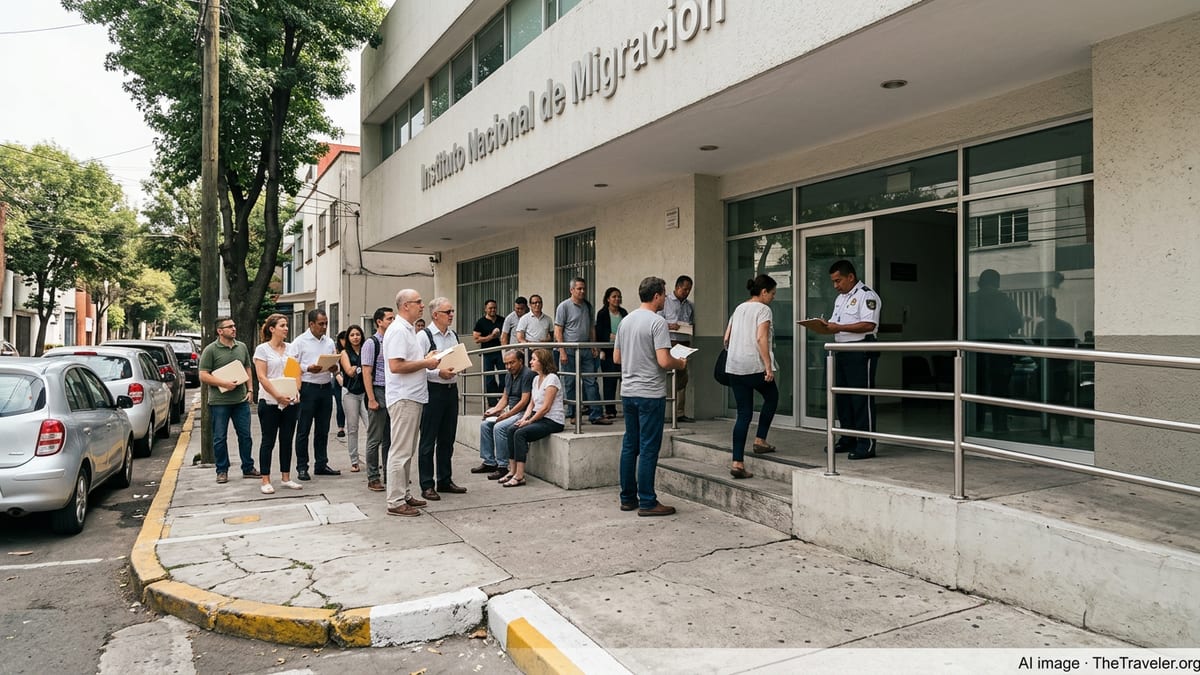
Institutional Role of INM and What Happens Inside the Offices
Mexico’s immigration offices are field representations of the National Institute of Migration, an agency under the Interior Secretariat responsible for implementing immigration law, issuing residency documents and managing foreign nationals’ stay within Mexican territory. For expats, consulates abroad handle visa issuance, but virtually all post-arrival steps, including exchanging a pre-approved residency visa for a physical card (canje), renewing residency, changing employers or addresses and requesting exit-and-reentry permits, occur at local INM offices.
Inside a typical INM office, procedures are divided between intake, document review, payment verification, biometrics and card delivery. Applicants first submit or confirm forms and supporting documents, receive a file number, then wait for internal review. If the file is accepted, biometric capture (photo, fingerprints and signature) is scheduled, after which the office prints and releases the residency card. Many offices complete these stages in two or three visits; a minority still manage same-day processing, but this is increasingly the exception rather than the norm according to recent practitioner reports.
INM offices also enforce compliance with statutory deadlines. For example, foreign nationals arriving with a temporary or permanent residency visa generally must initiate their visa-to-card exchange at the office corresponding to their Mexican address within 30 calendar days of entry, or risk losing the approval and having to restart at a consulate. This deadline is monitored using entry records and creates time pressure that significantly shapes expat experiences with local offices.
In parallel with services to document-holding expats, some INM offices manage detention and enforcement operations, particularly at border locations. While this side is generally not relevant for financially qualified or employer-sponsored expats, it does influence office workloads, staffing pressures and public perceptions of the agency, which in turn can affect service quality and delays.
Appointment Systems, Queues and Office Variability
Access to INM services is now dominated by appointment systems, though implementation varies. After a period of suspension, the centralized online appointment platform was reactivated in September 2024 for many procedures and offices, making it possible in principle to secure a date and time slot digitally instead of queuing at dawn. In practice, larger-city offices see high demand and released slots can be taken within minutes, requiring applicants or facilitators to monitor the system closely.
Smaller regional offices and some local representations still rely on in-person or mixed systems. In these locations, expats may need to appear early in the morning to receive a same-day token or an assigned future appointment. Reports from various regional cities describe lines forming well before opening hours, with daily quotas that can be exhausted quickly in high season. Inevitably, this introduces uncertainty: being present at the office does not always guarantee that a file will be accepted that day.
Differences between offices are pronounced. Metropolitan offices such as Mexico City, Guadalajara or Cancún may offer more predictable digital appointment flows but tend to have heavier backlogs, while mid-size cities sometimes process cases in fewer calendar days but require more hands-on navigation. Local interpretations of national rules can also diverge, with some offices insisting on additional documents, specific formats or stricter timing than others. For relocation planning, this means expats should base expectations on the practices of the particular office that corresponds to their intended address, not on generic descriptions of the Mexican system.
Seasonality compounds the variability. Offices typically reduce operations or close to the public for a prolonged holiday period from approximately the third week of December until early January. During this window, no processing progress occurs and appointment availability immediately before and after the closure is compressed. Expats with cards expiring between mid-December and late January or with 30-day canje deadlines spanning that period need especially careful scheduling.
Processing Timelines and Frequency of Office Visits
For expats holding a pre-approved temporary or permanent resident visa, exchanging that visa for a resident card through INM is the first substantive interaction with an immigration office. Current anecdotal and practitioner data indicate that, once the initial appointment has taken place and the file is properly documented, most visa-to-card exchanges are completed within roughly two to four weeks, though stated ranges often cluster around three weeks for straightforward cases in busier offices. Smaller or less burdened offices can be faster, sometimes finalizing cards within days of biometrics, while overextended locations may extend to several weeks.
Several distinct phases drive the actual timeframe. First is the wait for an initial appointment, which can range from a few days to several weeks depending on local capacity and demand. Second is the internal review period between file submission and biometric scheduling or issuance of the official communication authorizing the next step. Third is card printing and release, which may be same-day after biometrics in some cities but deferred for a week or more in others. Each phase usually requires at least one physical visit to the office, and expats should plan for two to three visits for a basic canje under current practices.
Follow-on interactions add further complexity. Annual or multi-year renewals of temporary residency, changes from temporary to permanent status after four years, employer changes, or address updates all involve separate filings and processing cycles. Official guidance often states target timeframes in the range of 20 working days for certain procedures, but real-world outcomes can be shorter or longer, especially where files trigger additional review or where an office is facing staffing constraints or surges in humanitarian caseloads.
The operational consequence for relocation planning is that expats should allow generous time buffers both in their personal schedules and in any linked arrangements such as housing, employment onboarding or international travel. Expecting rapid, one-day results from INM is increasingly unrealistic outside a few specific offices and circumstances.
Documentation, Forms and Payment Logistics Inside INM
Interactions with immigration offices in Mexico are document-intensive, and documentation standards are enforced primarily at the office counter, not at the consulate that granted the initial visa. Core requirements include the official application form for each procedure, copies of passports and visas, proof of legal entry, photos where required, and supporting evidence for the specific process such as proof of address in Mexico, employer registration, civil status documents or financial proofs, depending on the case type.
Applicants are usually expected to arrive with printed forms and copies prepared, although some offices provide basic copying services. Many expats find that minor inconsistencies in names, addresses or dates can result in rejection or the need to resubmit, as front-line staff follow internal checklists closely. Documents in foreign languages may need to be accompanied by certified translations, and civil records can be required with apostilles or other legalization, which must be obtained before arrival in Mexico.
Payment of government fees is commonly handled via bank deposits or online payments using reference numbers generated from INM’s systems, with receipts presented at the office. This two-step structure means expats must often leave the office to visit a bank or complete an electronic payment and then return with proof of payment, either on the same day or at a subsequent appointment. Mis-typed reference numbers or incomplete payments can delay processing and require corrective visits.
Because communication within INM is primarily in Spanish, expats without functional Spanish language skills may face additional difficulties in understanding oral instructions, checking that forms are correctly completed or clarifying discrepancies. While English-speaking staff exist in some locations, this is not systematic. Many relocating professionals therefore engage interpreters or immigration facilitators to reduce the risk of procedural errors during office visits.
Service Quality, Transparency and Risk Factors
Service quality at Mexico’s immigration offices is mixed and highly location-specific. On the positive side, many expats report courteous treatment and efficient handling where files are complete, particularly in offices that have embraced standardized digital workflows. In these settings, applicants who follow instructions precisely may complete essential steps with minimal friction aside from waiting times and queue management.
However, there are recurring themes of unpredictability and limited transparency. Processing times can fluctuate week to week without public explanation, office rules may change with little advance notice, and staff may interpret national guidelines differently even within the same state. It is not uncommon for two expats with similar profiles to have meaningfully different experiences depending on which official receives their file. This inconsistency makes it difficult to produce firm guarantees for employers or assignees regarding exact durations or required number of visits.
Allegations of informal payments and irregular practices surface periodically, especially in high-demand coastal cities and popular retirement destinations. While this is not universal and should not be assumed as standard, expats may encounter situations where third parties claim that “express” handling is available for a fee beyond official tariffs. Official policy prohibits such behavior, and engaging in it carries legal and ethical risks. From a risk-management perspective, corporate mobility programs typically insist that all interactions with INM remain within formal channels and documented fee structures.
Another risk factor is the potential for policy or leadership changes to ripple through office practices. Adjustments to national residency criteria, scrutiny of particular visa categories or shifts in enforcement priorities can slow processing across the network while staff adapt to new rules. For expats, this means that processes that were swift in prior years may become slower or more exacting in subsequent seasons, and vice versa. Continuous monitoring of on-the-ground conditions therefore becomes an important component of any long-term assignment planning to Mexico.
Security, Environment and Practicalities at Immigration Offices
The physical environment surrounding immigration offices in Mexico is an important practical consideration for expats. Offices are often located in central administrative districts or suburban government complexes and are typically guarded, with controlled entry and security screening. Crowding is common during morning hours when most appointments and walk-in slots begin, which can produce long outdoor waits in hot or rainy weather in some regions.
The client mix is diverse, including retirees, corporate assignees, students and humanitarian migrants. In certain border and southern locations, high volumes of asylum seekers and irregular migrants interact with the same or adjacent facilities, and the wider security context can be more complex. While expats handling standard residency procedures are generally insulated from detention operations, the presence of multiple client groups can contribute to noise, congestion and heightened police or military presence near some offices.
Waiting times inside can be lengthy, with applicants often spending several hours for document intake, internal review and return of passports or receipts, even when an appointment exists. Facilities range from modern, well-ventilated waiting rooms with electronic queue systems to older spaces with limited seating. Access to food, water and restrooms may be inconsistent, so expats are advised to plan accordingly, particularly when attending with children or dependents.
Personal security incidents inside INM offices directed at routine expats appear relatively uncommon, but standard urban precautions apply. Keeping documents secure, avoiding displays of valuables and using registered taxis or reputable transportation to and from offices is prudent. For higher-risk border areas, corporate security teams may recommend escorted visits or scheduling during daylight hours only.
Practical Strategies for Managing INM Interactions
Given the operational realities of immigration offices in Mexico, expats and employers can take specific steps to reduce friction. First, precise calendar planning is critical. This includes counting 30-day windows from entry for visa-to-card exchanges, tracking card expiry dates several months in advance for renewals, and avoiding exposure to the December office closures and local public holidays that reduce appointment availability.
Second, documentation preparation should be treated as a project in its own right. Applicants should assemble multiple copies of all key documents, prepare Spanish translations and legalizations where required, and verify that names, dates and addresses match exactly across passports, consular visas, Mexican tax registrations and lease or property contracts. Investing extra effort to verify form data before appearing at an office significantly reduces the likelihood of repeat visits.
Third, where budget permits, using experienced local immigration counsel or facilitators can materially improve outcomes. Such professionals are familiar with the specific practices of the designated INM office, maintain up-to-date knowledge of local document preferences and appointment systems, and can pre-screen files for issues likely to trigger delays. Their fees are an additional relocation cost but can mitigate the business impact of assignment delays or failed filings.
Finally, expats should adopt realistic expectations about pace and communication. It is common for offices to provide no interim updates between filing and card readiness, and information channels such as phone lines or email addresses may be unresponsive. Building slack into relocation schedules, avoiding non-refundable travel bookings during critical processing windows and maintaining contingency plans for delayed cards or exit permits is essential for operational resilience.
The Takeaway
Dealing with immigration offices in Mexico is a central operational element of any relocation to the country. Experiences are shaped by the specific INM office, the timing of applications, the completeness of documentation and the applicant’s ability to navigate Spanish-language administrative procedures. While many expats successfully obtain and maintain residency through these offices each year, the process is rarely frictionless and should not be viewed as a simple formality.
From a decision-making standpoint, prospective expats and employers should factor in that residency procedures will likely require multiple in-person visits, waiting periods that extend over several weeks and ongoing interaction with a system that can be inconsistent and occasionally opaque. With careful planning, professional support and realistic timelines, these challenges are manageable for most qualified applicants, but they represent a material component of the overall relocation burden and should be weighed accordingly when evaluating Mexico as a long-term destination.
FAQ
Q1. How many visits to an immigration office should expats typically expect for the initial residency card?
Most expats should plan on at least two to three visits to their local INM office for the initial visa-to-card exchange: one for file submission, one for biometrics if not done on the same day and one for collecting the card if the office does not issue it immediately after biometrics.
Q2. How long does it usually take for Mexican immigration offices to issue a residency card after the first appointment?
For straightforward cases in many urban offices, current practice is that cards are typically issued within roughly two to four weeks after the initial appointment, although local backlogs can make processing faster or slower.
Q3. Are online appointments available at all Mexican immigration offices?
Many, but not all, INM offices use the national online appointment system for certain procedures, especially in larger cities. Smaller or regional offices may still rely on in-person booking or mixed methods, so availability depends on the specific office that corresponds to the applicant’s address.
Q4. What happens if an expat misses the 30-day deadline to start the visa-to-card exchange at INM?
If the 30-calendar-day window after entry is missed, the residency pre-approval can be considered lapsed, and in many cases the applicant must restart the process from a Mexican consulate abroad. Some offices may allow late filings in exceptional situations, but this cannot be relied upon.
Q5. Do Mexican immigration offices commonly offer same-day processing for residency cards?
Same-day completion still occurs in a limited number of offices and for certain straightforward cases, but it is no longer typical nationwide. Most expats should assume that at least several days to a few weeks will pass between the first appointment and card delivery.
Q6. Is Spanish required to deal effectively with immigration offices in Mexico?
Spanish is the working language inside INM, and most written instructions and verbal communications occur in Spanish. While some staff may speak basic English in larger cities, expats without Spanish skills generally benefit from bringing an interpreter or working with a local immigration facilitator.
Q7. Are there particular times of year when Mexican immigration offices are especially slow or closed?
Yes. Activity usually slows significantly toward the end of the year, with many offices closing to the public from roughly the third week of December until early January. Local public holidays and peak tourist or relocation seasons can also reduce appointment availability and extend processing times.
Q8. How standardized are document requirements across different INM offices?
Core national requirements are similar, but offices often apply them with local variations and may request additional documents or specific formats. This means that what was sufficient in one city may not be accepted in another, so applicants should follow instructions from the office responsible for their address.
Q9. Is it safe for expats to visit immigration offices in Mexico?
Most expats complete their immigration office visits without security incidents, especially in major cities. However, offices can be crowded, and some border locations have more complex security environments, so standard precautions such as safeguarding documents and visiting during daylight hours are advisable.
Q10. Should expats use third-party agents to deal with immigration offices, and are unofficial payments expected?
Using reputable immigration lawyers or facilitators is common and often helpful, especially for non-Spanish speakers. Unofficial or informal payments to accelerate processing are not part of the formal system and pose legal and ethical risks, so they should be avoided in favor of transparent, documented service relationships.