


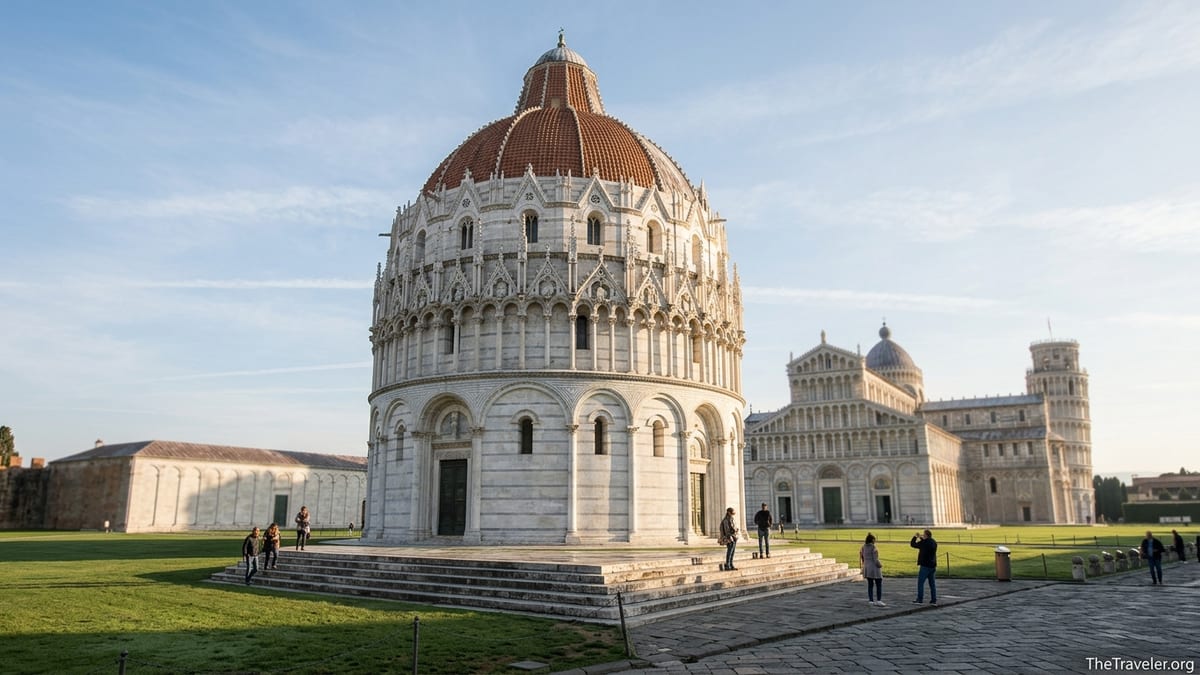
Travelers often arrive in Pisa focused on a single photograph of the Leaning Tower, yet the first sacred space that medieval worshippers encountered was not the tower or even the cathedral. It was the circular, white‑marble Baptistery of St John, standing like a stone lantern at the western edge of the Piazza dei Miracoli. To understand why Tuscany’s religious history still matters in the present, you have to begin at this doorway of faith, where generations of Pisans were baptized, choirs still test the haunting acoustics, and visitors step into a living echo of Christian ritual.
Get the latest updates straight to your inbox!
The Baptistery as the First Threshold of Faith
When the Baptistery of St John was begun in the mid‑12th century, Pisa was a maritime power whose ships sailed from the Arno estuary to Spain, North Africa, and the eastern Mediterranean. Before a child in the city could be brought into full participation in Christian life, the family crossed the grassy Piazza and entered this free‑standing circular building opposite the cathedral’s main doors. The spatial order was deliberate: baptism first, Eucharist later. In liturgical terms, the Baptistery functioned as the threshold to everything else that happened in the Duomo, from Sunday Mass to grand civic ceremonies.
Today the flow of people is different, but the symbolism remains easy to read. A modern visitor coming from central Pisa often enters the walled square through the Porta Nuova, with ticket offices to the right and the Baptistery rising almost directly ahead. Even if you are just joining a guided tour booked through Opera della Primaziale Pisana, you are repeating a movement that medieval parents and godparents made on feast days, approaching the Baptistery as the first stop in a journey that continued towards the altar of the cathedral.
Inside, the font at the center of the floor still anchors the space. It is octagonal, a traditional Christian shape that alludes to the “eighth day” of creation and new life. Guides will often stand on the steps around it as they explain how, for centuries, public baptisms for the entire city were held here, especially at Easter and on the feast of St John the Baptist. Even visitors with little religious background quickly feel how the building organizes every eye and every movement around that sacramental center.
In practice, this meant that Pisa’s civic story and its religious identity were forged together. Every notable Pisan, from merchants and admirals in the medieval republic to ordinary artisans, began life ritually in this same pool of water. When you stand by the marble rim, you are not just looking at a monument; you are standing where generations of Tuscan lives began in the eyes of the Church.
Architecture That Encodes a Theological Program
The Baptistery of St John is the largest in Italy, rising to more than 50 meters in height and spanning over 30 meters in diameter, yet it rarely feels oppressive. From the outside you see a banded shell of pale stone crowned with a curious double roof: part conical dome, part red tile. The mixture of Romanesque arches in the lower level and more elaborate Gothic pinnacles above reflects a long construction history that stretched from the 1150s to the 14th century, but it also mirrors a theological interest in bridging stability and transcendence. The heavy lower arcade feels rooted and earthbound, while the lace‑like upper tiers pull the eye heavenward.
For travelers interested in Tuscan religious history, this stylistic fusion is more than a matter of taste. Romanesque architecture across Tuscany, from Lucca’s San Michele in Foro to the Pisan‑inspired churches of the countryside, emphasized solidity and clear geometric order. As Gothic ideas filtered south from France in the 13th century, many religious builders experimented with more light, verticality, and narrative sculpture. In the Baptistery’s façade you can trace that shift stone by stone, literally watching the region’s spiritual imagination open up.
Step inside and the program becomes even clearer. Light filters in from high windows and the oculus of the dome, creating a soft, almost dusty illumination that leaves the lower walls relatively bare and focuses attention on the central font and the pulpit. The walls are not crammed with side altars as in later Baroque churches. Instead, the plan insists on a single, shared focus: baptism as the entry point to Christian life, proclaimed and explained from a raised marble pulpit.
The pulpit itself, carved in the 13th century by Nicola Pisano, is a key link in Tuscany’s religious and artistic history. Its reliefs of the Nativity and Last Judgment show a transition from stylized medieval figures to more classical, weighty bodies influenced by ancient Roman sarcophagi. This was not simply an aesthetic revolution; it signaled a renewed theological interest in the incarnation, in the idea that the divine enters fully into human flesh. Standing beneath those panels, a modern visitor can see how Tuscan artists and preachers used stone to express shifting understandings of faith long before the Renaissance fully blossomed in Florence.
Where Sound Becomes a Sacred Experience
One of the most striking ways the Baptistery still matters is something you do not see at first: its sound. Because of the building’s circular plan, domed roof, and hard marble surfaces, it has unusually long reverberation. Measurements made by acoustic researchers suggest that a sung note can hang in the air for many seconds, overlapping with the next phrase. In medieval liturgy, when Gregorian chant filled the space on major feast days, this would have wrapped worshippers in a wash of sound that blurred the distinction between single voices and communal response.
Contemporary visitors can experience a hint of this during short demonstrations periodically offered by the staff. A custodian may step into the center, ask for silence, and then sing a few simple notes. The first tone is clear; the second and third build on the lingering echo until a small, impromptu chord vibrates in the air above the font. Even people who arrived simply looking for a break from the Tuscan sun often find themselves standing still, phones lowered, listening.
For Tuscany’s religious history, this acoustical character is more than a delightful curiosity. It testifies to a time when architecture was designed hand in hand with liturgy. The building amplifies monophonic chant so that a single deacon or cantor can be heard clearly by a crowd gathered around the font, yet the resonance also encourages slow, measured singing, adapting the pace of ritual to the physics of stone and air. Scholars studying historical worship spaces have used the Baptistery as a case study in how sacred architecture shapes prayer, music, and even theology of community.
On a practical level, travelers today encounter that legacy in subtle ways. A small sign may ask for quiet, not only out of respect, but also because every whisper rises and circles the dome. Guided groups that spend most of their time chatting in other monuments find themselves instinctively lowering their voices here. In effect, the acoustics still teach visitors that this is primarily a place of listening and reflection, even as it functions as a ticketed attraction.
Part of a Larger Sacred Landscape in Pisa and Tuscany
The Baptistery does not stand alone in Pisa’s story. It forms one corner of a carefully orchestrated sacred landscape within the Piazza dei Miracoli, which also includes the cathedral, the Leaning Tower (originally the cathedral’s bell tower), and the Camposanto cemetery. Since 1987 this ensemble has been recognized as a UNESCO World Heritage Site for its significance to medieval Christian architecture and urbanism. The square shows how a Tuscan city organized its most important religious functions: baptism, Eucharist, proclamation, remembrance of the dead, and the daily marking of time by bells.
In this layout, the Baptistery marks the entry. The cathedral, with its long nave and gilded ceiling, is the heart of regular worship. The bell tower calls people to prayer and signals civic events, while the cemetery frames memory and hope in the resurrection. Many Tuscan towns share a similar pattern on a smaller scale, from San Gimignano’s cluster of churches around the Piazza del Duomo to Lucca’s combination of cathedral and octagonal baptistery traces. Pisa’s Baptistery thus becomes a reference point for understanding how sacred space was planned throughout the region.
For travelers who are tracing a broader itinerary through Tuscany’s religious sites, the Baptistery of St John in Pisa can be paired with visits to other important baptisteries, such as the octagonal Baptistery of San Giovanni in Florence beside the Duomo or the more compact Baptistery in Siena tucked beneath its cathedral. Each reflects a slightly different political context and artistic school, but all revolve around the same sacrament of initiation. Comparing the rich bronze doors of Florence with the more austere marble of Pisa, for example, reveals how different city‑states projected their identity through religious architecture.
On the ground, this might mean spending a morning in Pisa, then taking a regional train to Florence or Siena later in your trip, using the Baptistery of St John as a mental starting point for noticing baptismal fonts, chapels, and processional routes elsewhere. In doing so, you begin to read Tuscany as a network of sacred entry points rather than a mere checklist of famous domes and bell towers.
From Civic Rituals to Today’s Pilgrims and Tourists
In medieval Pisa, baptisms were public civic events. The city’s calendar was punctuated by major feasts when families from different neighborhoods brought infants to the Baptistery together. Local chronicles describe processions that began in parish churches and converged in the Piazza, with clergy, confraternities, and civic officials joining in. The sacrament marked not only an individual’s entry into the Church but also their enrollment into a particular urban community that defended its independence at sea and in political rivalries with Florence and Genoa.
Although the Republic of Pisa eventually declined and political power shifted, the association of the Baptistery with shared identity endured. Well into the modern era, many Pisan families continued to request baptism there even when smaller parish fonts were closer to home. Stories circulate of grandparents proudly recounting how their children or grandchildren “were baptized in San Giovanni,” reinforcing an emotional bond between the building and family memory.
Today the rhythm of ritual is layered with tourism. On a typical day in high season, thousands of visitors pass through the Baptistery’s doors, most on combined tickets that also cover the cathedral and cemetery. A single monument that once hosted a few major ceremonies each year is now part of a daily flow of guided tours, school groups, and independent travelers who have slotted Pisa into a longer Italian itinerary between Cinque Terre and Florence. Yet the building’s religious function has not vanished entirely. Baptisms and special liturgies still occur, particularly for local communities and on key feasts, even if they are less visible amid the cameras.
For travelers, recognizing this dual identity can deepen the visit. It helps to remember that the ticket gate you pass through is a modern layer wrapped around a much older ritual core. Standing respectfully to one side while a small group prays near the font, or pausing to reflect on your own life thresholds while you listen to the acoustic demonstration, aligns your experience more closely with the space’s original purpose. In this way the Baptistery remains a living node in Tuscany’s religious landscape, not a museum piece frozen in time.
Planning Your Visit: Practical Details With Historical Insight
Even the logistics of visiting the Baptistery today say something about how Tuscany manages its religious heritage. Tickets for the Pisa monuments are sold through the Opera della Primaziale Pisana, the historic body responsible for the cathedral complex. Rather than charging separate high fees at each doorway, they typically offer a combined ticket that includes the Baptistery, cathedral, Camposanto, and museums, with an optional supplement if you wish to climb the Leaning Tower. Recent visitor reports suggest that a multi‑monument ticket without the tower can cost in the low‑teens euro range per person, while adding the tower raises the price significantly into the mid‑20s or higher, depending on season and demand.
Opening hours vary by time of year but commonly run from mid‑morning to late afternoon or early evening, often around 9:00 to 18:00 in spring and summer, with shorter hours in winter. Because schedules can shift for religious services or restoration work, it is wise to check the latest times the day before you go and plan some flexibility. Many travelers aim for the first hours after opening or the late afternoon window, when tour‑bus crowds thin and the interior feels less crowded, which makes it easier to appreciate both the architecture and the sound.
On the ground, expect basic visitor infrastructure immediately outside the walled square: cafés offering espresso and simple panini, souvenir stands selling everything from rosary beads to miniature Leaning Towers, and small grocery shops where you can buy bottled water for a few euros. Within the Piazza dei Miracoli itself, the atmosphere is more controlled, with green lawns, security staff, and discreet signage in multiple languages explaining the sacred nature of the monuments. Modest dress is requested inside all religious buildings, so bringing a light scarf or wearing clothing that covers shoulders and knees is advisable.
If you are fascinated by the religious history, consider combining your Baptistery visit with time in the cathedral museum, where original sculptures and liturgical objects from the complex are displayed in a quieter setting. Seeing carved figures from the façade up close, or chalices and reliquaries used in medieval worship, helps contextualize what you see inside the Baptistery and underscores how central this complex was to Tuscany’s spiritual and artistic life.
The Takeaway
In a region overflowing with famous churches and art‑filled museums, the Baptistery of St John in Pisa can seem at first like a supporting actor to the Leaning Tower’s celebrity. Yet for anyone interested in how Tuscany’s religious history still shapes the present, it deserves to be treated as a destination in its own right. Here, ritual and architecture converge in a building that once welcomed every new citizen of a proud maritime republic and continues to welcome visitors from around the world.
Its circular plan encodes a theological vision of entry and belonging, its sculpted pulpit and evolving façade trace shifts in religious art and thought, and its extraordinary acoustics offer a rare chance to feel sound as something almost tangible. As you stand under the dome listening to a simple chant dissolve into silence, you are sharing an experience with countless unnamed Pisans who crossed the same threshold seeking blessing, identity, and hope.
To walk through the Baptistery’s doors with this awareness is to see Pisa differently. The Leaning Tower becomes not just a photographic challenge but part of a larger sacred composition. The surrounding Tuscan landscape of cathedrals, baptisteries, and parish churches resolves into a network of places where human lives were, and still are, marked and transformed. In that sense, the Baptistery of St John continues to matter profoundly, not only as a masterpiece of stone, but as a living gateway into Tuscany’s enduring religious story.
FAQ
Q1. What exactly is the Baptistery of St John in Pisa used for today?
The Baptistery functions both as a historic monument open to visitors and as a consecrated space where occasional baptisms and special liturgies still take place.
Q2. Why was the Baptistery built separately from the cathedral?
Medieval Christian tradition often placed baptisteries in separate buildings to emphasize baptism as a distinct threshold into church life before entering the main worship space.
Q3. How old is the Baptistery of St John in Pisa?
Construction began in the mid‑12th century and continued into the 14th century, so the building reflects roughly two centuries of architectural development.
Q4. Why are the acoustics in the Baptistery so special?
The circular plan, domed roof, and hard marble surfaces create a long reverberation time, allowing sung notes to linger and overlap in a striking way.
Q5. Is the Baptistery still important for local residents, or mainly for tourists?
While most daily visitors are tourists, many Pisan families still feel a strong emotional attachment to the Baptistery as a traditional place of baptism and civic identity.
Q6. How does the Baptistery relate to other famous religious sites in Tuscany?
It forms a key part of the UNESCO‑listed Piazza dei Miracoli and offers a useful comparison point with baptisteries in Florence, Siena, and smaller Tuscan towns.
Q7. Do I need a separate ticket to enter the Baptistery?
Tickets are typically sold as part of combined passes for the cathedral complex, with options that include or exclude the Leaning Tower depending on your budget and interests.
Q8. How long should I plan to spend inside the Baptistery?
Most visitors spend 20 to 40 minutes, allowing time to walk around the font, study the pulpit carvings, and, if possible, listen quietly during an acoustic demonstration.
Q9. Can I take photographs inside the Baptistery?
Photography is generally allowed for personal use, but flash and tripods may be restricted, and visitors are asked to be respectful of the building’s sacred nature.
Q10. What is the best way to appreciate the Baptistery’s religious significance during a short visit?
Arrive with a sense of quiet, stand near the central font, look up into the dome, and imagine centuries of baptisms and chants that once filled this same circular space.