


Riding NJ Transit for the first time can feel surprisingly high stakes. You are juggling unfamiliar stations, peak and off-peak schedules, and confusing zone maps, all while trying not to buy the wrong ticket or get hit with an on-board surcharge. The transit system serving New Jersey, New York, and Philadelphia is powerful and extensive, but its ticket and transfer rules are not always intuitive. Understanding a few common pitfalls before you travel can save you money, time, and a lot of stress on the platform.
Get the latest updates straight to your inbox!
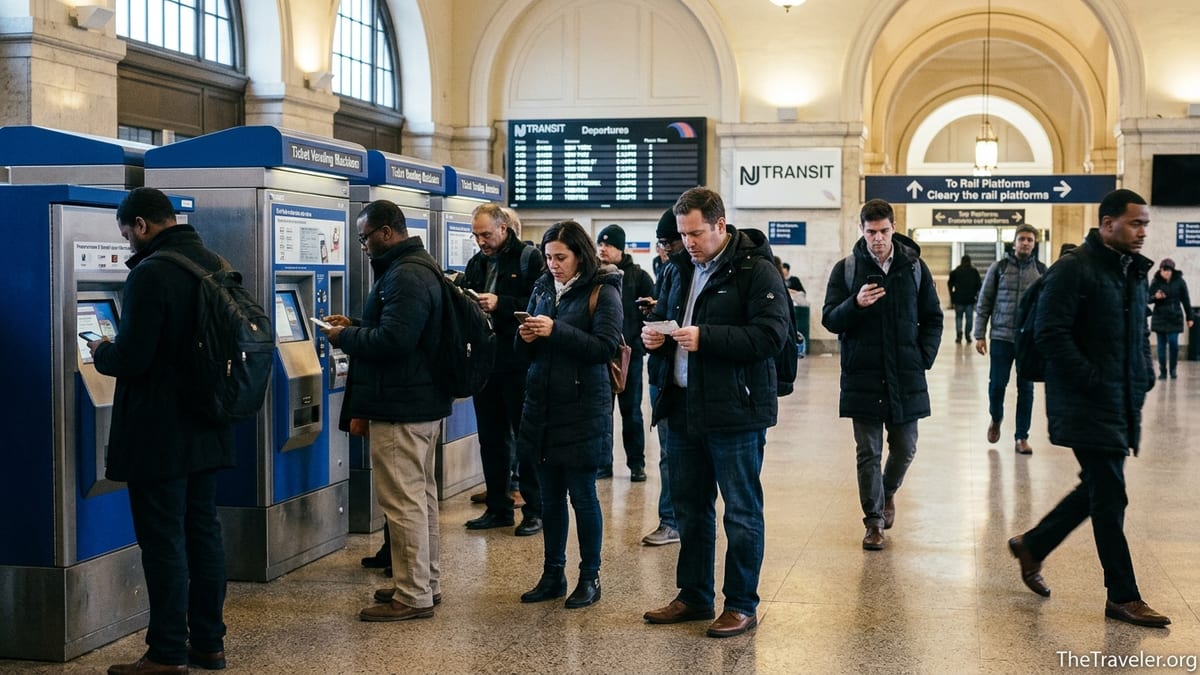
Misunderstanding “Buy Before You Board” on Trains
One of the biggest surprises for first-time NJ Transit rail riders is that tickets are meant to be purchased before boarding the train. On most lines, especially those heading into New York Penn Station or Newark, conductors are required to charge an on-board surcharge if you buy a ticket from them and there was a working ticket vending machine or staffed window at your origin station. Many new riders step on at smaller stations like Maplewood or Metuchen assuming they can just pay on the train, only to discover the fare is several dollars higher than what the machine would have charged.
Imagine you are traveling from Summit to New York Penn for the first time on a weekday morning. You arrive at the station with only a couple of minutes to spare, see the train pulling in, and decide to hop on, figuring you will pay the conductor. Because Summit has working ticket machines, the conductor may charge an on-board fee on top of the regular one-way price. Repeat that mistake a few times a month and you are spending the cost of a nice dinner in Manhattan on unnecessary surcharges.
The simplest way to avoid this is to buy as soon as you reach the station or, better yet, before you even leave home. NJ Transit’s own channels emphasize purchasing at station vending machines or through the official mobile app prior to boarding, and only relying on conductors when there truly is no way to buy in advance. If you arrive and see a long line at the machine, it is often still cheaper to wait and catch the next train than to pay a higher on-board fare for the current one.
For riders coming from airports or infrequent-service stations like Newark Liberty Airport station, it is especially important to look for vending machines before following the signage to the platform. At Newark Liberty, for example, you must purchase your rail ticket at the airport AirTrain station machines before boarding the shuttle to the mainline platforms. Many first-time visitors rush through and only realize they missed the machines when a conductor asks for tickets on board.
Confusion About Ticket Types, Zones, and Expiration
NJ Transit uses a zone-based fare system on buses and trains, which can confuse riders who are used to flat fares or distance-based pricing. A common mistake is assuming that a one-way ticket is valid for the whole day or for multiple trips. In reality, a standard rail one-way ticket is good for a single trip between the origin and destination printed on the ticket, for the number of zones shown. Riders sometimes purchase several tickets in advance for peace of mind, not realizing that the system has begun using limited validity periods for one-way, round-trip, and ten-trip tickets bought through official channels.
A typical example: a traveler from New Brunswick buys a stack of one-way rail tickets to New York Penn weeks before a series of meetings. They tuck the unused tickets into a wallet and pull one out for a trip a couple of months later, only to be told by the conductor that it is no longer valid. On the bus side, a similar problem appears when people buy zone-based paper tickets from a terminal like Port Authority Bus Terminal and then later try to reuse an old ticket on a different route, not realizing the printed origin and destination matter.
Zones themselves can be tricky. First-time riders often misread the fare chart and buy fewer zones than they actually need. For instance, someone boarding a North Jersey Coast Line train at Long Branch and heading all the way to New York Penn may buy a ticket priced for fewer zones after scanning the wrong line on the chart. On board, the conductor will either ask them to pay the difference or charge an override fare, which can easily add several dollars. The same thing happens on buses when a rider tells the driver the wrong zone or simply pays the base cash fare, not realizing their ride crosses more zones than that fare covers.
The way to avoid zone and expiration issues is to always check the current fare information immediately before you buy, either in the official app or at an NJ Transit ticket machine. Enter your actual origin and destination rather than trying to calculate zones yourself. When buying multiple tickets ahead of time, be sure to understand how long they will remain valid. If you are planning an occasional trip, it is often safer to buy tickets closer to the travel date rather than stockpiling them far in advance.
Using the Mobile App Incorrectly or at the Wrong Time
The NJ Transit mobile app is designed to simplify ticketing, but first-time riders often misuse it in ways that cause unnecessary stress. A common error is assuming that purchasing a mobile ticket automatically activates it. In fact, buying creates a stored ticket in your account that must be manually activated just before you board. New riders sometimes buy a ticket days in advance, then on the day of travel open the app for inspection and realize they never tapped the “activate” button. Scrambling to activate while the conductor is at their seat can be stressful, especially if the device is struggling with a weak signal.
Another frequent mistake is activating a ticket too early. For example, a rider going from Newark Penn to Princeton Junction might activate their ticket at home in Jersey City while they are still on the PATH system, figuring it will make things easier later. If a delay or change of plans causes them to travel much later than expected, the already-activated ticket may expire before or during the rail trip. The same issue appears on light rail, where activated mobile tickets are valid only for a limited time window once you tap them. A rider who activates a Newark Light Rail ticket 20 minutes before reaching the station could find a significant part of that window wasted on simply getting to the platform.
There are also technical pitfalls. Mobile tickets rely on your phone’s battery and screen working properly when the conductor appears. First-time riders occasionally activate a ticket, then continue using their phone heavily for streaming or navigation while waiting. By the time the train is midway to New York, the battery dies, and they cannot display a valid ticket. In such situations, conductors can treat the rider as if they are traveling without proof of payment, meaning a new ticket at on-board prices or more serious consequences if they refuse.
The safest approach is to purchase tickets in the app ahead of time but wait to activate them until you are actually boarding the bus, train, or light rail, or just moments before. Keep your phone charged, and consider carrying a small battery pack if you will be on a long ride from places like Trenton or Dover into New York. If your phone is malfunctioning, seek out a ticket vending machine as a backup before boarding so that you are not relying solely on a problematic device once the train doors close.
Mixing Up Bus, Rail, and Light Rail Transfers
Transfers within NJ Transit can feel inconsistent because the rules vary between buses, commuter rail, and light rail. One of the biggest mistakes newcomers make is assuming that a transfer from a bus automatically covers a train or that a rail ticket lets you hop on any connecting bus for free. In reality, paper transfers on buses generally apply only to another bus within New Jersey for a one-zone continuation, and they must be purchased from the driver at the time you pay your original fare. Riders boarding at the Port Authority Bus Terminal or Journal Square often forget to ask for a transfer when they get on their first bus and are surprised to pay full fare again on the second leg.
Rail tickets and passes, on the other hand, have their own rules. For example, a monthly rail pass with a certain minimum value can be used on connecting NJ Transit buses and light rail lines within the number of zones shown on the pass. This can be a great deal for commuters who take a train to Hoboken and then continue on a bus up the Hudson River waterfront or use the Hudson-Bergen Light Rail. First-time riders, however, often do not realize that this flexibility exists, and they waste money buying separate bus tickets after already paying for a qualifying monthly rail pass.
Connections involving Newark Light Rail can be especially confusing. Many riders traveling between Newark Broad Street and Newark Penn do not realize that certain rail tickets purchased “via Secaucus” can be used on the Newark Light Rail for that short link at no extra charge during the trip. They end up buying a separate light rail ticket or tapping a mobile ticket unnecessarily. The misunderstanding works in the other direction too, when someone with only a Newark Light Rail ticket assumes they can step onto an NJ Transit commuter train from Newark Broad Street without purchasing a separate rail fare.
To reduce transfer mistakes, think of each mode as its own system with limited overlaps. When boarding a bus, decide in advance whether your complete trip requires a second bus and ask the driver for a transfer right away. For train and light rail, check whether your monthly or weekly pass includes bus or light rail zones, and learn the special cases, such as the Newark Broad Street to Newark Penn connection. If you are on an occasional trip with multiple legs, it can be worth doing a quick fare comparison between buying separate tickets, using transfers, or upgrading to a weekly or FlexPass-type product if you will make several similar trips in a short period.
Ignoring Peak vs Off-Peak and Direction Rules
Another area of confusion for first-time riders is peak versus off-peak pricing and when each ticket type really applies. NJ Transit’s off-peak tickets and some promotional options are meant for lower-demand times. New riders sometimes buy the cheaper off-peak option without fully understanding that it may not be valid during the height of weekday rush hours into or out of Manhattan. For instance, someone commuting from Montclair to New York Penn for an early-morning meeting might select an off-peak ticket in the app to save a few dollars, only to be told on board that they must pay an additional charge because the train is considered peak.
Direction matters too. On certain rail ticket products, including some round-trip and off-peak offerings, the origin and destination points are fixed in each direction. First-time visitors might purchase a discounted round-trip ticket with “New York Penn” as the origin and “Princeton Junction” as the destination, then try to use it first from Princeton Junction to New York. When the conductor inspects it, they discover that the ticket is valid only when used in the direction printed for that segment. That can result in awkward conversations and the need to buy an entirely new ticket for what they assumed was already covered.
Peak and off-peak also affect how long your trip might take and whether you can rely on express trains. Travelers who assume that an off-peak ticket lets them board any train between two points sometimes end up on a faster peak-period express that costs more than they paid. For example, someone traveling from Metropark to New York may hop on a morning express to save time, but if their ticket is priced for an off-peak or slower service, staff may require an adjustment. While this is often resolved with a relatively modest surcharge, it can erode the savings that attracted them to off-peak pricing in the first place.
To avoid these issues, always check trip details for the specific train or bus you plan to ride at the time you buy your ticket. Pay attention to any mention of peak-period restrictions in NJ Transit’s fare information and within the mobile app’s ticket descriptions. If your travel patterns are unpredictable, it may be worth paying slightly more for an unrestricted fare rather than risking invalid tickets at busy times, especially when traveling into New York Penn or Hoboken during the commuter rush.
Assuming Tickets Work Across Carriers and Special Services
First-time riders sometimes treat NJ Transit tickets as universal passes across the New York region’s many overlapping transit brands. In reality, an NJ Transit ticket is distinct from a ticket on Amtrak, PATH, or local municipal systems such as Newark’s city buses. A traveler arriving at New York Penn Station with an NJ Transit ticket from Trenton might wrongly assume they can simply board an Amtrak regional train using the same ticket if their NJ Transit service is delayed. In practice, Amtrak and NJ Transit are separate operators, and the conductor on an Amtrak train will expect an Amtrak fare.
Similarly, someone using the PATH system between Jersey City and Manhattan may think their NJ Transit bus or rail ticket covers that connection. It does not. Even where the networks share stations, such as Newark Penn Station or Hoboken Terminal, tickets are not interchangeable. This leads to frustration for first-time visitors who purchase only an NJ Transit ticket from Newark Airport to New York Penn, then try to transfer to PATH at Newark Penn without buying a separate PATH fare.
Special services can be another trap. For example, riders sometimes expect that their regular monthly NJ Transit rail pass will automatically cover separately ticketed premium buses, shuttles, or event trains. While there are occasional joint tickets available for things like sports events or shore excursions, those are specific products with their own pricing. Trying to use a standard monthly pass on a special-event service may result in being asked to buy a new ticket. The same applies to private shuttles that connect to NJ Transit stations but are not operated by the agency.
The safest rule for first-time riders is to assume that an NJ Transit ticket is valid only on NJ Transit-operated services and only for the trip printed or selected within the app, unless you have specifically confirmed a broader acceptance. If you know you will need to mix NJ Transit with PATH, subways, or Amtrak, plan those as separate fares and budgets. That way, any pleasant surprises in reciprocal acceptance feel like a bonus rather than a necessity.
The Takeaway
NJ Transit is a robust system that can move you efficiently across New Jersey and into major cities like New York and Philadelphia, but its ticketing and transfer rules can be unforgiving for first-time riders. The most common mistakes revolve around buying tickets on board when you should purchase in advance, misunderstanding ticket validity and zones, mishandling mobile app activation, and misusing transfers between buses, trains, and light rail. Confusion about peak versus off-peak restrictions and mixing NJ Transit with other carriers adds another layer of risk.
By taking a few minutes to understand how the system expects you to buy and show tickets, you can avoid unexpected surcharges, invalid fares, and awkward encounters with conductors. Use official channels like station vending machines and the NJ Transit app, check fare details just before traveling, and be conservative about when you activate mobile tickets. Treat each mode and each operator as distinct unless you know a specific rule that allows crossover. With these habits in place, your first ride on NJ Transit can be smooth, predictable, and focused on the journey rather than the fine print.
FAQ
Q1. Do I really have to buy my NJ Transit train ticket before boarding?
Yes in almost all cases you are expected to buy your rail ticket before boarding, either from a station vending machine, ticket window, or the official mobile app. If those options were available and you still board without a ticket, the conductor will usually charge an on-board surcharge on top of the regular fare.
Q2. When should I activate a mobile ticket in the NJ Transit app?
Buy your ticket in advance, but wait to activate it until you are about to board the train, bus, or light rail. Activating too early can cause the ticket to expire before or during your trip, while forgetting to activate can leave you scrambling when a conductor appears.
Q3. Can I use a bus transfer on a train or light rail?
No, standard paper bus transfers are meant for a continuation ride on another NJ Transit bus within New Jersey, typically for one additional zone. They do not cover commuter rail or light rail trips, which require their own tickets or valid passes.
Q4. Does my NJ Transit rail monthly pass work on buses and light rail?
Many rail monthly passes above a certain value can be used on NJ Transit buses and light rail up to the number of zones printed on the pass. You should always check the conditions printed on your specific pass and review current fare information, but if your pass shows bus zones it generally covers those rides during its valid month.
Q5. What happens if my phone dies and my ticket is in the app?
If your phone battery dies and you cannot display an active mobile ticket, staff may treat you as riding without proof of payment. That usually means buying a new ticket on board at the higher on-board price. To avoid this, carry a charger or battery pack and consider printing or buying a paper ticket if you know your phone is unreliable.
Q6. Are off-peak tickets valid on any train between my two stations?
Not always. Off-peak tickets and discounts are generally intended for lower-demand times and may be restricted during busy peak periods, especially for travel into or out of Manhattan. If you board a peak-period train with an off-peak ticket, you may be required to pay the difference or an additional charge.
Q7. Can I use an NJ Transit ticket on Amtrak, PATH, or the subway?
No, NJ Transit tickets are generally valid only on NJ Transit services. They are not accepted on Amtrak, PATH, or local subway systems, even if those services share stations. You must purchase separate fares for those other carriers.
Q8. How do I know how many zones I need on a bus or train?
The easiest way is to let NJ Transit’s own tools do the math. Use the official app or a ticket vending machine, choose your exact origin and destination, and let the system select the correct fare. Trying to count zones yourself from a chart can easily lead to underpaying and being charged extra on board.
Q9. Are NJ Transit tickets refundable if my plans change?
Some unused tickets and passes can be refunded or exchanged, but there are time limits and possible processing fees. For example, one-way and round-trip tickets may have fixed validity periods and become nonrefundable once they are close to expiring or have been partially used. Always check the latest refund rules before buying large numbers of tickets in advance.
Q10. Is it cheaper to buy individual tickets or a weekly or monthly pass?
It depends on how often you travel. If you commute regularly, weekly or monthly passes often cost less than buying individual one-way tickets every day, and they may include additional benefits like bus or light rail rides within certain zones. For occasional trips, single tickets or a flexible product that bundles a fixed number of rides may be more cost effective.