


Like many travelers planning a Mykonos escape, I assumed Psarou Beach would be the most overrated stop of the trip. I pictured a narrow ribbon of sand choked with selfie sticks and designer labels, a place visited for its reputation rather than its reality. But within an hour of arriving, sitting with my feet in clear, still water and watching the late-morning light slide over the yachts, I realized I had completely misjudged it. Psarou is not just a status symbol; it is a carefully choreographed slice of Cycladic coastline where the details quietly justify the hype.
Get the latest updates straight to your inbox!
Arriving With Low Expectations on a High-Profile Beach
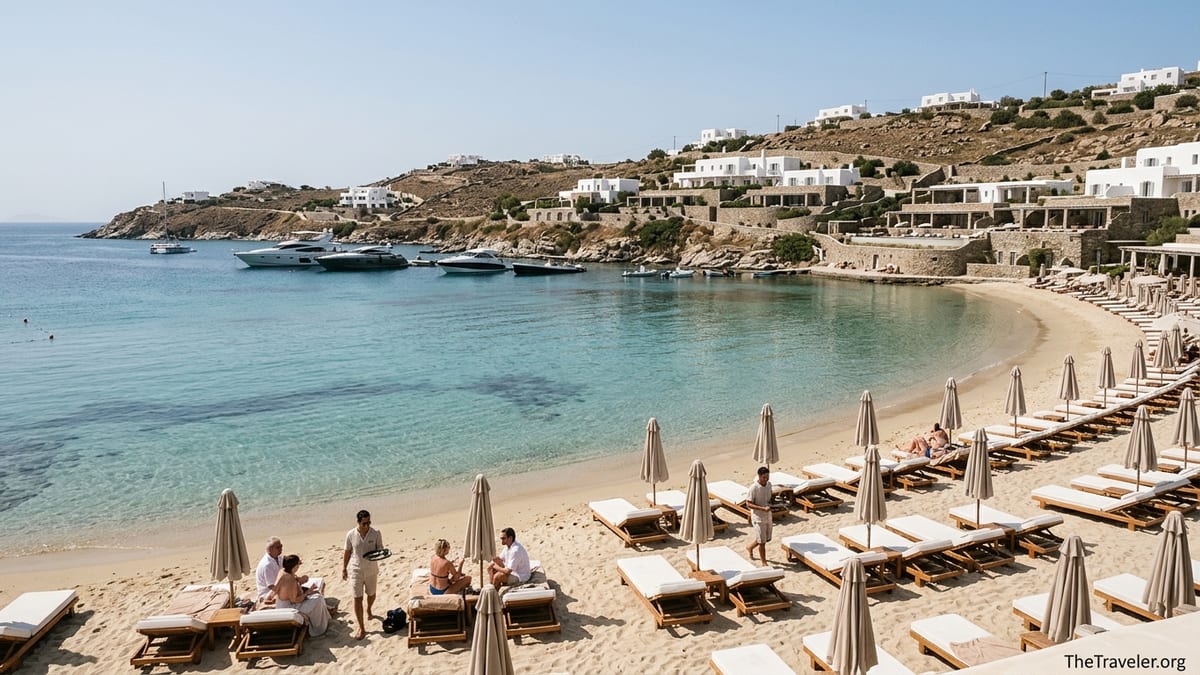
Psarou Beach sits on the sheltered south coast of Mykonos, roughly five kilometers from the whitewashed maze of Mykonos Town. Drivers swing down a winding access road and suddenly the view opens onto a small, almost perfectly curved bay of pale sand cupping aquamarine water. It is a short distance from Platis Gialos and Ornos, two other popular beaches, yet the mood feels immediately more composed and curated. For a place so often name-dropped in glossy magazines, the scale is surprisingly intimate.
Reaching Psarou does not require a private driver, though many visitors arrive that way. In summer, public buses run frequently between Mykonos Town and the cluster of beaches on this coast, with a stop by Psarou or nearby Platis Gialos for just a few euros each way. Some travelers choose to walk the coastal path from Platis Gialos, a scenic 10 to 15 minute stroll skirting the water. The only moment where the hype intrudes is at the top of the access road, where parking is tight and rental cars and quad bikes compete for space above a beach that looks tailor-made for postcards.
My own arrival fell firmly into the skeptical category. I had read countless comments about inflated prices, celebrity sightings, and sunbeds that cost more than a hotel room in other parts of Greece. It sounded like a parody of a Mediterranean beach. Yet as I descended the final steps and saw how calm the water was, how neatly raked the sand, and how the low-slung, white architecture blended into the hillside rather than dominating it, the scene felt less like a circus and more like a very polished amphitheater facing out to sea.
First Impressions: More About the Sea Than the Scene
The first surprise at Psarou is not the beach clubs but the water. The bay is small and deeply sheltered, protected from the worst of the Meltemi winds that hammer much of Mykonos in July and August. When nearby north-facing beaches can feel like standing in front of a wind tunnel, Psarou often stays glassy and swimmable. Even on a breezy day, you can usually wade in without fighting waves, which is one reason families and those who dislike rough seas are drawn here.
Standing at the shoreline late in the morning, the color gradation is almost unreal: a pale, luminous turquoise by the sand, turning richer and deeper as it reaches the line of anchored yachts. Visibility is excellent, so you can see your own shadow on the seabed and small fish slipping between bands of light. It is the sort of water that convinces even hesitant swimmers to plunge in. I watched one couple who evidently came only for the beach club scene end up spending half their visit just drifting in the shallows, cocktails forgotten on their side tables.
The second surprise is how compact the beach feels. Psarou is not a long, sweeping shoreline where you can walk for half an hour; it is a short, perfectly formed crescent. Most of the sand is taken up by sunbeds and umbrellas belonging to the beach clubs and hotels, yet the scale means that even from the far end you can see the entire bay at a glance. Rather than feeling crushed, it feels like a single, self-contained stage set. The soundtrack is a blend of downtempo playlists from the clubs and the soft slap of water against the hulls of moored boats.
Yes, It Is Expensive. Here’s Why People Still Pay.
Let us be honest: Psarou is not an affordable day at the beach, and anyone visiting should understand that before they arrive. In peak summer, basic sunbed sets at the most sought-after sections of the beach can run into the hundreds of euros per pair, especially in the front rows closest to the water. In some seasons and in the most exclusive clubs, travelers have reported packages that exceed many people’s daily vacation budget. Even in the back rows, where prices are considerably lower, you are still paying a premium compared with less famous Mykonos beaches such as Ornos, Platis Gialos, or Elia.
Yet as the day unfolds, it becomes clearer why visitors willingly spend so much here. Service on the sand is closer to what you would expect in a luxury hotel lobby than on a public beach. Staff circulate constantly with chilled towels, menus, and ice buckets, and the food and drink offering is more akin to a high-end restaurant than a casual taverna. Sushi platters appear on whitewashed side tables, salads arrive piled high with local tomatoes and creamy Mykonian cheeses, and champagne bottles sit in deep bowls of crushed ice next to designer beach bags.
The infrastructure behind the scenes is equally polished. Changing cabins are spotless, showers are powerful and hot, and the sound system is tuned carefully so that music feels immersive but not overwhelming, at least until late afternoon when the energy climbs. With reservations required for many front-row loungers, staff know exactly who is arriving and when. This orchestration is part of what you are paying for: a sense that everything has been pre-arranged so you can simply sink into the day without friction.
For those unwilling to commit to premium sunbeds, it is sometimes possible, especially early in the season or later in the afternoon, to negotiate more modest packages further back from the water, or to settle for bar seating and swims without a dedicated lounger. Occasionally, there will be a small strip of public sand where you can lay a towel, though on the most crowded days this space can almost vanish. If budget is your priority, other beaches on Mykonos will suit you better. But if you treat Psarou as a one-day splurge, the sticker shock softens when weighed against the overall experience.
The Subtle Luxury of Staying Above the Bay
Part of what gives Psarou its distinctive atmosphere is the way the hillsides above the beach are terraced with low, white architecture rather than high-rise hotels. Properties like Mykonos Blu, a long-established resort perched on a bluff above the bay, and Kenshō Psarou, an intimate boutique hotel set just behind the sand, lean into Cycladic design: whitewashed walls, rounded corners, natural stone, and wooden pergolas that filter Mediterranean light. From their terraces, Psarou looks less like a party zone and more like a quiet bay framed by soft geometry.
At Mykonos Blu, bungalows and suites step down toward the water, many with private pools or plunge pools that seem to float above the Aegean. Guests can wander down a dedicated path to reach the beach in minutes, slipping between the busy public shoreline and the quieter world of the resort’s own infinity pools and shaded courtyards. Even if you are not staying there, catching a glimpse from the sea highlights how carefully the property is woven into the landscape rather than imposed upon it.
Kenshō Psarou, by contrast, feels like a compact, design-forward hideout tucked almost on the beach itself. Rooms and suites are layered with textural details like aged wood, sculpted built-in furniture, and statement lighting, and many come with private hot tubs or plunge pools. Guests step out directly into the heart of the bay’s action, yet the interior spaces are sound-insulated and cocooned, designed for those who want to dip into the beach club scene and then retreat to quiet luxury within seconds.
Even for travelers not staying at these flagship properties, the presence of such thoughtfully designed hotels shapes the wider mood at Psarou. Their guests tend to skew toward couples, small groups of friends, and families used to a high level of service, which in turn nudges the entire bay toward polished, grown-up energy rather than rowdy chaos. It is a reminder that at its core, Psarou is a beach attended by people who want comfort and control as much as spectacle.
When Psarou Shifts From Relaxed to Electric
In the late morning, Psarou can feel almost subdued. Guests are still waking up from long nights in Mykonos Town, and many loungers sit half-empty. The soundtrack is mellow, staff move at an unhurried pace, and the loudest sounds are children splashing near the shoreline and the soft putter of tenders bringing guests from their yachts to the sand. It is a sweet time to swim, read, or quietly people-watch.
As the afternoon unfolds, the temperature rises and so does the mood. By mid-afternoon, beach clubs gradually ease up the volume, and the first bottles of chilled rosé and champagne start appearing in ice buckets. Groups of friends arrive dressed in linen and resort wear that looks pulled from a beachwear campaign, and staff sweep past with trays of cocktails and elaborate fruit platters. This is when Psarou begins to resemble the image that dominates social media: sunglasses, bronzed skin, and a sense of theatricality.
By early evening in high season, certain sections of the beach feel like a low-key day party. People dance around their loungers, DJs lean into more upbeat tracks, and the line between beach and bar almost disappears. Yet even at its most animated, Psarou is not the wildest beach on Mykonos. Those seeking full-scale daytime raves and late-night beach parties often gravitate instead to places like Paradise or Super Paradise, where the atmosphere is famously more hedonistic. Psarou occupies a more polished middle ground: convivial, photogenic, and sometimes extravagant, but rarely out of control.
The key is to time your visit according to your mood. Arrive early, ideally before 11 a.m., if you want calm water and space to stretch out before the crowds. Aim for mid-afternoon into sunset if you want to feel folded into the social pulse. Either way, it is wise to reserve loungers or a table ahead of time in peak months, especially from late June through August, when sunbeds can be fully booked days in advance.
How to Experience Psarou Without Overspending
It is entirely possible to experience the essence of Psarou without handing over your entire travel budget. One way is to treat the beach as a partial-day outing rather than a full-day commitment. Arrive in the late afternoon, when some loungers may be released at lower minimum spends or when it becomes easier to secure bar seating with access to the sea. Enjoy a couple of hours of swimming and people-watching, then stay for a single well-chosen cocktail as the light softens over the bay.
Another strategy is to base yourself at a less expensive beach such as Ornos or Platis Gialos, where sunbeds are typically far cheaper, and then visit Psarou as a special excursion. Public buses and water taxis on this part of the coast make it easy to move between beaches in a single day. You might spend the morning at a more relaxed, budget-friendly spot, then head to Psarou for a late lunch and a swim before returning to your home base in the evening.
Travelers willing to forgo a sunbed entirely can sometimes enjoy Psarou at almost no cost beyond transport and a drink. Depending on crowd levels and local enforcement, there may be a thin strip of sand where you can spread a towel, especially toward the edges of the bay, or you can base yourself at a bar table and use the sea between drinks. This approach works best outside of peak dates and on weekdays, when the pressure on space eases.
Ultimately, the secret is to decide in advance how much you are comfortable spending and then treat any Psarou splurge as an intentional part of your travel story rather than an accidental overspend. That clarity, combined with realistic expectations about prices, turns what could feel like a shock into a deliberate and memorable indulgence.
Beyond the Stereotypes: Who Psarou Really Suits
Psarou’s global reputation suggests it is a playground only for celebrities, influencers, and those whose idea of fun revolves entirely around being seen. While that crowd certainly exists here, they are only part of the picture. On any given day, you will see young Greek families teaching children to float in the calm shallows, honeymooning couples splitting a salad and a bottle of wine in the shade, and multi-generational groups of friends marking a special birthday trip with a long, lazy lunch on the sand.
What unites most of the people who choose Psarou over other Mykonos beaches is not celebrity aspiration but a desire for seamlessness. They are willing to pay for a beach day with minimal friction: no scrambling for parking far away, no lugging umbrellas and picnic bags, no hunting for decent bathrooms, and no worrying about whether the wind will turn the sand into a sandblaster. Psarou offers a version of the Mediterranean beach ideal where everything works, and where the aesthetics have been refined to a high gloss.
If you are a traveler who prioritizes wild, undeveloped nature, there are other Mykonos beaches that will appeal more. Places with minimal or no facilities, where you bring your own shade and snacks and accept that the wind and waves might dominate the day. Psarou is the opposite: a curated experience where the natural beauty of the bay is carefully framed and enhanced by design, service, and infrastructure.
Seen through that lens, the beach is less about being overrated and more about being very specifically rated: a niche product that excels at what it intends to be. For values-driven travelers who understand exactly what they are coming for, it can be one of the most satisfying days of a Mykonos stay.
The Takeaway
Psarou Beach will never be the place to escape the world entirely, nor is it trying to be. It is a curated slice of Cycladic coast where luxury hotels are terraced into the hillside, beach clubs turn the sand into an outdoor lounge, and the water remains improbably calm even during Mykonos’ windier days. What surprised me was how coherent it all felt. There was no bait-and-switch, no sense of a destination that had coasted on its name. The prices are high, but so is the standard of care.
Arriving with a chip on my shoulder about overrated spots, I left seeing Psarou differently. It is not a beach for every budget or every taste, but for travelers who want a day where the logistics fade into the background and the focus is on clear water, attentive service, and an atmosphere that moves gently from relaxed to celebratory, it delivers. Treated as a focused splurge within a wider Cycladic itinerary, Psarou can feel less like a cliché and more like a precisely executed promise.
FAQ
Q1. Is Psarou Beach worth visiting if I am not staying at a luxury hotel?
Yes. While many guests come from nearby high-end hotels, day visitors can still enjoy the bay by reserving sunbeds at a beach club, using bar seating with access to the sea, or, in quieter periods, finding a small stretch of public sand. It works particularly well as a half-day visit combined with more affordable beaches elsewhere on the island.
Q2. How expensive are sunbeds at Psarou compared with other Mykonos beaches?
Psarou is among the most expensive beaches on the island for sunbeds, especially in peak season and in the front rows closest to the water. Prices are typically significantly higher than at Ornos, Platis Gialos, or Elia, and there may be minimum spends for certain sections. Planning it as a one-off splurge rather than a daily habit keeps costs manageable.
Q3. Do I need to reserve in advance, or can I just show up?
In high season, especially from late June through August, it is strongly recommended to reserve loungers or at least a table in advance, particularly on weekends. Last-minute walk-ins sometimes find space in back rows or at the bar, but front-row sunbeds and prime lunch slots are often fully booked.
Q4. How do I get to Psarou Beach from Mykonos Town without a car?
In summer there are frequent public buses from Mykonos Town to the beaches on the south coast, including a stop that serves Psarou or nearby Platis Gialos. Tickets are inexpensive and the ride takes around 20 minutes. Some visitors also use water taxis that shuttle between major beaches or walk the coastal path from neighboring Platis Gialos.
Q5. Is Psarou suitable for children and families?
Yes. The bay is small and sheltered, with calm, clear water that is excellent for children who are confident swimmers. Families should be prepared for higher prices for sunbeds and food than on other Greek beaches, but in return they get clean facilities, organized shade, and easy access to snacks, bathrooms, and service on the sand.
Q6. What is the best time of day to visit Psarou if I prefer it quiet?
Arriving in the morning, ideally before 11 a.m., offers the calmest atmosphere. At this time the music is softer, crowds are thinner, and the sea feels almost private. By mid-afternoon the mood becomes livelier and more social, with louder music and a more pronounced party tone in some sections.
Q7. Can I enjoy Psarou on a budget, or is it only for luxury travelers?
Visiting Psarou will almost always cost more than visiting other beaches on Mykonos, but there are ways to soften the impact. You can focus on a shorter visit, use bar seating rather than premium front-row sunbeds, share dishes instead of ordering full individual meals, and time your visit outside the absolute peak weeks of summer.
Q8. How does Psarou compare to other famous Mykonos beaches like Paradise or Super Paradise?
Psarou is more polished and curated, with an emphasis on high-end service, calm water, and a see-and-be-seen atmosphere. Paradise and Super Paradise are usually louder, more party-focused, and often draw a younger, more budget-conscious crowd. Travelers looking for sophisticated, controlled energy tend to prefer Psarou, while those chasing all-day beach parties lean toward the others.
Q9. Is there any truly public space left on Psarou Beach?
Most of Psarou’s sand is occupied by organized sunbeds belonging to clubs and hotels, but depending on the day and the season there is often a narrow strip of public sand at the edges of the bay. Space is limited and can vanish during very busy periods, so anyone relying on free access should arrive early and remain flexible.
Q10. When is the best season to experience Psarou at its best?
Late June through early September offers the full Psarou experience, with all beach clubs operating, warm water, and a lively social scene. For slightly lower prices and thinner crowds, late May, early June, or mid-September can be attractive, though the vibe is calmer and some services may run shorter hours compared with the peak weeks of high summer.