


In the global imagination, Lapland is a place of snow-draped forests, northern lights and, inevitably, reindeer. Among the region’s many winter activities, from snowmobiling to husky safaris, it is the humble reindeer ride that often lingers longest in travelers’ memories. Moving quietly through the boreal forest behind an animal that has shaped Arctic life for thousands of years is not just a photo opportunity. Done thoughtfully, a reindeer ride becomes a window into Sámi culture, a lesson in Arctic nature and one of Lapland’s most powerful, slow-burn travel experiences.
Get the latest updates straight to your inbox!
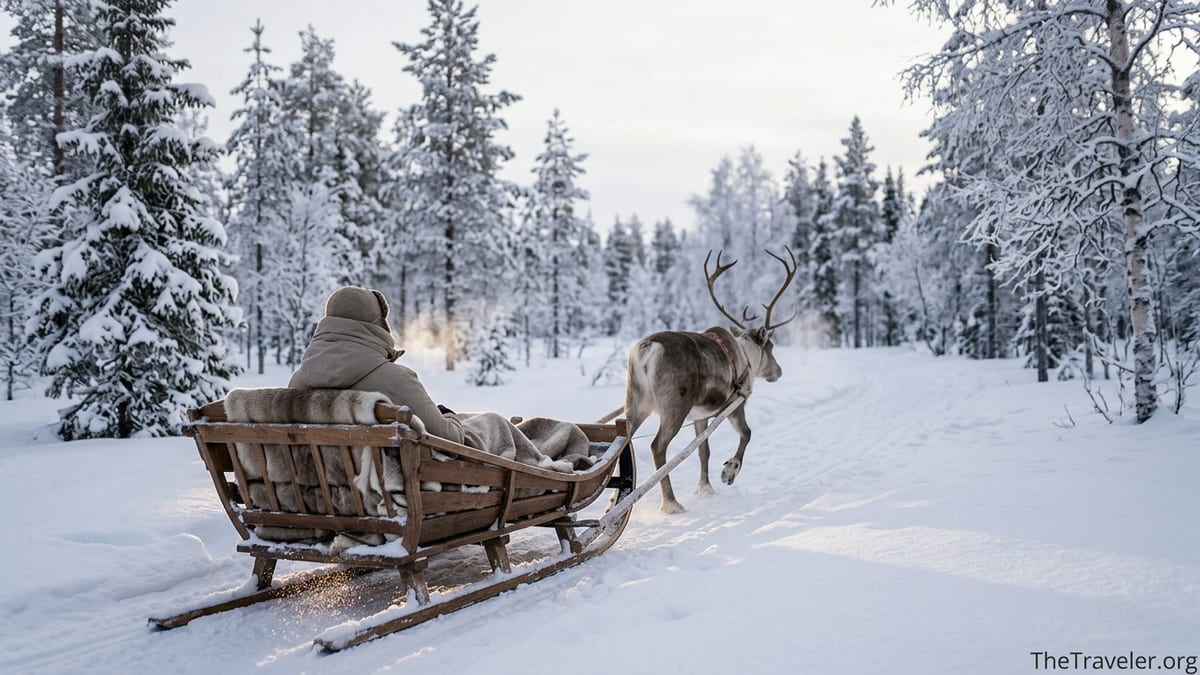
Why Reindeer Rides Capture the Essence of Lapland
Reindeer are not a marketing invention created to sell winter holidays. In Sápmi, the homeland of the Indigenous Sámi people that stretches across northern Norway, Sweden, Finland and Russia, reindeer herding has been central to livelihoods and culture for centuries. In modern Finland, northern Sweden and Norway, reindeer are still herded for meat, hides and, increasingly, tourism, where sleigh rides and farm visits have become flagship winter activities for international visitors.
Unlike fast-paced Arctic pursuits such as snowmobiling, reindeer rides are slow by design. On a typical one-hour sleigh ride outside Rovaniemi or Levi, the reindeer settles into a steady trot as you glide through snow-covered spruce and birch. There is no engine noise, only the soft hiss of the wooden runners over compacted snow and the occasional jingle of harness bells. This quiet pace creates space to notice details that would otherwise blur past: the blue shadows on untouched snow at midday, the faint tracks of Arctic hare crossing the trail, or the muted orange glow of a distant cabin.
Tourism authorities in Finland and across Lapland often describe reindeer as one of the region’s primary draws for winter visitors, alongside northern lights and Santa-themed attractions. In practice, this means that whether you base yourself near Rovaniemi, Inari, Kiruna or Tromsø, you are likely to see reindeer-themed excursions prominently marketed in hotels and local tour desks. Yet travelers consistently report that it is the more intimate rides, often in small family-run reindeer farms, that feel the most memorable long after they have flown home.
The essence of Lapland is not only its scenery but its relationship between people, animals and harsh climate. A reindeer ride distills that relationship into a single experience. You are moving across the snow in a way that predates roads and cars, in weather that may drop below minus 20 degrees Celsius, pulled by an animal perfectly adapted to find lichen beneath ice and snow. It is an encounter with Lapland on its own terms rather than through the filter of high-speed modern convenience.
From Ancient Transport to Modern Arctic Adventure
Long before they became tourism icons, reindeer and simple wooden sleds were a crucial means of transport for Sámi families and other northern communities. Reindeer could move efficiently over deep snow, pull modest loads and survive on sparse winter forage where horses struggled. In parts of Finland and Norway, reindeer-drawn sledges were still used for everyday journeys well into the 20th century. Today, reindeer husbandry laws in Norway and Sweden recognize herding as a protected Sámi livelihood, underscoring how tightly interwoven the animals remain with Indigenous culture.
Modern reindeer rides in Lapland are a direct descendant of this history, even if most visitors now experience them as excursions booked through hotels or tour operators. In Rovaniemi, for example, a common offering is a short 400 to 800 meter loop ride at a reindeer farm combined with a cultural talk. These brief rides, often priced from around 25 to 40 euros per adult as part of a larger visit, are designed for families with young children who want a taste of the experience without a long outing in subzero temperatures.
Elsewhere in Finnish Lapland, such as around Saariselkä, Inari or Levi, travelers can join longer safaris that last from one to three hours. These excursions often cost roughly 120 to 200 euros per person, typically including hotel transfers, warm outerwear, hot drinks and sometimes lunch. In Swedish Lapland, near Kiruna or Jokkmokk, Sámi-owned companies combine reindeer sledding with cultural storytelling, lasso-throwing practice and a traditional meal served inside a lavvu, the conical tent used historically by herding families. These experiences generally mirror Finnish pricing and emphasize small groups rather than mass tourism.
In Norway’s Finnmark region, especially around Alta and Karasjok, visitors encounter similar formats: short sleigh rides on frozen rivers or through birch forest paired with the chance to feed reindeer and hear joik, the traditional Sámi form of song. A winter visitor might, for instance, split a day between a morning reindeer sledding excursion and an evening northern lights hunt, with each activity booked through local guesthouses or regional providers. The key thread running through all of these is continuity: reindeer, once a backbone of Arctic mobility, now form the backbone of many winter itineraries.
Immersive Encounters: What a Reindeer Ride Really Feels Like
The practical reality of a reindeer ride begins well before you step into the sleigh. In midwinter, temperatures in Lapland can fall to minus 30 degrees Celsius, so many operators in Rovaniemi, Kittilä and Ivalo supply guests with insulated overalls, boots and mittens on top of their own base layers. After a short transfer from your accommodation, you often arrive at a farm or corral where the reindeer, with their thick winter coats and frosted muzzles, are already harnessed or waiting quietly by wooden fences.
Guides typically start with a safety briefing: how to sit or lie comfortably in the sleigh, why you should keep arms and legs inside, and what to expect if the reindeer stops to graze on lichen. On a one-hour forest loop near Levi, for example, you may travel in pairs, tucked under reindeer skins and heavy blankets, with the guide leading from the front on skis or walking alongside in snowshoes. Children often ride with a parent, and the gentle motion quickly lulls younger riders into a calm, wide-eyed quiet.
Once the reindeer sets off, the experience shifts into something almost meditative. In Finnish and Swedish Lapland, daylight in December can be limited to a few blue hours around midday, so many rides take place in soft twilight. Headlamps or small lanterns attached to the sleigh cast a warm pool of light onto the trail, while overhead the sky might reveal faint stars or, on lucky nights, a veil of northern lights. Travelers frequently describe this as one of the few moments on a busy Lapland itinerary when time seems to slow down rather than rush from one scheduled activity to another.
At the halfway point, some longer safaris pause at a kota or lavvu for hot berry juice or coffee. Here, sitting around a crackling fire, you may have the chance to feed lichen to the reindeer, feel the weight of their antlers in your hands if the guide shows a shed pair, or listen to stories about winter herding. Near Inari, guides sometimes describe how snow conditions and climate change are affecting the ability of reindeer to dig through ice crusts to reach their food, connecting your pleasant ride to the broader environmental pressures facing Arctic communities.
Sámi Culture at the Heart of the Experience
Many of the most meaningful reindeer rides in Lapland are those hosted by Sámi families themselves. These experiences go beyond the mechanics of sledding to explore language, history and contemporary realities. In Swedish Lapland, for instance, Sámi-led tours around Jokkmokk or Kiruna often begin with an introduction to traditional clothing such as the gákti, with its distinctive colors and embroidery, and explanations of how patterns can signal a person’s home region or family connections.
At small reindeer camps in Norway’s Finnmark, visitors might be welcomed into a lavvu, seated on reindeer skins around an open fire and served smoked reindeer meat or fish soup while the host shares stories about seasonal migrations and modern herding challenges. Rather than presenting culture as a frozen past, guides often emphasize that reindeer husbandry today operates within a complex mix of national regulations, land rights issues and the pressures of mining, wind farms and growing tourism.
In Finland’s Inari region, where Sámi institutions, media and cultural centers are concentrated, reindeer excursions may be combined with visits to museums or craft workshops. A traveler might spend the morning on a reindeer sleigh ride with a local family and the afternoon at a cultural center learning about Sámi languages, duodji handicrafts and political movements. This combination helps ensure that the reindeer ride is placed in context rather than consumed as a stand-alone novelty.
For many Sámi hosts, tourism is a double-edged tool. On one hand, small-scale reindeer experiences can provide crucial income that helps families maintain herds and pass on knowledge to younger generations. On the other, insensitive behavior, overcrowded excursions and imitation “Sámi shows” run by non-Indigenous operators risk reducing a living culture to a decorative backdrop. Choosing Sámi-led tours and approaching them respectfully allows travelers to contribute to cultural resilience instead of mere consumption.
Choosing Ethical and Responsible Reindeer Rides
As reindeer rides have grown more popular, questions about animal welfare and cultural respect have become more prominent. In Finland, researchers and tourism organizations have developed wellbeing criteria for reindeer used in tourism, offering guidelines on issues such as working hours, rest periods, harness fit and access to food and water. Travelers do not need to know every technical detail, but they can look for signs that an operator takes these issues seriously.
On the ground, this might mean small group sizes, calm animals, and guides who are willing to answer questions about how often each reindeer works and how they are cared for outside the season. Farms that allow reindeer to move freely in larger enclosures, rather than keeping them tied for long periods, are generally preferable. Responsible tourism bodies in Lapland also encourage visitors to ask operators directly about welfare policies, making it clear that ethical treatment is a priority for guests as well as regulators.
Cultural ethics matter just as much. In some heavily touristed areas near Rovaniemi, for example, travelers may encounter staff in costumes that borrow elements of Sámi clothing without meaningful connection to Sámi communities. By contrast, Sámi-owned operations typically introduce their identity clearly, explain the significance of clothing and symbols, and frame the experience as a meeting between guests and hosts rather than a themed performance. When in doubt, look for companies that identify their Sámi ownership or partnerships transparently and that focus on education as well as entertainment.
Environmental responsibility is another layer to consider. Lapland’s landscapes are under pressure from expanding infrastructure, climate change and increasing visitor numbers. Some reindeer ride providers respond by limiting motorized support, keeping group sizes small and avoiding sensitive grazing areas, particularly during stressful periods for the animals. Booking with such operators, traveling outside peak weeks when possible and following local advice on waste, noise and off-trail behavior all help ensure that your memorable ride does not come at the expense of the Arctic environment.
Planning Your Trip: When, Where and What It Costs
For most travelers, the main season for reindeer rides in Lapland runs from late November through March, when snow cover is reliable and daylight, though limited, provides enough visibility on the trails. The deep-winter period from late December to early February offers the most intense Arctic atmosphere, with pale blue midday hours and long nights that are ideal for aurora hunting. However, the shoulder weeks of early December and late March can be more comfortable temperature-wise and often slightly less crowded.
Rovaniemi, often marketed as the “official” hometown of Santa Claus, is the most accessible gateway for short breaks. It has frequent winter flights from major European hubs and a dense offering of reindeer rides ranging from quick farm loops near Santa-themed attractions to longer forest safaris a short drive away. Further north, resort areas such as Levi and Ylläs attract skiers who may add a half-day reindeer excursion to their itinerary, while Inari and Saariselkä appeal to those seeking a quieter, more remote atmosphere with strong cultural programming.
In Sweden, Kiruna and the area around Abisko National Park are popular bases. Here, reindeer experiences often sit alongside icehotel stays and northern lights photography tours. In Norway, Alta, Tromsø and Karasjok serve as common starting points, with reindeer rides taking place on frozen river plains or in gentle hill country. For travelers planning multi-country itineraries, it is entirely possible to experience different styles of reindeer tourism across borders, contrasting, for example, a short family-oriented ride near Rovaniemi with a more in-depth Sámi cultural day in Swedish Lapland.
Prices vary widely depending on length, inclusions and location, but a few broad ranges are useful. Short reindeer sleigh loops incorporated into larger theme-park style visits can start around a few dozen euros per person. Standalone one- to two-hour safaris with transfers and hot drinks frequently fall in the low to mid hundreds of euros for adults, with children’s rates somewhat lower. Full-day cultural programs that include meals, storytelling, handicraft demonstrations and extended time with the reindeer are usually the most expensive options but also the most immersive. Booking directly with local farms and Sámi-owned companies, when possible, helps ensure more of your payment supports the communities maintaining these traditions.
Staying Safe and Comfortable in the Arctic Cold
Reindeer rides are suitable for a wide range of ages and fitness levels, but the Arctic environment demands respect. The greatest risks are usually cold exposure and slips on ice, rather than anything related to the animals themselves. Most reputable operators supply additional outer layers, but travelers are wise to pack thermal base layers, wool socks, a warm hat that covers the ears, and thin glove liners to wear under bulkier mittens.
Before setting out, guides typically check whether anyone has health conditions that might be affected by cold, such as asthma or circulation issues, and can advise on whether a shorter ride is more appropriate. Parents traveling with infants or very young children often opt for brief farm-based rides where it is easy to retreat indoors quickly if needed. In all cases, it is important to follow instructions about sitting still in the sleigh, keeping feet tucked inside and not leaning out to take photos while moving.
Weather in Lapland can change rapidly. A day that begins with clear skies and gentle snowfall around minus 10 degrees Celsius can shift to biting winds and lower temperatures by afternoon. Operators keep a close eye on forecasts and may adjust routes or cancel rides if conditions become unsafe, particularly in open areas where windchill is severe. While last-minute changes can be disappointing, they are a sign of responsible risk management rather than poor organization.
Travel insurance that covers winter activities, including animal-drawn sleigh rides, is a sensible precaution. So is setting realistic expectations: a reindeer ride is not a thrill-seeking adventure but a calm, often contemplative journey through cold, quiet landscapes. Those who approach it as such usually find that the slow pace becomes a highlight rather than a drawback.
The Takeaway
Among the many winter experiences on offer in Lapland, reindeer rides occupy a special place. They bridge past and present, connecting visitors to a form of travel that predates roads while operating within a modern tourism infrastructure of warm gear, hotel pickups and multilingual guides. For many travelers, the strongest memories of their Arctic trip are not of snowmobile speed or even bright auroras but of hushed movement through a snowy forest behind a sure-footed animal, breath hanging in the air, bells barely audible under the snow’s muffling weight.
Choosing a thoughtful, small-scale and preferably Sámi-led reindeer experience transforms what could be a simple photo stop into a meaningful encounter with culture and landscape. It becomes an opportunity to support communities who have lived with reindeer for generations, to learn about contemporary challenges and to see Lapland as more than a backdrop for winter fantasies. In that sense, a reindeer ride is not only one of Lapland’s most memorable Arctic experiences; it is also one of its most revealing.
FAQ
Q1. Are reindeer rides in Lapland suitable for young children and older travelers?
Yes. Reindeer rides are generally gentle and slow, making them suitable for most ages. Many farms offer short loops ideal for families with small children and older travelers who prefer to limit time in the cold.
Q2. When is the best time of year to go on a reindeer ride in Lapland?
The main season runs from late November to March, when snow conditions are reliable. December and January feel most “Arctic,” while early December and late March can be slightly warmer and less crowded.
Q3. How much do reindeer rides typically cost?
Prices vary, but short rides at farms often cost from a few dozen euros per person, while one- to two-hour safaris with transfers and hot drinks commonly fall into the low to mid hundreds of euros for adults.
Q4. What should I wear for a reindeer sleigh ride?
Dress in layers: thermal base layers, a warm mid-layer, insulated outerwear, wool socks, a hat, scarf or buff and good gloves or mittens. Many operators provide additional overalls and boots in winter.
Q5. Are reindeer rides ethical and safe for the animals?
In Finland and neighboring countries, reindeer tourism is subject to animal welfare regulations. Look for small-scale operators who limit working hours, allow rest days and are transparent about how their animals are cared for.
Q6. How can I make sure my reindeer experience supports Sámi culture respectfully?
Choose Sámi-owned or Sámi-led tours when possible, listen to guidance from your hosts, ask permission before close-up photography and treat cultural stories and practices with the same respect you would at home.
Q7. Will I see the northern lights during a reindeer ride?
It is possible on clear winter nights, especially between late autumn and early spring, but never guaranteed. Some operators offer evening or night rides timed for better aurora chances if the forecast is favorable.
Q8. Do I need previous experience with winter sports to enjoy a reindeer ride?
No. Guests sit or lie in the sleigh while the guide leads the reindeer. Basic instructions are provided, and the activity requires no special skills beyond following safety advice and dressing warmly.
Q9. How far in advance should I book a reindeer ride?
During peak holiday weeks in December and early January, it is wise to book several weeks or even months ahead. Outside those times, a few days’ notice is often enough, especially in larger resorts.
Q10. Can I combine a reindeer ride with other Arctic activities in one day?
Yes. Many visitors pair a morning reindeer experience with afternoon skiing, snowshoeing or a husky safari, and then join an evening northern lights tour, building a varied but balanced winter itinerary.